

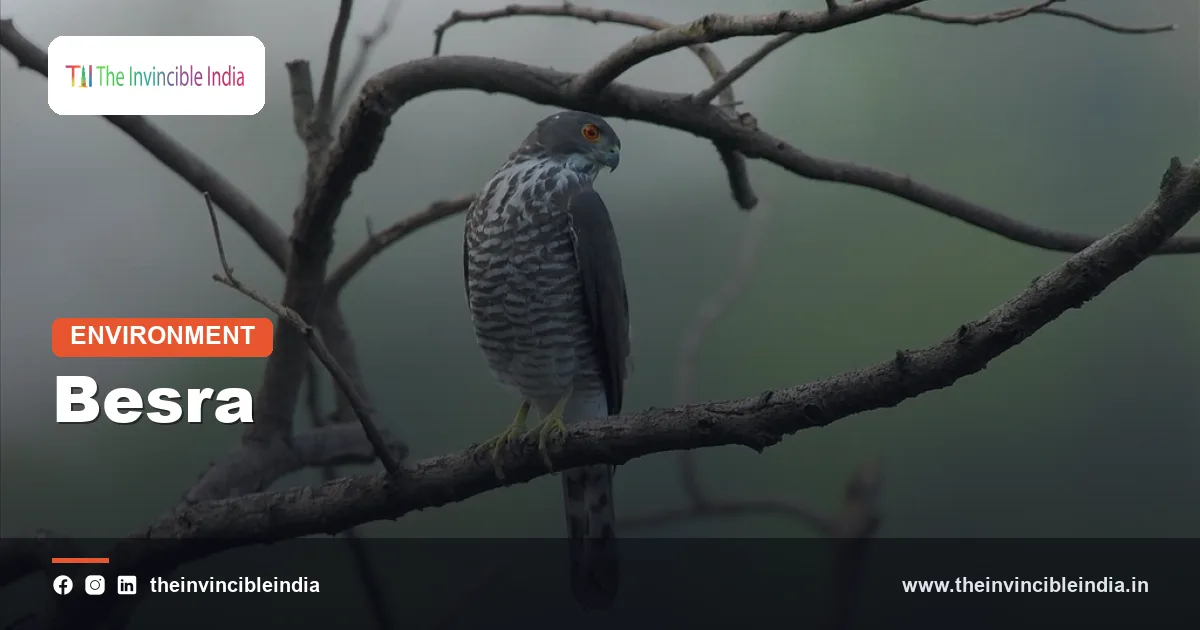
The besra (Accipiter virgatus) is a small, secretive forest hawk of the sparrowhawk group that lives in the hills and wooded areas of India and ambushes small birds among the trees. It has short, rounded wings, a long barred tail and a fierce yellow eye, all adaptations for chasing prey through dense woodland. The besra is far less often seen than the common open-country raptors, yet it is a regular resident of many Indian hill forests.
The besra belongs to the genus Accipiter, the bird-hunting hawks, and is one of the smallest members found in the Indian subcontinent. Its name is believed to come from a word used in Indian falconry for small hawks. This article explains how to recognise a besra, where it lives, what it hunts and how it breeds, and how to tell it from similar sparrowhawks.
Quick Facts
| Common name | Besra (also called besra sparrowhawk) |
|---|---|
| Scientific name | Accipiter virgatus |
| Family | Accipitridae (hawks, eagles, kites and harriers) |
| Size | About 29 to 36 cm long; the female is larger than the male |
| Range and habitat in India | Forests and wooded hills, including the Himalayan foothills, the Western Ghats, the Eastern Ghats and the northeast; some birds move to lower ground in winter |
| Diet | Small birds, lizards, large insects and occasionally small mammals |
| Breeding | Builds a small stick nest in a tree; breeds mainly in the spring and early summer in the Himalayas and at other times in the south |
| Conservation status | Least Concern on the IUCN Red List |
Key Takeaways
- The besra is a small forest hawk of the genus Accipiter found in the hills and wooded country of India and across southern and eastern Asia.
- The adult male besra has slaty-grey upperparts, a white throat with a dark central stripe and rusty barring on the breast and belly.
- The besra hunts mainly small birds by ambushing them from a hidden perch and chasing them in a fast, twisting dash through trees.
- The besra has short, rounded wings and a long tail, which allow it to turn sharply through dense branches.
- The female besra is noticeably larger and browner than the male, a pattern that is common among hawks.
- The besra is rated Least Concern globally, but it depends on tree cover, so forest loss in the hills is the main long-term threat.
What does a besra look like?
A besra is a compact hawk about the size of a pigeon or smaller, with short rounded wings, a long tail with dark bands, long yellow legs and a bright eye. The details of the plumage differ between the sexes and by age.
The adult male has dark slaty-grey upperparts, a white throat with a thin black line down the centre, known as the gular stripe, and a chest and belly closely barred with rufous or rusty-brown. The female is larger and browner above, with browner, less rufous barring below. Females may look quite dull compared with the neat males.
Young birds are browner above with pale edges to the feathers and have dark drop-shaped spots or streaks on the chest rather than neat bars. The eye is yellow in young birds and becomes orange or reddish as the bird matures. The legs are long and slender with long toes, used to grip small birds.
How can you tell a besra from a shikra and other sparrowhawks?
A besra is told apart from a shikra mainly by its dark throat stripe, darker upperparts, heavier rufous barring and its preference for forest rather than open country. India has several small Accipiter hawks, and they look alike at a glance.
| Species | Typical habitat | Distinguishing features |
|---|---|---|
| Besra | Forest and wooded hills | Dark central throat stripe, slaty upperparts, rufous barring below |
| Shikra | Open woodland, farmland, towns and gardens | Paler grey, no strong throat stripe, finer pale barring below, red eye in adults |
| Eurasian sparrowhawk | Woodland; winter visitor in the north | Slightly larger, grey or brown above, fine barring below |
| Crested goshawk | Forest | Larger, with a short crest, spotted chest and streaked throat |
The besra is also somewhat smaller and chunkier than the Eurasian sparrowhawk. For a confident identification, observers should look for the throat stripe, the tail bars and the habitat. The shikra, a very common bird, is the species most frequently mistaken for a besra.
Where does the besra live in India?
The besra lives mainly in forests and wooded hills across India, including the lower and middle Himalayas, the hills of the northeast, the Eastern Ghats, the Western Ghats and parts of the central highlands. It prefers evergreen and moist deciduous forest with a good tree canopy.
Several subspecies are recognised across its range, which stretches from the Indian subcontinent through Southeast Asia to China, Taiwan and the Philippines. In India, the birds of the Himalayan region and the peninsular hills differ slightly in size and shade. Some Himalayan birds move down to the foothills and plains in winter, so the besra can occasionally be seen in woodland patches, plantations and large gardens outside its breeding range.
Within its habitat, the besra is usually found along forest edges, clearings, streams and tracks, where there are gaps in the trees that allow it to hunt. Dense, undisturbed forest with a mix of tall and low trees supports the largest number of small birds, which are its main prey.
Why does the besra have short wings and a long tail?
The besra has short, rounded wings and a long tail because this body shape lets a hawk accelerate quickly, twist between branches and brake or turn without losing control. Open-country raptors such as kites and falcons have longer, more pointed wings that suit soaring and fast straight flight, but those wings would be a hindrance in a thicket.
The same design explains several other features of the besra. The long, thin legs and toes can reach into foliage to snatch a bird that has dived into cover. The rounded wing tips reduce the risk of damage when the bird brushes against leaves. The large eyes, set forward on the face, give the sharp binocular vision needed to judge distance at speed. Together these traits make the besra a specialist of woodland, and they explain why the species is seldom found far from trees.
What does the besra eat?
The besra eats mainly small forest birds, along with lizards, large insects and sometimes small mammals. It is a specialist hunter of birds up to about the size of a bulbul or a small thrush.
The prey can include babblers, white-eyes, flycatchers, tits, bulbuls and the young of larger birds. In the breeding season, a pair requires a steady supply of small birds to feed the chicks, so the male hunts almost continuously. Lizards such as garden lizards and skinks are taken in the warmer months, and large insects such as dragonflies and grasshoppers are caught when plentiful.
A besra usually plucks the feathers from a bird before eating it. A plucking post, which is a stump or branch covered with feathers, can reveal where a hawk is hunting even when the bird itself is out of sight.
How does the besra hunt?
The besra hunts by ambush, sitting quietly in a leafy tree, then launching a rapid low dash to seize a small bird by surprise before it can escape. It relies on speed, stealth and manoeuvrability rather than on long chases.
- Perch and wait: the hawk sits motionless in cover and scans for movement.
- Surprise dash: a short, fast flight through trees, often along a forest edge or track.
- Twisting pursuit: the short wings and long tail give extreme agility among branches.
- Foot capture: the long toes and sharp talons grasp the prey in flight.
The hunt is often over in seconds. If the first attack fails, the besra often gives up and returns to cover rather than chasing a prey bird in the open. The alarm calls of small birds, including the mobbing calls of drongos and babblers, often signal that a hawk is nearby.
How does the besra breed?
The besra breeds by building a small, flat platform of sticks high in a tree, where the female lays a small clutch of pale bluish-white eggs and incubates them while the male brings food. The nest is often well hidden in leafy foliage.
In the Himalayas, nesting generally takes place in spring and early summer, and in the southern hills it can occur earlier. The nest is usually lined with green leaves or fine twigs and is placed in a fork or on a horizontal branch. The female does most of the incubation and stays with the young while they are small, and the male hunts for the family and passes food to her near the nest.
The young hawks leave the nest after several weeks but depend on their parents for food for some time. During the courtship season, pairs may perform soaring and circling flights above the forest canopy, which are among the few occasions when the besra is conspicuous.
What sounds does the besra make?
The besra makes a series of sharp, repeated, high-pitched calls, usually heard near the nest or during courtship, and is otherwise a fairly silent bird. The call is often a quick, chattering “ki-ki-ki” or a thin whistle.
Because the bird is quiet and keeps to dense cover, the most reliable clues to its presence are indirect. The sudden alarm calls of other birds, a flash of grey and a barred tail disappearing into foliage and a fresh pile of plucked feathers on a branch all suggest a besra. Learning the calls of the common forest birds helps observers notice when something has disturbed them.
Is the besra threatened?
No, the besra is rated Least Concern on the IUCN Red List because it has a very wide range across Asia and is not thought to be declining quickly. In India, however, its fortunes are tied to the health of forests in the hills.
The main threats are the clearing of forest for agriculture, plantations, roads and settlements, the fragmentation of habitat and the use of pesticides that can reduce prey and accumulate in predators. The capture of small hawks for falconry has historically been a risk in parts of Asia, but trapping and keeping wild raptors is illegal in India under the Wildlife (Protection) Act, 1972.
Conservation of hill forests, forest corridors and mixed tree cover protects not only the besra but the many small birds that it feeds on.
How can you spot a besra in the wild?
You can spot a besra by watching forest edges, clearings and streams in hilly country, especially in the early morning, and by listening for the alarm calls of small birds. Patience is more important than equipment.
- Best habitat: forested hills in the Himalayas, the northeast and the Western Ghats.
- Best time: early morning, when hawks are most active.
- Look for: a small hawk with a barred tail and a dark throat stripe, perched in cover.
- Tip: follow the mobbing calls of small birds, which often give away a hunting hawk.
Bottom Line
The besra is a small, agile forest hawk that is easy to overlook but forms an important part of the hill-forest food web. Keeping hill forests intact is the surest way to keep this secretive hunter in Indian woodland.
Frequently Asked Questions
What is a besra?
A besra is a small forest hawk of the genus Accipiter, found in the hills and wooded regions of India and across southern and eastern Asia. It hunts small birds by ambush among trees. It has short, rounded wings and a long barred tail.
How can you identify a besra?
A besra is identified by its dark slaty upperparts, a white throat with a thin dark central stripe, rusty barring on the underparts and a long banded tail. It lives mainly in forest. The female is larger and browner than the male.
What is the difference between a besra and a shikra?
The difference between a besra and a shikra is that the besra has a dark throat stripe, darker upperparts and heavier rufous barring, and it prefers forest. The shikra is paler, lacks a strong throat stripe and is common in open woodland, farmland and towns. The shikra is the more frequently seen of the two.
What does the besra eat?
The besra eats mainly small birds, which it ambushes in forest. It also takes lizards, large insects and sometimes small mammals. Prey is usually plucked before it is eaten.
Where does the besra live in India?
The besra lives in forests and wooded hills across India, including the Himalayan foothills, the northeast, the Eastern Ghats and the Western Ghats. Some birds move to lower ground in winter. It is rarely found in open country.
Is the besra rare?
No, the besra is rated Least Concern on the IUCN Red List and is not rare across its wide range. It is secretive, so it is seldom seen. Its survival in India depends on the protection of hill forests.
{“@context”:”https://schema.org”,”@graph”:[{“@type”:”FAQPage”,”mainEntity”:[{“@type”:”Question”,”name”:”What is a besra?”,”acceptedAnswer”:{“@type”:”Answer”,”text”:”A besra is a small forest hawk of the genus Accipiter, found in the hills and wooded regions of India and across southern and eastern Asia. It hunts small birds by ambush among trees. It has short, rounded wings and a long barred tail.”}},{“@type”:”Question”,”name”:”How can you identify a besra?”,”acceptedAnswer”:{“@type”:”Answer”,”text”:”A besra is identified by its dark slaty upperparts, a white throat with a thin dark central stripe, rusty barring on the underparts and a long banded tail. It lives mainly in forest. The female is larger and browner than the male.”}},{“@type”:”Question”,”name”:”What is the difference between a besra and a shikra?”,”acceptedAnswer”:{“@type”:”Answer”,”text”:”The difference between a besra and a shikra is that the besra has a dark throat stripe, darker upperparts and heavier rufous barring, and it prefers forest. The shikra is paler, lacks a strong throat stripe and is common in open woodland, farmland and towns. The shikra is the more frequently seen of the two.”}},{“@type”:”Question”,”name”:”What does the besra eat?”,”acceptedAnswer”:{“@type”:”Answer”,”text”:”The besra eats mainly small birds, which it ambushes in forest. It also takes lizards, large insects and sometimes small mammals. Prey is usually plucked before it is eaten.”}},{“@type”:”Question”,”name”:”Where does the besra live in India?”,”acceptedAnswer”:{“@type”:”Answer”,”text”:”The besra lives in forests and wooded hills across India, including the Himalayan foothills, the northeast, the Eastern Ghats and the Western Ghats. Some birds move to lower ground in winter. It is rarely found in open country.”}},{“@type”:”Question”,”name”:”Is the besra rare?”,”acceptedAnswer”:{“@type”:”Answer”,”text”:”No, the besra is rated Least Concern on the IUCN Red List and is not rare across its wide range. It is secretive, so it is seldom seen. Its survival in India depends on the protection of hill forests.”}}]}]}


