

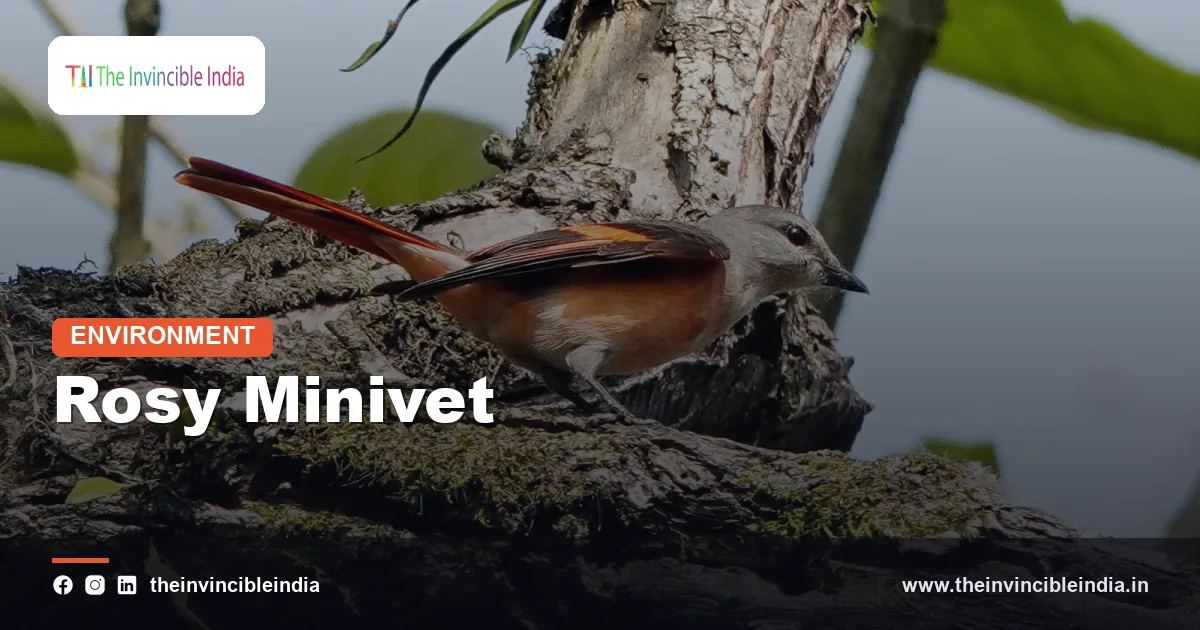
The rosy minivet (Pericrocotus roseus) is a slim, small songbird, about the size of a bulbul, with a pink-washed underside in the male, that forages in flocks through the forest canopy of India and southern Asia and feeds mainly on insects. Minivets belong to the cuckooshrike family, and the rosy minivet is the member of the group whose male is not bright red or yellow but soft rose-pink over grey. It is a bird of treetops, usually noticed first by its thin, sweet, whistling calls.
The rosy minivet breeds in the hills and foothills of the Himalayas and in parts of northeastern and southern Asia, and it moves to lower ground and other regions for the winter. This article explains how to recognise the rosy minivet, how it differs from other minivets, where it lives in India, what it eats, how it nests and how it migrates.
Quick Facts
| Common name | Rosy minivet |
|---|---|
| Scientific name | Pericrocotus roseus |
| Family | Campephagidae (cuckooshrikes and minivets) |
| Size | About 20 cm long, a little larger than many other minivets |
| Range and habitat in India | Broadleaf forest, open woodland, orchards and tree-lined areas, from the Himalayan foothills and northeast to the plains and peninsular hills in winter |
| Diet | Insects, caterpillars, spiders and other small invertebrates picked from foliage |
| Breeding and migration | Breeds in the foothills and hills in spring and summer in a tiny cup nest; many birds move to lower ground and further south in winter |
| Conservation status | Least Concern on the IUCN Red List |
Key Takeaways
- The rosy minivet is a small, slender songbird of the cuckooshrike family that feeds on insects in the canopy of forests and wooded country.
- The male rosy minivet has a grey-brown head and back, a pale throat and rose-pink underparts and rump, while the female is paler and greyer with a yellowish wash.
- The rosy minivet moves in small, lively flocks, often with other canopy birds, and keeps in touch with thin whistling calls.
- The rosy minivet breeds in hill and foothill forests of the Himalayas and eastwards, and moves to lower and southern areas of India in winter.
- The rosy minivet builds a small, neat cup nest of fine twigs bound with spider silk and covered with lichen so that it looks like a knot on a branch.
- The species is rated Least Concern globally and is fairly common, but it depends on trees and suffers where canopy cover is lost.
What does the rosy minivet look like?
The rosy minivet is a slender, long-tailed songbird about 20 cm long, and the adult male is easily recognised by its pink underparts and rump set against a grey-brown head and back. The female shares the same shape but has softer, paler colours.
The male has a grey-brown crown, nape and back, a pale whitish or pinkish-white throat and cheeks, rose-pink underparts and a rose-pink rump. The wings and the tail are blackish, with pale markings that show in flight. The overall effect is a delicate bird, pastel in tone rather than bright. The bill is short and black, and the eye is dark.
The female is greyer above and paler below, with a faint yellowish wash on the underparts and rump. Immature birds resemble the female. In poor light, both sexes can look plain greyish, but the pink of the male often shows clearly when the bird flies from one tree to the next.
How does the rosy minivet differ from other minivets?
The rosy minivet differs from other Indian minivets mainly in the male’s soft rose-pink and grey colouring, whereas most other minivets have bright red or yellow males against black. India is home to several minivet species, and the males are the easiest to separate.
| Species | Male colour | Typical habitat |
|---|---|---|
| Rosy minivet | Grey-brown above, rose-pink below and on the rump | Broadleaf forest, open woodland, wooded plains |
| Scarlet minivet | Glossy black with bright scarlet markings | Forests and well-wooded plains |
| Long-tailed minivet | Slate grey with scarlet markings and a long tail | Hill and foothill forests |
| Small minivet | Dark with scarlet markings, smaller size | Forests and dry woodland |
| Ashy minivet | Grey above, white below; no bright colour | Winter visitor to forests and coasts |
The female minivets of different species are more similar to each other, and observers often rely on the yellow or buff tones, the extent of the pale areas on the wings and the overall size. The rosy minivet’s slightly larger size and plainer look are useful clues.
What is a minivet?
A minivet is a small, long-tailed songbird of the genus Pericrocotus, in the cuckooshrike family Campephagidae, known for the bright colours of the males and for a canopy-dwelling, flock-forming habit. The genus is found across southern and eastern Asia, and India hosts several species.
The family name refers to the loose, fluffy feathers on the rump, which minivets can raise when alarmed. Minivets have short, slightly hooked bills suited to picking insects from leaves, and sexes differ in colour, with the males in red, yellow or pink and the females in softer yellow, buff or grey. The rosy minivet is one of the larger members of the group and is the only one in which the male is pink rather than red or yellow.
Many Indian birdwatchers meet minivets first as a flash of colour in the treetops, and the group is a good introduction to canopy birding. Because several species can share the same forest, learning the male plumage differences is a useful skill.
Where does the rosy minivet live in India?
The rosy minivet lives in broadleaf forests, open woodland and tree-rich cultivation across the Indian hills, foothills and plains, and it is found chiefly in the Himalayan region in the breeding season and in the lowlands and peninsula in winter. It prefers areas with tall, leafy trees.
In the breeding season, the species occurs mostly in the Himalayan foothills and middle hills, where it favours oak, pine mixed forest and open broadleaf woodland, and in other hill forests of northern and northeastern India. In winter, many birds move down to the plains and southwards, and the rosy minivet may then be seen in mango orchards, sal forests, tree-lined avenues and large gardens, including some city parks.
Beyond India, the species ranges through Nepal, Bhutan, Bangladesh, Myanmar, southwestern China and mainland Southeast Asia. Because it moves between altitudes and regions, the rosy minivet is partly migratory, with the pattern varying from one population to another.
What does the rosy minivet eat?
The rosy minivet eats mainly insects and other small invertebrates, including caterpillars, beetles, bugs, flies and spiders, which it gleans from leaves and twigs in the tree canopy. It is almost wholly insectivorous.
Foraging birds work through the foliage with quick hops and short flights, checking the underside of leaves and the tips of twigs. They often flutter briefly to catch a flying insect or to pull a caterpillar from a leaf. In winter, the species sometimes joins mixed-species feeding flocks, in which small birds move together through the forest and benefit from many pairs of eyes watching for predators.
By eating large numbers of leaf-eating insects, the rosy minivet and its relatives help keep tree-eating caterpillars in check, which is a quiet but real service to forest and orchard trees.
Why does the rosy minivet live in flocks?
The rosy minivet lives in flocks because group foraging improves safety and efficiency: more birds mean more watchful eyes against predators and more chances to flush insects. Flocks are typically small, ranging from a few birds to a couple of dozen, and are most obvious outside the breeding season.
Within a flock, birds call constantly to stay in contact. When the group flies from tree to tree, it moves as a loose stream, flashing the pink and grey colours. The flock can keep the same general area for days, before moving on to another patch of fruiting or insect-rich trees. Minivets also tend to feed at the top of the tree, which makes them hard to photograph from the ground.
- Flocks are loose and noisy.
- The birds spend most of the time in the upper canopy.
- Flocks often include several other minivet species, drongos and warblers.
What does the rosy minivet sound like?
The rosy minivet makes a thin, sweet, rising whistle and a series of soft, tinkling notes, which are the usual way to locate a flock high in the trees. The calls are less harsh than those of many other canopy birds.
The soft calls are repeated frequently as the flock moves, and the combined effect is a faint musical chatter from the treetops. Beginners often hear the minivets long before they see them. Learning this call is the single most useful skill for finding the species, since the birds can be hidden in dense leaves.
How does the rosy minivet nest?
The rosy minivet nests by building a small, shallow cup of fine twigs, grass and rootlets, bound together with spider silk and decorated with lichen, which it places on a horizontal branch high in a tree. The camouflage makes the nest look like a natural knot.
The female usually lays three or four eggs, and both parents help to build the nest and feed the nestlings. Nesting takes place in the spring and early summer in the hills. Because the nest is small, well hidden and high above the ground, it is rarely found, and minivets may be known in an area for years before anyone sees a nest.
The use of spider webs to bind the cup is a trait shared with several other small tree-nesting birds. It gives the structure strength and flexibility, and the lichen on the outside helps the nest blend with the bark.
Does the rosy minivet migrate?
Yes, the rosy minivet is partly migratory, with many birds leaving their northern and hill breeding areas after the nesting season and moving to lower ground or further south for the winter. The extent of movement varies between populations.
After breeding, birds in the Himalayan foothills and hills tend to descend to the plains, and in autumn numbers rise in the lowlands and in the peninsular region. Birds then return to the hills in spring. Because the movements are gradual and flocks are loose, they are hard to track, and the full details of migration routes are not well known. The seasonal changes explain why the rosy minivet can be common in a place in one season and absent in another.
Is the rosy minivet threatened?
No, the rosy minivet is rated Least Concern on the IUCN Red List because it has a large range and is fairly common. As a canopy bird, however, it depends on tall trees, and local numbers fall when forests are cleared or heavily lopped.
The main risks in India are deforestation in the hills, the fragmentation of woodland, the clearing of old trees in orchards and avenues, and heavy pesticide use that reduces insects. Protecting mature trees along roads, in villages and in city parks helps to maintain populations of this and other canopy birds.
The species is covered by the general protection that Indian law gives to wild birds under the Wildlife (Protection) Act, 1972, which prohibits hunting and capture.
Bottom Line
The rosy minivet is a delicate, social canopy bird whose seasonal movements link the Himalayan hills with the Indian plains. Preserving mature trees, in forests and in towns, is the simplest way to ensure these pink-and-grey flocks continue to pass through the Indian treetops.
Frequently Asked Questions
What is a rosy minivet?
A rosy minivet is a small, slender songbird of the cuckooshrike family that lives in the canopy of Indian forests and woodland. The male has rose-pink underparts and a grey-brown back. It feeds on insects and moves in flocks.
How can you identify a rosy minivet?
A rosy minivet is identified by its slender shape, long tail and, in the male, grey-brown upperparts with rose-pink underparts and rump. The female is paler and greyer with a yellowish wash. The birds usually appear in flocks high in trees.
What does the rosy minivet eat?
The rosy minivet eats mainly insects, including caterpillars, beetles and bugs, and also spiders. It gleans them from leaves and twigs in the canopy. It sometimes flutters out to catch insects in the air.
Is the rosy minivet a migratory bird?
Yes, the rosy minivet is partly migratory. Many birds leave their hill breeding areas after nesting and move to the plains or further south for the winter. Some return to the hills in spring.
Where can you see the rosy minivet in India?
You can see the rosy minivet in broadleaf forests and open woodland in the Himalayan foothills and northeast in the breeding season, and in orchards, forests and well-wooded plains in winter. Look and listen high in the trees. A flock calling with thin whistles is a good sign.
Is the rosy minivet threatened?
No, the rosy minivet is rated Least Concern on the IUCN Red List and is fairly common. Local populations fall when forests and large trees are cleared. It is protected under the Wildlife (Protection) Act, 1972, like other wild birds in India.
{“@context”:”https://schema.org”,”@graph”:[{“@type”:”FAQPage”,”mainEntity”:[{“@type”:”Question”,”name”:”What is a rosy minivet?”,”acceptedAnswer”:{“@type”:”Answer”,”text”:”A rosy minivet is a small, slender songbird of the cuckooshrike family that lives in the canopy of Indian forests and woodland. The male has rose-pink underparts and a grey-brown back. It feeds on insects and moves in flocks.”}},{“@type”:”Question”,”name”:”How can you identify a rosy minivet?”,”acceptedAnswer”:{“@type”:”Answer”,”text”:”A rosy minivet is identified by its slender shape, long tail and, in the male, grey-brown upperparts with rose-pink underparts and rump. The female is paler and greyer with a yellowish wash. The birds usually appear in flocks high in trees.”}},{“@type”:”Question”,”name”:”What does the rosy minivet eat?”,”acceptedAnswer”:{“@type”:”Answer”,”text”:”The rosy minivet eats mainly insects, including caterpillars, beetles and bugs, and also spiders. It gleans them from leaves and twigs in the canopy. It sometimes flutters out to catch insects in the air.”}},{“@type”:”Question”,”name”:”Is the rosy minivet a migratory bird?”,”acceptedAnswer”:{“@type”:”Answer”,”text”:”Yes, the rosy minivet is partly migratory. Many birds leave their hill breeding areas after nesting and move to the plains or further south for the winter. Some return to the hills in spring.”}},{“@type”:”Question”,”name”:”Where can you see the rosy minivet in India?”,”acceptedAnswer”:{“@type”:”Answer”,”text”:”You can see the rosy minivet in broadleaf forests and open woodland in the Himalayan foothills and northeast in the breeding season, and in orchards, forests and well-wooded plains in winter. Look and listen high in the trees. A flock calling with thin whistles is a good sign.”}},{“@type”:”Question”,”name”:”Is the rosy minivet threatened?”,”acceptedAnswer”:{“@type”:”Answer”,”text”:”No, the rosy minivet is rated Least Concern on the IUCN Red List and is fairly common. Local populations fall when forests and large trees are cleared. It is protected under the Wildlife (Protection) Act, 1972, like other wild birds in India.”}}]}]}


