

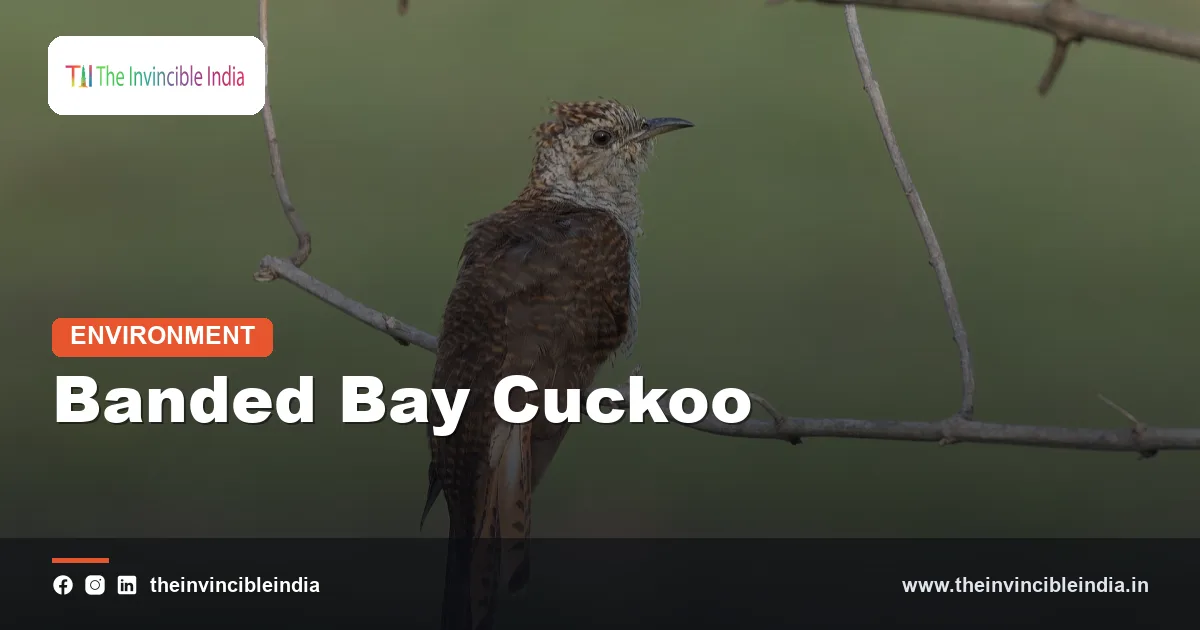
The banded bay cuckoo (Cacomantis sonneratii) is a small, finely barred, rufous-brown cuckoo of wooded country in India and South-East Asia, known for laying its eggs in the nests of other birds and for its repeated, whistled call. Because the banded bay cuckoo is a brood parasite, it never builds a nest or raises its own chicks; it relies instead on small insect-eating songbirds to foster its young.
The banded bay cuckoo is more often heard than seen, since it spends much of its time within the leafy canopy of forests and plantations. Learning the bird’s markings, its call and its parasitic habit helps explain a corner of Indian bird life that most people never notice.
| Quick Fact | Details |
|---|---|
| Common name | Banded bay cuckoo |
| Scientific name | Cacomantis sonneratii |
| Family | Cuculidae (cuckoos), order Cuculiformes |
| Size | About 22 to 24 cm long |
| Range and habitat in India | Wooded country, forest edges, plantations and gardens in the Himalayan foothills, the Western Ghats, peninsular India and the north-east |
| Diet | Insects, especially hairy caterpillars, plus other invertebrates |
| Breeding | Brood parasite; lays eggs in the nests of small insect-eating birds and builds no nest of its own |
| Conservation status | Least Concern on the IUCN Red List |
Key Takeaways
- The banded bay cuckoo is a small, rufous-brown, finely barred cuckoo found in the wooded country of India and South-East Asia.
- Banded bay cuckoos are brood parasites, so the female lays eggs in the nests of other small birds and plays no part in raising the chicks.
- The banded bay cuckoo is best recognised by its barred plumage, a dark stripe through the eye and a repeated series of short, whistled notes.
- Banded bay cuckoos eat many hairy caterpillars that most birds avoid, which makes the species a useful natural check on leaf-eating insects.
- The banded bay cuckoo is a resident bird that is easier to hear than to see because it stays within dense foliage.
- The banded bay cuckoo is rated Least Concern, but it depends on healthy woodland that supports both its caterpillar food and its host species.
What is the banded bay cuckoo?
The banded bay cuckoo is a small, slender cuckoo with bay or rufous-brown upperparts and whitish underparts that are finely barred with dark lines. It belongs to the genus Cacomantis, a group of mainly tropical cuckoos that includes the plaintive cuckoo, which is also common in India.
The species name sonneratii honours Pierre Sonnerat, an eighteenth-century French naturalist who travelled in India and South-East Asia and described many animals of the region. The common name refers to the bay or reddish-brown colour of the upper plumage and to the bands that cross the back, wings and underside.
The bird is about the size of a bulbul, though slimmer, with a longer tail. Its sexes look similar, though young birds are more heavily marked and their barring is bolder.
What does a banded bay cuckoo look like?
A banded bay cuckoo has rufous-brown upperparts crossed by dark bars, a pale buff or whitish stripe above the eye, a dark stripe through the eye, and white underparts finely barred with brown or black. The tail is long and rounded, with dark and pale bars across it.
Adults
Adults have a small, slightly curved bill that is dark above and paler below,. The throat and breast are white or pale buff with fine barring that extends to the belly.
Juveniles
Young birds are more heavily barred both above and below, and the contrast between bars is stronger. Because juveniles can look quite different from adults, they are sometimes confused with other cuckoos and with small hawk-cuckoos. Checking the call and the overall bay colour of the upperparts usually settles the identification.
Similar species
| Bird | Scientific name | Key difference from the banded bay cuckoo |
|---|---|---|
| Plaintive cuckoo | Cacomantis merulinus | Adult has a grey head and plain rufous belly, without fine barring below |
| Common hawk-cuckoo | Hierococcyx varius | Larger, with a hawk-like build and a pale grey head; calls “brain-fever” |
| Indian cuckoo | Cuculus micropterus | Larger, with a grey head and a four-note call |
| Grey-bellied cuckoo | Cacomantis passerinus | Grey adult morph with a plain grey body; a rufous morph exists in females |
Where is the banded bay cuckoo found in India?
The banded bay cuckoo is found in many forested and wooded parts of India, including the foothills of the Himalayas, the Western Ghats, the hills of peninsular India and the north-eastern states. Outside India, its range extends through much of South-East Asia.
The species is a resident in most of its Indian range, although some local movements may occur with the seasons. It is generally a bird of low hills and plains with good tree cover, rather than of high mountains or treeless country.
Its distribution is wide but not uniform. The banded bay cuckoo is more frequent in moist and semi-evergreen woodland, and less common in very dry regions. Observers in the Western Ghats, the Eastern Ghats and the north-eastern hills often record it, particularly during the breeding season when its call is loudest.
What habitat does the banded bay cuckoo prefer?
The banded bay cuckoo prefers wooded habitats with a leafy canopy, such as moist deciduous forest, forest edges, secondary growth, plantations and well-wooded gardens. It needs trees for perching and calling, and a supply of small birds’ nests in the surrounding vegetation.
Typical places include:
- Moist deciduous and semi-evergreen forest at low and middle elevations.
- The edges of forest clearings, tracks and streams.
- Coffee, tea and rubber plantations with shade trees.
- Well-wooded gardens, parks and campuses near forest.
- Secondary growth and scrub with scattered tall trees.
The bird often perches high on a bare branch to call, then slips into the canopy to forage. It can adapt to modified habitats if enough trees remain, which helps explain why it can be heard in plantations and large gardens as well as in natural forest.
What is the call of the banded bay cuckoo?
The call of the banded bay cuckoo is a rapid series of short, clear, whistled notes, often written as a repeated “pi-pipi-pwee”, which rises and falls in pitch and is repeated several times. The call carries well through woodland and is the easiest way to detect the bird.
Calling is most intense during the breeding season, when males call repeatedly from the treetops through the morning and sometimes at dusk. The call may continue for long stretches, with only short pauses. Some observers describe it as a bright, cheerful whistle rather than the more mournful song of the plaintive cuckoo.
Learning the call is the best investment for anyone hoping to record the species. Because the bird hides in leafy trees, many sightings begin with a sound, followed by a careful search of the upper branches with binoculars.
What does the banded bay cuckoo eat?
The banded bay cuckoo eats mainly insects, with a strong preference for caterpillars, including hairy ones that many birds reject. It also takes beetles, grasshoppers, bugs and other invertebrates found on leaves and branches.
Many cuckoos have specialised digestive systems that allow them to eat hairy caterpillars. Before swallowing the prey, the bird may rub it against a branch, and it can shed the lining of its stomach along with the irritating hairs. This ability gives cuckoos access to food that is plentiful but unappealing to other birds.
By eating large quantities of caterpillars, the banded bay cuckoo helps to limit damage to forest trees and plantation crops. The effect is difficult to measure, but ecologists regard cuckoos as valuable insect predators.
How does the banded bay cuckoo breed?
The banded bay cuckoo breeds by brood parasitism: the female lays a single egg in the nest of a small host bird, which then incubates the egg and feeds the cuckoo chick. The cuckoo builds no nest, does not incubate its eggs and does not feed its young.
The parasitic strategy
The female cuckoo watches host birds as they build or attend their nests. When the host is away, she slips in, removes or ignores one of the host’s eggs, and lays her own. The cuckoo egg often resembles the host’s eggs in colour, though the match is not always perfect. The host then incubates the egg along with its own.
The cuckoo chick
The cuckoo chick usually hatches earlier than the host’s own chicks and may push the other eggs or young out of the nest. This ensures that the host parents devote their efforts to feeding the cuckoo alone. The young cuckoo grows rapidly and eventually leaves the nest, continuing to be fed for a time by its foster parents.
Records of host species are limited compared with those for the Asian koel or the common cuckoo, and observers are still adding to the list. The birds chosen as hosts tend to be small, insect-eating songbirds that nest in bushes or low trees. The breeding season in India usually falls between spring and the monsoon months, though it varies by region.
Why are cuckoos brood parasites?
Many cuckoos are brood parasites because the habit of laying eggs in other birds’ nests lets them save the energy and time needed to build nests and raise young. This strategy has evolved independently in several cuckoo lineages, including the group that contains the banded bay cuckoo.
The benefit to the cuckoo is clear. A female can lay more eggs in a season if she does not have to incubate them or feed the chicks. The cost falls on the host, which loses some or all of its own young. In response, many host birds have evolved defences, such as recognising and rejecting eggs that look different, or attacking adult cuckoos near their nests.
This ongoing contest between parasite and host is a classic example of coevolution. Cuckoo eggs evolve to look like host eggs, and hosts evolve better ways of detecting fakes. The relationship does not usually threaten the host species as a whole, since only a fraction of nests are parasitised.
What is the conservation status of the banded bay cuckoo?
The banded bay cuckoo is rated Least Concern on the IUCN Red List, meaning it is not currently regarded as threatened. It has a wide range and is reasonably common in suitable habitat across India and South-East Asia.
The species nevertheless depends on healthy woodland. The main risks include:
- Loss of forest and wooded land to agriculture, mining and urban growth.
- Reduction of caterpillar abundance through heavy pesticide use.
- Decline of host bird populations when scrub and understorey are cleared.
- Fragmentation that isolates patches of suitable woodland.
In India, the banded bay cuckoo, like nearly all native birds, is protected under the Wild Life (Protection) Act, 1972. Its widespread occurrence in forests, plantations and sanctuaries means that conserving woodland generally benefits the species.
How can you see a banded bay cuckoo?
The best way to see a banded bay cuckoo is to visit wooded country in the breeding season, listen for its whistled call, and scan the tree tops from the edge of a clearing or track. Early morning, when the bird calls most, gives the best chance of a sighting.
A few pointers can improve the odds:
- Learn the call before going out, so you can pick it out from other whistles.
- Look for a bird perched upright on a high bare branch, often with the tail hanging down.
- Use binoculars to check the fine barring below and the dark eye-stripe.
- Compare the bird with the plaintive cuckoo, which has a plainer belly and a different call.
- Visit forest edges, plantations and wooded sanctuaries in the Western Ghats, the Eastern Ghats or the north-east.
Patience matters, since the bird may call for long periods from the same perch while staying partly hidden by leaves. Moving slowly and quietly usually yields a better view than approaching quickly.
Why does the banded bay cuckoo matter?
The banded bay cuckoo matters because it is a natural predator of caterpillars, a participant in the long-running evolutionary contest between parasites and hosts, and an indicator of well-wooded habitat. Its presence suggests a landscape that still supports both insects and the small birds on which the cuckoo depends.
The bird also offers a way for the public to engage with a less familiar side of nature. Most people are aware of the koel’s call in summer, but the banded bay cuckoo shows that India has a range of cuckoos with different appearances, calls and habits. Recording their calls and sightings through citizen-science platforms contributes to a better understanding of bird distribution.
Bottom Line
The banded bay cuckoo is a small, barred, rufous-brown brood parasite that lives in the wooded country of India and South-East Asia, announcing itself with a repeated whistled call. It feeds on caterpillars, relies on other birds to raise its young, and remains of Least Concern as long as healthy woodland persists.
Frequently Asked Questions
What is a banded bay cuckoo?
A banded bay cuckoo is a small, finely barred, rufous-brown cuckoo that lives in wooded country in India and South-East Asia. It is a brood parasite that lays its eggs in other birds’ nests. Its scientific name is Cacomantis sonneratii.
How can you identify a banded bay cuckoo?
You can identify a banded bay cuckoo by its bay-brown upperparts, a dark stripe through the eye and white underparts finely barred with dark lines. The tail is long and barred. The repeated, whistled call is another useful clue.
What does the banded bay cuckoo sound like?
The banded bay cuckoo gives a rapid series of short, clear, whistled notes that rise and fall, often written as pi-pipi-pwee. The call is repeated many times and carries far through woodland. It is loudest during the breeding season.
Is the banded bay cuckoo a brood parasite?
Yes, the banded bay cuckoo is a brood parasite that lays its eggs in the nests of other small birds. The foster parents incubate the egg and feed the chick. The cuckoo builds no nest of its own.
Where is the banded bay cuckoo found in India?
The banded bay cuckoo is found in wooded areas of India, including the Himalayan foothills, the Western Ghats, peninsular hills and the north-east. It prefers forest edges, plantations and gardens with good tree cover. It is generally a resident bird.
What does the banded bay cuckoo eat?
The banded bay cuckoo eats mainly insects, especially caterpillars, including hairy ones that many other birds avoid. It also takes beetles, grasshoppers and other invertebrates from leaves and branches. This diet helps control insect pests in woodland.
{“@context”:”https://schema.org”,”@graph”:[{“@type”:”FAQPage”,”mainEntity”:[{“@type”:”Question”,”name”:”What is a banded bay cuckoo?”,”acceptedAnswer”:{“@type”:”Answer”,”text”:”A banded bay cuckoo is a small, finely barred, rufous-brown cuckoo that lives in wooded country in India and South-East Asia. It is a brood parasite that lays its eggs in other birds’ nests. Its scientific name is Cacomantis sonneratii.”}},{“@type”:”Question”,”name”:”How can you identify a banded bay cuckoo?”,”acceptedAnswer”:{“@type”:”Answer”,”text”:”You can identify a banded bay cuckoo by its bay-brown upperparts, a dark stripe through the eye and white underparts finely barred with dark lines. The tail is long and barred. The repeated, whistled call is another useful clue.”}},{“@type”:”Question”,”name”:”What does the banded bay cuckoo sound like?”,”acceptedAnswer”:{“@type”:”Answer”,”text”:”The banded bay cuckoo gives a rapid series of short, clear, whistled notes that rise and fall, often written as pi-pipi-pwee. The call is repeated many times and carries far through woodland. It is loudest during the breeding season.”}},{“@type”:”Question”,”name”:”Is the banded bay cuckoo a brood parasite?”,”acceptedAnswer”:{“@type”:”Answer”,”text”:”Yes, the banded bay cuckoo is a brood parasite that lays its eggs in the nests of other small birds. The foster parents incubate the egg and feed the chick. The cuckoo builds no nest of its own.”}},{“@type”:”Question”,”name”:”Where is the banded bay cuckoo found in India?”,”acceptedAnswer”:{“@type”:”Answer”,”text”:”The banded bay cuckoo is found in wooded areas of India, including the Himalayan foothills, the Western Ghats, peninsular hills and the north-east. It prefers forest edges, plantations and gardens with good tree cover. It is generally a resident bird.”}},{“@type”:”Question”,”name”:”What does the banded bay cuckoo eat?”,”acceptedAnswer”:{“@type”:”Answer”,”text”:”The banded bay cuckoo eats mainly insects, especially caterpillars, including hairy ones that many other birds avoid. It also takes beetles, grasshoppers and other invertebrates from leaves and branches. This diet helps control insect pests in woodland.”}}]}]}


