

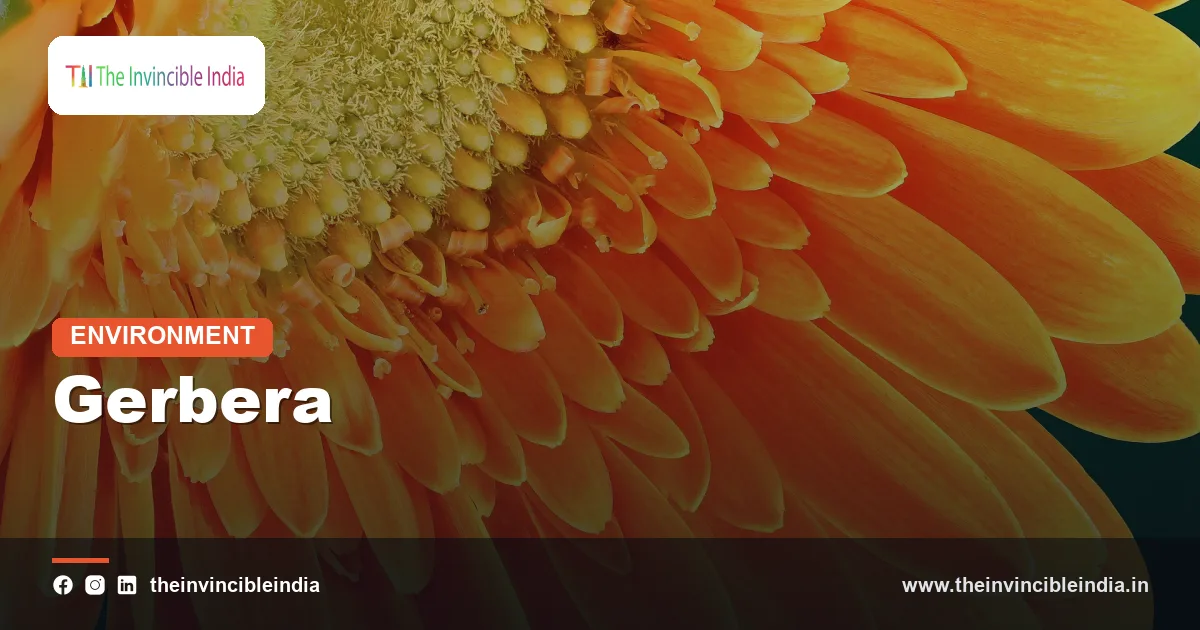
The gerbera is a large, bright, daisy-like flower of the sunflower family (Asteraceae), native to South Africa and grown in India mainly in polyhouses as one of the country’s leading cut flowers. Its single, long, leafless stalk carries one wide flower head in almost every colour except true blue, which is why florists use it in bouquets, stage decoration and wedding arrangements across the year.
Although most people see the gerbera only as a vase flower, it is a perennial herb that grows as a low rosette of lobed leaves close to the ground. This article explains what a gerbera is, where it comes from, how Indian growers raise it under protected cultivation, which types and colours exist, and how to keep the cut flowers fresh.
Quick Facts
| Common names | Gerbera, Barberton daisy, Transvaal daisy, African daisy |
|---|---|
| Scientific name | Gerbera jamesonii (and its many hybrids) |
| Family | Asteraceae (daisy or sunflower family) |
| Origin | Eastern South Africa, including the Barberton region of the Transvaal |
| Where grown in India | Polyhouses around Pune, Bengaluru, Hosur, Nashik, Sirsi and the hill states, plus home gardens and pots |
| Flowering | Almost year-round under protection; outdoors mainly in the cool season and spring |
| Plant habit | Perennial rosette herb, about 30 to 60 cm tall in flower |
| Main uses | Cut flowers, bouquets, event decoration, pot plants and garden beds |
Key Takeaways
- The gerbera (Gerbera jamesonii) is a perennial member of the daisy family Asteraceae that is native to South Africa.
- Each gerbera “flower” is actually a compound head made of many small ray florets around a central disc of tiny florets.
- In India the gerbera is grown mostly in polyhouses on raised beds, often in soilless media such as cocopeat, because protected cultivation gives steady quality and yield.
- Commercial gerbera plants are multiplied by tissue culture, which gives uniform, disease-free planting material and fast propagation of new hybrids.
- Gerbera flower heads occur in red, pink, orange, yellow, cream and white, with single, double and crested forms, but not in a natural blue.
- Cut gerbera stems usually last about one to two weeks in a vase if harvested at the right stage and kept in clean, cool water.
What is a gerbera flower, botanically?
A gerbera is a flowering herb of the daisy family whose showy “flower” is a composite head, called a capitulum, made up of hundreds of tiny florets. The outer, petal-like florets are ray florets, while the small tubular florets packed in the centre form the disc, and the whole head sits on a hollow, leafless stalk known as a scape.
The leaves of the gerbera arise from the base of the plant in a rosette. They are long, lobed and slightly hairy underneath, and they stay close to the ground, so the plant looks like a tuft of foliage from which the flower stalks rise one by one. The root system is fibrous and shallow, which is the reason well-drained media matter so much in cultivation.
Because the gerbera belongs to the same family as the sunflower, marigold, aster and chrysanthemum, the structure is familiar. The ray florets of the garden types are what a casual observer calls petals, and their count and arrangement decide whether a variety is classed as single, semi-double or double.
Where does the gerbera come from and how did it get its name?
The gerbera comes from southern Africa, and the garden species Gerbera jamesonii is native to the eastern parts of South Africa, which is why it is also called the Barberton daisy or Transvaal daisy. The genus name honours Traugott Gerber, an eighteenth-century German botanist and physician, while the species name jamesonii refers to Robert Jameson, a Scottish-born businessman who collected the plant near Barberton in the late nineteenth century.
Plants raised from his collection flowered in European glasshouses and attracted breeders. A cross between Gerbera jamesonii and the related Gerbera viridifolia produced the first garden hybrids, and later breeding in Europe, especially the Netherlands, created the wide colour range and large flower sizes seen in markets today.
The genus Gerbera contains around thirty species spread across Africa and Asia, and a few wild species occur in the Himalaya and other parts of Asia. The commercial flower grown in Indian polyhouses, however, is a hybrid derived from the South African species and is imported or multiplied from improved breeding lines.
Why is the gerbera grown in polyhouses in India?
The gerbera is grown in polyhouses in India because protected cultivation controls temperature, rain, humidity and pests, allowing the plant to give long, straight, blemish-free stems almost throughout the year. Open-field gerbera suffers from heavy monsoon rain, strong sun and sudden heat, which spoil the petals and encourage disease, so most commercial growers prefer a covered structure.
A polyhouse, or polyethylene greenhouse, is a frame covered with UV-stabilised plastic film, often with shade nets, ventilation and drip irrigation. Growers in India use naturally ventilated structures more often than fully air-conditioned ones because they cost less. Government horticulture schemes, such as support under the National Horticulture Mission and related programmes, have encouraged farmers to build these structures, particularly for high-value flowers.
Gerbera suits protected cultivation for a few reasons:
- It is a perennial, so one planting can produce flowers for roughly two to three years.
- It flowers continuously, so harvest takes place every few days rather than in a single season.
- It has steady demand from florists, hotels, event planners and gifting businesses.
- It gives a high return per unit of area compared with most field crops.
Where is gerbera grown in India?
Gerbera is grown commercially in India mainly in the milder uplands and plateau regions of Maharashtra, Karnataka and Tamil Nadu, with additional production in hill states and around large cities. Growers near Pune and Nashik in Maharashtra, around Bengaluru and Sirsi in Karnataka and near Hosur in Tamil Nadu are among the best known.
The reason is climate. The gerbera prefers daytime temperatures of roughly 20 to 28 degrees Celsius and nights that do not fall far below about 12 degrees, a range that many upland areas offer for much of the year. Cooler hill states such as Himachal Pradesh, Uttarakhand and Sikkim grow gerbera in polyhouses too, while growers in hot plains regions face more difficulty in summer and usually rely on shade nets, fogging or cooling pads.
Production is meant for large urban markets. Bunches are packed and sent to flower markets in Mumbai, Delhi, Bengaluru, Hyderabad, Chennai and Kolkata, and some premium stems are exported. The flower travels well when cooled quickly, which helps growers reach customers hundreds of kilometres away.
How is gerbera cultivated?
Gerbera is cultivated by planting tissue-cultured saplings on raised beds in well-drained, slightly acidic media under a polyhouse, followed by regular drip irrigation, balanced feeding and removal of old leaves. The steps below summarise the common practice.
Planting material
Commercial plants are produced by tissue culture, in which small pieces of plant tissue grow into many identical plantlets in a laboratory. This gives clean, uniform stock of a named variety. Seed-grown plants vary widely in colour and form, so they are used mainly by hobbyists. Division of mature clumps is another traditional method, but it multiplies plants slowly.
Media and beds
Gerbera needs a light, airy, well-drained medium with a pH of about 5.5 to 6.5. Many Indian growers use raised beds filled with a mixture of red soil, sand and organic matter or with coir pith, and some use pure soilless media such as cocopeat in bags or channels. The crown of the plant, where leaves meet the roots, must sit slightly above the surface because burying it invites rot.
Water and nutrition
Drip irrigation delivers water directly to the root zone, which keeps leaves and flowers dry and lowers disease. Fertigation, meaning fertiliser dissolved in irrigation water, supplies nitrogen, phosphorus and potassium in changing proportions during the vegetative and flowering stages. Over-feeding with nitrogen gives plenty of leaves but fewer or weaker flowers.
Plant care
Growers remove old and yellowing leaves to improve airflow and light, and they pick spent flowers promptly. A plant normally begins to flower a few months after planting, and good varieties continue to give several flowers per plant each year.
What types and colours of gerbera are there?
Gerbera types are usually grouped by flower form and size, while colour ranges from white and cream through yellow, orange, pink and red to deep maroon. The table below lists the commonly used categories in the trade.
| Category | Description |
|---|---|
| Single | One ring of ray florets around a prominent disc; the classic daisy look |
| Semi-double | Two or more rows of ray florets, with the central disc still visible |
| Double | Many rows of ray florets that largely hide the disc |
| Crested double | A small, differently coloured crest of short florets in the centre |
| Spider type | Narrow, twisted or quilled ray florets that give a spiky look |
| Mini gerbera | Smaller heads on slender stems, used in compact bouquets and pot culture |
Breeders select for stem strength, flower size, number of flowers per plant, vase life and resistance to disease. Bicoloured flowers, with a dark eye or contrasting tips, are also popular. Because the flower heads face the sun and open fully during the day, they look striking in simple monochrome bunches as well as in mixed arrangements.
Which pests and diseases affect gerbera?
The main problems of gerbera are sap-sucking insects such as whiteflies, thrips and spider mites, leaf miners, and fungal diseases including powdery mildew and crown or root rot. These troubles appear more easily when air is humid and still or when water collects around the crown.
- Whiteflies and thrips: tiny insects that suck sap, mark petals and can spread plant viruses.
- Red spider mites: thrive in hot, dry spells and cause stippled, bronzed leaves.
- Leaf miners: larvae tunnel inside leaves and leave pale winding trails.
- Powdery mildew: a white powdery growth on leaves and buds that reduces quality.
- Crown rot and root rot: caused by soil fungi such as Phytophthora and Pythium when media stay waterlogged.
Good management starts with clean planting material, well-drained media, spacing that allows air movement, sticky traps for insects and careful watering. Growers rotate chemical and biological controls according to local agricultural advice, and they keep records of crop health so that problems are noticed early.
How long does a cut gerbera last, and how should it be handled?
A cut gerbera typically lasts about seven to fourteen days in a vase, depending on the variety, the stage at which it was harvested and how it was treated afterwards. Harvest is done when the outer one or two rows of disc florets show pollen, because flowers picked too early may not open well and flowers picked too late fade sooner.
Stems are pulled or cut cleanly at the base, graded by length and head size, then placed straight into clean water. Quick cooling to a few degrees above freezing slows ageing during transport. Gerbera stems are hollow and can become soft near the neck of the flower, so growers often support the heads with plastic sleeves or cardboard collars in packs.
At home or in a shop, a few habits extend the life of gerbera stems:
- Use a clean vase and cool water, and keep the water level shallow, about a few centimetres, because standing stems in deep water encourages bacterial growth.
- Trim about a centimetre or two from the base of each stem and change the water every day or two.
- Keep the flowers away from direct sun, heat sources and ripening fruit.
What are the uses of gerbera?
Gerbera is used mainly as an ornamental flower, either as cut stems for bouquets and decoration or as a flowering pot plant for balconies and offices. It has no major role as food, medicine or fibre, so its value lies in its looks, long vase life and wide colour range.
In India the flower is common in wedding stage designs, hotel lobbies, gifting bouquets and corporate events, and it is often combined with roses, carnations, lilies and foliage. Smaller potted gerberas are sold through nurseries as colourful indoor and patio plants. Some studies have also examined the gerbera as a model plant for research on flower development, because its compound head is an excellent example of how many small flowers can form a single display.
Can gerbera be grown at home in India?
Gerbera can be grown at home in India in pots or garden beds if it gets bright light, good drainage and protection from extreme heat and heavy rain. A balcony or terrace with morning sun and a little afternoon shade is often suitable, especially in cooler or moderate climates.
Gardeners should choose a pot with plenty of drainage holes and fill it with light, well-draining potting mix containing sand, compost and coir. The plant should be set so that the crown stays slightly above the soil line, and watering should be moderate: moist but never soggy. A balanced liquid feed every couple of weeks during active growth supports flowering. Removing dead leaves and spent flowers keeps the plant tidy and reduces disease. In very hot plains summers, moving pots into partial shade protects the plants, and in the monsoon it helps to shelter them from continuous rain.
Bottom Line
The gerbera is a South African daisy that Indian growers have turned into a major polyhouse cut flower, valued for its big, long-lasting heads and wide colour choice. It rewards careful control of drainage, light and humidity, whether on a commercial farm or in a pot at home.
Frequently Asked Questions
What is a gerbera?
A gerbera is a daisy-like flowering plant of the family Asteraceae, native to South Africa, grown for its large, brightly coloured flower heads. Each head is a compound structure of ray and disc florets on a long leafless stalk. In India it is a leading cut flower raised mainly in polyhouses.
Is the gerbera native to India?
No, the garden gerbera is not native to India, because Gerbera jamesonii comes from eastern South Africa. A few other wild Gerbera species occur in Asia, including the Himalayan region, but the flowers sold in Indian markets are hybrids derived from the South African species.
Why are gerberas grown in polyhouses?
Gerberas are grown in polyhouses because protected cultivation shields the flowers from rain, strong sun and pests while allowing steady, high-quality production. The covered structure, drip irrigation and raised beds also help control disease and permit harvest across most of the year.
How long do gerbera flowers last in a vase?
Gerbera flowers usually last about one to two weeks in a vase. Longevity improves when stems are harvested at the right stage, cooled quickly, kept in clean shallow water and placed away from direct sun, heat and ripening fruit.
Can gerbera grow in hot Indian summers?
Gerbera can survive Indian summers but does best when daytime temperatures stay below about 30 degrees Celsius, so growers in hot regions use shade nets, ventilation or cooling. In pots, the plant should be shifted to light shade during peak heat, and the soil must be kept moist but well drained.
What colours does a gerbera come in?
Gerbera flowers come in white, cream, yellow, orange, pink, red and deep maroon, along with bicoloured forms. A natural true blue does not exist in gerbera, although dyed or artificially tinted flowers are sometimes sold for decoration.
{“@context”:”https://schema.org”,”@graph”:[{“@type”:”FAQPage”,”mainEntity”:[{“@type”:”Question”,”name”:”What is a gerbera?”,”acceptedAnswer”:{“@type”:”Answer”,”text”:”A gerbera is a daisy-like flowering plant of the family Asteraceae, native to South Africa, grown for its large, brightly coloured flower heads. Each head is a compound structure of ray and disc florets on a long leafless stalk. In India it is a leading cut flower raised mainly in polyhouses.”}},{“@type”:”Question”,”name”:”Is the gerbera native to India?”,”acceptedAnswer”:{“@type”:”Answer”,”text”:”No, the garden gerbera is not native to India, because Gerbera jamesonii comes from eastern South Africa. A few other wild Gerbera species occur in Asia, including the Himalayan region, but the flowers sold in Indian markets are hybrids derived from the South African species.”}},{“@type”:”Question”,”name”:”Why are gerberas grown in polyhouses?”,”acceptedAnswer”:{“@type”:”Answer”,”text”:”Gerberas are grown in polyhouses because protected cultivation shields the flowers from rain, strong sun and pests while allowing steady, high-quality production. The covered structure, drip irrigation and raised beds also help control disease and permit harvest across most of the year.”}},{“@type”:”Question”,”name”:”How long do gerbera flowers last in a vase?”,”acceptedAnswer”:{“@type”:”Answer”,”text”:”Gerbera flowers usually last about one to two weeks in a vase. Longevity improves when stems are harvested at the right stage, cooled quickly, kept in clean shallow water and placed away from direct sun, heat and ripening fruit.”}},{“@type”:”Question”,”name”:”Can gerbera grow in hot Indian summers?”,”acceptedAnswer”:{“@type”:”Answer”,”text”:”Gerbera can survive Indian summers but does best when daytime temperatures stay below about 30 degrees Celsius, so growers in hot regions use shade nets, ventilation or cooling. In pots, the plant should be shifted to light shade during peak heat, and the soil must be kept moist but well drained.”}},{“@type”:”Question”,”name”:”What colours does a gerbera come in?”,”acceptedAnswer”:{“@type”:”Answer”,”text”:”Gerbera flowers come in white, cream, yellow, orange, pink, red and deep maroon, along with bicoloured forms. A natural true blue does not exist in gerbera, although dyed or artificially tinted flowers are sometimes sold for decoration.”}}]}]}


