

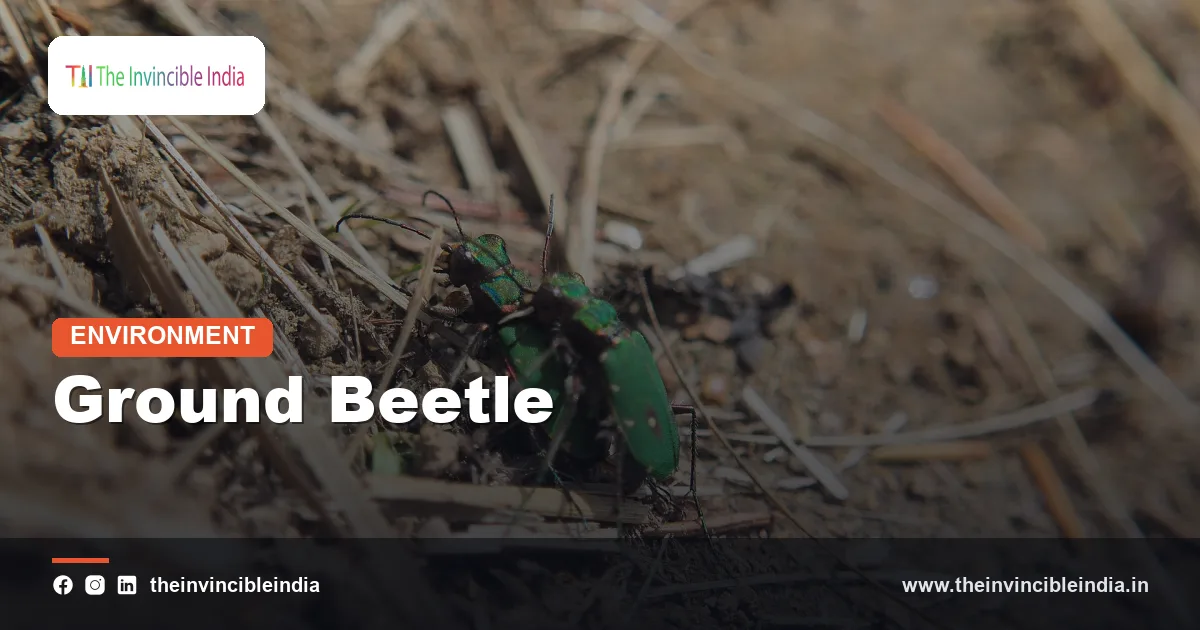
A ground beetle is a fast-running, usually dark and shiny beetle of the family Carabidae that lives on or just under the soil surface and hunts other small animals, mostly at night. In India these beetles are common in crop fields, gardens, forest floors, riverbanks and leaf litter, and a single field can hold dozens of species at once. Because they eat caterpillars, aphids, slugs, fly maggots and the eggs of many pests, farmers and entomologists regard the ground beetle as one of the most useful natural enemies of crop pests.
Most people notice a ground beetle only when a stone or flower pot is lifted and a glossy black insect scuttles away. This article explains what ground beetles are, how they live, how their life cycle works, what the famous bombardier beetle does, and why these quiet soil predators matter for Indian agriculture and for ecological monitoring.
| Attribute | Details |
|---|---|
| Scientific classification | Order Coleoptera, family Carabidae (ground beetles) |
| Number of species | More than 40,000 described species worldwide, one of the largest beetle families |
| Typical size | About 2 mm to over 30 mm, with most Indian field species between 5 mm and 25 mm |
| Habitat in India | Soil surface, leaf litter, under stones and logs, crop fields, grassland, forest floor, riverbanks and paddy bunds |
| Diet | Mostly carnivorous: caterpillars, aphids, fly larvae, slugs, snails and eggs; some species eat weed seeds or plant matter |
| Life cycle | Complete metamorphosis: egg, three larval stages, pupa and adult, usually inside a soil chamber |
| Ecological role | Natural pest controller, weed-seed eater, soil-surface predator and bioindicator |
| Notable features | Hardened wing covers, long running legs, chemical defence sprays, mostly nocturnal habits |
Key Takeaways
- A ground beetle belongs to the family Carabidae, which contains more than 40,000 described species and is one of the largest families in the beetle order Coleoptera.
- Most ground beetles are nocturnal predators that run fast on the soil surface and feed on caterpillars, aphids, slugs, fly larvae and insect eggs.
- Ground beetle larvae are also predators, living in the soil and hunting prey with strong curved jaws before they pupate underground.
- Bombardier beetles, a group within the ground beetle family, defend themselves by firing a hot, irritating chemical spray from the tip of the abdomen.
- Ground beetles are harmless to people and crops, and their numbers fall when soil is heavily disturbed or sprayed with broad-spectrum insecticides.
- Scientists use ground beetles as bioindicators because their species mix changes quickly with soil, vegetation and land-use conditions.
What is a ground beetle?
A ground beetle is a member of the beetle family Carabidae, a large group of mostly predatory beetles that are adapted for running over the ground. Like all beetles, ground beetles belong to the order Coleoptera, whose name means “sheath wings” because the front pair of wings has hardened into protective covers called elytra.
The body of a typical ground beetle is long and flattened, the head is narrower than the body, and the antennae are thread-like with eleven segments. The legs are long and slender, which allows a quick, scurrying run. Many species are black, brown or metallic bronze, green or blue, while some Indian species show bright patterns of yellow or red on the wing covers.
Ground beetles are not related to the dung beetles or the scarab beetles, even though they may be seen on the same soil. Scarab beetles have clubbed, fan-like antennae and usually feed on dung or plants, whereas a ground beetle has plain thread-like antennae and the sharp jaws of a hunter.
Where are ground beetles found in India?
Ground beetles are found across India, from the Himalayan foothills and the Western Ghats to the Gangetic plains, the Deccan plateau and the northeastern hill forests. The family prefers places where the ground is damp, shaded and rich in small prey, but different species have adapted to very different surroundings.
- Farmland and gardens: many species hide in the day under clods, crop residue and mulch, and come out after dark to hunt among the plants.
- Paddy fields and wetland edges: several species live on mud banks and bunds, where they catch small insects stranded at the waterline.
- Forests and plantations: leaf litter and rotting logs provide cover and a steady supply of insects, snails and earthworm relatives.
- Riverbanks and sandy ground: specialised species run on open sand and gravel and are active even in warm daylight.
Ground beetles are strongly attracted to lights at night, so they often turn up on verandas and near street lamps during the monsoon. Their presence indoors is accidental, and they do not feed on stored food, cloth or wood.
What do ground beetles eat?
Most ground beetles are carnivores that eat caterpillars, cutworms, aphids, fly maggots, small slugs and snails, mites and the eggs and pupae of other insects. The ground beetle catches prey with its jaws, then pours digestive juices onto the food and sucks up the liquefied remains, a process known as external digestion.
Diet differs between groups, and this difference matters for pest control:
- Caterpillar hunters: large beetles of the genus Calosoma are specialists that climb plants and trees in search of caterpillars.
- Generalist predators: many medium-sized species eat whatever small soft-bodied animals they can overpower on the soil surface.
- Seed eaters: beetles of genera such as Harpalus and Amara include many species that feed partly or mainly on seeds, which helps reduce the weed seed bank in fields.
- Mixed feeders: a number of species switch between animal prey and plant material depending on what is available.
Ground beetles can eat several times their own body weight in prey over a season, and their appetite is highest in warm, humid weather when pests are most abundant.
How does the ground beetle life cycle work?
The ground beetle passes through complete metamorphosis, which means it has four distinct stages: egg, larva, pupa and adult. The whole cycle can take a few months in tropical conditions, while some species in cooler areas need a full year.
Egg stage
The female ground beetle lays small, oval eggs singly or in small groups in soil crevices, under debris or in a little chamber she digs. Some species guard or prepare the egg site, but most leave the eggs to hatch on their own after a few days to a few weeks.
Larval stage
The ground beetle larva is long, slender and flattened, with a hard head, strong curved jaws and a pair of small tail appendages called urogomphi. The larva usually goes through three growth stages, called instars, and feeds on soil-dwelling insects, worms and eggs. Larvae are often more voracious than adults, though they are rarely seen because they live underground.
Pupal and adult stages
The mature larva builds a small earthen cell and turns into a pupa, in which the adult body forms. The new adult stays in the cell until its cuticle hardens, then digs out. Many adults live for one to two years, and some large species survive several seasons by sheltering through the cold or dry months.
Why is the ground beetle called a farmer’s friend?
The ground beetle is called a farmer’s friend because it eats large numbers of crop pests without damaging the crop itself. Both the larvae and the adults feed on pests, so the beetle works as a pest controller through its whole life.
The benefits to agriculture can be grouped as follows:
- Ground beetles reduce populations of cutworms, armyworm caterpillars and other soil-surface pests.
- They eat the eggs and young stages of many insects before those pests can build up on the crop.
- Seed-eating species reduce the number of weed seeds that fall on the ground and sprout in the next season.
- Their presence costs the farmer nothing, since they arrive naturally when the habitat suits them.
This form of natural pest control is part of conservation biological control, in which farmers protect the natural enemies already present in the field instead of buying and releasing them. Practices such as keeping grassy bunds, leaving crop residue as cover, reducing deep tillage and avoiding unnecessary broad-spectrum sprays all help ground beetles survive.
What is a bombardier beetle and how does it defend itself?
A bombardier beetle is a type of ground beetle that defends itself by shooting a hot, irritating chemical spray from the tip of its abdomen. The spray is produced in a reaction chamber where hydroquinones and hydrogen peroxide are mixed with enzymes, and the reaction releases heat and gas so that the liquid is ejected as a quick, audible pop at close to boiling temperature.
Bombardier beetles of the genera Pheropsophus and Brachinus occur in India, often on damp ground and around paddy fields. The beetle can aim the spray by swivelling the tip of its abdomen, which makes it effective against ants, spiders, frogs and other small attackers. The spray stings and stains human skin brown but is not dangerous.
Other ground beetles have different defences. Many release foul-smelling or acidic fluids from glands near the abdomen, and some species spray formic acid. These chemicals discourage birds, lizards and mammals from eating the beetle, and the strong smell is the reason many people find a handled ground beetle unpleasant.
Which ground beetle groups are seen in India?
Several recognisable groups of ground beetles live in India, and the table below lists some of the best-known ones with their usual habits.
| Group or genus | Usual appearance | Typical habit |
|---|---|---|
| Pheropsophus (bombardier beetles) | Orange or yellow with dark patterns | Damp soil, paddy bunds, sprays hot chemicals when disturbed |
| Calosoma (caterpillar hunters) | Large, metallic or dark, ridged wing covers | Climbs plants and trees to eat caterpillars |
| Chlaenius | Metallic green or bronze with pale borders | Moist ground near water, hunts at night |
| Scarites | Black, with a narrow waist and strong jaws | Digs shallow burrows in sandy or loose soil |
| Harpalus | Dark brown or black, medium sized | Fields and grassland, eats seeds and insects |
| Tiger beetles (Cicindelinae) | Bright metallic, long legs, large eyes | Open sandy ground, fast daytime hunters |
Tiger beetles are classified as a subfamily within Carabidae in many modern classifications, although older books treat them as a separate family. This difference explains why tiger beetles are sometimes counted with ground beetles and sometimes listed apart.
Do ground beetles fly, bite or sting?
Ground beetles rarely fly, they do not sting and they are not dangerous to people. Many species have reduced hind wings or wing covers that are fused together, so they depend on running. Other species can fly and do so at night, which explains why they are drawn to lights.
A ground beetle may nip with its jaws if it is gripped, and a large one can pinch skin, but the bite is mild and carries no venom or disease. The chief nuisance is the smell or the stain of a defensive spray. A ground beetle found in a house can be carried outside in a cup, and no treatment is needed.
It is also useful to know what a ground beetle is not. It is not a cockroach, even though both are dark and quick, and it does not eat food, books or clothes. Its only interest in a house is shelter and the small insects that live there.
Why are ground beetles used as bioindicators?
Ground beetles are used as bioindicators because they are easy to collect, widespread, well studied and quick to respond to changes in soil, moisture, vegetation and land use. A change in the number and kinds of ground beetles in a place therefore signals a change in the health of the habitat.
Researchers usually sample them with pitfall traps, which are simple cups sunk level with the soil surface. The beetles walking at night fall into the cups and can be counted and identified. Studies in many countries use this method to compare forests, plantations, farms, grasslands and restored land.
Ground beetles respond to several pressures:
- Heavy pesticide use reduces predator numbers more than it reduces some pests.
- Frequent ploughing destroys larval chambers and exposes pupae.
- Loss of leaf litter and ground cover removes daytime shelter.
- Pollution and soil compaction favour a few tough species over a rich mix.
How can people protect ground beetles?
People can protect ground beetles by giving them shelter, reducing disturbance of the soil and avoiding unnecessary insecticides. These steps work in a village field as well as in a city balcony garden.
- Leave patches of grass, mulch, straw or leaf litter in and around fields and gardens.
- Keep stones, logs or boards in a quiet corner as daytime hiding places.
- Reduce deep and repeated tillage where the crop allows it.
- Use targeted, minimal sprays and follow integrated pest management advice from local agricultural extension services.
- Switch off or shield unnecessary outdoor lights near gardens in the monsoon, since lights draw beetles away from their hunting grounds.
Bottom Line
The ground beetle is a common, harmless and valuable predator of Indian soil that removes pests while it hides from view. Protecting its shelter and avoiding needless sprays keeps this free pest control working, and watching its numbers offers a simple way to judge the health of a field or forest floor.
Frequently Asked Questions
What is a ground beetle?
A ground beetle is a predatory beetle of the family Carabidae that runs on the soil surface and feeds mainly on small insects, slugs and eggs. More than 40,000 species are known worldwide and many occur in India. Most are dark, shiny and active at night.
Are ground beetles harmful to humans or crops?
No, ground beetles are not harmful to humans and most are helpful to crops. They do not sting, carry no venom and rarely bite. A few seed-eating species may take some planted seeds, but the overall effect of the family on farms is beneficial.
What do ground beetles eat?
Ground beetles mostly eat caterpillars, aphids, fly maggots, slugs, snails and insect eggs. Some species also eat weed seeds or plant matter. They digest food externally by pouring enzymes onto the prey and sucking up the liquid.
How does a bombardier beetle spray work?
A bombardier beetle sprays by mixing hydroquinones and hydrogen peroxide with enzymes in a reaction chamber inside its abdomen. The reaction produces heat and gas, which fire a hot, irritating liquid out of the abdomen tip. The beetle can aim the spray at ants, spiders and other attackers.
Why do ground beetles come into the house at night?
Ground beetles come into houses at night mainly because they are attracted to lights. Species that can fly are drawn to lamps during the monsoon. They do not breed or feed indoors and can be moved outside safely.
How can I attract ground beetles to my garden?
You can attract ground beetles by providing shelter such as mulch, leaf litter, stones and grassy borders. Avoid heavy digging and unnecessary insecticide sprays. A mix of plants and undisturbed corners helps the beetles hide by day and hunt pests at night.
{“@context”:”https://schema.org”,”@graph”:[{“@type”:”FAQPage”,”mainEntity”:[{“@type”:”Question”,”name”:”What is a ground beetle?”,”acceptedAnswer”:{“@type”:”Answer”,”text”:”A ground beetle is a predatory beetle of the family Carabidae that runs on the soil surface and feeds mainly on small insects, slugs and eggs. More than 40,000 species are known worldwide and many occur in India. Most are dark, shiny and active at night.”}},{“@type”:”Question”,”name”:”Are ground beetles harmful to humans or crops?”,”acceptedAnswer”:{“@type”:”Answer”,”text”:”No, ground beetles are not harmful to humans and most are helpful to crops. They do not sting, carry no venom and rarely bite. A few seed-eating species may take some planted seeds, but the overall effect of the family on farms is beneficial.”}},{“@type”:”Question”,”name”:”What do ground beetles eat?”,”acceptedAnswer”:{“@type”:”Answer”,”text”:”Ground beetles mostly eat caterpillars, aphids, fly maggots, slugs, snails and insect eggs. Some species also eat weed seeds or plant matter. They digest food externally by pouring enzymes onto the prey and sucking up the liquid.”}},{“@type”:”Question”,”name”:”How does a bombardier beetle spray work?”,”acceptedAnswer”:{“@type”:”Answer”,”text”:”A bombardier beetle sprays by mixing hydroquinones and hydrogen peroxide with enzymes in a reaction chamber inside its abdomen. The reaction produces heat and gas, which fire a hot, irritating liquid out of the abdomen tip. The beetle can aim the spray at ants, spiders and other attackers.”}},{“@type”:”Question”,”name”:”Why do ground beetles come into the house at night?”,”acceptedAnswer”:{“@type”:”Answer”,”text”:”Ground beetles come into houses at night mainly because they are attracted to lights. Species that can fly are drawn to lamps during the monsoon. They do not breed or feed indoors and can be moved outside safely.”}},{“@type”:”Question”,”name”:”How can I attract ground beetles to my garden?”,”acceptedAnswer”:{“@type”:”Answer”,”text”:”You can attract ground beetles by providing shelter such as mulch, leaf litter, stones and grassy borders. Avoid heavy digging and unnecessary insecticide sprays. A mix of plants and undisturbed corners helps the beetles hide by day and hunt pests at night.”}}]}]}


