

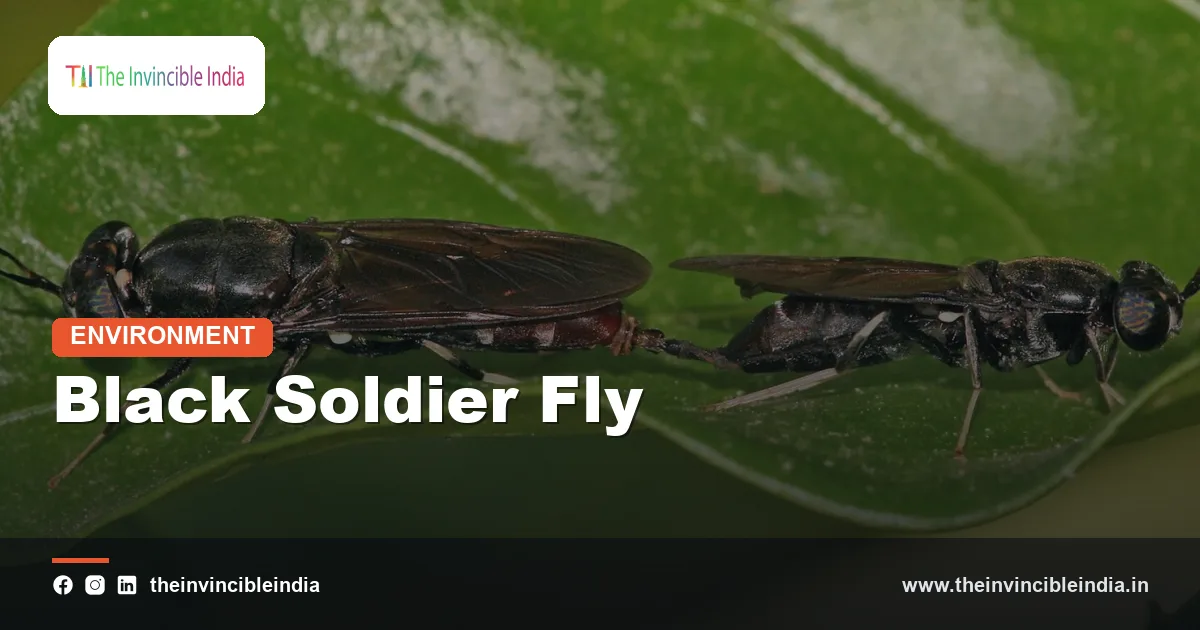
The black soldier fly (Hermetia illucens) is a harmless, wasp-like fly whose larvae eat food waste, manure and other organic matter at great speed, and this ability has made the soldier fly a popular tool for composting and animal feed production in India. The adult does not bite, sting or feed, and it does not spread disease. Only the larva eats, and in about two weeks it can turn a heap of kitchen or market waste into rich protein and a crumbly soil-like residue.
The soldier fly is native to the Americas but now lives in warm regions across the world, including most of India. This article explains what the black soldier fly is, how its life cycle works, what its larvae eat, how it is used for waste recycling and feed, and how it differs from the housefly.
| Attribute | Details |
|---|---|
| Scientific name | Hermetia illucens (black soldier fly) |
| Order and family | Order Diptera (true flies), family Stratiomyidae (soldier flies) |
| Adult size | About 15 mm to 20 mm long, with a slender wasp-like body |
| Habitat in India | Warm and humid places near decaying matter: compost heaps, manure, market waste, farms and gardens |
| Diet | Larvae eat decaying plant and animal matter; adults do not feed and live on stored fat |
| Life cycle | Complete metamorphosis in roughly 40 to 45 days under warm conditions: egg, larva, prepupa, pupa and adult |
| Ecological role | Decomposer and recycler of organic waste; also a source of insect protein for feed |
| Notable features | Adults are harmless, larvae suppress houseflies, and the prepupae crawl out of waste on their own |
Key Takeaways
- The black soldier fly (Hermetia illucens) belongs to the soldier fly family Stratiomyidae and is a true fly of the order Diptera.
- Black soldier fly adults have no functional feeding mouthparts, so they do not bite, sting, visit food or carry disease.
- Black soldier fly larvae can consume a very large share of their own weight in organic waste each day and can reduce the waste volume by roughly half or more.
- The larvae are rich in protein and fat and are used as feed for poultry, fish and pets, while their waste residue serves as a soil conditioner.
- The complete life cycle of the soldier fly takes around six weeks in warm weather, which suits most Indian climates.
- Soldier fly larvae change the waste they live in so that it is less attractive to egg-laying houseflies.
What is the black soldier fly?
The black soldier fly is a medium-sized, mostly black fly of the family Stratiomyidae, scientifically named Hermetia illucens. Adults resemble a slim wasp, with a narrow waist, a black body and two translucent whitish “windows” near the base of the abdomen. The feet are pale, which helps separate the species from similar insects.
Unlike a wasp, the black soldier fly has only one pair of functional wings, as all true flies do. Its antennae are long and the flight is slow and slightly clumsy. At rest the wings fold flat over the back. The name “soldier fly” is given to the whole family, and the family name Stratiomyidae comes from Greek words meaning “soldier” and “fly”.
The family contains thousands of species around the world, but the black soldier fly is the one that has gained attention for waste treatment. Other Indian soldier flies are often green or metallic and their larvae live in water, wet soil or rotting plant material.
Is the black soldier fly native to India?
No, the black soldier fly is originally from the Americas, but it has spread through trade and travel to tropical and warm temperate regions around the world, including India. In India it now appears naturally around manure and compost, and it is also bred on purpose in small farms, community composting units and start-up facilities.
The warm Indian climate suits the species. Larvae grow best at roughly 27 to 30 degrees Celsius, and temperatures in most of peninsular and central India stay in or near this range for much of the year. In colder northern winters, growth slows, and indoor or sheltered units are used.
How does the soldier fly life cycle work?
The soldier fly develops through complete metamorphosis in five stages, which are the egg, the larva, the prepupa, the pupa and the adult. Under warm conditions the full cycle takes about 40 to 45 days.
Eggs
The female lays a cluster of several hundred eggs, commonly cited as 500 or more, in dry crevices close to decaying matter. She does not lay directly on the waste, which protects the eggs from drowning. The eggs hatch in around four days, and the tiny larvae crawl to the food.
Larvae
The larval stage lasts about two to three weeks and is the only feeding stage. The larva is creamy, segmented and flattened, grows to about 20 to 25 mm and has strong mouthparts for scraping and chewing. It goes through several growth stages called instars, and each stage grows rapidly.
Prepupa and pupa
When growth is complete the larva turns darker and enters the prepupal stage. The prepupa stops eating and crawls out of the waste in search of a dry, sheltered place. This self-harvesting habit is very useful for farmers, since the prepupae can be collected from a ramp or container without sorting them from the waste. Inside the hardened prepupal skin the insect pupates for about one to two weeks.
Adults
The adult emerges, mates within a few days and lays eggs. Adults live only about a week, because they do not feed and rely on fat stored during the larval stage. Their short lives are spent on mating and egg laying.
What do black soldier fly larvae eat?
Black soldier fly larvae eat almost any soft, decaying organic material, including kitchen scraps, fruit and vegetable waste, spoiled grain, food-market leftovers, animal manure and slaughterhouse waste. The larvae feed in dense groups, and their combined movement keeps the waste mixed, aerated and moist.
The type of food changes the speed of growth and the composition of the larvae. Soft, moist, nutrient-rich waste gives the best results. Some materials are poor feed or need preparation:
- Very dry or woody waste is hard to eat and needs moisture or shredding.
- Large quantities of citrus peel, spicy leftovers or very oily food slow down growth.
- Plastic, metal, glass and other non-organic items are not eaten and should be kept out.
- Waste containing high levels of heavy metals or toxic chemicals can pass these into the larvae, so source material is chosen with care.
How do soldier flies help in composting and waste recycling?
Soldier flies help in composting by converting fresh organic waste into larval biomass and a dark, crumbly residue in a matter of days, which is faster than conventional composting. The larvae digest the waste with enzymes and gut microbes, and they can cut the weight and volume of the waste by roughly half or more.
The residue left behind, often called frass, contains the larval droppings and partly digested material. It is used as a soil conditioner and is usually cured for some time before application to crops. The larvae themselves are the second product. They can be collected, dried or processed into meal and oil.
The process fits Indian needs in several ways:
- Cities and towns generate large amounts of wet organic waste from homes, markets and hotels, and much of it is dumped or burned.
- Farms and poultry units produce manure that is costly to handle and attracts flies.
- Small decentralised units can treat waste close to where it is produced, so less waste needs to be transported.
- The larvae provide an income-earning product, which helps make waste treatment self-supporting.
Municipal bodies, research institutions and private enterprises in India have tried black soldier fly systems for food waste and manure, and the model is spreading slowly as operators learn how to control moisture, temperature and odour.
How is the black soldier fly used as animal feed?
The black soldier fly is used as animal feed because its larvae contain a high share of protein and fat, which makes them a good ingredient for poultry, fish and pet food. Dried larvae often contain around 40 percent protein by dry weight, although the exact figure depends on what the larvae were fed.
Feed makers use the larvae in several forms:
- Live or dried larvae are given directly to chickens, ducks and ornamental fish.
- Larval meal replaces part of the fishmeal or soybean meal in compounded feeds.
- Larval fat can be separated and used as an energy-rich oil in feed or in other products.
Insect protein is attractive because the larvae need little land and water compared with soybean or fish capture, and they grow on material that would otherwise be waste. Regulations on the use of insects in animal feed differ from country to country, and producers in India follow the standards set by the relevant authorities for feed safety.
How is the soldier fly different from a housefly?
The soldier fly differs from the housefly in appearance, behaviour and effect on people: the adult soldier fly is larger, wasp-like and non-feeding, whereas the housefly feeds on food, lands on human meals and can carry disease organisms. The table below sets out the main differences.
| Feature | Black soldier fly | Housefly |
|---|---|---|
| Scientific name | Hermetia illucens | Musca domestica |
| Family | Stratiomyidae | Muscidae |
| Adult size | About 15 to 20 mm, slender and wasp-like | About 6 to 7 mm, grey and stout |
| Adult feeding | Does not feed | Feeds on liquids and food |
| Enters homes | Rarely | Very commonly |
| Disease risk | Not known as a disease carrier | Can carry germs on its body and feet |
| Larvae | Grow in dense groups and recycle waste | Small maggots that breed in filth |
| Value to people | Waste recycling and feed | Mainly a pest |
The two flies also interact. Dense groups of soldier fly larvae change the moisture and chemistry of the waste and make it less suitable for egg-laying houseflies. Farms that keep soldier fly colonies in manure therefore often report fewer houseflies.
Are black soldier flies dangerous or a pest?
Black soldier flies are not dangerous and are not considered a pest in normal conditions. The adults cannot bite or sting, because their mouthparts are reduced, and they do not land on food or spread germs in the way that houseflies do. Their larvae live in waste, not in stored food.
A few cautions apply. Larvae kept in open, wet waste can produce odour if the system is overfed or poorly drained. A rare accidental infestation of larvae in stored food or in the human digestive tract has been described for several fly species, but it is not typical for this species. Good management of moisture, feed quantity and covers keeps colonies productive and clean.
How can a small unit keep black soldier flies?
A small unit keeps black soldier flies by providing a breeding cage for adults, shaded bins for larvae and a way for prepupae to crawl out and be collected. Many home and community units follow the same basic design.
- Adult cage: a netted enclosure with plants, light and a dry spot for egg laying, such as corrugated cardboard.
- Feeding bin: a tray or crate with drainage, filled with soft organic waste and covered to keep out rain and pests.
- Harvest ramp: a sloping side from which migrating prepupae drop into a collecting container.
- Frass collection: removal and curing of the residue before use in soil.
Keeping the bin warm, shaded and moist but not flooded is the main skill. Most problems, such as smell, slow growth or escaping larvae, arise from too much water, too much feed in one go or temperatures that are too low.
Bottom Line
The black soldier fly is a harmless insect with a useful larva that turns organic waste into feed protein and a soil-ready residue. Its fit with warm Indian conditions and its ability to suppress houseflies make it a practical option for farms, markets and community composting.
Frequently Asked Questions
What is a black soldier fly?
A black soldier fly is a wasp-like fly of the family Stratiomyidae, scientifically named Hermetia illucens. The adult is about 15 to 20 mm long and does not bite, sting or feed. The larvae eat decaying organic matter and are used for composting and animal feed.
Is the soldier fly harmful to humans?
No, the soldier fly is not harmful to humans. The adult has no functional biting mouthparts and does not feed on food or spread disease. It is mainly seen near compost and manure and rarely enters homes.
How long does the black soldier fly life cycle take?
The black soldier fly life cycle takes about 40 to 45 days in warm conditions. Eggs hatch in around four days, the larval stage lasts two to three weeks, and the prepupa and pupa stages take another one to two weeks. Adults live for only about a week.
What can black soldier fly larvae eat?
Black soldier fly larvae can eat most soft, decaying organic waste, including kitchen scraps, fruit and vegetable waste, spoiled grain and animal manure. They do not eat plastic, metal or glass. Very dry, woody or oily material is hard for them to process.
Can black soldier fly larvae replace compost worms?
Black soldier fly larvae do not fully replace compost worms, but they work faster on fresh, wet and mixed food waste. Larvae reduce the waste within days and produce a residue that needs curing, whereas worms make a finer vermicompost over weeks. Some farms use both systems together.
Why are black soldier flies good for animal feed?
Black soldier flies are good for animal feed because the larvae are rich in protein and fat, often around 40 percent protein by dry weight. They can be grown on waste with little land and water. Poultry and fish feed makers use them to replace part of fishmeal or soybean meal.
{“@context”:”https://schema.org”,”@graph”:[{“@type”:”FAQPage”,”mainEntity”:[{“@type”:”Question”,”name”:”What is a black soldier fly?”,”acceptedAnswer”:{“@type”:”Answer”,”text”:”A black soldier fly is a wasp-like fly of the family Stratiomyidae, scientifically named Hermetia illucens. The adult is about 15 to 20 mm long and does not bite, sting or feed. The larvae eat decaying organic matter and are used for composting and animal feed.”}},{“@type”:”Question”,”name”:”Is the soldier fly harmful to humans?”,”acceptedAnswer”:{“@type”:”Answer”,”text”:”No, the soldier fly is not harmful to humans. The adult has no functional biting mouthparts and does not feed on food or spread disease. It is mainly seen near compost and manure and rarely enters homes.”}},{“@type”:”Question”,”name”:”How long does the black soldier fly life cycle take?”,”acceptedAnswer”:{“@type”:”Answer”,”text”:”The black soldier fly life cycle takes about 40 to 45 days in warm conditions. Eggs hatch in around four days, the larval stage lasts two to three weeks, and the prepupa and pupa stages take another one to two weeks. Adults live for only about a week.”}},{“@type”:”Question”,”name”:”What can black soldier fly larvae eat?”,”acceptedAnswer”:{“@type”:”Answer”,”text”:”Black soldier fly larvae can eat most soft, decaying organic waste, including kitchen scraps, fruit and vegetable waste, spoiled grain and animal manure. They do not eat plastic, metal or glass. Very dry, woody or oily material is hard for them to process.”}},{“@type”:”Question”,”name”:”Can black soldier fly larvae replace compost worms?”,”acceptedAnswer”:{“@type”:”Answer”,”text”:”Black soldier fly larvae do not fully replace compost worms, but they work faster on fresh, wet and mixed food waste. Larvae reduce the waste within days and produce a residue that needs curing, whereas worms make a finer vermicompost over weeks. Some farms use both systems together.”}},{“@type”:”Question”,”name”:”Why are black soldier flies good for animal feed?”,”acceptedAnswer”:{“@type”:”Answer”,”text”:”Black soldier flies are good for animal feed because the larvae are rich in protein and fat, often around 40 percent protein by dry weight. They can be grown on waste with little land and water. Poultry and fish feed makers use them to replace part of fishmeal or soybean meal.”}}]}]}


