

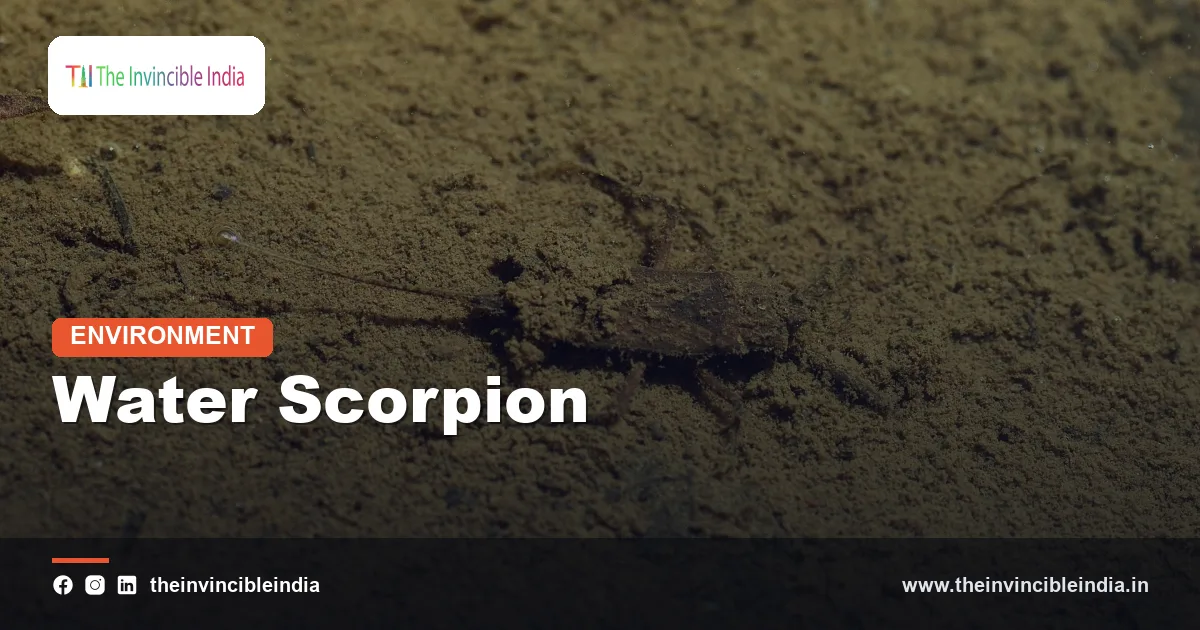
A water scorpion is a slender, stick-like predatory water bug of the family Nepidae that lives in still freshwater and breathes through a long tail tube while it grabs prey with pincer-like front legs. Despite the name, the water scorpion is an insect, not a scorpion, and it is not related to the land scorpions, which are arachnids. In India, water scorpions are found in ponds, paddy fields, marshes and slow streams, where they wait motionless for tadpoles, small fish and insect larvae.
This article explains what a water scorpion is, how its breathing tube works, what it eats, how it breeds, and how it differs from the giant water bug and the water stick insect. It also answers common questions on whether the pond bug is dangerous and what its presence says about a pond.
| Attribute | Details |
|---|---|
| Scientific classification | Order Hemiptera (true bugs), suborder Heteroptera, family Nepidae |
| Common Indian genera | Laccotrephes (water scorpions) and Ranatra (water stick insects) |
| Size | Roughly 30 mm to 50 mm in body length, not counting the breathing tube |
| Habitat in India | Ponds, tanks, paddy fields, marshes, ditches and slow streams with weeds |
| Diet | Tadpoles, small fish, insect larvae, mosquito larvae, snails and other small water animals |
| Life cycle | Incomplete metamorphosis: egg, five nymph stages and winged adult |
| Ecological role | Ambush predator in freshwater food webs and consumer of mosquito larvae |
| Notable features | Tail breathing siphon, grasping forelegs, leaf-like camouflage, ability to fly and to play dead |
Key Takeaways
- The water scorpion belongs to the family Nepidae of the order Hemiptera and is an aquatic insect, not an arachnid or a true scorpion.
- A water scorpion breathes air through a long tube at the tail end that it pushes through the water surface, so it does not need to leave the water to breathe.
- The water scorpion catches prey with powerful hinged forelegs and feeds by piercing the victim and sucking out its body fluids.
- Water scorpions undergo incomplete metamorphosis, and the young nymphs resemble small wingless adults.
- The water scorpion has no sting, and the tail tube is a breathing organ, but handling one can lead to a painful stab from its beak.
- The presence of water scorpions indicates a freshwater habitat with vegetation and a good supply of small prey.
What is a water scorpion?
A water scorpion is an aquatic true bug of the family Nepidae that has a brown, flattened or stick-like body, large grasping forelegs and a long breathing tube at the rear. The name comes from the resemblance of the raised front legs and tail to a scorpion, and the resemblance ends there.
The body of a typical water scorpion is brown or greyish and blends with dead leaves and mud. The head is small, the eyes are modest, and the beak, called a rostrum, is short and tucked under the head. Two long, sturdy front legs fold back like a knife blade and can snap shut around prey. The four remaining legs are thin and used for slow walking on plants and the pond floor.
Like other bugs in the order Hemiptera, the water scorpion has piercing and sucking mouthparts. It is therefore a relative of cicadas, aphids and bed bugs, and not of beetles or spiders.
Is a water scorpion a real scorpion?
No, a water scorpion is not a real scorpion. True scorpions are arachnids with eight legs, pincers and a venomous stinger at the end of a segmented tail, while the water scorpion is an insect with six legs and a non-venomous tail tube used for breathing.
The differences are easy to list:
- A water scorpion has six legs, whereas a true scorpion has eight.
- The “tail” of a water scorpion is a hollow breathing siphon, not a stinger.
- A water scorpion has wings, which are tucked away under the leathery front wings, and a true scorpion has none.
- A water scorpion lives in water and a true scorpion is a land animal.
The raptorial front legs of the water scorpion are similar to the pincers of a praying mantis, a case of convergent adaptation for grasping prey, and not a sign of relationship.
How does a water scorpion breathe?
A water scorpion breathes through a long siphon at the tip of its abdomen that it pushes up through the water surface to draw in air. The siphon is made of two half-tubes that lock together to form one hollow tube, and the tube leads to the breathing openings on the insect’s body, called spiracles.
The insect hangs head-down in the water, usually among weeds, with only the tip of the tube touching the air. This allows the water scorpion to stay hidden and still for hours while it breathes. When it dives deeper, it carries a thin film of air held over its body and spiracles.
The length of the tube varies with the genus. In Laccotrephes it is moderately long, and in the thinner Ranatra it can be as long as the body. The tube is harmless to people and does not sting.
What does a water scorpion eat?
A water scorpion eats living prey, including tadpoles, small fish, insect larvae, mosquito wrigglers, small snails and other aquatic invertebrates. It is a sit-and-wait predator that remains almost motionless among plants until something comes within range.
The hunt follows a consistent pattern:
- The water scorpion clings to a plant stem or rests on the bottom, camouflaged like a dead leaf or twig.
- When a victim passes within reach, the forelegs snap forward and pin it against the body.
- The beak pierces the prey and injects digestive enzymes that dissolve the soft tissues.
- The insect then sucks up the liquefied contents and discards the empty shell.
Because water scorpions eat mosquito larvae as part of a varied diet, they contribute to natural limits on mosquito numbers in ponds and paddy fields. They also eat tadpoles and small fish, which can matter in fish nurseries and small hatchery tanks.
Where do water scorpions live in India?
Water scorpions live in still or slowly moving freshwater across India, including village ponds, temple tanks, paddy fields, marshy ditches and the weedy edges of lakes and slow streams. They favour water that is shallow, warm and full of submerged and floating plants.
Common Indian species include Laccotrephes griseus and Laccotrephes maculatus, which are broader and more scorpion-like, and Ranatra species, which are thin and resemble walking sticks. Both belong to the same family and often share the same ponds.
Water scorpions can fly. At night, adults leave the water and fly to new ponds, especially after the monsoon rains refill temporary pools, and they are sometimes found at lights near water bodies. In dry seasons, adults survive in mud or move to deeper water.
How does the water scorpion life cycle work?
The water scorpion life cycle uses incomplete metamorphosis, which means the young hatch from eggs as wingless nymphs and become adults through several moults without a pupal stage. The three stages are the egg, the nymph and the adult.
Eggs
The female lays eggs inside plant stems or in wet mud near the water’s edge, using her ovipositor to insert them where the plant tissue is soft. The eggs of the family carry thin thread-like projections at one end that reach out into the air or water and help the embryo breathe. Eggs hatch in a few weeks, depending on temperature.
Nymphs
The nymph looks like a small, wingless version of the adult and has the same grasping forelegs and an even shorter breathing tube. It usually passes through five nymphal stages, called instars, and sheds its skin between each of them. The nymph feeds on very small prey at first and larger prey as it grows.
Adults
The adult develops full wings and can reproduce. Adults often live for several months, and the generation that matures late in the season can survive through dry or cooler weather before breeding in the next rains.
Is the water scorpion dangerous to humans?
The water scorpion is not dangerous to humans, though it can inflict a painful stab with its beak if it is picked up or trodden on. It has no venomous sting, and the tail tube is only a breathing organ.
The painful puncture comes from the piercing mouthparts that the insect uses on prey. The pain is usually brief, similar to a sharp pinprick, and washing the spot with clean water is sufficient. Bites do not transmit disease. People catching tadpoles or fish by hand in ponds are the most likely to be stabbed, and a net or a small container avoids the problem.
Water scorpions may also appear to be dead when disturbed. This behaviour, called thanatosis or playing dead, makes the insect stiff and motionless for some time, and it often fools predators and children alike.
How is a water scorpion different from similar pond insects?
A water scorpion is different from other pond bugs mainly in its body shape and the length of its breathing tube. The table below compares it with look-alike insects that share Indian ponds.
| Insect | Family | Body shape | Breathing | Main habit |
|---|---|---|---|---|
| Water scorpion (Laccotrephes) | Nepidae | Flat, oval, leaf-like with grasping forelegs | Long tail siphon | Ambush predator among weeds and mud |
| Water stick insect (Ranatra) | Nepidae | Long, thin, stick-like | Very long tail siphon | Ambush predator on plant stems |
| Giant water bug | Belostomatidae | Broad, oval and large | Short breathing straps at tail | Powerful predator of fish and frogs |
| Backswimmer | Notonectidae | Boat-shaped, swims upside down | Air bubble under the body | Fast swimmer, hunts at the surface |
The water stick insect is often called a water scorpion in everyday speech because it shares the family and the tail tube. Giant water bugs are larger, broader and have short tail straps instead of a long siphon.
Why do water scorpions matter for ponds and people?
Water scorpions matter because they are middle-order predators in freshwater food webs, and their presence shows that a pond has plant cover and a good supply of small animals. They help control mosquito larvae, midge larvae and other small invertebrates.
They are also food for larger animals, including fish, frogs, herons, kingfishers and water snakes. Their numbers fall when ponds are filled in, cleared of all vegetation, polluted or treated with strong chemicals. A healthy mix of insects, including water scorpions, is a sign of a pond that is still functioning as living habitat.
For schools and nature clubs, the water scorpion is an excellent teaching animal. It shows breathing adaptations, camouflage, ambush hunting and incomplete metamorphosis in a single insect that can be observed in a shallow tray of pond water.
Bottom Line
The water scorpion is a harmless-looking but efficient ambush predator of Indian ponds, equipped with a snorkel tail and pincer legs. It is an insect, not a scorpion, and it plays a useful part in the food web of a weedy, healthy pond.
Frequently Asked Questions
What is a water scorpion?
A water scorpion is a predatory aquatic bug of the family Nepidae that has grasping front legs and a long breathing tube at the tail. It lives in still freshwater such as ponds and paddy fields. It is an insect and not a true scorpion.
Does a water scorpion sting?
No, a water scorpion does not sting with its tail, because the tail is a hollow breathing tube. It can, however, stab with its sharp beak if handled, which causes brief pain. The bite is not known to be medically serious and does not spread disease.
How does a water scorpion breathe underwater?
A water scorpion breathes by pushing the tip of its long tail siphon through the water surface to take in air. The siphon is formed by two interlocking half-tubes. This lets the insect stay hidden and still in the water while it breathes.
What do water scorpions eat?
Water scorpions eat tadpoles, small fish, insect larvae, mosquito larvae and other small water animals. They grab the prey with their front legs, pierce it with the beak and suck out its body fluids. They hunt by waiting still among weeds.
Can a water scorpion fly?
Yes, adult water scorpions can fly, mostly at night. They use their hidden hind wings to move between ponds, especially after rain. This is why they sometimes appear near lights or in newly filled water.
What is the difference between a water scorpion and a water stick insect?
A water scorpion is broader and flatter, while a water stick insect is long, thin and stick-like, but both belong to the family Nepidae. Both have grasping forelegs and a breathing tube. The water stick insect belongs to the genus Ranatra and is often called a water scorpion too.
{“@context”:”https://schema.org”,”@graph”:[{“@type”:”FAQPage”,”mainEntity”:[{“@type”:”Question”,”name”:”What is a water scorpion?”,”acceptedAnswer”:{“@type”:”Answer”,”text”:”A water scorpion is a predatory aquatic bug of the family Nepidae that has grasping front legs and a long breathing tube at the tail. It lives in still freshwater such as ponds and paddy fields. It is an insect and not a true scorpion.”}},{“@type”:”Question”,”name”:”Does a water scorpion sting?”,”acceptedAnswer”:{“@type”:”Answer”,”text”:”No, a water scorpion does not sting with its tail, because the tail is a hollow breathing tube. It can, however, stab with its sharp beak if handled, which causes brief pain. The bite is not known to be medically serious and does not spread disease.”}},{“@type”:”Question”,”name”:”How does a water scorpion breathe underwater?”,”acceptedAnswer”:{“@type”:”Answer”,”text”:”A water scorpion breathes by pushing the tip of its long tail siphon through the water surface to take in air. The siphon is formed by two interlocking half-tubes. This lets the insect stay hidden and still in the water while it breathes.”}},{“@type”:”Question”,”name”:”What do water scorpions eat?”,”acceptedAnswer”:{“@type”:”Answer”,”text”:”Water scorpions eat tadpoles, small fish, insect larvae, mosquito larvae and other small water animals. They grab the prey with their front legs, pierce it with the beak and suck out its body fluids. They hunt by waiting still among weeds.”}},{“@type”:”Question”,”name”:”Can a water scorpion fly?”,”acceptedAnswer”:{“@type”:”Answer”,”text”:”Yes, adult water scorpions can fly, mostly at night. They use their hidden hind wings to move between ponds, especially after rain. This is why they sometimes appear near lights or in newly filled water.”}},{“@type”:”Question”,”name”:”What is the difference between a water scorpion and a water stick insect?”,”acceptedAnswer”:{“@type”:”Answer”,”text”:”A water scorpion is broader and flatter, while a water stick insect is long, thin and stick-like, but both belong to the family Nepidae. Both have grasping forelegs and a breathing tube. The water stick insect belongs to the genus Ranatra and is often called a water scorpion too.”}}]}]}


