

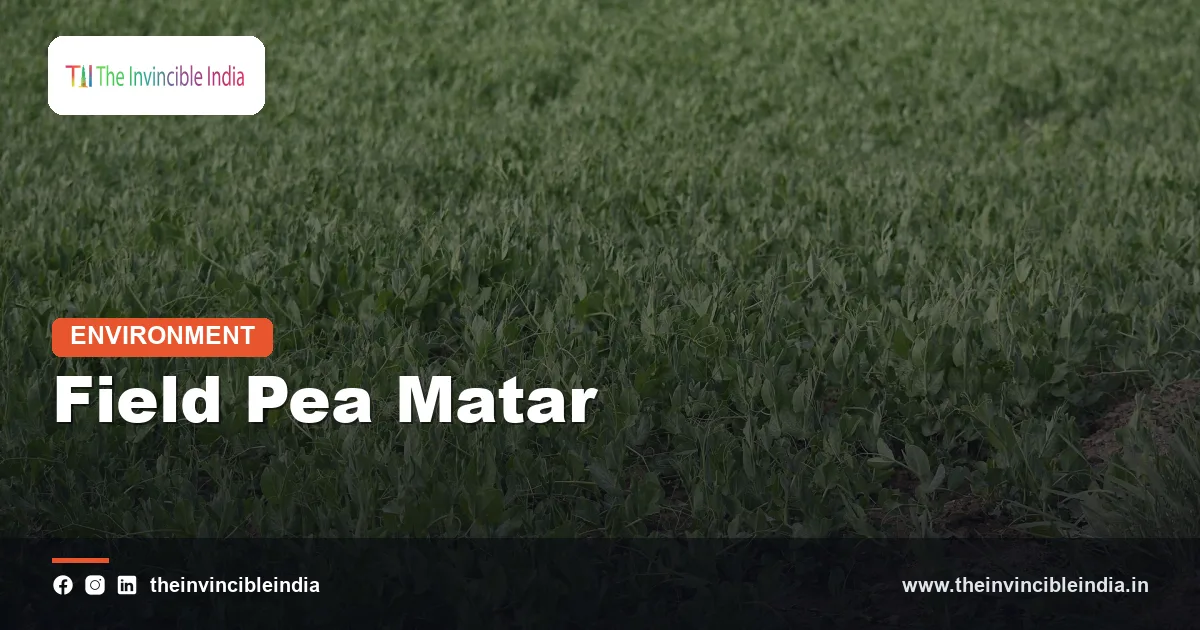
The field pea, known in Hindi as matar, is a cool-season legume (Pisum sativum) grown in India as a rabi pulse for its dried seeds and as a winter vegetable for fresh green peas. The field pea is a climbing or bushy annual herb of the family Fabaceae, and it also enriches the soil with nitrogen through the bacteria that live in its root nodules.
Matar is cooked in homes across the country, from the green peas in a winter pulao to the dried white peas in a plate of ragda. This article explains what the field pea is, how it differs from the garden pea, where and when it is grown in India, how it improves soil, which pests affect it, and how it is used in food.
Quick Facts
| Attribute | Details |
|---|---|
| Common names | Field pea, pea, matar (Hindi), vatana (Marathi and Gujarati) |
| Scientific name | Pisum sativum (field types are often placed in subspecies or variety arvense) |
| Family | Fabaceae (legume or pea family) |
| Where grown in India | Mainly the northern and central plains: Uttar Pradesh, Madhya Pradesh, Bihar, Jharkhand, Punjab, Haryana, Rajasthan, plus the hills of Himachal Pradesh, Uttarakhand and Jammu and Kashmir |
| Season | Rabi (winter): sown around October to November and harvested around February to March |
| Part used | Dried seeds (dry pea or split dal), fresh green seeds in pods, tender shoots and fodder |
| Plant type | Annual, self-pollinating, with tendrils; nitrogen-fixing legume |
| Uses | Vegetable, pulse and dal, snack, flour, animal feed and green manure |
Key Takeaways
- The field pea (Pisum sativum), called matar in Hindi, is a cool-season legume of the family Fabaceae grown in India during the rabi season.
- The field pea fixes atmospheric nitrogen through Rhizobium bacteria in its root nodules, so the crop improves soil fertility for the next crop.
- Field pea is used both as a dry pulse for dal, ragda and snacks and as a fresh green vegetable in winter dishes.
- Uttar Pradesh has traditionally been the leading field pea growing state in India, with other north and central Indian states also producing large areas.
- Frost during flowering, high temperatures during pod filling, powdery mildew and pod borer are the main risks to a field pea crop.
- Gregor Mendel used the pea plant in experiments from 1856 to 1863 to discover the basic laws of inheritance.
What is a field pea?
A field pea is a pea plant grown in open fields mainly for its dry, ripe seeds, as opposed to the garden pea, which is grown mainly for fresh tender pods. Both belong to the same species, Pisum sativum, a member of the legume family Fabaceae.
The plant is a slender annual with hollow stems, compound leaves ending in branched tendrils, and leaf-like stipules at the base of each leaf. The tendrils allow the plant to cling to neighbouring stems or supports. The flowers are butterfly-shaped, as in other legumes, and are mostly self-pollinated, which means the seed is true to type from one generation to the next. Each pod holds a row of round or slightly wrinkled seeds.
In everyday Indian usage, the word matar covers both the green peas sold in winter markets and the dried peas stored through the year. Field pea crops are grown for a variety of purposes: dry seed for dal and snacks, fresh pods for vegetable markets, and green plants for fodder or green manure.
How is the field pea different from the garden pea?
The field pea differs from the garden pea mainly in purpose and plant type: field pea is bred for dry grain, while garden pea is bred for sweet, tender fresh pods. The two are usually treated as varieties of the same species and can cross with one another.
| Feature | Field pea | Garden pea |
|---|---|---|
| Main purpose | Dry seed for dal, flour and snacks | Fresh green pods and seeds as a vegetable |
| Seeds when ripe | Round, smooth and often yellow, green, white or brown | Often wrinkled and sweeter |
| Flowers | Often coloured, in many varieties | Mostly white |
| Harvest stage | Fully mature, dry pods | Green, tender pods |
| Typical use in India | Safed matar, matar dal, ragda | Matar paneer, pulao, aloo matar |
In Indian markets these distinctions blur. Many “green peas” sold in winter come from varieties bred as vegetable types, while the dried white or green peas in grocery shops come from field types. Farmers choose varieties according to the market they supply.
Where is the field pea grown in India?
The field pea is grown mainly across the northern and central plains of India, with Uttar Pradesh the leading producer of the crop in most years. Madhya Pradesh, Bihar, Jharkhand, Punjab, Haryana, Rajasthan, Odisha, Assam and Maharashtra also grow peas, in varying amounts.
In the Himalayan states of Himachal Pradesh, Uttarakhand and Jammu and Kashmir, peas are sown in different months because the climate is cooler. The hill regions grow peas in the summer and early autumn, so they supply fresh green peas to city markets at a time when the plains crop is out of season. This is often called off-season vegetable pea cultivation.
India is among the world’s largest growers of green peas and a major consumer of dry peas. Production has also varied from year to year with winter temperatures, rainfall and the area under competing rabi crops such as wheat, chickpea and mustard. The country has sometimes imported dried peas to meet demand, since domestic production of pulses has not always matched consumption.
When and how is the field pea grown?
The field pea is grown as a rabi crop, sown in October and November after the monsoon and harvested around February and March, when the weather is cool and dry. The crop prefers a cool, moist growing period and a warm, dry finish.
The main practices are as follows.
- Soil: Well-drained loam or clay loam soils with a near-neutral reaction suit the crop. Waterlogging and very acidic or saline soils reduce yield.
- Sowing: Seeds are sown in rows or broadcast after land preparation, and treated with a Rhizobium culture so that root nodules form well.
- Water: Peas need little irrigation compared with wheat; one or two light irrigations at the flowering and pod-filling stages are common where rains are scarce.
- Weeding: Early weed control is important because pea seedlings grow slowly at first.
- Support: Tall types may be given stakes or grown alongside a cereal, while dwarf types stand without support.
- Harvest: Green pods are picked about two to three months after sowing, while dry grain is harvested when the plants and pods have turned yellow and dry.
The crop is sensitive to weather. Severe frost at flowering can damage flowers and young pods, and a sudden rise in temperature at the grain-filling stage shortens the period and lowers yield. Early sowing in warm soil can also increase disease, so farmers try to sow within the recommended window for their region.
How does the field pea improve the soil?
The field pea improves the soil by fixing nitrogen from the air through a partnership with Rhizobium bacteria that live in nodules on its roots. This lets the plant make its own nitrogen supply and leaves some residual nitrogen for the following crop.
The bacteria infect the root hairs of the young plant and trigger the formation of small nodules. Inside the nodules the bacteria convert nitrogen gas, which plants cannot use directly, into forms that the plant can absorb. In return the plant supplies the bacteria with sugars made by photosynthesis. The species associated with peas is Rhizobium leguminosarum.
Because of this process, pulses such as the field pea are a standard part of crop rotations in India. A wheat crop that follows a pulse often needs less nitrogen fertiliser than one that follows another cereal. The roots, fallen leaves and crop residue also add organic matter, and the crop can be ploughed in as a green manure when it is grown for this purpose.
Which pests and diseases affect the field pea?
The field pea is affected mainly by powdery mildew, rust, wilt, the pea leaf miner, aphids and pod borers, and these can reduce yield if not managed. The severity of each problem depends on the weather and the sowing date.
| Problem | Type | Effect |
|---|---|---|
| Powdery mildew (Erysiphe pisi) | Fungal disease | White powdery coating on leaves, stems and pods; early drying of plants |
| Rust | Fungal disease | Orange to brown pustules on leaves and stems |
| Fusarium wilt | Soil-borne fungal disease | Yellowing, wilting and death of plants |
| Pea leaf miner (Chromatomyia horticola) | Insect pest | Winding mines in the leaves that reduce photosynthesis |
| Pod borer (Helicoverpa armigera) | Insect pest | Caterpillars feed on pods and developing seeds |
| Aphids | Sap-sucking insects | Weakened plants and spread of plant viruses |
| Pulse beetles (Callosobruchus) | Storage pest | Grubs bore into stored dry seeds |
Management combines resistant varieties, timely sowing, crop rotation, seed treatment and the careful use of sprays where needed. Clean, dry storage in sealed containers protects dried peas from beetles.
How is matar used in Indian food?
Matar is used in Indian food both as a fresh vegetable and as a dried pulse, appearing in rice dishes, curries, snacks and street food. The fresh crop is a defining flavour of winter in north Indian kitchens.
- Fresh green peas: Matar paneer, aloo matar, matar pulao, matar kachori, peas in poha and upma, and the winter dish nimona in Uttar Pradesh.
- Dried white peas (safed matar): Soaked and boiled for ragda patties in Maharashtra and Gujarat, the white pea curry served with kulcha as matar kulcha, and tikki chaat.
- Dried green peas: Soaked and cooked as a thick curry known as hara matar in many regions.
- Split peas (matar dal): Cooked into dal or ground into batter and savoury fritters in some parts of the country.
- Preserving: Fresh peas are blanched and frozen, and the surplus may be sun-dried for use through the year.
The pods, vines and plant residue are also used as animal fodder, and the green plants can be cut as a nutritious forage crop in some areas.
What is the nutritional value of the field pea?
The field pea is a good source of plant protein, dietary fibre, carbohydrates and several minerals and vitamins. Dry peas contain roughly 20 to 25 percent protein by weight, while fresh green peas contain much more water and have a lower protein share.
Peas supply iron, magnesium, phosphorus, potassium and zinc, along with folate and other B vitamins, and vitamin K. Fresh green peas also provide vitamin C. The fibre content is high, and the starch is digested more slowly than that of refined cereals. As with other pulses, the protein in peas is low in the amino acid methionine, which is why traditional Indian meals pair pulses with cereals such as rice or roti to give a better balanced intake.
Some people experience gas or bloating after eating pulses because of their fermentable carbohydrates. Soaking dried peas overnight and discarding the water before cooking helps to reduce this effect.
Why is the pea important in science?
The pea plant is important in science because Gregor Mendel used it between 1856 and 1863 to work out the basic laws of heredity. His experiments in the monastery garden at Brno, now in the Czech Republic, formed the foundation of modern genetics.
Mendel chose the pea because it grows quickly, has clear contrasting traits, and can be self-pollinated or crossed by hand. He studied seven traits, including seed shape, seed colour, flower colour, pod shape, pod colour, the position of flowers and the height of the plant. By counting thousands of offspring, he found that traits are inherited as separate units and that some, which he called dominant, mask others. He published his results in 1866, and they were rediscovered in 1900.
Mendel’s work is taught in every Indian biology course, and peas remain a model plant for studying genetics, plant development and nitrogen fixation.
Bottom Line
The field pea, or matar, is a cool-season Indian pulse and winter vegetable that feeds people, enriches soil and has a place in the history of science. A cool rabi season, well-drained soil, disease management and good storage are the keys to a successful crop.
Frequently Asked Questions
What is a field pea?
A field pea is a pea plant (Pisum sativum) grown in open fields mainly for its dry seeds. It is a cool-season legume of the family Fabaceae. In India it is called matar and is also eaten fresh as green peas.
When is field pea grown in India?
Field pea is grown in India as a rabi crop, sown from about October to November and harvested around February to March. The crop prefers cool weather. In the Himalayan hills, peas are also grown in summer for off-season vegetable markets.
Is matar a pulse or a vegetable?
Matar is both: the dry ripe seeds are a pulse, while the fresh green pods and seeds are eaten as a vegetable. The plant is the same species, Pisum sativum. Farmers choose varieties and a harvest stage according to the intended use.
Which state grows the most field pea in India?
Uttar Pradesh has traditionally been the leading pea-growing state in India. Madhya Pradesh, Bihar, Jharkhand, Punjab, Haryana and Rajasthan also grow it, and the exact ranking can change from year to year. The hill states supply off-season green peas.
Does the field pea improve soil?
Yes, the field pea improves soil because it fixes nitrogen from the air with the help of Rhizobium bacteria in its root nodules. Part of this nitrogen remains in the soil for the next crop. This is why pulses are used in crop rotation with cereals such as wheat.
How is field pea different from chickpea?
Field pea is a different species from chickpea: field pea is Pisum sativum, a climbing or bushy plant with tendrils, while chickpea is Cicer arietinum, an upright bushy plant. Both are rabi pulses of the legume family. Chickpea tolerates drier conditions, whereas the field pea prefers cooler, moister weather.
{“@context”:”https://schema.org”,”@graph”:[{“@type”:”FAQPage”,”mainEntity”:[{“@type”:”Question”,”name”:”What is a field pea?”,”acceptedAnswer”:{“@type”:”Answer”,”text”:”A field pea is a pea plant (Pisum sativum) grown in open fields mainly for its dry seeds. It is a cool-season legume of the family Fabaceae. In India it is called matar and is also eaten fresh as green peas.”}},{“@type”:”Question”,”name”:”When is field pea grown in India?”,”acceptedAnswer”:{“@type”:”Answer”,”text”:”Field pea is grown in India as a rabi crop, sown from about October to November and harvested around February to March. The crop prefers cool weather. In the Himalayan hills, peas are also grown in summer for off-season vegetable markets.”}},{“@type”:”Question”,”name”:”Is matar a pulse or a vegetable?”,”acceptedAnswer”:{“@type”:”Answer”,”text”:”Matar is both: the dry ripe seeds are a pulse, while the fresh green pods and seeds are eaten as a vegetable. The plant is the same species, Pisum sativum. Farmers choose varieties and a harvest stage according to the intended use.”}},{“@type”:”Question”,”name”:”Which state grows the most field pea in India?”,”acceptedAnswer”:{“@type”:”Answer”,”text”:”Uttar Pradesh has traditionally been the leading pea-growing state in India. Madhya Pradesh, Bihar, Jharkhand, Punjab, Haryana and Rajasthan also grow it, and the exact ranking can change from year to year. The hill states supply off-season green peas.”}},{“@type”:”Question”,”name”:”Does the field pea improve soil?”,”acceptedAnswer”:{“@type”:”Answer”,”text”:”Yes, the field pea improves soil because it fixes nitrogen from the air with the help of Rhizobium bacteria in its root nodules. Part of this nitrogen remains in the soil for the next crop. This is why pulses are used in crop rotation with cereals such as wheat.”}},{“@type”:”Question”,”name”:”How is field pea different from chickpea?”,”acceptedAnswer”:{“@type”:”Answer”,”text”:”Field pea is a different species from chickpea: field pea is Pisum sativum, a climbing or bushy plant with tendrils, while chickpea is Cicer arietinum, an upright bushy plant. Both are rabi pulses of the legume family. Chickpea tolerates drier conditions, whereas the field pea prefers cooler, moister weather.”}}]}]}


