

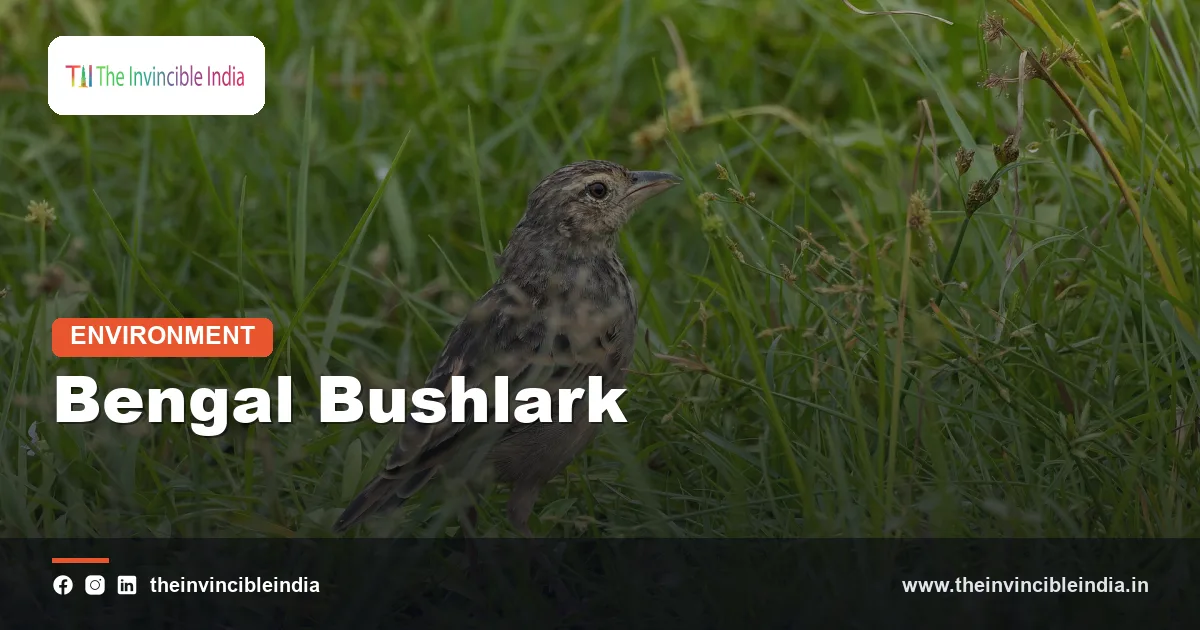
The Bengal bushlark (Mirafra assamica) is a small, streaky, rufous-winged lark of open grassland, scrub and fallow fields across northern and eastern India, known for the fluttering song-flight in which the male rises from a perch and sings in the air. It is a resident bird, which means it stays in the same region through the year, and it is often noticed first by its song rather than its looks.
The Bengal bushlark is typical of the larks in being a plain, well-camouflaged ground bird that spends most of its life on bare earth and short grass. Learning its rusty wing patch, its upright pose on a low perch and its distinctive aerial display makes it easy to separate from the other brown birds of the Indian countryside.
| Attribute | Detail |
|---|---|
| Common name | Bengal bushlark |
| Scientific name | Mirafra assamica |
| Family | Alaudidae (larks) |
| Size | About 15 cm in length, plump with a short tail and thick bill |
| Range in India | Northern and eastern India, from the Himalayan foothills across the Gangetic plain to the north-east |
| Habitat | Open grassland, scrub, fallow land, field edges and dry paddy fields |
| Diet | Seeds, grain and insects taken from the ground |
| Breeding | Ground-nesting; a domed grass nest with a side entrance, mainly in the warmer months |
| Conservation status | Least Concern on the IUCN Red List |
Key Takeaways
- The Bengal bushlark (Mirafra assamica) is a small resident lark in the family Alaudidae found in open grassland and farmland of northern and eastern India.
- A Bengal bushlark shows a rufous patch on the wing, a streaked brown back, a short tail and a stout, slightly heavy bill.
- The male Bengal bushlark sings in a fluttering song-flight, rising from a perch, singing on slowly beating wings and then dropping back to the ground.
- The Bengal bushlark eats seeds, grain and insects, which it collects by walking and pecking on bare or sparsely grassy ground.
- The Bengal bushlark builds a domed grass nest with a side entrance on the ground, sheltered by a clump of grass or a small bush.
- The Bengal bushlark is rated Least Concern by the IUCN, though loss of open grassland to development and intensive farming affects local populations.
What is the Bengal bushlark?
The Bengal bushlark is a small songbird belonging to the lark family, Alaudidae, and the genus Mirafra, whose members are generally called bushlarks. These birds are stocky and short-tailed, with brown streaked plumage and a habit of perching on a clod, a low bush or a fence post to sing.
Bushlarks differ from the crested larks and the sparrow-larks in several ways. Their bills are relatively thick, their bodies rounder, and most species have a patch of rufous or chestnut on the wings that shows during flight. The Bengal bushlark occupies the northern and eastern part of India, while a similar-looking relative, the Indian bushlark, occupies drier country farther south and west.
The classification of the bushlark group has been revised several times, and some older books list the Bengal bushlark as a form of a wider bushlark species. Many modern checklists treat it as a species in its own right, and this article follows that approach.
How can you identify a Bengal bushlark?
A Bengal bushlark is identified by its small, plump shape, the streaked brown upperparts, a cream or pale buff eyebrow and a rusty patch on the wing that is most visible in flight. The underparts are buffy with fine dark spots on the breast.
Plumage
The Bengal bushlark has a brown crown with dark streaks, which may lift into a small crest when the bird is excited. The back is brown with darker centres to the feathers, giving a scaly or streaked pattern that blends well with dry grass and soil. The throat is paler, and the lower belly is whitish to buff.
Wing and tail
The most useful single feature is the rufous wing. When the bird opens its wings, a bright rusty-chestnut panel appears on the flight feathers, in contrast with the brown body. The short tail is brown with pale edges on the outer feathers, which flash when the bird flies.
Bill and posture
The bill is relatively stout and slightly curved on the upper edge, adapted for crushing seeds. When perched on a low branch or fence post the bird stands quite upright, with the crown feathers often raised. On the ground it walks or runs in short bursts rather than hopping.
Where does the Bengal bushlark live in India?
The Bengal bushlark lives across northern and eastern India, typically in dry, open habitats with short grass, scattered shrubs and bare patches of soil. Its range extends from the foothills of the Himalaya across the Gangetic plain to the north-east and into neighbouring countries.
Suitable habitats include the following.
- Open grassland and the edges of savanna-like scrub.
- Fallow fields, stubble and other uncultivated farmland.
- Dry paddy fields, pastures and embankments.
- Scrubby wasteland, riverbanks and sparsely vegetated sandy ground.
The species avoids dense forest and heavily wooded areas. It tolerates a certain amount of farming and grazing, which keep grass short, but it is displaced when land is converted to dense plantations or built up with roads and housing.
Why does the Bengal bushlark sing in flight?
The male Bengal bushlark sings in flight to advertise its territory and attract a mate, using a fluttering display that makes the bird visible and audible across open ground. In the absence of tall trees, the air above the grass serves as the singing stage.
In the display the male launches from a low perch such as a bush, a mound or a fence, rises steeply and then hovers or flutters on slow wing beats while pouring out a series of repeated, musical phrases. After a short period the bird drops, often in a gliding descent, back to the ground or to another perch. The song consists of varied whistles and trills.
The display is most frequent in the breeding season, which in much of northern India coincides with the warm, humid months around the monsoon. The male may sing from the same perch repeatedly, defending a small territory against rivals.
What does the Bengal bushlark eat?
The Bengal bushlark eats seeds, grains and small insects, which it picks from bare ground, short grass and stubble. Grass seed and spilled crop grain provide most of its food outside the breeding season.
During the breeding season insects become more important, particularly for the growing young. Grasshoppers, beetles, ants and small caterpillars are typical prey, and the parents carry them to the nest in the bill. The lark forages quietly, walking in short runs, stopping to peck and to look around.
Feeding is often done in small groups outside the breeding season. Birds may share a stubble field with other larks, pipits, sparrows and finches, and the group moves along together in loose formation.
How does the Bengal bushlark breed?
The Bengal bushlark breeds on the ground, building a domed nest of dry grass with a side entrance that is tucked under a clump of grass, a small bush or a clod of earth. The dome shape shields the eggs and chicks from sun and rain.
The female usually lays two to four eggs that are whitish with brown or grey speckles, which blend with the soil. Both parents tend the young, although the female does most of the incubation. The chicks leave the nest quickly and run about on the ground before they can fly well, which is a common feature of larks.
The timing of nesting varies across the range. Many pairs breed in the hotter part of the year and into the monsoon, when insects are plentiful and the grass offers cover. A pair may raise more than one brood in a favourable season.
How does the Bengal bushlark differ from similar larks?
The Bengal bushlark differs from other Indian larks chiefly in its rufous wing patch, its heavier bill, its song-flight and its preference for grassy, scrubby ground. The table below compares it with some similar species.
| Species | Typical habitat | Distinguishing features |
|---|---|---|
| Bengal bushlark | Grassland and fields of northern and eastern India | Rufous wing patch, stout bill, fluttering song-flight |
| Indian bushlark | Dry scrub and stony ground of the peninsula and west | Similar rufous wings and shape; told apart mainly by range and habitat |
| Oriental skylark | Open fields and short grass, widespread | Longer wings, a small crest and a prolonged, high song-flight |
| Sykes’s lark | Dry Deccan grassland and scrub | Crested, with sandy-rufous plumage and a shorter bill |
Song is a reliable clue, as each species has its own pattern of notes and its own style of flight. Beginners often learn the Bengal bushlark by its habit of rising from a post and fluttering back down with its wings held slightly open.
What is the Bengal bushlark’s role in the grassland ecosystem?
The Bengal bushlark plays a role in the grassland ecosystem as both a consumer of seeds and insects and as a prey species for raptors, snakes and small mammals. Because it relies on open, low vegetation, it is also a useful indicator of the health of grassland and farmland mosaics.
By feeding on insects, the bird helps limit populations of species that damage crops, although its effect on any single farm is modest. Its seed-eating habit has little impact on agriculture, since much of what it consumes is weed seed or spilled grain.
Grasslands in India have long been undervalued, often classed as wasteland and converted to other uses. Birds such as the Bengal bushlark depend on these habitats, and their presence signals that some natural cover remains.
Is the Bengal bushlark threatened?
The Bengal bushlark is not currently considered threatened and is listed as Least Concern by the International Union for Conservation of Nature (IUCN). The species is widespread in its range and tolerates a degree of human activity.
Local pressures nevertheless exist. Open grassland and scrub are lost to construction, afforestation with tall trees, mining and intensive farming. Heavy pesticide use may reduce the supply of insects needed for chicks. Preserving patches of fallow land, field margins and traditional grazing areas helps the bushlark and many other grassland species.
Where and when can you watch a Bengal bushlark in India?
The Bengal bushlark can be watched throughout the year in suitable habitat, but the best time is the breeding season, when males perform their song-flights. Early mornings and late afternoons are the most rewarding periods.
- Walk along field margins, grassy embankments and fallow plots in northern and eastern India.
- Scan low perches such as fence posts, mounds and bushes for an upright, streaky bird.
- Listen for repeated musical phrases from the air, and watch for a bird fluttering upward from the ground.
- Look for the rufous wing when a bird flies off, which is the best identification mark.
- Keep a respectful distance during the nesting season and avoid walking through breeding grass.
Bottom Line
The Bengal bushlark is a resident grassland lark of northern and eastern India, recognised by its rufous wings and its fluttering song-flight. It is not at risk at present, but it depends on open ground that is steadily shrinking, so its fortunes track those of India’s grassland and farmland.
Frequently Asked Questions
What is a Bengal bushlark?
A Bengal bushlark is a small, streaky, rufous-winged lark, Mirafra assamica, found in northern and eastern India. It lives on open grassland, fallow fields and scrub. The male is known for singing in a fluttering display flight.
Where is the Bengal bushlark found?
The Bengal bushlark is found across northern and eastern India, from the Himalayan foothills over the Gangetic plain to the north-east. It prefers open habitats with short grass and scattered bushes. It avoids dense forest and heavily built-up areas.
Why does the Bengal bushlark have a rufous wing?
The Bengal bushlark has a rufous wing patch because rusty wing feathers are a characteristic feature of many bushlarks, and the patch shows as a bright panel when the wing opens. The colour contrasts with the streaked brown body and helps observers identify the bird in flight. It may also play a part in display, though its exact function is not fully established.
What does the Bengal bushlark eat?
The Bengal bushlark eats seeds, grain and small insects, which it picks from the ground. Seeds dominate the diet outside the breeding season, while insects are more important when it feeds chicks. It forages on foot in short runs.
Does the Bengal bushlark migrate?
No, the Bengal bushlark is a resident bird and does not make regular long-distance migrations. It may move locally in response to harvesting, drought or heavy rain. Most birds stay in the same region throughout the year.
How is the Bengal bushlark different from the Indian bushlark?
The Bengal bushlark differs from the Indian bushlark mainly in range and fine plumage details. The Bengal bushlark occurs in northern and eastern India, while the Indian bushlark prefers drier habitats in the peninsula and west. Both have rufous wings and similar songs, so range and habitat are important clues.
{“@context”:”https://schema.org”,”@graph”:[{“@type”:”FAQPage”,”mainEntity”:[{“@type”:”Question”,”name”:”What is a Bengal bushlark?”,”acceptedAnswer”:{“@type”:”Answer”,”text”:”A Bengal bushlark is a small, streaky, rufous-winged lark, Mirafra assamica, found in northern and eastern India. It lives on open grassland, fallow fields and scrub. The male is known for singing in a fluttering display flight.”}},{“@type”:”Question”,”name”:”Where is the Bengal bushlark found?”,”acceptedAnswer”:{“@type”:”Answer”,”text”:”The Bengal bushlark is found across northern and eastern India, from the Himalayan foothills over the Gangetic plain to the north-east. It prefers open habitats with short grass and scattered bushes. It avoids dense forest and heavily built-up areas.”}},{“@type”:”Question”,”name”:”Why does the Bengal bushlark have a rufous wing?”,”acceptedAnswer”:{“@type”:”Answer”,”text”:”The Bengal bushlark has a rufous wing patch because rusty wing feathers are a characteristic feature of many bushlarks, and the patch shows as a bright panel when the wing opens. The colour contrasts with the streaked brown body and helps observers identify the bird in flight. It may also play a part in display, though its exact function is not fully established.”}},{“@type”:”Question”,”name”:”What does the Bengal bushlark eat?”,”acceptedAnswer”:{“@type”:”Answer”,”text”:”The Bengal bushlark eats seeds, grain and small insects, which it picks from the ground. Seeds dominate the diet outside the breeding season, while insects are more important when it feeds chicks. It forages on foot in short runs.”}},{“@type”:”Question”,”name”:”Does the Bengal bushlark migrate?”,”acceptedAnswer”:{“@type”:”Answer”,”text”:”No, the Bengal bushlark is a resident bird and does not make regular long-distance migrations. It may move locally in response to harvesting, drought or heavy rain. Most birds stay in the same region throughout the year.”}},{“@type”:”Question”,”name”:”How is the Bengal bushlark different from the Indian bushlark?”,”acceptedAnswer”:{“@type”:”Answer”,”text”:”The Bengal bushlark differs from the Indian bushlark mainly in range and fine plumage details. The Bengal bushlark occurs in northern and eastern India, while the Indian bushlark prefers drier habitats in the peninsula and west. Both have rufous wings and similar songs, so range and habitat are important clues.”}}]}]}


