

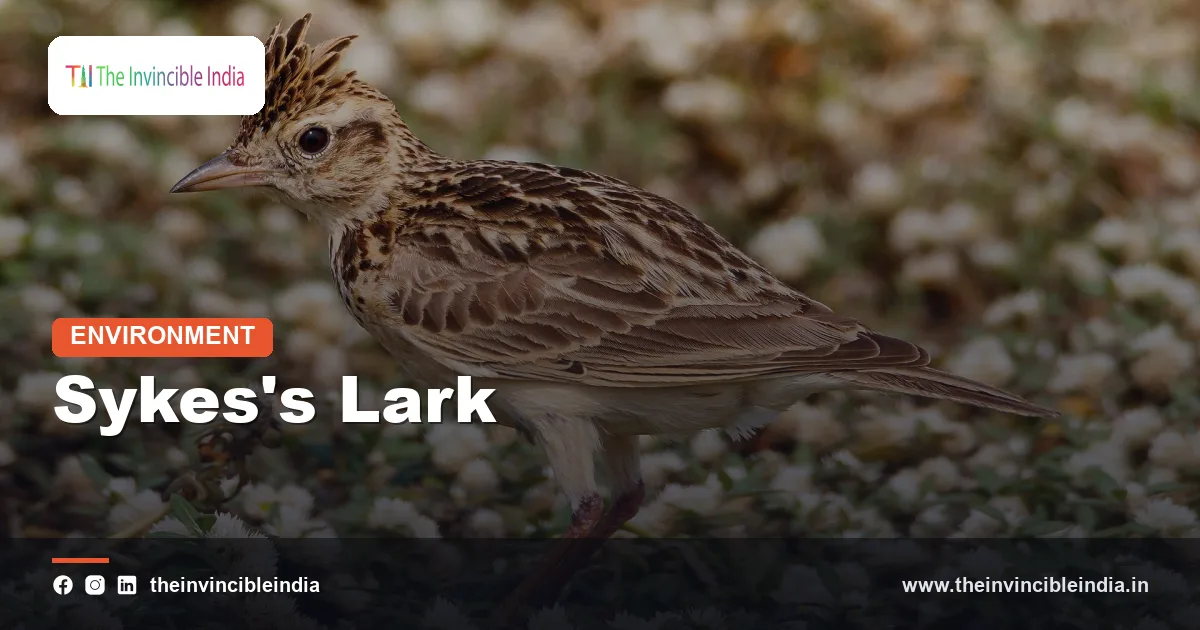
Sykes’s lark (Galerida deva) is a small, short-crested, sandy-rufous lark of the dry Deccan plateau and neighbouring parts of peninsular India, found on stony grassland, scrub and fallow fields where it feeds on seeds and insects and sings from the ground and in display flight. It is a resident species, so it remains in the same dry-country habitats through the year.
Sykes’s lark is easily overlooked because its colours match the soil it walks on, but it is a distinctive member of the Indian lark community. Its small crest, rich rufous tones and dry-country habits separate it from larger crested larks, and it is named in honour of Colonel William Henry Sykes, a nineteenth-century British naturalist who documented the birds of the Deccan.
| Attribute | Detail |
|---|---|
| Common name | Sykes’s lark (also called the tawny lark) |
| Scientific name | Galerida deva |
| Family | Alaudidae (larks) |
| Size | About 14 to 15 cm in length, with a short crest and short, stout bill |
| Range in India | Dry peninsular India, centred on the Deccan plateau |
| Habitat | Dry grassland, stony scrub, fallow land and open farmland |
| Diet | Seeds and small insects picked from the ground |
| Breeding | Ground-nesting, with a cup of grass placed under a tuft or stone |
| Conservation status | Least Concern on the IUCN Red List |
Key Takeaways
- Sykes’s lark (Galerida deva) is a small crested lark of the family Alaudidae that lives in the dry grassland and scrub of the Deccan plateau and the surrounding peninsula.
- Sykes’s lark has sandy-rufous upperparts, a short crest, a streaked breast and a short bill, which together separate it from the larger crested lark.
- Sykes’s lark is a resident bird, staying in dry open country throughout the year rather than making long seasonal migrations.
- Sykes’s lark eats seeds and small insects, which it collects by walking and pecking on bare or stony ground.
- Sykes’s lark builds its nest on the ground, usually a small grass cup under a tuft, a clod or a stone that gives shade and cover.
- Sykes’s lark is rated Least Concern by the IUCN, though conversion of dry grassland to farms, plantations and construction reduces its habitat.
What is Sykes’s lark?
Sykes’s lark is a small songbird in the lark family, Alaudidae, and the genus Galerida, which contains the crested larks. The genus is known for birds with a pointed crest, streaked upperparts and a ground-dwelling life. Sykes’s lark is one of the smaller members and is restricted to the Indian subcontinent.
The species is sometimes called the tawny lark because of its warm, sandy-rufous colouring, and older books also place it with the crested larks of the Old World. It is named after Colonel William Henry Sykes, who studied the zoology of the Deccan in the early nineteenth century while serving with the East India Company’s army.
Like other larks, Sykes’s lark has a long, straight hind claw, which helps it balance on open ground, and a pleasant song, often delivered from the ground, a low perch or in the air.
How can you identify Sykes’s lark?
Sykes’s lark is identified by its small size, short crest, warm rufous-buff upperparts streaked with brown and a lightly streaked breast. The bird looks like a small, compact crested lark on stony ground.
Head and crest
The crest of Sykes’s lark is short and often lies flat, though it is raised when the bird is alert or singing. The face is plain with a pale eyebrow and a pale throat. The bill is short and stout compared with that of larger crested larks, and the upper part is dark.
Body and wings
The upperparts are rufous-brown with darker streaks, producing a mottled appearance that blends with dry soil. The breast carries dark spots or streaks on a buffy ground, and the belly is paler. In flight the wings show rufous tones and the tail has buff outer feathers, a useful pattern when the bird takes off.
Behaviour in the field
Sykes’s lark walks or runs across open ground in quick bursts, stopping to peck. When disturbed it may crouch and rely on camouflage, flying only when approached closely. It then flies low and lands a short distance away, again standing still to observe.
Where does Sykes’s lark live in India?
Sykes’s lark lives in the dry, open parts of peninsular India, with the Deccan plateau as the centre of its range. It is found in states such as Maharashtra, Karnataka, Telangana, Andhra Pradesh and Tamil Nadu, and in neighbouring dry regions, but it is generally absent from wet forest and humid coasts.
Typical habitats include the following.
- Dry grassland with short, sparse grass and bare patches of soil.
- Stony or rocky scrubland and low hills with scattered shrubs.
- Fallow farmland, field boundaries and open pasture.
- Dry river beds and other open waste ground away from dense trees.
The bird prefers ground that is open enough for it to see predators. It avoids tall grass, dense forest and irrigated land with continuous crop cover, although it may visit stubble fields after harvest.
Why is Sykes’s lark associated with the Deccan?
Sykes’s lark is associated with the Deccan because the plateau provides the dry, open, stony habitat that the bird needs and that is found in few other parts of India. The Deccan lies in the rain shadow of the Western Ghats and receives relatively little rain, which favours scrub and grassland over forest.
This rain-shadow landscape supports a community of dry-country birds in addition to Sykes’s lark. Species such as the Indian courser, the sandgrouse and several other larks share the open ground, and the area is known to naturalists as a distinct bioregion.
Because the habitat is dry, the lark’s life is tuned to the seasons of the plateau. Breeding often follows the first rains or the cooler months, when insects increase, while the long hot season is a time of survival on scattered seeds.
What does Sykes’s lark eat?
Sykes’s lark eats seeds of grasses and small herbs together with small insects, picked from the ground as the bird walks. The diet shifts with the season and the supply of food.
In the dry months the bird relies mostly on seeds, which remain on the ground long after the plants have withered. When the rains arrive, termites, beetles, grasshoppers and small caterpillars become abundant, and the lark takes many of these. Insects are particularly important for feeding the nestlings.
The lark forages singly, in pairs or in small groups. It does not need open water every day, because it gains moisture from its food, but it will drink from puddles and small pools where they are available.
How does Sykes’s lark breed?
Sykes’s lark breeds on the ground, building a small cup of grass and rootlets in a shallow scrape beneath a tuft of grass, a clod or a stone. The shelter gives shade from the sun and some protection from predators.
The female lays a small clutch, usually two to four eggs, that are whitish or buff with fine brown markings. Both parents feed the young, bringing insects to the nest. The chicks leave the nest before they can fly strongly and shelter in the surrounding grass, a common strategy among larks.
The timing of breeding varies with local rainfall. In many areas it coincides with the monsoon season or the cooler months that follow, when food is plentiful. A pair may nest more than once in a year if conditions are favourable.
The male defends a territory through song, which he delivers from a clod, a low bush or in a short display flight. The song is a series of musical phrases that rise and fall.
How is Sykes’s lark different from other crested larks?
Sykes’s lark is different from other crested larks mainly in its smaller size, shorter bill, shorter crest and warmer rufous colour. The table below compares it with other larks that share part of its range.
| Species | Typical habitat in India | Distinguishing features |
|---|---|---|
| Sykes’s lark | Dry Deccan grassland and scrub | Small, short crest, rufous tones, short stout bill |
| Crested lark | Dry plains and semi-desert of the north-west | Larger, longer bill, more prominent crest, greyer tone |
| Malabar lark | Western Ghats hills and grassy slopes | Crested with a darker, more heavily streaked plumage and a more humid habitat |
| Ashy-crowned sparrow-lark | Dry fields and open ground, widespread | Male has a black belly and brown crown; no long crest |
Range is a helpful guide, because the crested larks replace each other geographically. Together these species give a good example of how related birds divide the open habitats of the subcontinent.
What does Sykes’s lark sound like?
Sykes’s lark sounds like a short, musical series of whistles and trills, delivered from the ground, from a low perch or in a fluttering flight. The calls are brief and clear and carry well across open country.
The male sings mainly in the breeding season, which makes spring and the early monsoon the best periods for hearing it. Singing birds often raise their crests and lift the head. In flight display the male rises and then glides down on spread wings while singing.
Calls outside the breeding season are shorter and used to keep birds in touch as they feed. A flushed bird may utter a quick, liquid note as it takes off.
Is Sykes’s lark threatened?
Sykes’s lark is not considered threatened and is rated Least Concern by the International Union for Conservation of Nature (IUCN). It is locally common in suitable habitat and tolerates some farming and grazing.
Its main long-term concern is the loss and fragmentation of dry grassland. Large areas of the Deccan have been converted to irrigated farms, tree plantations, industry and housing. Because dry grassland is often labelled wasteland, it has received limited protection. Maintaining open grazing lands, field margins and fallow patches would help Sykes’s lark and other dry-country birds.
Where and when can you watch Sykes’s lark in India?
Sykes’s lark can be watched throughout the year in the dry Deccan, with the best chances in the early morning or late afternoon, when the birds feed and sing. The breeding season is the most rewarding period because males are more visible.
- Visit grassland reserves, scrubby hills and quiet farm roads on the Deccan plateau.
- Scan bare ground and small mounds for an upright bird with a short crest.
- Walk slowly and stop frequently, as larks often crouch rather than fly.
- Listen for musical phrases from the ground or low in the air.
- Use binoculars to check the bill, crest and breast pattern, and compare with other larks.
Bottom Line
Sykes’s lark is a small, rufous, crested lark that depends on the dry open grasslands of the Deccan. It is not at immediate risk, but its habitat is often treated as wasteland, so protecting open grazing lands is the key to keeping this quiet ground bird common.
Frequently Asked Questions
What is Sykes’s lark?
Sykes’s lark is a small crested lark, Galerida deva, found in the dry grasslands and scrub of peninsular India. It has sandy-rufous plumage, a short crest and a streaked breast. It is named after the naturalist Colonel William Henry Sykes.
Where is Sykes’s lark found in India?
Sykes’s lark is found in the dry parts of peninsular India, with the Deccan plateau at the centre of its range. It occurs in states such as Maharashtra, Karnataka, Telangana, Andhra Pradesh and Tamil Nadu. It avoids humid forest and wet coastal land.
What does Sykes’s lark eat?
Sykes’s lark eats seeds and small insects that it picks from the ground. Seeds dominate in the dry season, while insects such as termites, beetles and grasshoppers become common after the rains. Insects are especially important for feeding its chicks.
Is Sykes’s lark a migratory bird?
No, Sykes’s lark is a resident bird and does not make regular long-distance migrations. It stays in the same dry-country habitats throughout the year. Local movements may occur in response to drought or the loss of food.
How can you tell Sykes’s lark from the crested lark?
You can tell Sykes’s lark from the crested lark by its smaller size, shorter bill, shorter crest and warmer rufous colour. The crested lark is larger and greyer, with a longer bill and a more prominent crest. The two also occupy different parts of India, which helps with identification.
Is Sykes’s lark endangered?
No, Sykes’s lark is not endangered and is listed as Least Concern by the IUCN. It remains locally common in suitable habitat. Loss of dry grassland to farming, plantations and construction is the main long-term pressure.
{“@context”:”https://schema.org”,”@graph”:[{“@type”:”FAQPage”,”mainEntity”:[{“@type”:”Question”,”name”:”What is Sykes’s lark?”,”acceptedAnswer”:{“@type”:”Answer”,”text”:”Sykes’s lark is a small crested lark, Galerida deva, found in the dry grasslands and scrub of peninsular India. It has sandy-rufous plumage, a short crest and a streaked breast. It is named after the naturalist Colonel William Henry Sykes.”}},{“@type”:”Question”,”name”:”Where is Sykes’s lark found in India?”,”acceptedAnswer”:{“@type”:”Answer”,”text”:”Sykes’s lark is found in the dry parts of peninsular India, with the Deccan plateau at the centre of its range. It occurs in states such as Maharashtra, Karnataka, Telangana, Andhra Pradesh and Tamil Nadu. It avoids humid forest and wet coastal land.”}},{“@type”:”Question”,”name”:”What does Sykes’s lark eat?”,”acceptedAnswer”:{“@type”:”Answer”,”text”:”Sykes’s lark eats seeds and small insects that it picks from the ground. Seeds dominate in the dry season, while insects such as termites, beetles and grasshoppers become common after the rains. Insects are especially important for feeding its chicks.”}},{“@type”:”Question”,”name”:”Is Sykes’s lark a migratory bird?”,”acceptedAnswer”:{“@type”:”Answer”,”text”:”No, Sykes’s lark is a resident bird and does not make regular long-distance migrations. It stays in the same dry-country habitats throughout the year. Local movements may occur in response to drought or the loss of food.”}},{“@type”:”Question”,”name”:”How can you tell Sykes’s lark from the crested lark?”,”acceptedAnswer”:{“@type”:”Answer”,”text”:”You can tell Sykes’s lark from the crested lark by its smaller size, shorter bill, shorter crest and warmer rufous colour. The crested lark is larger and greyer, with a longer bill and a more prominent crest. The two also occupy different parts of India, which helps with identification.”}},{“@type”:”Question”,”name”:”Is Sykes’s lark endangered?”,”acceptedAnswer”:{“@type”:”Answer”,”text”:”No, Sykes’s lark is not endangered and is listed as Least Concern by the IUCN. It remains locally common in suitable habitat. Loss of dry grassland to farming, plantations and construction is the main long-term pressure.”}}]}]}


