

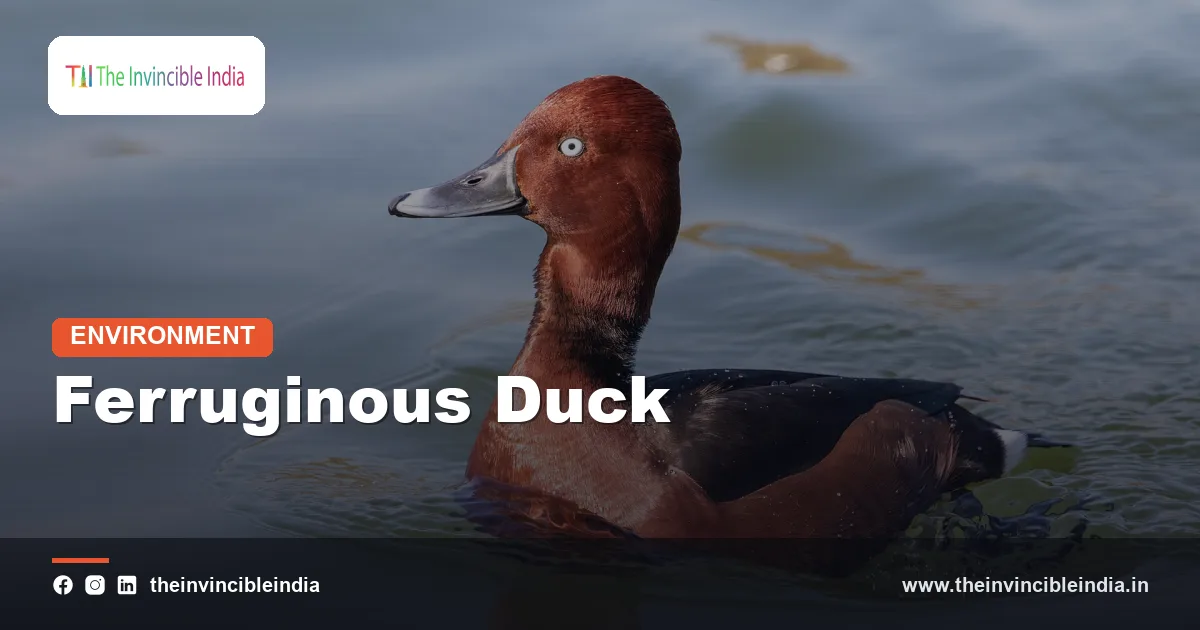
The ferruginous duck (Aythya nyroca) is a small, rich chestnut-coloured diving duck that breeds across parts of Europe and Central Asia and spends the winter on lakes, reservoirs and marshes in the Indian subcontinent. The species is also called the ferruginous pochard or the white-eyed pochard, and it is classed as Near Threatened on the IUCN Red List because its wetland habitat is shrinking and its numbers have declined across much of its range.
For Indian birdwatchers the ferruginous duck is a quiet winter visitor rather than a showy one. It keeps to reedy, densely vegetated waters, often hides along the edge of cover, and is easily overlooked among larger flocks of tufted ducks and common pochards. This article explains how to recognise the bird, where it lives, what it eats, how it breeds, and why it is a useful indicator of healthy shallow wetlands. It was last reviewed on 30 October 2026.
| Attribute | Detail |
|---|---|
| Scientific name | Aythya nyroca |
| Family | Anatidae (ducks, geese and swans) |
| Other names | Ferruginous pochard, white-eyed pochard |
| Size | About 38 to 42 cm long, with a wingspan of roughly 60 to 67 cm |
| Range | Breeds from southern and eastern Europe and the Mediterranean to Central Asia; winters in Africa, the Middle East and South Asia, including India |
| Diet | Aquatic plants, seeds, and small invertebrates such as insects, snails and crustaceans |
| Breeding | Ground nest hidden in dense vegetation beside water; clutch of about 8 to 10 eggs; breeds mainly outside India |
| Status | Near Threatened (IUCN); a winter migrant to India |
Key Takeaways
- The ferruginous duck (Aythya nyroca) is a small diving duck of the family Anatidae, recognised by its deep chestnut plumage and a clean white patch under the tail.
- An adult male ferruginous duck has a pale white iris, while the female has a dark brown eye, which is the quickest way to tell the sexes apart.
- In India the ferruginous duck is mainly a winter migrant, arriving from its breeding grounds in Europe and Central Asia around October and leaving by March or April.
- The ferruginous duck dives for aquatic plants, seeds and small invertebrates, and prefers shallow, reed-fringed, still waters with plenty of submerged vegetation.
- The IUCN lists the ferruginous duck as Near Threatened, mainly because of wetland drainage, pollution, hunting and disturbance.
- Annual winter counts of waterbirds, such as the Asian Waterbird Census, help track how many ferruginous ducks use Indian wetlands each year.
What is the ferruginous duck?
The ferruginous duck is a diving duck in the genus Aythya, the group commonly called pochards. It belongs to the family Anatidae, which also includes the mallard, the pintail, geese and swans. The word “ferruginous” means rust-coloured, and it describes the deep reddish-brown tone of the bird’s head, neck and body, a colour that looks nearly chestnut in good light.
The scientific name Aythya nyroca was given in the eighteenth century and is still used today. The genus name comes from an old Greek word for a sea bird that dives, and the species name “nyroca” is thought to come from a Russian word for a diving duck. Within the genus the ferruginous duck is among the smaller members. It is more compact than the common pochard and a little smaller than the tufted duck, with a rounded head and a short neck.
Unlike surface-feeding “dabbling” ducks such as the mallard or the spot-billed duck, pochards feed by diving. Their legs are set far back on the body, which makes them strong swimmers but clumsy on land. A ferruginous duck therefore spends most of its time on the water and seldom walks far from the water’s edge.
How can you identify a ferruginous duck?
A ferruginous duck is identified by its overall dark chestnut-brown colour, a rounded head with a slight peak at the crown, and a bright white patch under the tail. In flight the bird shows a long, clean white stripe along the trailing edge of the wing and a white belly, which stand out strongly against the dark body.
Adult male
The adult male in breeding plumage has a rich chestnut head, neck and breast, with a narrow dark collar at the base of the neck. The back is dark brown, almost blackish, and the flanks are a warm brown. The bill is dark slate with a thin pale band near the tip in some birds, and the iris is a pale, whitish colour. This pale eye gives the species its alternative name, the white-eyed pochard.
Adult female
The female ferruginous duck is duller and browner, with less chestnut, and her eye is dark brown. She is easily confused with other female pochards, so the white undertail and the small peaked head are the main clues. Young birds in their first winter resemble the female but have paler, buffier tones on the flanks.
Field marks to look for
- Deep, uniform chestnut-brown plumage, richer in the male than in the female.
- A sharply defined white undertail, visible when the bird swims and when it tips forward.
- A rounded head with a small bump at the back of the crown.
- A white wing bar in flight, with a white belly.
- A pale eye in the adult male, and a dark eye in the female and juvenile.
The ferruginous duck rides low in the water, with its tail often held flat or slightly raised. It is a quiet bird, although the male gives a soft nasal call during the breeding season, and the female utters a harsher quack.
Where does the ferruginous duck live and breed?
The ferruginous duck breeds in the temperate and subtropical belt of the Palaearctic, from the Mediterranean basin and southern and eastern Europe across the Black Sea region and Central Asia towards western China. Much of the breeding population nests on shallow, reed-fringed lakes, fishponds, slow rivers and marshes with abundant emergent vegetation.
After the breeding season the species moves south. Many birds winter in the Mediterranean region and in Africa, along the Nile and in the Sahel, while a large portion of the Central Asian population travels to the Middle East and to South Asia. Wintering birds appear in Pakistan, India, Nepal and Bangladesh, and some reach Myanmar and Southeast Asia in smaller numbers.
The ferruginous duck is not tied to a single type of wetland. In both its summer and winter ranges it prefers still or slow-moving fresh water, usually less than a few metres deep, with fringing reeds, sedges or floating plants for cover. It often avoids open, deep reservoirs, which lack food and shelter, and prefers shallow lakes where vegetation grows from the bottom.
Where and when is the ferruginous duck seen in India?
The ferruginous duck is seen in India chiefly between October and March, when it visits freshwater lakes, jheels, reservoirs and village tanks across the northern plains and in many other regions. Numbers are usually small and scattered, and the bird is more often found singly or in small groups than in the thousands that gather for species such as the northern pintail or the gadwall.
Wetlands across the Indo-Gangetic plain, Gujarat, Rajasthan, Madhya Pradesh, Maharashtra, Odisha, West Bengal and Assam are regularly reported to host wintering ferruginous ducks, along with some sites in the south. Well-known Indian wetland birding areas, such as Keoladeo National Park in Rajasthan, Sultanpur in Haryana, Nal Sarovar in Gujarat, Harike in Punjab and Chilika in Odisha, attract large numbers of waterfowl, and the species is looked for among them. The exact numbers change from year to year, so birdwatchers should treat any single site as a likelihood rather than a guarantee.
The ferruginous duck is a Palaearctic migrant, which means that it moves between breeding areas in the northern part of the Eurasian landmass and wintering grounds further south. Some authorities have noted occasional breeding in the northwestern Himalaya, but these are rare and irregular, and for practical purposes the bird should be treated as a winter visitor to India.
Typical timing in India
- Arrival: late September to October, when the first birds appear on northern lakes.
- Peak presence: November to February, when counts are highest.
- Departure: March to early April, as the birds begin the return journey north.
What does the ferruginous duck eat?
The ferruginous duck eats a mixed diet of aquatic plants and small animals. Its food includes the seeds, roots and leaves of submerged and floating plants, along with insects and their larvae, small molluscs such as snails, small crustaceans, tadpoles and occasionally small fish. The proportion of animal food is usually higher in the breeding season, when ducklings and laying females need extra protein.
A ferruginous duck feeds mostly by diving. It submerges for a few seconds, grabs food from the bottom or from underwater plants, and surfaces to swallow it. It also feeds by up-ending in shallow water, a behaviour more typical of dabbling ducks, and by dipping its head under the surface while swimming. Feeding is often most active at dawn and dusk, and many birds rest in sheltered reeds through the middle of the day.
Because the species depends on submerged vegetation and aquatic invertebrates, it is sensitive to changes in water quality. Heavy algal blooms, silt, chemical runoff and the removal of aquatic plants can reduce its food supply. Healthy, clear, moderately nutrient-rich shallow water with good plant growth is the type of habitat in which the ferruginous duck does best.
How does the ferruginous duck breed?
The ferruginous duck breeds in late spring and early summer, building a nest on the ground or on floating vegetation close to the water. The nest is a shallow cup of reeds, sedges and other plant material, lined with down, and it is usually well concealed in dense cover. The female lays a clutch of about eight to ten eggs, which are creamy or pale buff in colour.
Incubation is carried out by the female alone and lasts roughly four weeks. The ducklings are precocial, which means that they hatch covered in down with open eyes and leave the nest within a day or so, following the mother to the water. They feed themselves from the start, mainly on small insects and other invertebrates, and they learn to fly after several weeks. The male usually leaves the female during incubation and joins other males to moult.
Because the breeding grounds are far from India, Indian birdwatchers seldom see nesting behaviour. They may, however, see early courtship displays on wintering lakes in February and March, when males begin to dip their heads, stretch their necks and call as the birds prepare to head north.
Which ducks look similar to the ferruginous duck?
The ferruginous duck is most often confused with other pochards that share Indian lakes in winter, namely the common pochard, the tufted duck and the endangered Baer’s pochard. All are diving ducks of the genus Aythya, and all have compact bodies and rounded heads, so careful attention to head shape, eye colour and undertail pattern is needed.
| Species | Main colour | Distinguishing features |
|---|---|---|
| Ferruginous duck | Deep chestnut-brown | White undertail, peaked head, white eye in the male |
| Common pochard | Grey body with a red-brown head | Larger, pale grey back, black breast, sloping forehead |
| Tufted duck | Black and white in the male | Drooping crest, white flanks, yellow eye |
| Baer’s pochard | Dark head with a greenish gloss, chestnut breast | Larger, whitish flank patch, white eye in the male |
Baer’s pochard (Aythya baeri) is a particularly important look-alike because it is much rarer, and mistaken identifications of ferruginous ducks as Baer’s pochards, and the reverse, are common. Hybrids between the two species are also known. For this reason, experienced observers pay close attention to the size, the shape of the head, the bill pattern and the extent of white on the flanks before recording a rare pochard.
Why is the ferruginous duck Near Threatened?
The ferruginous duck is classed as Near Threatened by the International Union for Conservation of Nature (IUCN) because its global population has declined, and because it is exposed to continuing loss of wetland habitat across its breeding and wintering range. A Near Threatened species is not yet in one of the formal threatened categories, but it is close to qualifying for them.
The main pressures on the ferruginous duck are well understood:
- Wetland drainage and conversion for farming, housing and industry, which removes shallow marshes and lakes.
- Pollution from sewage, fertiliser and pesticide runoff, which harms plant growth and invertebrate life.
- Hunting and disturbance, including shooting and netting in some parts of the range, and lead poisoning from ingested shot.
- Reed-bed clearance and changes in water level, which destroy nesting and roosting cover.
- Invasive aquatic weeds, such as water hyacinth, which can choke shallow lakes and lower the food supply.
Climate change also affects the species, because shifting rainfall patterns can dry out shallow wetlands in both summer and winter ranges. The ferruginous duck’s low density and its habit of hiding in cover make it hard to count, so the true trend is not always certain. For this reason, regular monitoring is an important part of conservation.
How is the ferruginous duck protected and monitored?
The ferruginous duck is protected through a mix of international agreements, national wildlife laws and the protection of key wetlands. Internationally, the species is covered by agreements on migratory waterbirds, and wetlands that support it can be designated under the Ramsar Convention on Wetlands, an intergovernmental treaty on the wise use of wetlands that India joined in 1982.
In India, many of the sites where the ferruginous duck is found are national parks, wildlife sanctuaries, Ramsar sites or village wetlands managed by local bodies. Counting is organised through the Asian Waterbird Census, a volunteer-based survey coordinated across Asia by Wetlands International, in which birdwatchers count all waterbirds at chosen sites in January each year. Indian partners, including the Bombay Natural History Society, help collect and analyse the data. Citizen-science platforms, such as eBird, also provide records that help show where and when the bird is seen.
Good wetland management benefits the ferruginous duck and many other species at once. Keeping shallow areas with natural water-level changes, maintaining reed beds, controlling pollution and invasive weeds, reducing disturbance during the winter and preventing illegal hunting are the practices most often recommended.
How can you watch ferruginous ducks in India?
The best way to watch ferruginous ducks in India is to visit a well-vegetated freshwater wetland between November and February, arrive early in the morning, and scan the reed edges and shallow bays carefully with binoculars or a spotting scope. Because the bird tends to stay close to cover, patience is more useful than covering large distances.
- Choose shallow lakes and jheels with reeds, lotus or submerged plants rather than deep open reservoirs.
- Scan flocks of tufted ducks and common pochards, as the ferruginous duck often mixes with them.
- Look for the white undertail and the dark chestnut colour before checking the head shape.
- Keep a respectful distance and avoid using boats or noise that might flush the birds, which wastes their energy during the cold months.
- Record sightings on a citizen-science platform to add useful data for conservation.
Light matters for identification. In bright sun the chestnut can look warm and rusty, while in poor light the bird can appear almost black, so it helps to observe it from several angles and at different times of the day.
Bottom Line
The ferruginous duck is a small, chestnut-coloured diving duck that visits Indian wetlands each winter after breeding in Europe and Central Asia. It is Near Threatened because the shallow, reedy wetlands it depends on are being drained, polluted and disturbed. Protecting those wetlands, and counting the birds that use them, is the most practical way to keep the species on Indian lakes.
Frequently Asked Questions
What is a ferruginous duck?
A ferruginous duck is a small diving duck, Aythya nyroca, with deep chestnut-brown plumage and a white patch under the tail. It belongs to the pochard group of the family Anatidae. It is also called the ferruginous pochard or the white-eyed pochard.
Is the ferruginous duck found in India?
Yes, the ferruginous duck is found in India as a winter migrant. It arrives from breeding areas in Europe and Central Asia around October and leaves by March or April. It uses shallow, reed-fringed lakes, jheels and reservoirs, mainly across the northern plains and other parts of the country.
Why is it called a ferruginous duck?
The bird is called ferruginous because the word means rust-coloured, and its head, neck and body are a deep reddish-chestnut. The male also has a pale whitish eye, which is why the species is sometimes called the white-eyed pochard. The female has a dark brown eye.
What does a ferruginous duck eat?
A ferruginous duck eats aquatic plants, seeds and small animals, including insects, snails, crustaceans and tadpoles. It mostly dives to find food on the bottom or on submerged plants. It also up-ends in shallow water and feeds at dawn and dusk.
Is the ferruginous duck endangered?
The ferruginous duck is not endangered, but it is classed as Near Threatened on the IUCN Red List. Its numbers have declined because of wetland drainage, pollution, hunting and disturbance. It is close to qualifying for a threatened category if these pressures continue.
How is a ferruginous duck different from a tufted duck?
A ferruginous duck is chestnut-brown with a white undertail, while a male tufted duck is black and white with a drooping crest and white flanks. The ferruginous duck is also smaller and has a rounded, peaked head and a pale eye in the male. The tufted duck has a bright yellow eye.
{“@context”:”https://schema.org”,”@graph”:[{“@type”:”FAQPage”,”mainEntity”:[{“@type”:”Question”,”name”:”What is a ferruginous duck?”,”acceptedAnswer”:{“@type”:”Answer”,”text”:”A ferruginous duck is a small diving duck, Aythya nyroca, with deep chestnut-brown plumage and a white patch under the tail. It belongs to the pochard group of the family Anatidae. It is also called the ferruginous pochard or the white-eyed pochard.”}},{“@type”:”Question”,”name”:”Is the ferruginous duck found in India?”,”acceptedAnswer”:{“@type”:”Answer”,”text”:”Yes, the ferruginous duck is found in India as a winter migrant. It arrives from breeding areas in Europe and Central Asia around October and leaves by March or April. It uses shallow, reed-fringed lakes, jheels and reservoirs, mainly across the northern plains and other parts of the country.”}},{“@type”:”Question”,”name”:”Why is it called a ferruginous duck?”,”acceptedAnswer”:{“@type”:”Answer”,”text”:”The bird is called ferruginous because the word means rust-coloured, and its head, neck and body are a deep reddish-chestnut. The male also has a pale whitish eye, which is why the species is sometimes called the white-eyed pochard. The female has a dark brown eye.”}},{“@type”:”Question”,”name”:”What does a ferruginous duck eat?”,”acceptedAnswer”:{“@type”:”Answer”,”text”:”A ferruginous duck eats aquatic plants, seeds and small animals, including insects, snails, crustaceans and tadpoles. It mostly dives to find food on the bottom or on submerged plants. It also up-ends in shallow water and feeds at dawn and dusk.”}},{“@type”:”Question”,”name”:”Is the ferruginous duck endangered?”,”acceptedAnswer”:{“@type”:”Answer”,”text”:”The ferruginous duck is not endangered, but it is classed as Near Threatened on the IUCN Red List. Its numbers have declined because of wetland drainage, pollution, hunting and disturbance. It is close to qualifying for a threatened category if these pressures continue.”}},{“@type”:”Question”,”name”:”How is a ferruginous duck different from a tufted duck?”,”acceptedAnswer”:{“@type”:”Answer”,”text”:”A ferruginous duck is chestnut-brown with a white undertail, while a male tufted duck is black and white with a drooping crest and white flanks. The ferruginous duck is also smaller and has a rounded, peaked head and a pale eye in the male. The tufted duck has a bright yellow eye.”}}]}]}


