

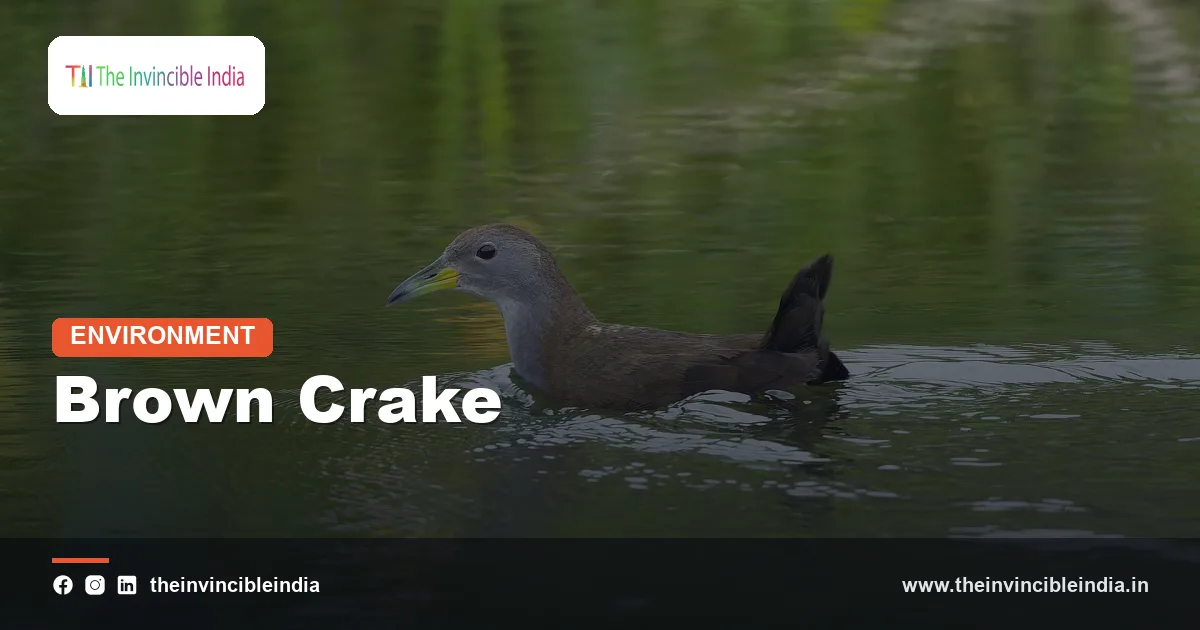
The brown crake (Zapornia akool, formerly placed in the genus Amaurornis) is a shy, olive-brown marsh bird of the rail family that lives in reed beds, wet ditches, overgrown ponds and damp gardens across much of the Indian subcontinent. It is a resident species, which means that it stays in the same region through the year, and it is far more often heard at dusk than seen in daylight.
Many people living near ponds, canals and paddy fields in India have a brown crake as a neighbour without ever knowing it. The bird slips through dense cover with its body compressed from side to side, freezes at the first sign of danger, and bursts into a short, low flight only when pushed. This article explains how to recognise the brown crake, where it lives, what it eats, how it breeds and how it differs from other rails. It was last reviewed on 30 October 2026.
| Attribute | Detail |
|---|---|
| Scientific name | Zapornia akool (earlier Amaurornis akool) |
| Family | Rallidae (rails, crakes, waterhens, moorhens and coots) |
| Size | About 28 cm long, a little smaller than a village hen |
| Range | Resident across the Indian subcontinent, in parts of Pakistan, India, Nepal and Bangladesh, mainly in lowlands and foothills |
| Diet | Insects, worms, snails and other small invertebrates, plus seeds and soft plant matter |
| Breeding | Cup-shaped nest of reeds and grass in dense wet vegetation; small clutch of eggs, mostly in the rainy season |
| Status | Least Concern (IUCN); a local and secretive resident |
| Habits | Skulking, mostly crepuscular; walks with a flicking tail and calls at dawn and dusk |
Key Takeaways
- The brown crake (Zapornia akool) is a shy marsh bird of the rail family, Rallidae, that lives year-round in the lowland wetlands of the Indian subcontinent.
- An adult brown crake is olive-brown above and slaty-grey below, with a greenish bill, a red eye and bright red legs.
- The brown crake feeds on insects, worms, snails and seeds, which it picks from mud and shallow water at the edge of dense cover.
- The brown crake prefers reed beds, marshy ditches, overgrown ponds, paddy margins and even neglected gardens, often close to people.
- The brown crake is classed as Least Concern by the IUCN, although drainage and clearing of small wetlands removes habitat locally.
- The best time to detect a brown crake is early morning or evening, when it calls from within the reeds and sometimes steps briefly into the open.
What is the brown crake?
The brown crake is a small, secretive wetland bird in the rail family, known to science as Zapornia akool, that is found as a resident across South Asia. Rails are a worldwide family of marsh birds, and the brown crake is one of several crakes, waterhens and rails that live in the reeds and ditches of India.
Taxonomists have moved the brown crake between genera over the years, and older books and field guides may list it as Amaurornis akool. The bird is part of a group of small, round-bodied rails that look similar and are best told apart by leg colour, bill colour and call.
Unlike the larger white-breasted waterhen, which often walks in the open in India, the brown crake is a bird of dense cover. It is not a rare species, but its habit of staying hidden means that even experienced birdwatchers may spend years before getting a clear look.
How can you identify a brown crake?
A brown crake is identified by its uniform olive-brown upperparts, slaty grey face and underparts with a brownish wash on the belly, a greenish-yellow bill, a red eye and strong red legs. The bird is about the size of a small hen or a large myna, with a short tail that it flicks constantly as it walks.
The sexes look alike in the field. Juvenile birds are duller and browner, with a dull eye and legs that lack the bright red colour. Because the brown crake has no bold patterns, identification depends on seeing the combination of dark plumage, a pale bill and red legs.
Key field marks
- Olive-brown back, wings and tail, with no streaks or bars.
- Grey face, neck and breast, shading to browner flanks and belly.
- A pale green or yellowish-green bill, with no red shield on the forehead.
- A red or reddish eye.
- Bright red legs and long, slender toes adapted for walking over mud and floating plants.
The brown crake is sometimes confused with the ruddy-breasted crake and the white-breasted waterhen. The ruddy-breasted crake is smaller and has a warm reddish-chestnut underside, while the white-breasted waterhen has a white face and breast and is far bolder in the open.
Where is the brown crake found in India?
The brown crake is found in much of lowland India, particularly in the north and east, where it lives in marshes, reed beds and wet fields from the plains to the foothills of the Himalaya. It is reported from states such as Uttar Pradesh, Bihar, West Bengal, Assam, Odisha, Punjab, Haryana, Gujarat and parts of peninsular India, though it is locally patchy and is thin in dry regions.
Outside India, the species occurs in Pakistan, Nepal and Bangladesh and in some neighbouring parts of South Asia. Different populations have been described as subspecies, which differ slightly in colour. The bird is not a long-distance migrant, although it may make short local movements in response to rain, flooding or drying of wetlands.
The brown crake tends to follow water. In the monsoon it spreads into flooded fields and temporary pools, and in the dry season it retreats to permanent marshes, ditches, tanks and rivers. In many Indian towns, a brown crake may live in a small, overgrown pond, a drain lined with reeds or a patch of marshy waste ground.
What habitat does the brown crake prefer?
The brown crake prefers wet places with dense, low cover where it can hide and forage at the same time, such as reed beds, bulrush stands, flooded grassland, water-hyacinth patches, paddy field margins, marshy ditches and the thick vegetation around village ponds. Even small, degraded wetlands may support a pair if the cover is thick.
The bird often lives near people, and it is regularly reported from neglected gardens, canal banks and the edges of sewage-fed ponds. That tolerance makes it less vulnerable than some wetland specialists, though it also means that the bird is exposed to disturbance, dogs, cats and the draining of small water bodies.
What cover does the brown crake need?
- Dense emergent plants, such as reeds, cattails and sedges, for shelter and nesting.
- Shallow water or soft mud, where it can probe for food.
- Tangled bushes or tall grass at the water’s edge as an escape route.
- Some damp ground that stays wet for most of the year.
What does the brown crake eat?
The brown crake eats a mixed diet of small animals and plants, picking insects, worms, snails, small crustaceans, larvae and the seeds and shoots of marsh plants from the mud and shallow water. It is an opportunistic feeder and takes whatever is easiest to find at the edge of cover.
A brown crake forages by walking slowly with its head bobbing and its tail flicking, probing soft mud and turning over leaves. It may feed at the edge of a reed bed or on a floating mat of vegetation, wading carefully on its long toes. Its feeding peaks in the early morning and in the evening, when light is low and the bird is less exposed to predators.
By eating insects, snails and larvae, the brown crake helps to control invertebrate numbers in marsh and paddy habitats. In rice fields it feeds on insects and other small animals, although its overall role in pest control is modest and has not been measured precisely.
How does the brown crake call and behave?
The brown crake is a skulking bird that is more often heard than seen, and its call is a series of loud, croaking or chattering notes delivered mostly at dawn and dusk. The call can carry across a pond and is often the only sign that the bird is present. In the breeding season, pairs may call in a duet and answer one another from different parts of the reeds.
When disturbed, the brown crake usually walks quickly into denser cover rather than flying. If forced to fly, it makes a short, weak flight with dangling legs and drops back into the reeds. The bird flicks its short tail as it walks, and this flicking is a useful clue to its presence.
The species is largely crepuscular, which means that it is most active in twilight. In quiet or overcast conditions, or in places where it is not disturbed, it may step out onto open mud or a path at the edge of a pond for a short time.
How does the brown crake breed?
The brown crake breeds mainly in the monsoon and the weeks around it, when water levels rise and vegetation is thick. The pair builds a cup-shaped nest of reeds, grass and leaves, usually hidden in dense growth just above the water or on a clump of vegetation, and the female lays a small clutch of eggs that are pale and spotted.
Both parents share the incubation and the care of the young. Like other rails, the chicks are covered in black down when they hatch and can leave the nest soon afterwards, following their parents through the reeds. They stay near cover for the first weeks, feeding on small insects supplied or pointed out by their parents, and they gradually become independent.
Because the nest is hidden and the birds are shy, breeding records are scarce, and many details of the brown crake’s breeding biology are still gathered from a few observations. Exact dates and clutch sizes vary with region and season.
How is the brown crake different from other rails?
The brown crake differs from other Indian rails mainly in its plain, dark olive-brown and grey plumage, its red legs and its greenish bill without a bright frontal shield. Comparing it with the commonest look-alikes helps to make field identification easier.
| Bird | Size | Key features |
|---|---|---|
| Brown crake | About 28 cm | Olive-brown above, grey below, greenish bill, red legs, red eye |
| Ruddy-breasted crake | About 22 cm | Smaller, chestnut-red underside, short red legs, dark upperparts |
| White-breasted waterhen | About 32 cm | White face and breast, slaty back, rusty undertail, often seen in the open |
| Common moorhen | About 32 cm | Red frontal shield, yellow-tipped bill, white flank streak, swims readily |
| Eurasian coot | About 38 to 40 cm | All-black body, white shield and bill, swims in open water |
These birds all belong to the rail family, but they use habitats differently. Coots and moorhens swim in open water, waterhens walk more boldly in the open, and crakes such as the brown crake stay deep in vegetation.
Is the brown crake threatened?
The brown crake is not threatened globally. The International Union for Conservation of Nature (IUCN) classes it as Least Concern, because it has a wide range and is thought to have a large population, although it is secretive and its numbers are not easy to measure.
Even so, the brown crake depends on small wetlands, and those habitats are under pressure in many parts of India. The main local threats include:
- Draining and filling of ponds, ditches and marshes for construction and farming.
- Clearing of reed beds and aquatic vegetation, which removes nesting and roosting cover.
- Pollution of water by sewage, plastic waste and agricultural chemicals.
- Predation and disturbance by stray dogs and cats near urban wetlands.
- Changes in water level caused by embankments, canals and diversion of water.
Because the brown crake tolerates modest disturbance, it can persist in small, messy wetlands that other birds avoid. Conserving even small marshes and ponds in towns and villages therefore helps this species along with frogs, dragonflies and many other forms of wildlife.
How can you spot a brown crake?
The best way to spot a brown crake is to sit quietly near a reedy pond or marshy ditch at dawn or dusk, listen for its calls and scan the muddy edge of the vegetation with binoculars. Patience is more useful than movement, because the bird will not come into the open if it senses a person.
- Visit early in the morning, when the bird is most active.
- Stand or sit still at a distance from the reeds, and avoid sudden movements.
- Listen first, and note the direction of any call before trying to see the bird.
- Look for a flicking tail or a quiet movement along the base of the reeds.
- Note the red legs and the greenish bill to separate it from other crakes.
Record sightings on citizen-science platforms such as eBird. Local records for secretive species like the brown crake add valuable information about where the bird still survives.
Bottom Line
The brown crake is a shy, olive-brown rail that lives quietly in India’s reed beds, ditches and small ponds. It is not globally threatened, but it depends on the small wetlands that are easily drained or polluted. Keeping a little cover and water in villages, towns and farms is enough to keep this unobtrusive neighbour around.
Frequently Asked Questions
What is a brown crake?
A brown crake is a small, shy marsh bird of the rail family, scientifically named Zapornia akool. It is olive-brown above and grey below, with a greenish bill and red legs. It lives in reed beds, ditches and wet gardens across the Indian subcontinent.
Where is the brown crake found?
The brown crake is found across much of lowland India, as well as in Pakistan, Nepal and Bangladesh. It lives in marshes, reed beds, wet fields and overgrown ponds, from the plains to the foothills. It is a resident and does not make long migrations.
What does a brown crake eat?
A brown crake eats insects, worms, snails, small crustaceans and seeds. It picks food from mud and shallow water while walking along the edge of dense cover. It feeds mainly in the early morning and evening.
How do you identify a brown crake?
You identify a brown crake by its plain olive-brown back, grey underparts, greenish bill, red eye and bright red legs. It is about 28 cm long and flicks its tail as it walks. Its habit of skulking in dense reeds is another clue.
Is the brown crake rare or endangered?
No, the brown crake is not rare or endangered. The IUCN lists it as Least Concern because it has a wide range. It is secretive and local, however, and the draining of small wetlands can remove it from particular places.
When is the best time to see a brown crake?
The best time to see a brown crake is early morning or evening, when it is most active and calls from the reeds. Sitting quietly beside a reedy pond or marshy ditch gives the best chance. During the monsoon the bird is often more vocal because it is breeding.
{“@context”:”https://schema.org”,”@graph”:[{“@type”:”FAQPage”,”mainEntity”:[{“@type”:”Question”,”name”:”What is a brown crake?”,”acceptedAnswer”:{“@type”:”Answer”,”text”:”A brown crake is a small, shy marsh bird of the rail family, scientifically named Zapornia akool. It is olive-brown above and grey below, with a greenish bill and red legs. It lives in reed beds, ditches and wet gardens across the Indian subcontinent.”}},{“@type”:”Question”,”name”:”Where is the brown crake found?”,”acceptedAnswer”:{“@type”:”Answer”,”text”:”The brown crake is found across much of lowland India, as well as in Pakistan, Nepal and Bangladesh. It lives in marshes, reed beds, wet fields and overgrown ponds, from the plains to the foothills. It is a resident and does not make long migrations.”}},{“@type”:”Question”,”name”:”What does a brown crake eat?”,”acceptedAnswer”:{“@type”:”Answer”,”text”:”A brown crake eats insects, worms, snails, small crustaceans and seeds. It picks food from mud and shallow water while walking along the edge of dense cover. It feeds mainly in the early morning and evening.”}},{“@type”:”Question”,”name”:”How do you identify a brown crake?”,”acceptedAnswer”:{“@type”:”Answer”,”text”:”You identify a brown crake by its plain olive-brown back, grey underparts, greenish bill, red eye and bright red legs. It is about 28 cm long and flicks its tail as it walks. Its habit of skulking in dense reeds is another clue.”}},{“@type”:”Question”,”name”:”Is the brown crake rare or endangered?”,”acceptedAnswer”:{“@type”:”Answer”,”text”:”No, the brown crake is not rare or endangered. The IUCN lists it as Least Concern because it has a wide range. It is secretive and local, however, and the draining of small wetlands can remove it from particular places.”}},{“@type”:”Question”,”name”:”When is the best time to see a brown crake?”,”acceptedAnswer”:{“@type”:”Answer”,”text”:”The best time to see a brown crake is early morning or evening, when it is most active and calls from the reeds. Sitting quietly beside a reedy pond or marshy ditch gives the best chance. During the monsoon the bird is often more vocal because it is breeding.”}}]}]}


