

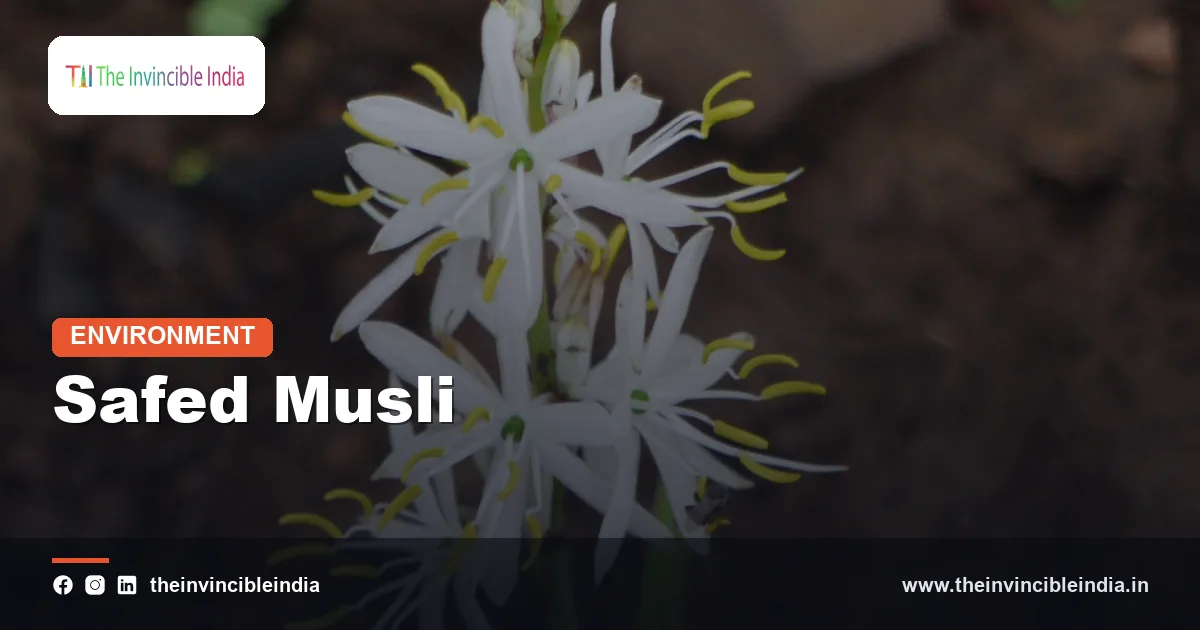
The safed musli is the white, tuberous-rooted Indian herb Chlorophytum borivilianum, a prized Ayurvedic tonic plant that is also grown as a cash crop by farmers in western and central India. The dried, peeled roots are sold as a traditional rejuvenating herb, and the plant is valued so highly that wild populations have come under heavy pressure from collection.
Safed musli sits at the meeting point of forest ecology, traditional medicine and small-farm economics. This explainer covers what safed musli is, how to recognise the plant, where and how it is cultivated, what Ayurveda says about it, how it differs from look-alike roots, and why its conservation matters.
Quick Facts: Safed Musli
| Scientific name | Chlorophytum borivilianum Santapau and Fernandes |
|---|---|
| Family | Asparagaceae (formerly placed in Liliaceae or Anthericaceae) |
| Common names | Safed musli, white musli, dholi musli; Sanskrit shweta musali |
| Plant type | Small perennial herb with a rosette of leaves and clustered fleshy roots |
| Useful part | Fleshy tuberous roots, harvested, peeled and dried |
| Native forests | Dry deciduous forests of Gujarat, Maharashtra, Madhya Pradesh and Rajasthan regions |
| Cultivated in | Gujarat, Madhya Pradesh, Maharashtra, Chhattisgarh, Rajasthan and several other states |
| Growing season | Planted with the monsoon; plant goes dormant after the rains and roots are lifted in the cool season |
| Traditional role | Rasayana (rejuvenating) and vajikarana (vitality) herb in Ayurveda |
Key Takeaways
- Safed musli is the common name of Chlorophytum borivilianum, an Indian perennial herb whose white, finger-like tuberous roots are used in Ayurvedic tonics.
- The safed musli plant grows with the monsoon rains, dies back to its underground roots in the dry season, and is harvested when the leaves have dried and fallen.
- Wild safed musli has been over-collected from Indian forests, and the plant is regarded as threatened in the wild in parts of its range.
- Farmers in Gujarat, Madhya Pradesh, Maharashtra and neighbouring states grow safed musli as a high-value medicinal cash crop, often on small plots.
- Safed musli is traditionally used as a general strength and vitality tonic, but scientific evidence in humans is limited and the herb is not a medically proven treatment.
- Safed musli is different from kali musli, which is the unrelated black-rooted herb Curculigo orchioides, and the market sometimes sells other Chlorophytum species under the same name.
What is safed musli?
Safed musli is a small perennial herb, botanically Chlorophytum borivilianum, that stores energy in a cluster of white, fleshy, finger-like roots and has been used in Indian traditional medicine for centuries. The word safed means white in Hindi, and musli refers to the club-shaped or rod-like root in several Ayurvedic names.
The species was formally described in the twentieth century by the botanists Santapau and Fernandes, and it is named after the Borivili area near Mumbai, now known as Borivali, where it was collected. Although the root was known to healers for much longer, this scientific naming helped separate Chlorophytum borivilianum from related species and from the many other roots sold in herb markets under the label musli.
In the Ayurvedic system, safed musli is called shweta musali in Sanskrit. It is listed among herbs used to build strength and stamina, and in trade it is also called dholi musli. The plant belongs to a large genus, Chlorophytum, with species found across tropical regions of Asia and Africa, but only a few of them are used as medicine.
How can you recognise the safed musli plant?
The safed musli plant can be recognised by its tuft of narrow, lance-shaped leaves rising straight from the ground, its slender flower stalk with small white flowers, and its bundle of thick, tapering white roots below the soil. The whole plant is low and grass-like, usually knee-high or less.
- Leaves: long, narrow and light green, arranged in a rosette, appearing when the monsoon rains begin.
- Flowers: small, star-shaped and white to cream, borne on an upright spike during the rainy season.
- Roots: a clump of fleshy, tapering roots that look like short fingers, up to several centimetres long, attached to a central crown.
- Dormancy: after the rains the leaves turn yellow and dry up, and the plant survives underground until the next monsoon.
Because the leaves vanish in the dry season, wild plants are hard to find outside the rainy months. This is one reason why collectors dig roots at the wrong time and why the plant has suffered from careless harvesting.
Where does safed musli grow in India?
Safed musli grows wild in the dry and moist deciduous forests of western and central India, mainly in Gujarat, Maharashtra, Madhya Pradesh and Rajasthan, and it is now also cultivated in several other states. The plant prefers well-drained, light soils in areas with a clear monsoon season.
In Gujarat, the tribal forest belts of the east and south, including the Dang district, are well known for natural stands of the herb. Madhya Pradesh and Chhattisgarh have both forest populations and farm plots, and Maharashtra’s Western Ghats foothills are another traditional source. Interest in cultivation has also spread to parts of Rajasthan, Uttar Pradesh, Andhra Pradesh, Telangana and Karnataka.
State agricultural universities and medicinal plant boards have promoted it as a crop for farmers with poor or marginal land.
How is safed musli cultivated?
Safed musli is cultivated by planting small pieces of the root crown, called fingers, in raised beds at the start of the monsoon, and harvesting the roots after the leaves have dried in the cool season. The crop is suited to light, well-drained soils and does not tolerate waterlogging.
Main steps of cultivation
- Land preparation: the field is ploughed to a fine tilth and raised beds are made so that excess rainwater drains away.
- Planting material: crowns with attached roots are separated and planted in June or July when the rains have settled.
- Care: weeding is the major task, since the plant is small and easily overgrown; organic manure is used, and irrigation is needed only if the rains fail.
- Dormancy: in the post-monsoon months the leaves dry and the crop is left underground for a few weeks before harvesting.
- Harvest: roots are dug carefully to avoid damage, the crowns are kept back for replanting, and the roots are washed and peeled.
- Drying: peeled roots are dried in the shade or in gentle sun until they become hard and brittle, losing most of their weight in the process.
Peeling is labour-intensive, and the quality and whiteness of the dried root affect its market price. Properly dried roots are stored in dry, airtight conditions to keep out moisture and pests.
Why is safed musli a valuable crop?
Safed musli is a valuable crop because dried roots fetch a high price per kilogram in herbal markets compared with most field crops, and the plant can be grown on small plots with modest inputs. This has attracted many small and tribal farmers, especially in central and western India.
However, the market has been uneven. Prices have risen and fallen sharply over the years, partly because many growers entered the crop at once during promotional drives and partly because buyers are few and quality standards are strict. Farmers who plan to grow safed musli are generally advised to secure a buyer or a buy-back arrangement before planting.
The demand for the root comes mostly from the herbal and Ayurvedic industry, which uses it in tonics, powders and formulations. The National Medicinal Plants Board under the Ministry of AYUSH has listed safed musli among the medicinal plants for which it encourages cultivation and conservation.
What does Ayurveda say about safed musli?
Ayurveda classifies safed musli as a rasayana, or rejuvenating herb, and a vajikarana herb that is traditionally used to improve strength, stamina and general vitality. It is regarded as having sweet and cooling qualities and is commonly given in powder, paste or milk-based preparations.
Traditional uses described by practitioners include taking the powdered root with milk as a general tonic, giving it to people recovering from long illness, and using it to support lactation after childbirth. The herb is also an ingredient in many commercial polyherbal formulations marketed for energy and vitality.
Laboratory research on safed musli has found compounds such as saponins and polysaccharides in the roots, and some studies in animals have explored effects on stress, immunity and reproductive function. Evidence from well-designed human trials is limited, so the herb should be understood as a traditional tonic, not as a proven treatment for any condition. People should consult a qualified practitioner before use, especially if they are pregnant, on medication, or have a chronic health problem.
How is safed musli different from kali musli?
Safed musli differs from kali musli because they are completely different plants: safed musli is Chlorophytum borivilianum with white tuberous roots, while kali musli is Curculigo orchioides, which has dark, slender, cylindrical roots. The two share the word musli in their names but belong to different plant families.
| Feature | Safed musli | Kali musli |
|---|---|---|
| Scientific name | Chlorophytum borivilianum | Curculigo orchioides |
| Family | Asparagaceae | Hypoxidaceae |
| Root colour | White to cream after peeling | Dark brown to black outside |
| Root shape | Clustered, finger-like and fleshy | Slender, tapering and cylindrical |
| Plant look | Narrow leaves in a rosette, white flower spikes | Grass-like pleated leaves, small yellow flowers |
| Traditional name | Shweta musali | Talmuli or kali musli |
The market also contains substitutes. Other Chlorophytum species, such as Chlorophytum tuberosum and Chlorophytum arundinaceum, have similar-looking roots and are sometimes sold as safed musli, usually at a lower price and with lower perceived quality. Buyers who want authentic material should purchase from reliable suppliers and, where possible, ask for botanical identification.
Is safed musli endangered?
Safed musli is considered threatened in the wild in parts of its range, because excessive digging of roots from forests has depleted natural populations. The plant takes time to regenerate, and collection of whole plants without leaving crowns behind has reduced the number of wild stands.
Several factors have added to the pressure on wild safed musli:
- High market prices that encourage illegal or unsustainable collection.
- Dormancy of the plant in the dry season, which makes it hard to monitor and easy to uproot at the wrong time.
- Loss of forest habitat to farming, development and fires.
- Limited natural reproduction compared with the speed of harvesting.
Cultivation is widely seen as one of the practical ways to reduce pressure on forests. If farmers can supply the market with raised roots, buyers have less reason to depend on wild collection. Conservation agencies in India also support the establishment of seed and crown banks and training in sustainable harvesting.
What should buyers and users know about safed musli?
Buyers and users should know that safed musli quality varies widely, that substitutes and adulterants are common, and that any health claim about it should be treated with caution. Authentic dried roots are hard, off-white to cream, and brittle, while poor material may be dark, moist or mouldy.
Powdered products can be especially hard to verify, so reputable brands, batch testing and certification from recognised Ayurvedic standards are useful safeguards. The herb is not a substitute for medical treatment of sexual, metabolic or other health conditions, and claims of dramatic effects, especially from unregulated sellers, should be viewed sceptically.
People with allergies, those who are pregnant or breastfeeding, and anyone taking prescription medicine should speak to a doctor before taking herbal supplements. Responsible users also avoid products that do not state their source, since over-harvested wild material harms forests.
Bottom Line
Safed musli is both a traditional Ayurvedic tonic herb and a promising small-farm cash crop, but its wild stands are under pressure and its human health benefits are not firmly proven. Buying cultivated, correctly identified roots supports both farmers and forests.
Frequently Asked Questions
What is safed musli?
Safed musli is the Indian herb Chlorophytum borivilianum, whose white tuberous roots are used as a traditional Ayurvedic tonic. It is both collected from forests and grown as a cash crop, mainly in western and central India.
What is safed musli used for in Ayurveda?
Safed musli is used in Ayurveda as a rasayana, or rejuvenating herb, for strength, stamina and general vitality. These are traditional uses, and strong evidence from human trials is limited.
Is safed musli the same as kali musli?
No, safed musli is not the same as kali musli. Safed musli is Chlorophytum borivilianum with white fleshy roots, while kali musli is Curculigo orchioides with dark, slender roots.
Where is safed musli grown in India?
Safed musli is grown mainly in Gujarat, Madhya Pradesh, Maharashtra, Chhattisgarh and Rajasthan. It also occurs naturally in dry deciduous forests of these regions.
When is safed musli harvested?
Safed musli is harvested after the monsoon, in the cool season, when the leaves have dried and fallen. The roots are then dug, peeled and dried.
Is safed musli endangered?
Safed musli is considered threatened in the wild in parts of its range because of over-collection and habitat loss. Cultivation is encouraged to reduce pressure on forest populations.
{“@context”:”https://schema.org”,”@graph”:[{“@type”:”FAQPage”,”mainEntity”:[{“@type”:”Question”,”name”:”What is safed musli?”,”acceptedAnswer”:{“@type”:”Answer”,”text”:”Safed musli is the Indian herb Chlorophytum borivilianum, whose white tuberous roots are used as a traditional Ayurvedic tonic. It is both collected from forests and grown as a cash crop, mainly in western and central India.”}},{“@type”:”Question”,”name”:”What is safed musli used for in Ayurveda?”,”acceptedAnswer”:{“@type”:”Answer”,”text”:”Safed musli is used in Ayurveda as a rasayana, or rejuvenating herb, for strength, stamina and general vitality. These are traditional uses, and strong evidence from human trials is limited.”}},{“@type”:”Question”,”name”:”Is safed musli the same as kali musli?”,”acceptedAnswer”:{“@type”:”Answer”,”text”:”No, safed musli is not the same as kali musli. Safed musli is Chlorophytum borivilianum with white fleshy roots, while kali musli is Curculigo orchioides with dark, slender roots.”}},{“@type”:”Question”,”name”:”Where is safed musli grown in India?”,”acceptedAnswer”:{“@type”:”Answer”,”text”:”Safed musli is grown mainly in Gujarat, Madhya Pradesh, Maharashtra, Chhattisgarh and Rajasthan. It also occurs naturally in dry deciduous forests of these regions.”}},{“@type”:”Question”,”name”:”When is safed musli harvested?”,”acceptedAnswer”:{“@type”:”Answer”,”text”:”Safed musli is harvested after the monsoon, in the cool season, when the leaves have dried and fallen. The roots are then dug, peeled and dried.”}},{“@type”:”Question”,”name”:”Is safed musli endangered?”,”acceptedAnswer”:{“@type”:”Answer”,”text”:”Safed musli is considered threatened in the wild in parts of its range because of over-collection and habitat loss. Cultivation is encouraged to reduce pressure on forest populations.”}}]}]}


