

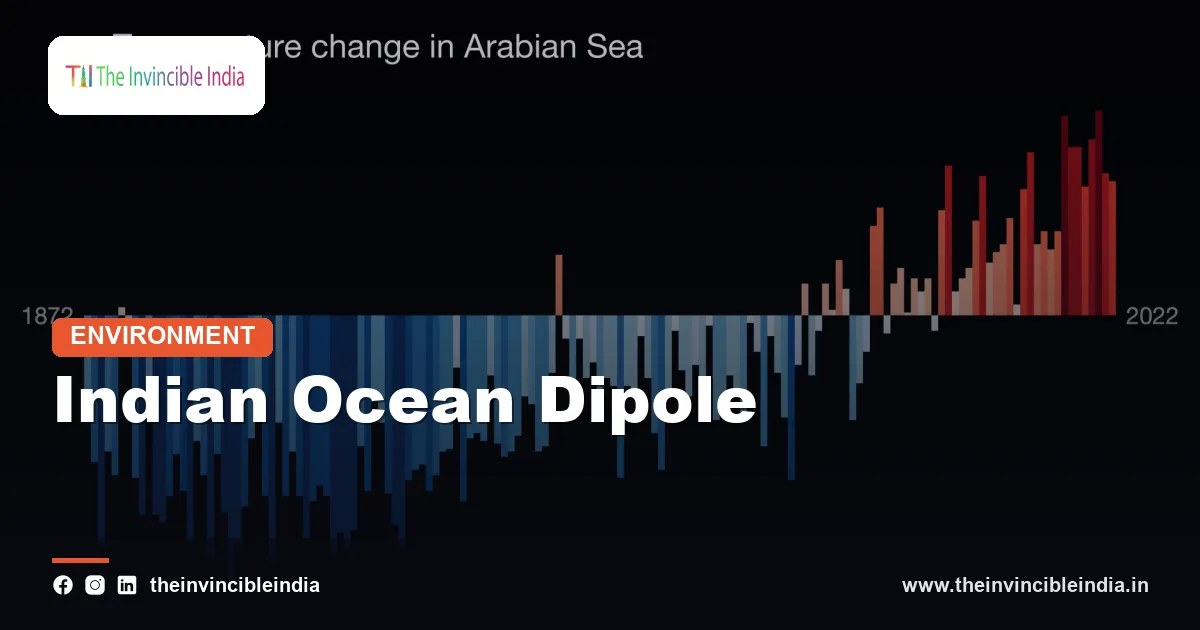
The Indian Ocean Dipole (IOD) is a natural see-saw of sea-surface temperatures between the western and eastern halves of the tropical Indian Ocean, and it can strengthen or weaken the Indian monsoon. When the western Indian Ocean is warmer than the east, the IOD is in its positive phase, which generally favours monsoon rain over India, while the reverse pattern is the negative phase.
The Indian Ocean Dipole is sometimes called the “Indian Nino” because it resembles the Pacific’s El Nino in some ways. Its effect on India is a statistical tendency, not a guarantee, and the IOD can work with or against El Nino and La Nina.
| Quick Facts | Details |
|---|---|
| Full name | Indian Ocean Dipole (IOD), also called the Indian Nino or Dipole Mode |
| What it is | An irregular see-saw of sea temperature between the western and south-eastern tropical Indian Ocean |
| Described by scientists | In 1999, in a study by a team that included Indian and Japanese researchers |
| Measured by | The Dipole Mode Index (DMI), the temperature difference between the western and eastern poles |
| Positive phase | Warmer west, cooler east, favourable for India’s monsoon |
| Negative phase | Cooler west, warmer east, tends to weaken the monsoon |
| Typical timing | Develops in May to June, peaks in September to October, fades by December |
| Interacts with | El Nino and La Nina in the Pacific (ENSO) |
| Monitored by | India Meteorological Department (IMD), Australian Bureau of Meteorology, NOAA |
Key Takeaways
- The Indian Ocean Dipole is a temperature see-saw between the western and eastern tropical Indian Ocean that was formally described by scientists in 1999.
- A positive Indian Ocean Dipole, with a warm west and cool east, generally helps the Indian monsoon by increasing moisture supply and rain over the subcontinent.
- A negative Indian Ocean Dipole, with a cool west and warm east, tends to weaken the Indian monsoon, though the link is less firm than for the positive phase.
- A strong positive Indian Ocean Dipole can offset the drying effect of El Nino, as in 1997 when India received near-normal monsoon rain despite a very strong El Nino.
- The Indian Ocean Dipole usually grows from May to June, peaks around September and October, and decays by December, so it is most relevant to the second half of the monsoon season.
- The Indian Ocean Dipole also strongly affects East Africa, Indonesia and Australia, which receive opposite rainfall effects from those seen in India.
What Is the Indian Ocean Dipole?
The Indian Ocean Dipole is a recurring pattern in which the sea-surface temperature of the western tropical Indian Ocean, off the coast of Africa, and the south-eastern tropical Indian Ocean, off Sumatra and Java, move in opposite directions. The word “dipole” means two poles, and here the two poles are the western and eastern parts of the ocean.
Scientists identified the pattern in 1999, in a study published by a team that included researchers from India and Japan. Before that, the Indian Ocean was often treated as a passive partner that simply responded to the Pacific. The discovery showed that the Indian Ocean has its own internal climate rhythm, which can influence the monsoon independently.
The strength of the IOD is measured by the Dipole Mode Index (DMI), which is the difference in sea-surface temperature anomaly between a western region and a south-eastern region of the tropical Indian Ocean. A DMI above a set threshold, typically about half a degree Celsius, indicates a positive event, and a value below the negative of that threshold indicates a negative event.
How Does the Indian Ocean Dipole Work?
The Indian Ocean Dipole works through a feedback between winds and ocean temperatures: when the winds along the equator weaken or reverse, warm water gathers in the west while cool deep water rises in the east, and the temperature gap then strengthens the winds further. The mechanism is similar in spirit to the Pacific’s El Nino, but it plays out on a smaller scale and a faster clock.
Normally the surface winds along the equator in the Indian Ocean blow weakly from west to east, and the warmest water sits near Indonesia. During a positive IOD, the south-easterly winds along the coast of Sumatra strengthen, and the usual equatorial winds weaken or reverse to blow from east to west. These winds push warm surface water toward Africa and allow cold water to well up from below off Sumatra and Java.
The warm west then supports more rising air and cloud, while the cool east supports sinking air and dry weather, and the atmospheric changes lock the pattern in for months. In the negative phase the reverse occurs, with warmer water and more rain in the east and cooler water in the west.
What Are the Positive and Negative Phases of the Indian Ocean Dipole?
The positive phase of the Indian Ocean Dipole has a warm western and cool eastern Indian Ocean, while the negative phase has the opposite arrangement, and each brings a different set of weather effects around the ocean rim. A neutral state, with little difference between the two sides, is also common.
| Feature | Positive IOD | Negative IOD |
|---|---|---|
| Western Indian Ocean (near Africa) | Warmer than normal | Cooler than normal |
| Eastern Indian Ocean (near Sumatra) | Cooler than normal | Warmer than normal |
| Equatorial winds | Weaker or reversed, blowing from east to west | Stronger westerlies |
| Indian monsoon | Tends to be helped, with more rain | Tends to be weakened |
| East Africa | Heavier rain and floods in the short rains | Drier than normal |
| Indonesia and Australia | Drier, with higher fire and drought risk | Wetter than normal |
The two phases are not exact mirror images. Positive events tend to be larger and more extreme than negative ones, and the positive phase is often better linked to the Pacific’s El Nino, while negative events are often connected to La Nina years.
How Does the Indian Ocean Dipole Affect the Indian Monsoon?
A positive Indian Ocean Dipole generally helps the Indian monsoon, because the warm western Indian Ocean provides more heat and moisture to the winds flowing toward India, and encourages rising air and rain over the subcontinent. A negative Indian Ocean Dipole tends to work the other way and can weaken the monsoon.
The monsoon is a seasonal reversal of winds that draws moist air from the Indian Ocean onto the land. The temperature pattern of the ocean surface is therefore a direct influence on how much moisture is on offer. When the western ocean is warm and the east is cool, the temperature gradient along the equator favours a stronger flow of moisture toward the Indian peninsula, and rainfall over India tends to increase.
The effect is strongest in the later part of the monsoon season, August and September, because the IOD builds through the summer and peaks in autumn. A positive IOD is also linked with a stronger-than-normal late monsoon and sometimes with a delayed withdrawal of the rains in September and October. In 2019, a strong positive IOD developed, and the monsoon ended above normal with rain continuing late into the season.
The influence is not uniform across the country. The IOD may matter more for central and southern India than for the north-east, and its role is overlaid on other influences such as the monsoon trough and the Madden-Julian Oscillation.
Can the Indian Ocean Dipole Offset El Nino?
Yes, a positive Indian Ocean Dipole can offset El Nino, because the extra moisture and rising air linked to a warm western Indian Ocean counter the sinking air and drying effect that El Nino tends to impose on India. The two influences compete, and the stronger or longer-lasting one has the greater say.
The standard example is 1997. A very strong El Nino developed that year, yet the Indian monsoon was close to normal. Researchers credited a strong positive IOD with cushioning the monsoon from the Pacific’s influence. The year is often cited because it shows that El Nino alone does not decide the monsoon.
In 2023, El Nino developed with a positive IOD that emerged during the monsoon season. Forecasters hoped the positive IOD would cushion the monsoon, and while late-season rain helped, the season ended below normal after a very dry August. The case shows that the IOD can soften an El Nino without always erasing its effects.
The opposite pairing is more worrying. An El Nino combined with a negative IOD removes the Indian Ocean’s potential cushion, and forecasters regard such a combination as carrying the greatest risk of a weak monsoon.
How Does the Indian Ocean Dipole Relate to El Nino and La Nina?
The Indian Ocean Dipole is related to El Nino and La Nina in that the two cycles often interact and sometimes occur together, though the IOD can also develop on its own. El Nino years frequently, but not always, coincide with a positive IOD, and La Nina years are more often linked with a negative IOD.
Part of this link comes through the atmosphere. The warm Pacific of an El Nino can alter winds over the Indian Ocean in ways that trigger or reinforce a positive dipole. Yet researchers have also found that the IOD can arise independently of the Pacific, so it is not simply a copy of ENSO.
- Same-direction years: El Nino with a positive IOD, or La Nina with a negative IOD, are common pairings, and the results for India often partly cancel.
- Reinforcing years: La Nina with a positive IOD gives the best setup for a strong monsoon, while El Nino with a negative IOD gives the worst setup.
- Independent years: In some years the IOD shows a clear signal while the Pacific is neutral, and the monsoon outcome then depends largely on the Indian Ocean.
Forecasters therefore watch both oceans together. For readers, the practical lesson is that a single index does not tell the whole story, and the combination of ENSO and IOD offers a better guide than either on its own.
What Does the Indian Ocean Dipole Do Beyond India?
The Indian Ocean Dipole affects weather around the entire Indian Ocean rim, and its effects on East Africa, Indonesia and Australia are often opposite to those on India. The pattern is one of the clearest examples of how a change in sea temperature can shift rainfall thousands of kilometres away.
- East Africa: A positive IOD often brings heavy rain and flooding to Kenya, Somalia and Ethiopia in the October to December short rains, while a negative IOD tends to bring drought.
- Indonesia: A positive IOD cools the eastern Indian Ocean off Sumatra and Java, reducing rain and raising the risk of drought and forest fires.
- Australia: A positive IOD is often linked with drier conditions across southern and central Australia in the winter and spring, and has been associated with severe fire seasons, such as the one in 2019.
- The Maldives, Sri Lanka and coastal India: Rainfall and sea conditions can shift, and ocean temperature changes affect fisheries.
The Indian Ocean Dipole can also affect cyclone activity in the north Indian Ocean in the post-monsoon season, since ocean temperature and winds affect storm formation, though the relationship is complex and still being studied.
How Do Scientists Monitor and Forecast the Indian Ocean Dipole?
Scientists monitor the Indian Ocean Dipole by tracking sea-surface temperature through satellites, ships and moored ocean buoys and computing the Dipole Mode Index, then forecast it with coupled ocean-atmosphere computer models. The Research Moored Array for African-Asian-Australian Monsoon Analysis and Prediction (RAMA), a network of buoys, is one source of data on the Indian Ocean.
The India Meteorological Department (IMD) lists the IOD along with ENSO among the major predictors for its monsoon forecasts, issuing its first outlook in April and an update around the end of May. The Indian Institute of Tropical Meteorology (IITM) in Pune and the Indian National Centre for Ocean Information Services (INCOIS) in Hyderabad are key institutions in this work. The Australian Bureau of Meteorology and NOAA also publish IOD outlooks.
The IOD is harder to predict than ENSO. The dipole develops quickly, has a shorter memory, and forecasts made before May are generally less reliable. This is a major reason why monsoon forecasters stress uncertainty, and why the IOD outcome often becomes clear only as the season progresses.
How Is Climate Change Affecting the Indian Ocean Dipole?
Climate change is affecting the Indian Ocean mainly by warming it faster than many other basins, and some studies suggest that extreme positive Indian Ocean Dipole events could become more frequent in a warmer world. The Indian Ocean has warmed noticeably over recent decades, which affects both sea level and rainfall.
A warmer ocean provides more evaporation and more atmospheric moisture, so the rain that falls can be more intense. Scientists are still working out how the pattern of the dipole itself may change, and model results differ. Readers should treat projections about future IOD behaviour as active research and not as settled fact.
What is clearer is that the background warming makes the Indian Ocean a more important player for India’s weather. Understanding the IOD is therefore likely to become more useful, not less, for farmers, water managers and disaster planners.
Bottom Line
The Indian Ocean Dipole is the Indian Ocean’s own climate see-saw, and its positive phase usually helps India’s monsoon while its negative phase tends to hurt it. Its greatest practical value is as a counterweight to El Nino, which it can soften or sometimes cancel. Like all such climate links, it shifts the odds without fixing the result.
Frequently Asked Questions
What is the Indian Ocean Dipole in simple words?
The Indian Ocean Dipole is a see-saw of sea temperatures in which the western and eastern parts of the tropical Indian Ocean warm and cool in opposite directions. It affects wind and rainfall patterns around the ocean, including India’s monsoon. Scientists described it in 1999, and it is measured with the Dipole Mode Index.
What is a positive Indian Ocean Dipole?
A positive Indian Ocean Dipole is the phase in which the western Indian Ocean is warmer than normal and the eastern Indian Ocean near Sumatra is cooler. It generally helps the Indian monsoon by boosting moisture and rain. It also brings heavy rain to East Africa and drought risk to Indonesia and Australia.
How does the Indian Ocean Dipole affect the monsoon?
The Indian Ocean Dipole affects the monsoon by changing how much heat and moisture the winds carry toward India. A positive phase tends to strengthen the monsoon, particularly in the later months. A negative phase tends to weaken it, although the relationship is a tendency and other factors also matter.
Can the Indian Ocean Dipole cancel the effect of El Nino?
Yes, a strong positive Indian Ocean Dipole can partly or wholly offset El Nino’s drying effect on India. In 1997, India had a near-normal monsoon despite a very strong El Nino. The outcome depends on how strong and long-lasting each influence is.
When does the Indian Ocean Dipole occur?
The Indian Ocean Dipole usually develops in May or June, peaks in September or October, and fades by December. It is therefore most relevant to the later part of the monsoon season and the following autumn. Its timing is one reason forecasts made early in the year are less certain.
Is the Indian Ocean Dipole the same as El Nino?
No, the Indian Ocean Dipole is not the same as El Nino, though the two are related. El Nino occurs in the tropical Pacific, while the IOD occurs in the Indian Ocean, and each has its own temperature pattern. They can occur together or separately, and their effects on India may reinforce or offset each other.
{“@context”:”https://schema.org”,”@graph”:[{“@type”:”FAQPage”,”mainEntity”:[{“@type”:”Question”,”name”:”What is the Indian Ocean Dipole in simple words?”,”acceptedAnswer”:{“@type”:”Answer”,”text”:”The Indian Ocean Dipole is a see-saw of sea temperatures in which the western and eastern parts of the tropical Indian Ocean warm and cool in opposite directions. It affects wind and rainfall patterns around the ocean, including India’s monsoon. Scientists described it in 1999, and it is measured with the Dipole Mode Index.”}},{“@type”:”Question”,”name”:”What is a positive Indian Ocean Dipole?”,”acceptedAnswer”:{“@type”:”Answer”,”text”:”A positive Indian Ocean Dipole is the phase in which the western Indian Ocean is warmer than normal and the eastern Indian Ocean near Sumatra is cooler. It generally helps the Indian monsoon by boosting moisture and rain. It also brings heavy rain to East Africa and drought risk to Indonesia and Australia.”}},{“@type”:”Question”,”name”:”How does the Indian Ocean Dipole affect the monsoon?”,”acceptedAnswer”:{“@type”:”Answer”,”text”:”The Indian Ocean Dipole affects the monsoon by changing how much heat and moisture the winds carry toward India. A positive phase tends to strengthen the monsoon, particularly in the later months. A negative phase tends to weaken it, although the relationship is a tendency and other factors also matter.”}},{“@type”:”Question”,”name”:”Can the Indian Ocean Dipole cancel the effect of El Nino?”,”acceptedAnswer”:{“@type”:”Answer”,”text”:”Yes, a strong positive Indian Ocean Dipole can partly or wholly offset El Nino’s drying effect on India. In 1997, India had a near-normal monsoon despite a very strong El Nino. The outcome depends on how strong and long-lasting each influence is.”}},{“@type”:”Question”,”name”:”When does the Indian Ocean Dipole occur?”,”acceptedAnswer”:{“@type”:”Answer”,”text”:”The Indian Ocean Dipole usually develops in May or June, peaks in September or October, and fades by December. It is therefore most relevant to the later part of the monsoon season and the following autumn. Its timing is one reason forecasts made early in the year are less certain.”}},{“@type”:”Question”,”name”:”Is the Indian Ocean Dipole the same as El Nino?”,”acceptedAnswer”:{“@type”:”Answer”,”text”:”No, the Indian Ocean Dipole is not the same as El Nino, though the two are related. El Nino occurs in the tropical Pacific, while the IOD occurs in the Indian Ocean, and each has its own temperature pattern. They can occur together or separately, and their effects on India may reinforce or offset each other.”}}]}]}


