

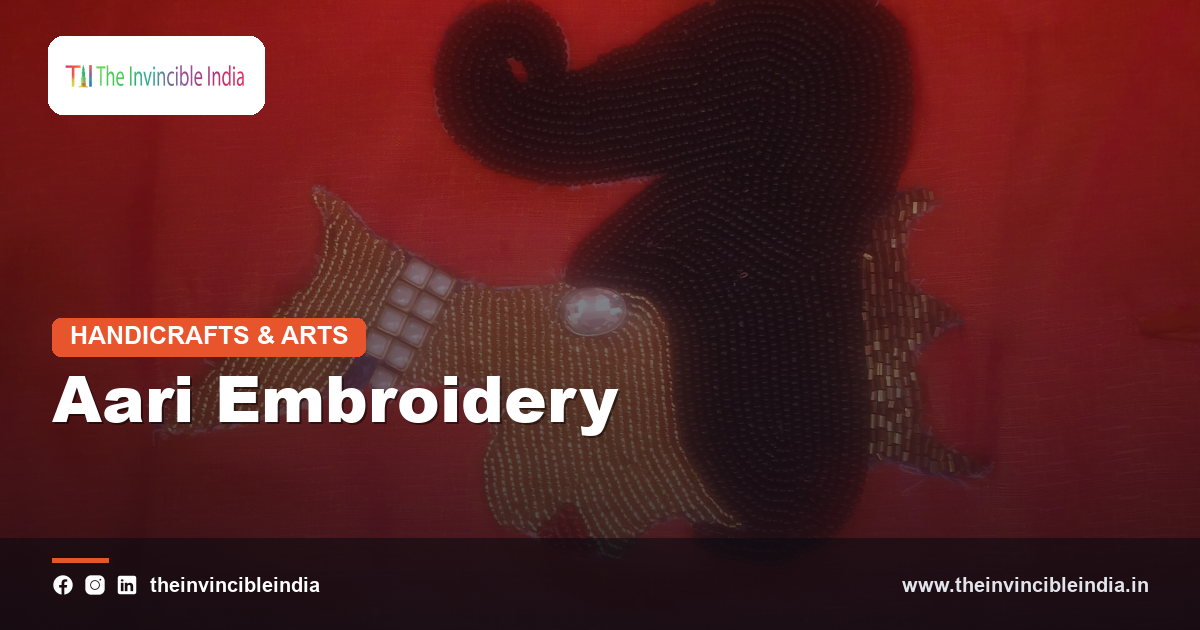
Aari embroidery is a chain-stitch technique worked with a hooked needle on fabric stretched across a frame, prized for the speed and density it brings to elaborate, embellishment-heavy designs. Practiced across Gujarat, Uttar Pradesh and Rajasthan, it is closely associated with bridal and festive wear, though it also decorates footwear, bags and everyday fashion. Like Bandhani tie-dye, Aari work reflects the diversity of India’s regional textile crafts, each shaped by local materials, tools and artisan lineages. This guide explores the technique’s origins, tools, motifs and continuing commercial importance.
Quick Facts
| Detail | Information |
|---|---|
| Craft Type | Hooked-needle embroidery |
| Tool Used | Aari (hook needle) |
| Base Fabric | Silk, satin, georgette, velvet |
| Key Embellishments | Beads, sequins, zari thread |
| Regions | Gujarat, Uttar Pradesh, Rajasthan |
| Primary Use | Bridal wear, footwear, accessories |
Origins and Historical Roots
Aari embroidery takes its name from the aari, a hooked needle historically associated with cobblers and leatherworkers who used similar tools to stitch leather footwear and accessories. Over time the technique was adapted from leatherwork to fabric embroidery, spreading across several regions of India including Gujarat, Uttar Pradesh and parts of Rajasthan.
Its origins are closely tied to artisan communities who specialised in working with a hook rather than a traditional needle, allowing for faster and more continuous stitching than conventional hand embroidery. As the technique moved from leather to cloth, it retained the characteristic chain-like stitch produced by the hook, while opening up new possibilities for elaborate, dense embroidery on garments. This practical advantage helped the technique spread and remain popular across generations of Indian textile craftsmanship.
The Aari Needle and Its History
The defining tool of Aari embroidery is the hooked needle itself, a slender awl-like instrument with a small hook at its tip that catches and pulls thread through the fabric from below. This tool allows an embroiderer to work considerably faster than with a conventional needle, since each stitch is formed with a quick hooking motion rather than a full pass of thread through the cloth.
The needle’s design is thought to derive from tools used historically by leatherworkers and shoemakers, who required an efficient way to stitch through tougher materials. As the technique was adapted for use on textiles stretched over a frame, the same hooked motion proved equally effective for creating fine chain stitches across cotton, silk and other fabrics. Mastery of the aari needle requires considerable practice and a distinct set of hand skills.
What Is Aari Embroidery
Aari embroidery refers to a style of chain-stitch embroidery produced using a hooked needle worked from above a fabric stretched taut on a frame, with thread fed from below by the embroiderer or an assistant. The result is a dense, continuous chain stitch capable of covering large areas of fabric relatively quickly, making it well suited to elaborate, all-over embroidery designs.
The technique is often combined with sequins, beads, small mirrors and metallic thread to create richly embellished surfaces, particularly for bridal and festive garments. Because the stitching is worked from a frame, designs can be drawn onto the fabric in advance and then filled in systematically, allowing for precise, repeatable patterns across large garment panels.
Materials and Fabrics
Aari embroidery is typically worked on fabrics that can withstand being stretched tightly across a frame without distorting, such as silk, satin, georgette and various blended fabrics commonly used in festive and bridal clothing. The fabric is mounted onto a wooden frame and kept taut throughout the embroidery process, which allows the hooked needle to move smoothly and consistently across the surface.
Heavier fabrics such as velvet are also used for certain garments, particularly where dense embellishment with beads or sequins is planned, since they can support the added weight without sagging. The choice of base fabric influences both the visual outcome and the durability of the finished piece, with finer fabrics suited to delicate floral patterns and heavier fabrics better able to support elaborate designs.
Threads, Beads and Embellishments
A wide range of materials is used alongside thread in Aari embroidery, including sequins, glass beads, small mirrors, pearls and metallic zari thread, all of which can be incorporated into the chain-stitch base to create richly textured surfaces. This combination of embroidery and embellishment distinguishes Aari work intended for bridal or festive wear from simpler everyday embroidery.
Silk and cotton threads are used for the underlying stitch work, with colours selected to complement or contrast with the embellishments layered on top. Metallic threads add a reflective quality that is particularly valued in wedding and celebratory garments. The layering of embroidery and embellishment requires careful planning, as the added weight and thickness of beads and sequins must be balanced against comfort.
Common Motifs and Design Styles
Aari embroidery draws on a wide range of motifs, including floral sprays, paisley forms, vines and geometric borders, with the specific style often reflecting regional preferences and the intended use of the finished piece. In bridal wear, dense all-over patterns combining floral motifs with heavy embellishment are common, while lighter garments may feature more restrained borders or scattered motifs.
Because Aari work spans several regions of India, motif preferences can vary considerably, with some areas favouring bold, structured patterns and others leaning toward more delicate, naturalistic designs. Despite this regional diversity, the underlying chain-stitch technique remains a unifying feature, allowing Aari embroidery to be recognised across its many stylistic variations.
The Aari Stitch Technique
Working Aari embroidery requires coordination between the hooked needle above the fabric and the thread supply below, with the embroiderer guiding the hook in a continuous looping motion to form an even chain stitch. Because the stitch can be worked quickly once mastered, skilled artisans are able to cover large areas of fabric with dense, uniform stitching in a fraction of the time required by conventional hand embroidery.
Maintaining even tension and consistent stitch length is essential to achieving a smooth, professional finish, and this consistency comes only with extended practice. The technique also allows for variation in stitch density, enabling artisans to create subtle shading effects or textured surfaces by adjusting how closely the chain stitches are worked.
The Embroidery Frame and Workshop Setup
Aari embroidery is worked with the fabric stretched tightly across a wooden frame, which holds the material taut and provides the stable surface needed for accurate, even stitching. In many workshops, the frame is raised on a stand or supported between two trestles, allowing the embroiderer to work seated with both hands free to manage the hook and guide the fabric.
On larger commissions, several embroiderers may work simultaneously on different sections of a single large piece of fabric mounted on an extended frame, dividing the labour to speed up production. This collaborative workshop arrangement is common in centres producing embellished bridal wear, where tight deadlines and large volumes of embroidery are often required.
Regional Centres of Aari Embroidery
Aari embroidery is practiced across several regions of India, with notable centres in Gujarat, particularly Kutch, as well as in Uttar Pradesh and parts of Rajasthan, each contributing its own stylistic nuances to the broader tradition. In Kutch, Aari work is often associated with mirror-work embellishment and vibrant colour combinations reflecting the region’s broader textile heritage.
In northern India, Aari embroidery frequently overlaps with other embellishment traditions used in bridal and festive wear production, contributing to a shared marketplace of richly decorated garments. The geographic spread of Aari embroidery has helped the technique remain adaptable, absorbing local influences while retaining its core hooked-needle chain-stitch identity.
Aari Embroidery in Bridal and Festive Wear
Aari embroidery is closely associated with bridal and festive clothing in India, where dense, embellishment-rich designs are often sought for their visual impact on important occasions. Wedding lehengas, blouses and dupattas frequently feature extensive Aari work combined with sequins, beads and metallic thread, reflecting the significance attached to elaborately decorated garments for major life events.
The labour-intensive nature of this embroidery, often requiring many days or weeks of sustained work, contributes to the perceived value and prestige of finished bridal pieces. This continued demand has helped sustain a substantial segment of the embroidery trade focused specifically on festive and ceremonial wear.
Aari on Footwear and Accessories
Reflecting its historical connection to leatherwork, Aari embroidery continues to be used on footwear such as embroidered mojaris and juttis, as well as on accessories including bags, belts and small decorative items. The technique’s origins in stitching leather make it particularly well suited to durable, structured items that benefit from dense, tightly worked embroidery.
Embroidered footwear often features smaller, more contained motifs compared with garment embroidery, reflecting the limited surface area available on shoes and accessories. This application of Aari work provides an additional market for the craft beyond clothing, allowing artisans to apply their skills to a wider range of products.
Aari in Everyday and Ready-to-Wear Fashion
Beyond elaborate bridal wear, Aari embroidery has also found its way into more accessible, ready-to-wear fashion, with simplified motifs and reduced embellishment used to create garments suited to everyday or semi-formal occasions. Designers and manufacturers have adapted the technique to suit contemporary silhouettes, incorporating Aari-embroidered panels, borders or accents into kurtas, tops and other casual garments.
Machine-assisted variations that mimic the visual appearance of hand Aari work have also entered the market, offering a lower-cost alternative for everyday fashion while hand embroidery remains reserved for premium and bridal segments. This layered market structure allows the craft to reach diverse price points while preserving demand for genuine handwork at the higher end.
The Artisan Community
Aari embroidery is practiced by artisan communities across several Indian states, often organised through family workshops or larger production units that supply garments to retailers and designers. Many embroiderers begin learning the technique at a young age within family settings, gradually building the hand and eye coordination required to work efficiently with the hooked needle.
In larger production centres, artisans may specialise in particular aspects of the embroidery process, such as design tracing, base stitching or the application of beads and sequins. This community of skilled artisans forms the backbone of the Aari embroidery trade, supplying both domestic fashion markets and export orders for embellished textiles.
Training and Skill Transmission
Skill in Aari embroidery is typically developed through sustained practice, beginning with simple straight lines and basic chain stitches before progressing to more complex motifs and embellishment work. Family-based transmission remains common, though formal training centres and vocational programmes have also emerged to teach the technique to a wider range of aspiring artisans.
These training initiatives often aim to standardise quality and introduce embroiderers to contemporary design trends, helping graduates find work with fashion houses, export units or independent studios. Continued investment in training helps ensure a steady supply of skilled embroiderers capable of meeting demand from both traditional and contemporary markets.
Economic Role and Trade
The Aari embroidery trade supports a significant number of artisans and associated workers across its various regional centres, contributing to local economies through both domestic sales and export of embellished garments and textiles. Bridal and festive wear featuring Aari work commands a substantial market within India, where demand for elaborately embroidered occasion clothing remains strong across income levels.
The trade involves a range of participants, from individual home-based embroiderers to larger workshops and export houses, each playing a role in bringing finished garments to market. Ensuring that value generated across this chain reaches artisans fairly remains an ongoing consideration for the industry as a whole.
Contemporary Challenges
Aari embroidery faces several contemporary challenges, including competition from machine embroidery capable of replicating similar chain-stitch effects at significantly lower cost and in less time. This competition can put pressure on prices for genuine handmade Aari work, particularly in more price-sensitive segments of the market.
Labour-intensive production also means that skilled embroiderers must be fairly compensated for the considerable time required to complete elaborate pieces, which can be difficult to sustain in a competitive pricing environment. Attracting younger practitioners to continue the craft can also be difficult when alternative employment options are available.
Aari Embroidery Today
Aari embroidery remains a widely practiced and commercially significant craft across India, valued for its distinctive chain-stitch technique and its compatibility with rich embellishment. It continues to play a central role in bridal and festive fashion while also finding new applications in everyday clothing, accessories and footwear.
Designers, retailers and craft organisations continue to promote Aari work both within India and internationally, helping connect skilled artisans with buyers who appreciate the craftsmanship involved. Its versatility across garments, footwear and accessories suggests that Aari embroidery will remain an important part of India’s embroidery heritage for the foreseeable future.
Sources & Further Reading
- Ministry of Textiles, Government of India (texmin.nic.in).
- National Institute of Fashion Technology (nift.ac.in).
Frequently Asked Questions
What is Aari embroidery?
Aari embroidery is a chain-stitch technique worked with a hooked needle on fabric stretched over a frame, often combined with beads, sequins and metallic thread.
Where did Aari embroidery originate?
It is believed to have developed from techniques used by leatherworkers and cobblers, later adapted for embroidering textiles across regions such as Gujarat and Uttar Pradesh.
What is Aari embroidery commonly used for?
It is widely used on bridal and festive wear, as well as on footwear, bags and accessories, and increasingly on ready-to-wear fashion.
How is Aari embroidery different from regular hand embroidery?
Aari uses a hooked needle worked from a frame, allowing faster, denser chain stitching than embroidery worked with a conventional needle.
Which regions are known for Aari embroidery?
Gujarat, particularly the Kutch region, along with Uttar Pradesh and parts of Rajasthan, are notable centres for Aari embroidery production.


