

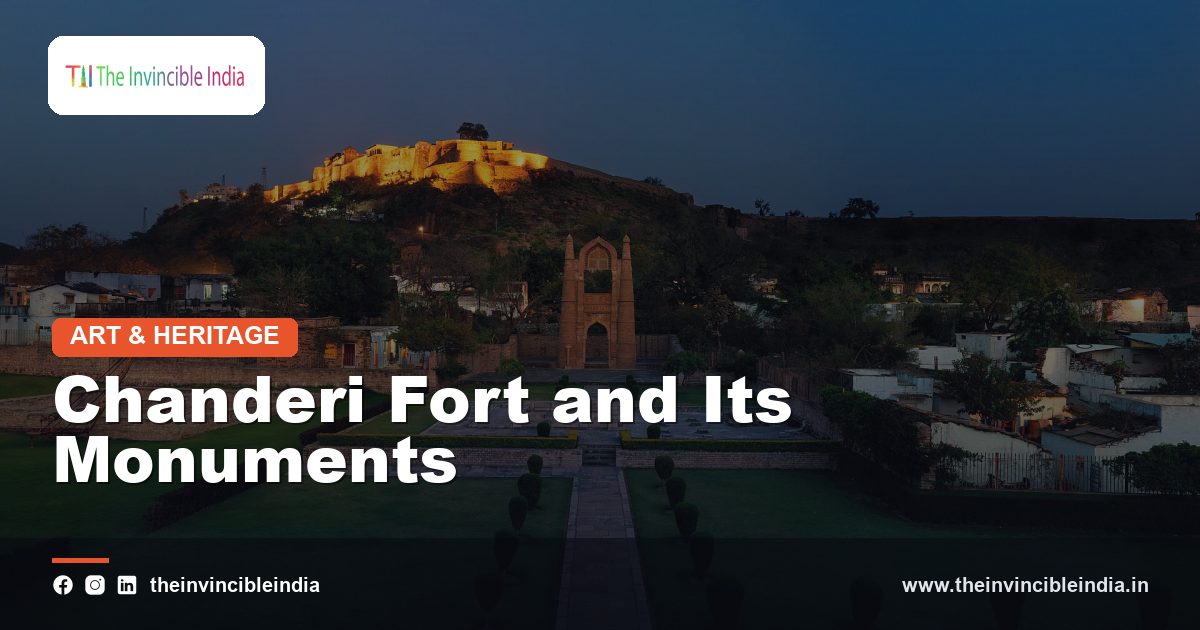
Chanderi Fort, also written Chanderi Qila and known locally as the fort of Chanderi, is a historic hill fort in the Ashoknagar district of Madhya Pradesh, standing above the old town of Chanderi on the frontier between Malwa and Bundelkhand. Over many centuries it was held by Rajput, Sultanate, Mughal and Bundela rulers, and each left buildings, gateways and tales within its walls. The town below is equally famous for its fine handwoven textiles. Its story belongs to the wider tradition of military architecture explored in the guide to the great forts of India. This article explains its history, monuments and significance.
Quick answer: Chanderi Fort is a historic hill fort overlooking the town of Chanderi in Ashoknagar district, Madhya Pradesh, India. Positioned between the regions of Malwa and Bundelkhand, it was ruled over the centuries by Rajput, Delhi and Malwa Sultanate, Mughal and Bundela powers. It is known for its monumental gateways, ruined palaces, tanks and the unfinished Koshak Mahal in the nearby landscape.
Key Takeaways
- Chanderi Fort is a hill fort above the town of Chanderi in Ashoknagar district, Madhya Pradesh.
- The fort lies on the old frontier between Malwa and Bundelkhand and controlled an important trade and military route.
- It passed through the hands of Rajput, Sultanate, Mughal and Bundela rulers, and each period left its mark.
- Notable monuments include the Badal Mahal Gateway, the Koshak Mahal, the Katighati gateway and the Jauhar Kund.
- The fort is associated with the siege of 1528, remembered in local tradition for the act of jauhar by the women of the garrison.
- The town of Chanderi is separately famous for its handwoven Chanderi fabric, which links the fort to a living craft tradition.
The sections below describe how the fort developed, what its monuments reveal and how it is remembered today.
Quick Facts
| Detail | Information |
|---|---|
| Location | Chanderi, Ashoknagar district, Madhya Pradesh |
| Type | Hill fort with palaces, gateways and tanks |
| Region | Border of Malwa and Bundelkhand |
| Ruling powers | Rajput, Delhi and Malwa Sultanates, Mughals, Bundelas |
| Notable gateway | Badal Mahal Gateway |
| Notable palace | Koshak Mahal (also called Koshak Mahal Sapt Manzil) |
| Associated craft | Chanderi handloom fabric |
| Protection | Protected monuments in the care of the Archaeological Survey of India |
What Is Chanderi Fort?
Chanderi Fort is a hill fort built on a rocky height above the town of Chanderi in central India. Its walls, bastions and gateways follow the shape of the hill, so the fort seems to grow out of the landscape instead of standing apart from it. Inside the enclosure there are ruined palaces, tanks, tombs and gateways that belong to several different periods. Like many Indian hill forts, it combined defence, administration and residence, and it also commanded the surrounding routes. The name Chanderi has been used for both the town and the fort for centuries, and the two are closely connected in history. Chanderi Fort therefore serves as a useful case study in how a fortified hill shaped the life of a medieval town.
Where Is Chanderi Fort Located?
Chanderi Fort is located in the Ashoknagar district of Madhya Pradesh, on the northern edge of the Malwa plateau near the border with Uttar Pradesh. The town of Chanderi lies below the fort, in a bowl of low hills and lakes near the Betwa river. The area sits between the regions of Malwa and Bundelkhand, and this made it a natural meeting point for travellers and armies. The nearest large towns are reached by road, and Chanderi is often visited on a heritage circuit that includes nearby sites of central India. The surrounding hills and water bodies give the landscape a quiet, scenic quality. The location of Chanderi helps explain why so many rulers wished to control it.
Why Was Chanderi Strategically Important?
Chanderi was strategically important because it controlled a route that linked Malwa in the south with Bundelkhand and the Gangetic plain in the north, and it also lay on paths leading toward Gujarat and the Deccan. A fort on a hill above the town could watch movement, collect tolls and protect trade. The surrounding hills offered natural defence, and tanks within and around the fort provided water for the garrison. Rulers who held Chanderi could influence both commerce and regional politics, which is why it appears again and again in chronicles. The fort’s position made it both a prize and a burden, as it attracted repeated attacks. Chanderi’s strategic setting explains the long list of dynasties that sought to hold it.
What Is the History of Chanderi Fort?
The history of Chanderi Fort stretches over many centuries, and tradition credits an early foundation to rulers of the Gurjara-Pratihara line, although the details are debated. In the medieval period the fort passed to Rajput chiefs and then to the sultans of Delhi, and later it became an important outpost of the Malwa Sultanate. In the early sixteenth century it was taken by the Mughal founder Babur, and under later Mughal rule it formed part of the imperial province system. Finally the Bundela rulers of the region held it, and their buildings are among the later layers of the site. Because so many powers held the fort, its walls and structures reflect a mixture of Rajput, Islamic and Bundela traditions. The long history of Chanderi shows how a single fort could mirror the shifting politics of central India.
What Is the Badal Mahal Gateway?
The Badal Mahal Gateway is a tall and imposing gateway in the town of Chanderi, close to the fort, and it is among the best known monuments of the place. It is a monumental entrance with two high pillars or towers of unequal design, and its slender, soaring shape makes it a landmark. The gateway is generally attributed to the Malwa Sultanate period and shows the decorative taste of the time. It appears on many images of Chanderi and has become a symbol of the town. The name Badal Mahal suggests a palace of the clouds, a poetic reference to its height. The Badal Mahal Gateway thus acts as a monumental threshold to the historic landscape of Chanderi.
What Is the Koshak Mahal?
The Koshak Mahal is a large palace-like structure near Chanderi that is traditionally linked with the Malwa ruler Mahmud Khalji in the fifteenth century. It is often described as a seven-storey building and is associated with a victory, although the building was apparently never completed, and its present form is partly a ruin. Its tall walls, arches and grand proportions show the ambition behind the project. The building is also called the Koshak Mahal Sapt Manzil, a name that refers to its intended seven levels. Visitors usually see it as a striking silhouette in the landscape. The Koshak Mahal remains a notable example of Sultanate-era monumental architecture in central India.
What Are the Gateways and Ramparts Like?
The fort is entered through a series of gateways that were designed to slow attackers and protect the inner enclosure. The Katighati gateway, a famous entrance cut through the rock of the hill, is among the most remarkable, as the passage appears like a huge notch carved in stone. Other gates in the walls are named for events or functions, and one of them has the grim name of the gate of blood, which recalls conflict. The ramparts follow the contour of the hill and are strengthened by bastions at intervals. Together the gates and ramparts show how a medieval fort used geography as well as masonry for defence. The defences of Chanderi illustrate the military engineering of several centuries.
What Is the Story of the Jauhar Kund?
The Jauhar Kund is a memorial within the fort associated with the act of jauhar, in which the women of a defeated garrison chose self-immolation rather than capture. Tradition connects the place with the siege of 1528, when the Mughal ruler Babur attacked Chanderi and the Rajput defenders resisted under their commander. The story is remembered in local memory as a tale of courage, loss and honour. As with many traditions of this kind, details come from later narratives and should be read with care. The site is treated with respect and is visited as a solemn place. The Jauhar Kund preserves an enduring and sombre memory of one of the fort’s most dramatic episodes.
Which Palaces and Buildings Stand Inside the Fort?
The fort and its immediate surroundings contain a number of palaces and buildings, many of them now partly ruined. The Nau Khanda Palace, associated with the Bundela period, shows the layered, multi-level planning typical of such residences. The Hawa Mahal, a pavilion designed to catch breezes, and other smaller structures once served as places of rest and administration. Tanks, wells and stepwells provided water, and stepped structures are an important part of the local landscape. The architecture mixes the arches and domes of the Sultanate tradition with the decorative features of Rajput and Bundela styles. These buildings together show that the fort was a complete settlement rather than a purely military station. The palaces of Chanderi give a glimpse of the daily life of the rulers who lived there.
What Other Monuments Are Found Around Chanderi?
Around the fort the town of Chanderi holds a remarkable collection of monuments, including mosques, tombs, stepwells and lakes. The Jama Masjid reflects the Sultanate architecture of the region, while tombs and memorial structures show later styles of commemoration. The Battisi Baoli, a large stepwell, and other water works reveal the importance of water management in a dry plateau. Nearby lakes such as the Parmeshwar Tal add to the scenic quality of the town. Jain temples and pilgrim sites in the surrounding area testify to the diversity of religious life. Chanderi is therefore valued as a historic town as much as a single fort, and its monuments should be seen together.
How Is the Fort Connected to Chanderi Fabric?
The fort is connected to the famous Chanderi fabric through the history of the town it overlooks. Chanderi is renowned for its handwoven textiles, which are light, translucent and often woven with fine silk and cotton threads and decorated with delicate motifs. The weaving tradition developed in the town over many centuries, and it is believed to have enjoyed the patronage of the courts that governed the region. Weavers still practise the craft in homes and workshops, and the fabric is sold across India and abroad. The craft links the military history of the fort with the artistic life of the community. Chanderi fabric thus gives the place a second identity as a centre of textile heritage, and an essential part of its cultural legacy.
Why Is Chanderi Important to the Heritage of Madhya Pradesh?
Chanderi is important to the heritage of Madhya Pradesh because it preserves, in a single compact area, monuments from several dynasties and religions. The fort and the town show how Rajput, Sultanate, Mughal and Bundela cultures overlapped on a frontier between regions. The architecture provides evidence for study of building techniques, materials and styles in central India. The surviving crafts and customs of the town add living heritage to the stone monuments. For students of history, Chanderi offers a place where political, artistic and social stories can be followed together. The site therefore deserves a place beside the better known monuments of the state when the heritage of Madhya Pradesh is discussed.
How Does Chanderi Compare With Other Indian Hill Forts?
Chanderi shares many features with other Indian hill forts, such as strong gateways, bastioned walls and carefully planned water supply, but it also has its own character. Its blend of Sultanate and Rajput architecture is typical of central India, and the cut-rock Katighati gateway is distinctive. Compared with the grand royal forts of Rajasthan, Chanderi is more modest in scale but rich in layers of history. It also stands in a landscape of lakes and hills rather than on a dramatic desert cliff. Studying it beside forts such as Gwalior and Mandu helps clarify how central Indian forts differed from those in other regions. Chanderi is therefore a valuable point of comparison within the wider study of Indian fortification.
What Is the Heritage Status of Chanderi Fort?
Chanderi Fort and several monuments around the town are protected under heritage law and are under the care of the Archaeological Survey of India and the state authorities. Protection includes clearing vegetation, repairing walls and gateways, and controlling visitor access to fragile areas. The town and its crafts have also attracted attention from heritage organisations interested in the preservation of living traditions. Conservation of a large hill fort is challenging, as weather and plant growth constantly threaten the masonry. Interest in cultural tourism has helped raise awareness and generate resources for care. Continued stewardship is needed so that Chanderi’s monuments can remain safe for future generations.
Chanderi Fort Today
Chanderi Fort today is a quiet heritage destination where visitors can walk among gateways, ruined palaces and views over the lakes and hills. It is appreciated by historians, photographers, craft enthusiasts and travellers who value places away from the busiest tourist circuits. The fort and the town together present a layered portrait of central Indian history, from early Rajput rule to the Sultanate, Mughal and Bundela periods. Local weavers keep alive a craft that has made the name of Chanderi known far beyond Madhya Pradesh. Ongoing conservation and research continue to add to what is known about the site. Chanderi Fort remains a meaningful reminder of a frontier region where many cultures met and left lasting marks.
Sources & Further Reading
- Archaeological Survey of India (asi.nic.in).
- Ministry of Culture, Government of India (indiaculture.gov.in).
Frequently Asked Questions
What is Chanderi Fort?
Chanderi Fort is a historic hill fort above the town of Chanderi in Ashoknagar district, Madhya Pradesh. It was held by Rajput, Sultanate, Mughal and Bundela rulers. It is known for its gateways, palaces and tanks.
Where is Chanderi Fort located?
Chanderi Fort is located in Ashoknagar district of Madhya Pradesh, near the border with Uttar Pradesh. It stands on a hill above the town of Chanderi on the frontier between Malwa and Bundelkhand. It is reached by road from nearby towns.
What is Chanderi Fort famous for?
Chanderi Fort is famous for its monumental gateways, its ruined palaces, its long history under several dynasties and the memory of the siege of 1528. The town below is also famous for Chanderi handwoven fabric. Together these give the place both military and artistic fame.
What is the Koshak Mahal in Chanderi?
The Koshak Mahal is a large, partly ruined palace near Chanderi traditionally linked with the Malwa ruler Mahmud Khalji in the fifteenth century. It is also called the Koshak Mahal Sapt Manzil because it was meant to have seven levels. It is a notable example of Sultanate architecture.
What is the Badal Mahal Gateway?
The Badal Mahal Gateway is a tall monumental gateway in Chanderi, generally attributed to the Malwa Sultanate period. Its soaring, slender design has made it a symbol of the town. The name suggests a palace of the clouds.
Is Chanderi Fort connected to Chanderi sarees?
Yes, the fort overlooks the town of Chanderi, which is famous for its handwoven Chanderi fabric. The weaving craft developed in the town over many centuries under the patronage of the ruling courts. The fabric is a key part of the town’s cultural identity.


