

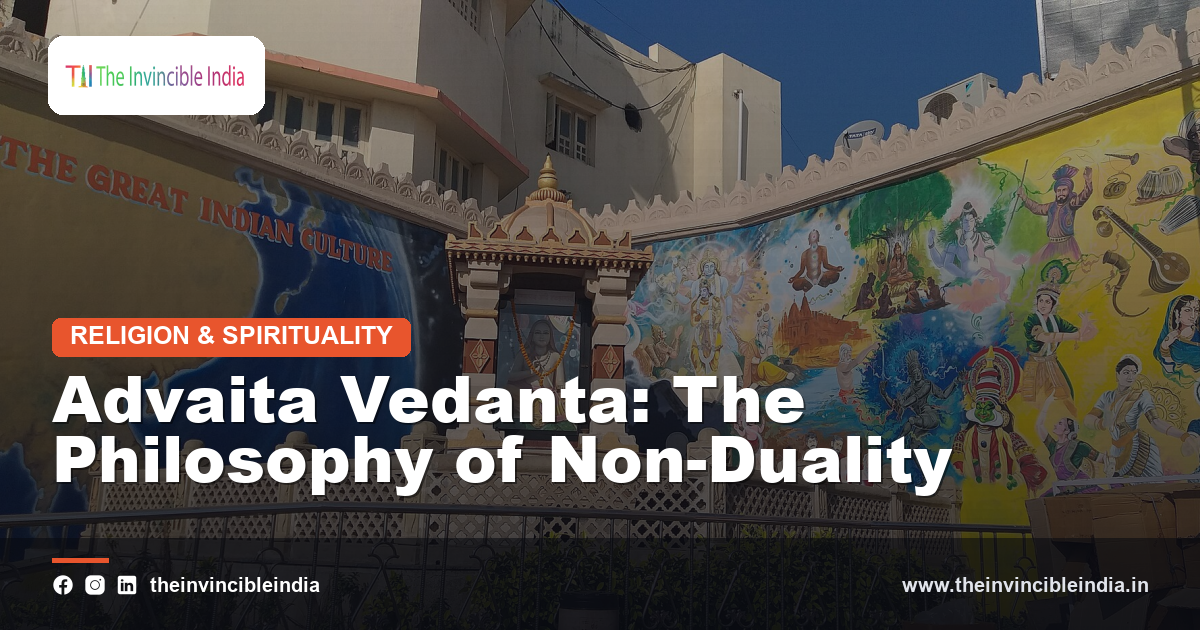
Advaita Vedanta is among the most influential schools of Indian philosophy, a tradition that approaches the deepest questions of existence through the idea of non-duality. Its central proposal is that the individual self and the ultimate reality are not fundamentally separate, and that the apparent multiplicity of the world rests on a single, undivided ground. Rooted in the Upanishads and given systematic form by Adi Shankara and later teachers, it forms an important strand of the wider Vedanta tradition. This guide explores its textual sources, key concepts, methods of study, institutions, and its enduring influence on Indian thought, literature, and contemporary spiritual conversation.
Quick Facts
| Detail | Information |
|---|---|
| Tradition | Advaita Vedanta (non-dual Vedanta) |
| Philosophical Family | Vedanta, one of the six classical Indian schools |
| Key Teacher | Adi Shankara |
| Foundational Texts | Upanishads, Brahma Sutras, Bhagavad Gita |
| Central Idea | Non-duality of Atman and Brahman |
| Path Emphasized | Jnana (knowledge) with ethical preparation |
What Advaita Means
The Sanskrit word Advaita is usually rendered as non-duality, literally meaning not two. It does not deny that the world is experienced as full of variety; rather, it proposes that beneath all variety there is a single reality that does not divide into separate parts. The word Vedanta refers to the end or culmination of the Vedas, which points to the Upanishads, the philosophical portions of the Vedic corpus. Together the two terms name a school that reads the Upanishads as teaching a unity beyond ordinary distinctions of subject and object, self and world, knower and known.
This simple idea carries a demanding implication, because it asks the student to reconsider the very basis of everyday experience. Advaita Vedanta is therefore best understood as a disciplined inquiry into the nature of the self, not merely a set of beliefs, and its meaning lies in this invitation to examine reality directly.
Roots in the Upanishads
The textual foundation of Advaita Vedanta lies in the Upanishads, a body of ancient Indian texts that record the reflections of teachers and students on the nature of the self and the cosmos. These texts contain dialogues, similes, and short declarations that explore how the individual relates to the ultimate. Many passages speak of a single principle underlying all things, and Advaita teachers read these passages as the heart of the scriptural message.
The Upanishads are not a single systematic treatise, and different schools of Vedanta have interpreted them in different ways. Advaita Vedanta stands out for the consistency with which it reads the major passages as pointing toward non-duality. The Upanishadic roots remain the primary source of authority for the tradition, and every later development refers back to them.
Brahman as Ultimate Reality
At the center of Advaita Vedanta stands Brahman, the ultimate reality described in the Upanishads as the ground of all existence. Brahman is understood as unchanging, without parts, and beyond the limits of name and form. Advaita thinkers often describe it through three terms: being, consciousness, and fullness, which are intended as pointers rather than complete definitions, since Brahman is said to exceed all description.
Because Brahman is considered the basis of everything, the school does not treat it as an object located somewhere apart from the world. It is instead the reality in which all experience appears. This understanding sets Advaita Vedanta apart from approaches that picture the ultimate as a distant being, and it explains why the tradition places so much emphasis on inquiry into the self.
Atman and the Self
Atman is the Sanskrit term for the self, the innermost witness of thoughts, sensations, and experiences. Advaita Vedanta distinguishes this witnessing awareness from the body, the senses, the mind, and the personality, all of which are seen as changing and as objects of observation. What remains constant across waking, dreaming, and deep sleep is taken to be the true self.
The decisive claim of the school is that this Atman is not different from Brahman. The individual self, when understood correctly, is the same reality that underlies the universe. This is the meaning of the tradition’s best known formulations, and it is why self-knowledge holds such a central place. To know the self fully is, in this view, to know the ultimate, which turns the study of the inner life into the most important inquiry a person can undertake.
Maya and the Appearance of Multiplicity
If reality is one, why does the world appear so varied? Advaita Vedanta answers with the concept of Maya, often translated as illusion but better understood as the power by which the one appears as many. Maya is not a claim that the world is a mere fantasy in the ordinary sense. It is a way of describing how names and forms are experienced as independent realities when they depend on a deeper ground.
Teachers often illustrate this with familiar images, such as a rope mistaken for a snake in dim light, where the error disappears once the rope is seen clearly. The point of such examples is not to dismiss everyday life but to show that understanding can change how reality is perceived. Maya thus explains the appearance of diversity while preserving the principle of unity.
Adi Shankara and His Legacy
Adi Shankara, also called Shankaracharya, is the teacher most closely associated with the classical formulation of Advaita Vedanta. Tradition remembers him as a young scholar and renunciant who travelled widely, engaged in debate with other schools, and wrote commentaries that gave the philosophy its lasting shape. Exact biographical details are discussed by historians, but his importance in Indian intellectual history is not in doubt.
Shankara did not invent the idea of non-duality, which had earlier voices, but he presented it with remarkable clarity and argued for it on the basis of scripture and reasoning. His writings made Advaita a major force in Indian thought, and later generations of teachers have continued to study, interpret, and defend his positions. His name remains a symbol of philosophical rigor and spiritual seriousness.
The Three Foundational Texts
Vedanta traditions commonly rely on three sources known together as the Prasthanatraya, meaning the triple foundation. These are the principal Upanishads, the Brahma Sutras, and the Bhagavad Gita. The Upanishads supply the revealed vision, the Brahma Sutras offer a compact set of aphorisms that organize and defend that vision, and the Gita presents its practical application within the demands of life and action.
Adi Shankara is traditionally credited with commentaries on these three sources, and these commentaries became central reference points for Advaita teachers. Studying the triple foundation together allows students to see how a single philosophical outlook can be expressed through poetry, argument, and dialogue. The Prasthanatraya remains the standard framework through which Advaita Vedanta is taught.
Jnana as the Path of Knowledge
Advaita Vedanta holds that the fundamental human problem is ignorance of one’s true nature, and that the remedy is knowledge rather than ritual or effort alone. This knowledge, called jnana, is not mere information but a direct and settled understanding of the self as non-different from Brahman. Study of the scriptures under a qualified teacher is regarded as the main means of generating it.
Traditional teaching describes a threefold process of hearing the texts, reflecting on their meaning, and sustained contemplation until doubts fall away. The emphasis on knowledge does not make the tradition dry or merely intellectual, because the understanding sought is meant to transform how a person lives and relates to others. The path of jnana therefore joins rigorous thought with inner maturity.
Ethical and Contemplative Preparation
Although knowledge is the central means, Advaita Vedanta does not suggest that anyone can grasp its teaching without preparation. Classical sources describe a set of qualities that make a student ready, including discrimination between the lasting and the passing, a measure of detachment, mental calm, self-restraint, and a sincere desire for freedom. These qualities support the steady attention that serious study demands.
Ethical living, devotion, selfless action, and meditation are all recognized as ways of refining the mind. Many teachers present them as complementary to inquiry rather than competing with it. This integration explains why Advaita communities often combine philosophical study with prayer, service, and disciplined routines, and why the tradition has never been confined to the classroom alone.
The Mahavakyas
Within the Upanishads, certain short declarations are singled out as the great sayings, known as the Mahavakyas. They express in compact form the identity of the individual self with the ultimate reality, and they are drawn from different Upanishads associated with different Vedic traditions. Teachers present them as the distilled statement of the Advaita vision.
In traditional instruction, these sayings are not treated as slogans to be repeated mechanically. They are explored patiently, with attention to the meaning of each word and the context in which it appears. The goal is to let the student see for themselves what the words indicate. The Mahavakyas thus serve as a bridge between scriptural text and lived understanding, summarizing the entire teaching in a few memorable phrases.
Monastic Centers and Teaching Lineages
Advaita Vedanta has been sustained over the centuries by lineages of teachers and by monastic institutions called mathas. Tradition holds that Adi Shankara established centers in different regions of India to preserve and transmit the teaching, and heads of these institutions continue to carry the title of Shankaracharya. These centers act as places of study, ritual, and guidance for seekers and lay communities.
Beyond the formal mathas, countless teachers in many parts of the country have passed the tradition on through personal instruction, commentaries, and spoken teaching. The principle of the guru and disciple relationship remains important, since the texts are considered best understood when explained by someone who has studied and embodied them. These lineages give Advaita Vedanta continuity across time and geography.
Dialogue with Other Vedanta Schools
Advaita Vedanta is one of several Vedanta schools, each reading the same Upanishadic sources in its own way. Traditions such as Vishishtadvaita and Dvaita emphasize a lasting distinction between the individual soul and the divine, and they give a larger place to personal devotion as the central path. Advaita, by contrast, regards the distinction as ultimately resolved in knowledge.
These differences produced centuries of vigorous philosophical debate, conducted through commentaries, treatises, and public disputation. The exchange sharpened the arguments of every side and enriched Indian thought as a whole. Seen together, the schools show that the Upanishads can support a range of interpretations, and that disagreement within a shared framework has long been a source of creativity rather than conflict.
Reasoning, Debate, and Method
Advaita Vedanta places great value on reasoned argument alongside scriptural authority. Its thinkers developed careful responses to rival schools, examining questions about perception, inference, the nature of knowledge, and the status of the world. They argued that reason, properly used, supports the scriptural teaching, even though the final realization is considered to go beyond argument.
Teaching methods include analysis of everyday experience, such as the contrast between the changing contents of the mind and the steady awareness that observes them. Analogies drawn from daily life are used to clarify subtle points. This combination of logic, example, and textual interpretation gives the tradition a distinctive character, making it both a philosophy that can be debated and a discipline that can be practiced.
Influence on Literature, Art, and Thought
The ideas of Advaita Vedanta have flowed far beyond the circles of formal philosophy. They appear in devotional poetry, in classical and folk literature, in reflections on the arts, and in the vocabulary through which many Indians think about the self and the world. Concepts such as the witness consciousness and the unity beneath diversity have become part of the wider cultural imagination.
The tradition has also shaped how many people approach contemplative practice, ethics, and the idea of inner freedom. Even people who belong to other religious traditions often encounter Advaita themes through literature, music, or conversation. This diffusion reflects the strength of a philosophy that speaks to universal questions about identity and meaning, and it explains its long and continuing presence in Indian life.
Modern Interpreters and Global Interest
In the modern period, Advaita Vedanta found fresh voices who presented its teaching to new audiences. Swami Vivekananda carried Vedantic ideas to international gatherings and linked them with service to humanity, while Ramana Maharshi became widely known for his simple emphasis on inquiry into the question of who one is. Many other teachers and scholars have contributed to its modern expression.
Universities in India and abroad now study Advaita as an important chapter in the history of philosophy, and its themes have drawn interest from scholars of religion, psychology, and comparative thought. Translations and commentaries have made the primary texts widely available. The tradition’s global reach shows that its questions are not limited by language or culture, and that its invitation to self-inquiry continues to attract serious attention.
Common Misunderstandings
Advaita Vedanta is sometimes summarized in ways that distort it. One frequent misunderstanding is that it declares the world to be nothing and therefore encourages indifference to life. In fact, the tradition has long insisted on ethical conduct, compassion, and responsible action, and it treats the world as a real field of experience even while examining its ultimate basis.
Another misunderstanding is that non-duality erases the individual in a way that makes personal growth meaningless. Teachers respond that the discipline of study and practice is exactly what leads to freedom from limiting self-images. Careful reading of the texts, guided by a teacher, helps avoid such oversimplifications. Understanding the tradition accurately requires attention to context, nuance, and the practical commitments that accompany its philosophy.
Advaita Vedanta Today
Advaita Vedanta remains a living tradition, taught in monasteries, universities, study circles, and online communities. Learners come to it for many reasons, including academic interest, spiritual search, and a desire to understand the roots of Indian philosophy. Its texts continue to be recited, translated, and discussed, and its lineages of teachers remain active across the country and abroad.
For many, its core insight, that the self is not separate from the whole, offers a framework for thinking about identity, compassion, and the unity of life. Whether approached as philosophy, as spiritual discipline, or as cultural heritage, Advaita Vedanta endures as one of India’s most distinctive contributions to world thought. Its long history demonstrates how a single idea, carefully examined, can sustain a tradition across many centuries.
Sources & Further Reading
- Ministry of Culture, Government of India (indiaculture.gov.in).
- Sahitya Akademi, India’s national academy of letters.
Frequently Asked Questions
What does Advaita Vedanta teach?
Advaita Vedanta teaches that the individual self (Atman) and the ultimate reality (Brahman) are not fundamentally different. The apparent multiplicity of the world is understood to rest on one undivided ground. Liberation is described as the direct knowledge of this identity.
Who was Adi Shankara?
Adi Shankara was a philosopher and teacher traditionally credited with giving Advaita Vedanta its classical form through commentaries on the Upanishads, the Brahma Sutras, and the Bhagavad Gita. Scholars discuss the details of his life, but his influence on Indian thought is widely acknowledged.
Does Advaita Vedanta say the world is unreal?
Advaita Vedanta uses the idea of Maya to explain how one reality appears as many forms. It does not encourage neglect of ethical life or responsibility. The tradition treats everyday experience seriously while examining its ultimate basis.
How is Advaita different from other Vedanta schools?
Other Vedanta schools, such as Vishishtadvaita and Dvaita, maintain a lasting distinction between the individual soul and the divine. Advaita holds that this distinction is resolved in knowledge. All of them draw on the same Upanishadic sources.
Can anyone study Advaita Vedanta?
The texts are widely available today in translation and are studied by people from many backgrounds. Traditional teaching recommends guidance from a qualified teacher and a certain ethical and mental preparation. Many contemporary centers offer structured courses.


