

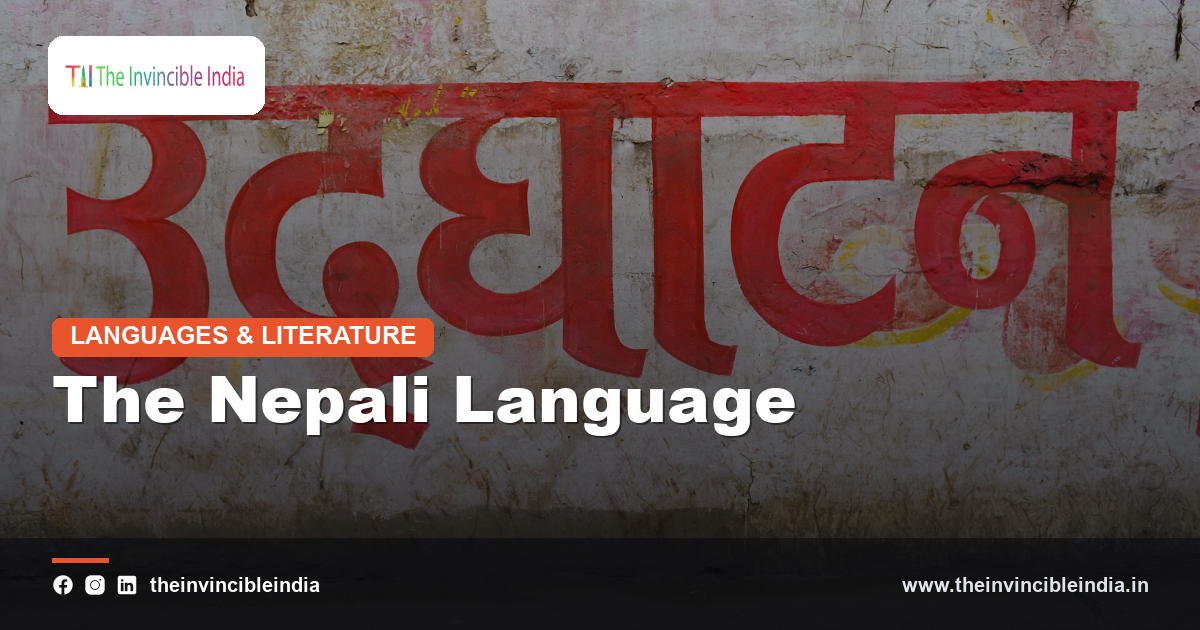
Nepali is an Indo-Aryan language spoken across the central Himalayan belt, serving as the national language of Nepal and as a living mother tongue for millions of people across India, particularly in Sikkim, the Darjeeling hills, and parts of Assam and the wider Northeast. Within the family of languages of India, Nepali holds a distinctive place as a scheduled language with a rich written tradition, a shared script with Hindi and Sanskrit, and a literary culture nurtured by poets, novelists, journalists, and singers on both sides of the border. Its story is one of mountain migration, cultural exchange, and a deep devotion to the written and spoken word that continues to shape identity across the Himalayan region.
Quick Facts
| Detail | Information |
|---|---|
| Language Family | Indo-Aryan (Indo-European) |
| Branch | Eastern Pahari group |
| Script | Devanagari |
| Primary Regions in India | Sikkim, Darjeeling hills, Assam, Northeast |
| Status in India | Scheduled language; official language of Sikkim |
| Literary Pioneer | Bhanubhakta Acharya, honoured as Aadikavi |
Origins and Language Family
Nepali belongs to the Indo-Aryan branch of the Indo-European language family, sharing deep ancestry with Sanskrit and a close kinship with the languages of the northern Indian plains. Its grammar, core vocabulary, and sound system all reflect this inheritance, which connects it to the great classical tradition of the subcontinent.
Within this family, Nepali is usually classified among the Pahari languages, the tongues of the lower and middle Himalayan ranges. This placement highlights how the language grew in the mountains while remaining part of the wider Indo-Aryan story, a bridge between the cultures of the plains and the peoples of the high hills.
The Eastern Pahari Branch
The Pahari languages are commonly divided into western, central, and eastern groups, and Nepali is the principal representative of the eastern group. Related speech forms are found along the Himalayan arc, and linguists often study them together to understand how Indo-Aryan speech spread and diversified through the mountain valleys.
As the best known and most widely written member of its group, Nepali acquired a standard form that is taught in schools and used in newspapers, broadcasting, and administration. This standardisation gave the language a prestige and reach beyond its local origins, and it allowed speakers from many different hill communities to share a common medium of expression.
Names and Historical Identity
The language has been known by several names over time, reflecting the shifting political and social landscape of the Himalayan region. Terms such as Khas Kura and Gorkhali have been used in the past, pointing to the communities and the kingdom whose expansion helped carry the language across the hills.
In the twentieth century the name Nepali became the established designation, particularly as the language was promoted in education and public life. In India, many speakers also use the term Gorkha or Gorkhali in a cultural sense, and the language functions as a unifying marker for a community whose members trace their roots to many different hill peoples.
The Devanagari Script
Nepali is written in the Devanagari script, the same writing system used for Sanskrit, Hindi, and Marathi. Devanagari is an abugida in which each consonant carries an inherent vowel, and vowel signs are added above, below, or beside the consonant to change its sound.
The shared script gives Nepali readers easy access to a vast body of literature in related languages and makes it straightforward for speakers to learn Hindi and Sanskrit. A horizontal line runs across the top of most letters, giving the script its characteristic appearance. In print, calligraphy, and signage across the Himalayan towns, this elegant script remains the visible face of the language.
Sounds and Grammar
Nepali has a grammar that will feel familiar to students of other Indo-Aryan languages, yet it retains features of its own. Nouns are not marked for grammatical gender in the way Hindi nouns are, which simplifies one of the most challenging aspects of learning related languages. Verbs, however, are rich in forms, reflecting tense, mood, and respect.
Sentences generally follow a subject, object, verb order, and relationships between words are shown by postpositions placed after nouns rather than prepositions placed before them. The sound system includes aspirated and unaspirated consonants and a range of vowels. Together these features give Nepali its clear, flowing rhythm and a structure that is logical and approachable.
Honorifics and Social Register
One of the most distinctive features of Nepali is its elaborate system of honorific levels. Speakers choose among several forms of the word for you, and the verb changes accordingly, depending on the age, status, and closeness of the person being addressed. The system expresses respect, intimacy, or distance with great precision.
Choosing the right level is an essential part of polite speech, and children learn it early within the family. Elders, teachers, and guests are addressed with the most respectful forms, while close friends and younger relatives are addressed more casually. This linguistic courtesy mirrors the importance of respect for seniors and hospitality in Himalayan society, and it makes the language a vehicle for cultural values as well as meaning.
Vocabulary and Borrowings
The vocabulary of Nepali draws heavily on Sanskrit, which supplies much of the formal, literary, and religious lexicon. Words inherited from earlier stages of Indo-Aryan form the everyday core, while a layer of borrowings from Hindi, Persian, and Arabic entered through contact with the northern plains and the wider subcontinent.
Because Nepali has lived alongside Tibeto-Burman languages for centuries, it has also absorbed words and expressions from neighbouring communities, especially in domains such as food, clothing, farming, and festivals. In recent times, English words have joined the mix through education and media. This layered vocabulary records the many encounters that shaped the language over its long journey through the mountains.
Dialects and Regional Variation
Like any widely spoken language, Nepali shows regional variation in pronunciation, vocabulary, and idiom. Speakers from different hills and valleys may recognise one another by small differences in accent or by local words for familiar objects, while still understanding each other without difficulty.
The Nepali spoken in the Darjeeling hills, Sikkim, and the Northeast has developed its own flavour through contact with Bengali, Hindi, Assamese, and local languages, as well as with Tibeto-Burman neighbours. These Indian varieties are part of the same continuum, and the standard written form allows readers across the region to share newspapers, textbooks, and books, keeping the language cohesive despite its geographic spread.
Nepali in Sikkim, Darjeeling and the Northeast
In India, Nepali is spoken by a large and well established community concentrated in Sikkim, the Darjeeling and Kalimpong hills of West Bengal, and many parts of Assam, Meghalaya, Arunachal Pradesh, and other Northeastern states. These communities have lived in the region for generations and regard Nepali as the language of home and cultural belonging.
In Sikkim, Nepali is among the official languages and is widely used in schools, government, and the media. In Darjeeling, it is the language of the tea gardens, the bazaars, and the vibrant literary and musical scene. This Indian presence makes Nepali a truly Indian language as well as the national language of a neighbouring country.
Bhanubhakta Acharya and the Aadikavi Tradition
The beginning of Nepali literary culture in its modern form is widely associated with Bhanubhakta Acharya, who is honoured as the Aadikavi, or first poet, of the language. His retelling of the Ramayana in Nepali verse brought the great epic into the speech of ordinary households and made poetry in the vernacular a source of national pride.
Because his version was simple, melodious, and accessible, it travelled far beyond scholarly circles and became part of daily devotion and recitation. Bhanubhakta is remembered not only as a gifted writer but also as someone who showed that the spoken language of the hills was worthy of high literature. His legacy continues to inspire poets and readers across the Nepali-speaking world.
Modern Poetry and the Romantic Awakening
In the twentieth century Nepali poetry entered a new phase, moving beyond devotional and courtly themes towards personal feeling, nature, and social reflection. Lakshmi Prasad Devkota, honoured with the title Mahakavi, is the towering figure of this romantic awakening, admired for epic poems, lyrics, and a bold imaginative range.
Poets after him explored free verse, protest, humanism, and the landscapes of the mountains, enriching the language with new imagery and rhythms. This modern poetic tradition thrived in Kathmandu as well as in Darjeeling, Kalimpong, and Gangtok, where gatherings, magazines, and recitals gave poets a lively public platform. Nepali poetry thus remains a barometer of the changing hopes and concerns of its people.
Fiction, Essays and Drama
Alongside poetry, Nepali developed a strong prose tradition that includes the short story, the novel, the essay, and the one-act and full-length play. Writers turned to subjects such as village life, family tension, love, migration, and social change, giving the language a mirror in which its communities could recognise themselves.
Novelists and storytellers from both Nepal and India contributed to this growth, and their works have been read widely across the hills and plains alike. Writing from Darjeeling and Sikkim often reflects the experience of living between cultures, with tea gardens, mountain paths, and soldiers on distant postings appearing as recurring images. Together these genres show the maturity of Nepali as a medium of serious and imaginative prose.
Folk Songs and Oral Traditions
Long before the printed page, Nepali was carried by song. Folk songs accompany farm work, festivals, weddings, and the long journeys of hill life, and their lyrics often speak of longing, separation, nature, and the hardships and joys of mountain communities. Many of them are sung without any fixed author, passed on by memory from one generation to the next.
Instruments such as the madal, a hand drum, and the sarangi, a bowed string instrument, are commonly associated with this music, and dance forms often accompany the songs at community gatherings. This vibrant oral tradition continues to feed modern Nepali music, film, and poetry, keeping the voice of the hills alive in contemporary culture.
Print, Press and Education
The spread of printing and journalism gave Nepali a public life beyond oral tradition. Newspapers, magazines, and literary journals appeared in hill towns of India as well as in Nepal, offering a stage for new writers and a means of discussing social and political issues in the language of the community.
Education has been equally important. Nepali is taught as a language and often as a medium of instruction in schools and colleges across Sikkim and the Darjeeling region, and universities offer advanced study of its literature. Textbooks, dictionaries, and grammars helped establish a shared standard, ensuring that young speakers can read and write with confidence in the language of their heritage.
Recognition and Official Status
The Nepali language enjoys formal recognition in India. It is included among the scheduled languages listed in the Eighth Schedule of the Constitution, a recognition that affirms its importance and supports its development through education, literature, and public institutions. This inclusion was welcomed by the community as a sign of respect for its cultural contribution.
In Sikkim, Nepali is an official language of the state, and in several districts of West Bengal and the Northeast it is used in local administration and schooling. The Sahitya Akademi recognises Nepali literature and honours its writers with awards and translation projects, helping works in the language reach readers in other Indian languages and strengthening its place within the national literary landscape.
Nepali and Cross-Border Culture
The Nepali language is one of the great cultural bridges between India and Nepal. Families, pilgrims, traders, and soldiers have moved across the border for generations, and the language travels with them, linking communities through shared literature, music, and festivals such as Dashain and Tihar.
Writers in India read authors from Nepal, and the exchange of books, songs, and films keeps both sides closely connected. The shared script and the overlap of religious and cultural traditions make the Himalayan belt a single cultural zone in many respects. This friendly exchange has enriched both countries, and the Nepali language stands as one of the clearest symbols of their ancient and continuing closeness.
Challenges and Preservation
Like many regional languages, Nepali faces the pressures of a globalising world. The attraction of English and Hindi in education and employment can lead some young speakers to use their mother tongue less in formal settings, and migration for work sometimes weakens daily contact with the language.
Communities, schools, and cultural organisations have responded with literary festivals, publishing projects, language classes, and digital initiatives. Writers and teachers encourage children to read and write in Nepali, and online platforms have given the language new reach. These efforts show a determination to preserve the language as a living, evolving medium rather than a relic of the past.
The Nepali Language Today
Today Nepali stands as a confident modern language with a long literary memory. It is heard in homes, classrooms, newsrooms, concert halls, and film studios across the Himalayan region, and it is written by a new generation of poets, novelists, bloggers, and songwriters who carry the tradition forward.
For India, Nepali is a valued part of the national mosaic, representing the culture of the eastern Himalaya and the many communities who call it home. Its script, honorifics, songs, and stories together form a heritage worth studying and celebrating. The language remains a living bond between peoples, mountains, and memories, and its future appears secure in the voices of its speakers.
Sources & Further Reading
- Sahitya Akademi (sahitya-akademi.gov.in).
- Ministry of Culture, Government of India (indiaculture.gov.in).
Frequently Asked Questions
What language family does Nepali belong to?
Nepali is an Indo-Aryan language within the Indo-European family. It is generally placed in the Eastern Pahari group, which is made up of the languages of the Himalayan foothills.
Which script is used to write Nepali?
Nepali is written in the Devanagari script, the same writing system used for Sanskrit, Hindi, and Marathi. This shared script makes it easy for readers to move between these languages.
Where is Nepali spoken in India?
In India, Nepali is spoken mainly in Sikkim, the Darjeeling and Kalimpong hills of West Bengal, and parts of Assam and the wider Northeast. It is an official language of Sikkim and a scheduled language of the country.
Who is Bhanubhakta Acharya?
Bhanubhakta Acharya is honoured as the Aadikavi, or first poet, of the Nepali language. He is remembered for rendering the Ramayana into Nepali verse that ordinary people could understand and recite.
What are the honorific levels in Nepali?
Nepali has several levels of address, with different forms of the word for you and matching verb endings. The speaker chooses a level according to the age, status, and familiarity of the listener, expressing respect or closeness.


