

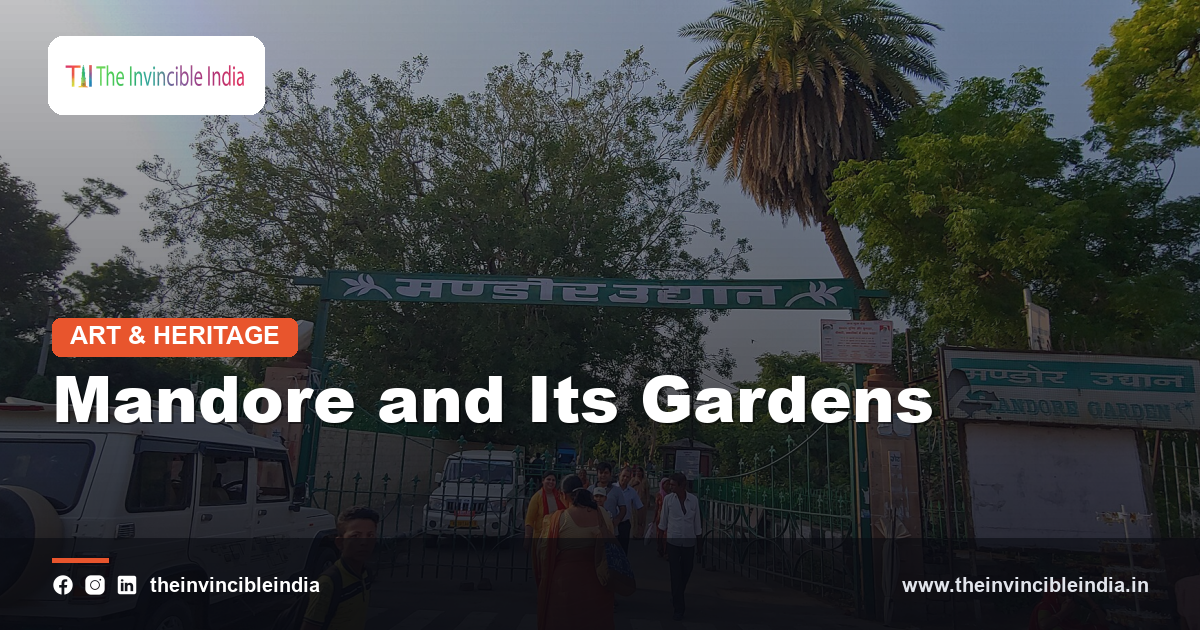
Mandore, also called Mandavyapura in its early history and spelled Mandor in some sources, is an ancient town and garden complex a few kilometres north of Jodhpur in Rajasthan. For several centuries it was the capital of the rulers of Marwar, long before Jodhpur was founded as a new seat of power. Today the place is best known for its terraced gardens, its tall red sandstone cenotaphs of Marwar rulers and the rock-cut Hall of Heroes. Mandore forms an essential chapter in the story of royal palaces and courts in India, and it rewards visitors who want to look beyond the famous fort of Jodhpur. This guide explains what Mandore is, how it grew and what remains.
Quick answer: Mandore is a historic town and heritage garden complex about nine kilometres north of Jodhpur, Rajasthan, India, and it was the capital of Marwar before Jodhpur was founded. It is known for its terraced gardens, tall red sandstone cenotaphs of the Rathore rulers and the Hall of Heroes. The site combines early medieval history, Rajput royal memory and public parkland.
Key Takeaways
- Mandore is a historic town and garden complex north of Jodhpur, Rajasthan, and was once the capital of Marwar.
- Its early name was Mandavyapura, and it was a seat of the Pratihara rulers before the Rathores took it.
- The Rathore rulers of Marwar made Jodhpur their capital in the fifteenth century, after which Mandore became a place of memory and leisure.
- The gardens are famous for tall cenotaphs, or devals, built in red sandstone to honour former rulers of Marwar.
- The Hall of Heroes, or Veeron Ki Sal, is a gallery of figures carved from rock, representing deities and folk heroes of Rajasthan.
- The garden complex is a popular public park, a museum site and a cultural landmark for the people of Jodhpur.
The sections below describe where Mandore lies, how it developed and what a visitor should look for.
Quick Facts
| Detail | Information |
|---|---|
| Location | About nine kilometres north of Jodhpur, Rajasthan |
| Region | Marwar, western Rajasthan |
| Early name | Mandavyapura (also written Mandor) |
| Type | Ancient capital, garden complex and royal cenotaph site |
| Famous for | Red sandstone cenotaphs, terraced gardens, Hall of Heroes |
| Associated rulers | Pratiharas, then Rathores of Marwar |
| Largest cenotaph | That of Maharaja Ajit Singh |
| Also includes | Government museum and temples |
What Is Mandore?
Mandore is a historic site and public garden complex on a rocky ridge a few kilometres north of the city of Jodhpur in the Marwar region of Rajasthan. It combines the ruins of an ancient fortified capital, a series of royal cenotaphs, temples, a museum and landscaped terraces that rise in steps against the rock. The name has long been associated with Marwar, whose rulers made it their seat before moving south. The visitor sees a place that works on several levels at once: it is an archaeological site, a memorial ground for rulers and a pleasant park filled with trees, shade and monkeys. The gardens were developed and cared for over time and remain a favourite outing for local families. Mandore therefore holds together history, memory and everyday life in a single compound.
Where Is Mandore Located?
Mandore is located about nine kilometres north of the walled city of Jodhpur, in western Rajasthan, on the edge of the Thar Desert. It lies along the old route running towards Nagaur and Bikaner, and the surrounding land is a landscape of dry scrub, low rocky hills and sandstone outcrops. This stone is important to the character of the place, because the reddish sandstone that builds Mandore’s monuments is quarried from the same region. The location was practical for an early capital, since the rocky ridge offered defence and the plains offered farmland and trade. Today the site is easily reached by road from Jodhpur and is often visited along with the Mehrangarh Fort and Jaswant Thada. The position of Mandore on the old northern road helps explain why it was an early power centre.
What Was Mandore Before Jodhpur?
Before Jodhpur existed, Mandore was the principal seat of power in this part of Rajasthan, known in early records as Mandavyapura. It was held by the Pratihara rulers, a branch of the wider Gurjara-Pratihara family that played an important role in early medieval northern India, and the town had a fortress on the ridge and a settlement below. Traditions and later chronicles describe Mandore as a prosperous place, though much of its early detail rests on inscriptions, ruins and local memory rather than full records. The remains of old fortifications and early temple fragments still hint at this earlier age. The history of Mandore is therefore older than the Rathore state and gives the site a depth that few Rajasthan towns can match. Its early period shows how long the region had been a centre of authority.
How Did the Rathores Come to Rule Mandore?
The Rathores took control of Mandore in the late medieval period, and tradition links the event with a marriage alliance between a Rathore chief and a Pratihara family, after which Mandore passed into Rathore hands. The Rathores, a Rajput clan who had migrated into the Marwar region, used Mandore as a base from which they extended their authority. The details of the transfer are told differently in different chronicles, so historians treat the exact sequence with care. What is clear is that the Rathores made Mandore their capital for a period and that their rulers were associated with the place for generations. The clan later expanded its power across Marwar. The Rathore chapter at Mandore forms the bridge between the Pratihara past and the Jodhpur state of later centuries.
Why Did the Capital Move From Mandore to Jodhpur?
The capital moved because Rao Jodha, a Rathore ruler of the fifteenth century, chose a stronger and more spacious site and founded the city of Jodhpur, traditionally dated to 1459. The high rock now crowned by Mehrangarh Fort offered a more commanding defensive position than the ridge at Mandore, and the new city could grow as a larger commercial and political centre. After the move, Mandore did not disappear but took on a new role as an honoured old capital and a memorial ground. The shift illustrates a common pattern in Indian history, in which growing kingdoms outgrew early capitals and rebuilt on grander lines. Mandore remained connected to royal ceremonies and remembrance. The move thus ended its life as a capital but began its life as a place of memory.
What Are the Mandore Gardens?
The Mandore Gardens are a terraced garden complex laid out against the rocky ridge, with shaded paths, flowering trees, lawns and stepped platforms that lead up towards the cenotaphs and temples. Garden planning in Rajasthan often responded to the dry climate by using water channels, shade trees and raised terraces, and Mandore reflects this tradition. The gardens were developed over many years by the rulers of Marwar and are today maintained as a public park. Visitors find cool shade, birds, langurs and a wide view of the surrounding plain. The setting softens the severity of the red sandstone monuments and makes the site pleasant for slow walking. The gardens at Mandore therefore turn a memorial ground into a living green space for the people of Jodhpur.
What Are the Cenotaphs of Mandore?
The cenotaphs of Mandore, called devals or chhatris in Rajasthani usage, are memorial monuments raised in honour of the rulers of Marwar, standing in a row on a raised terrace within the garden. They are built of red sandstone and rise in tiers to tall spires in the style of Hindu temples, which gives them the appearance of small temples rather than ordinary tombs. Each monument marks the place where a ruler was cremated, since Rajput custom favoured cremation and the building of a memorial rather than a grave. The stone is carved with floral patterns, brackets, pillars and sculpted panels. Together the devals form one of the finest groups of royal memorials in Rajasthan. For a wider comparison see the guide to Indian tombs and mausoleums.
Which Is the Largest Cenotaph at Mandore?
The largest and most striking cenotaph at Mandore is traditionally that of Maharaja Ajit Singh, an eighteenth-century ruler of Marwar, which rises high above the others on a broad platform. Its scale and richly carved surface reflect the importance of the ruler it commemorates, and it is often the first monument visitors admire. The spire is composed of carved tiers, and the walls and pillars bear sculpted figures, floral bands and architectural ornaments. Other devals in the row are smaller but share the same sandstone character and sacred form. Standing in front of the great monument, visitors can appreciate the craftsmanship of Marwar stonemasons. The cenotaph of Ajit Singh remains the visual centrepiece of Mandore and a prime example of Rajput funerary architecture.
What Is the Hall of Heroes at Mandore?
The Hall of Heroes, known in Hindi as Veeron Ki Sal, is a gallery of colossal figures carved out of a rock face, depicting gods, goddesses and folk heroes revered in Rajasthan. The sculptures were cut in the rock itself and then painted, and they represent figures from Hindu devotion and local legend, among them heroes who are worshipped as folk deities across the region. The hall reflects the strong Rajasthani tradition of honouring warriors and saints who defended cattle, villages and honour. The scale of the figures makes a vivid impression, as they tower above the visitor in the colours of popular art. The Hall of Heroes shows the blend of religion, bravery and storytelling that defines the culture of Marwar. It is among the most memorable features of the Mandore complex.
What Is the Temple of Thirty-Three Crore Gods?
The Temple of Thirty-Three Crore Gods is a unique shrine at Mandore in which a great number of Hindu deities are carved or painted on the walls of a single hall. The phrase thirty-three crore is a traditional way of speaking of the countless gods of the Hindu world, and it expresses the idea that the divine appears in endless forms. The temple was raised in the Marwar period and shows a popular and devotional style of art, with deities, saints, animals and sacred symbols arranged in crowded panels. Visitors commonly pause to identify the familiar figures of Ganesha, Vishnu, Shiva and the goddesses. The shrine brings together the diversity of Hindu belief in a compact visual form. It is a living reminder that Mandore was always a place of worship as well as of power.
What Is the Ek Thamba Mahal?
The Ek Thamba Mahal, meaning the single-pillar palace, is a small pavilion in the Mandore complex, so named because its upper storey is supported on a single central pillar. It is commonly described as a retreat or watch pavilion associated with the Marwar court of the later period, and it adds a note of architectural curiosity to the site. The design reflects the Rajput love for compact pavilions with balconies, screens and carved stone brackets. A building resting on a single pillar draws attention to the skill of the builders in balancing load and space. The structure can be photographed from the garden below. Though modest in size, the Ek Thamba Mahal is a memorable stop for those following the story of palace building described in royal architecture across Rajasthan.
What Does the Mandore Government Museum Hold?
The Government Museum at Mandore displays a collection of sculptures, paintings, textiles, arms, manuscripts and other objects related to the history and culture of Marwar. Exhibits typically include stone images from early temples, examples of Rajasthani miniature painting and household articles from the princely period. A museum in such a setting helps visitors connect the ruins and memorials with the lives of people who used them. The collection reflects the artistic traditions of western Rajasthan, which combined local craft with courtly refinement. Because exact displays change over time, travellers should check current details before planning a visit. The museum adds an interpretive layer to the open-air monuments and helps explain the variety of art that grew under the patronage of the Marwar rulers.
What Is the Folk Link Between Mandore and Mandodari?
Local folk tradition connects Mandore with Mandodari, the wife of Ravana in the Ramayana, and some Jodhpur communities regard Mandore as her ancestral home. According to the story, Ravana came to Mandore to marry Mandodari, and the town’s name is held to preserve her memory. This belief belongs to oral tradition and cannot be verified through historical sources, so it should be understood as folklore rather than documented history. Even so, such stories are an important part of how communities relate to their places, adding a layer of sacred geography to the physical landscape. Some groups in the region still honour the connection in their customs. The Mandodari tradition shows how deeply Mandore is woven into the imaginative life of Rajasthan.
How Is Mandore Different From Jaswant Thada?
Mandore and Jaswant Thada are both royal memorial sites near Jodhpur, but they belong to different periods and styles. Mandore holds the cenotaphs of rulers of Marwar from the era when Mandore was an honoured old capital, built in red sandstone with tall temple-like spires. Jaswant Thada, in contrast, is a later memorial built in white marble beneath Mehrangarh Fort, honouring Maharaja Jaswant Singh II and used by subsequent rulers. After that time, rulers of Jodhpur were commemorated at Jaswant Thada instead of at Mandore. Seeing both places in one day offers a clear picture of how royal funerary architecture changed over the centuries, from red stone devals to a pale marble pavilion. The comparison enriches understanding of both sites.
How Can Visitors Explore Mandore?
Visitors can reach Mandore easily by road from Jodhpur, and most spend a couple of hours walking through the gardens, cenotaphs, Hall of Heroes and museum. The cooler months, from about October to March, are the most comfortable, while summer afternoons can be very hot, so mornings and late afternoons are best. Comfortable shoes and a hat are useful, as the site has steps and open terraces. Visitors should treat the cenotaphs and temples with respect, since they are places of remembrance and worship, and should be cautious with food around the langurs and monkeys. Opening hours and entry rules change from time to time, so it is wise to check them in advance. A visit combined with Mehrangarh Fort and Jaswant Thada gives a rounded view of Marwar history.
Why Does Mandore Matter for Indian Heritage?
Mandore matters because it preserves the memory of a capital that came before Jodhpur and displays an unusual combination of royal funerary art, folk devotion and landscape design. Its cenotaphs are important examples of Rajput memorial architecture, while the Hall of Heroes captures popular religious feeling in stone. The site also shows how a former capital can continue to hold meaning through ritual, memory and public use. For historians it offers a link between the Pratihara period and the Rathore state, and for visitors it is a calm counterpoint to the busy city. Few places in Rajasthan combine so many layers in so compact an area. Mandore deserves its reputation as a quiet storehouse of the cultural memory of Marwar.
Mandore Today
Mandore today is a well-visited public garden and heritage site where families picnic under old trees while visitors photograph the great red sandstone cenotaphs. Regular upkeep keeps the terraces and paths in good order, though weathering of the sandstone is a constant challenge for conservators. The site hosts occasional cultural programmes and remains part of the standard tourist circuit around Jodhpur. For residents, it is a favourite green space, a place for weekend walks and a reminder of local history. Efforts to document, clean and protect the monuments continue, balancing public enjoyment with preservation. In its quiet gardens and towering memorials, Mandore continues to tell the story of Marwar, from its ancient capital days to the present.
Sources & Further Reading
- Ministry of Culture, Government of India (indiaculture.gov.in).
- Archaeological Survey of India (asi.nic.in).
Frequently Asked Questions
Where is Mandore located?
Mandore is located about nine kilometres north of Jodhpur in the Marwar region of western Rajasthan. It lies on a rocky ridge and is easily reached by road from the city. It is often visited together with Mehrangarh Fort and Jaswant Thada.
What is Mandore famous for?
Mandore is famous for its tall red sandstone cenotaphs of the Marwar rulers, its terraced gardens and the Hall of Heroes with rock-carved figures of gods and folk heroes. It was also the ancient capital of Marwar before Jodhpur. The site is both a public garden and a historic monument complex.
Was Mandore the capital before Jodhpur?
Yes, Mandore was the capital of Marwar before Jodhpur was founded. The Pratihara rulers held it earlier, and the Rathores later made it their seat. Rao Jodha moved the capital to Jodhpur in the fifteenth century.
What is the Hall of Heroes at Mandore?
The Hall of Heroes, or Veeron Ki Sal, is a gallery of large figures carved out of a rock face at Mandore. It depicts Hindu deities and folk heroes honoured in Rajasthan, and the sculptures are painted in bright colours. It is one of the most distinctive attractions of the garden complex.
Who is commemorated by the largest cenotaph at Mandore?
The largest cenotaph at Mandore is traditionally that of Maharaja Ajit Singh of Marwar. It stands on a high platform and is richly carved in red sandstone. Other devals in the row commemorate earlier rulers of the Rathore line.
What is the best time to visit Mandore?
The best time to visit Mandore is from October to March, when the weather in Jodhpur is cooler. Mornings and late afternoons are pleasant even in warmer months. Visitors should check opening hours before travelling.


