

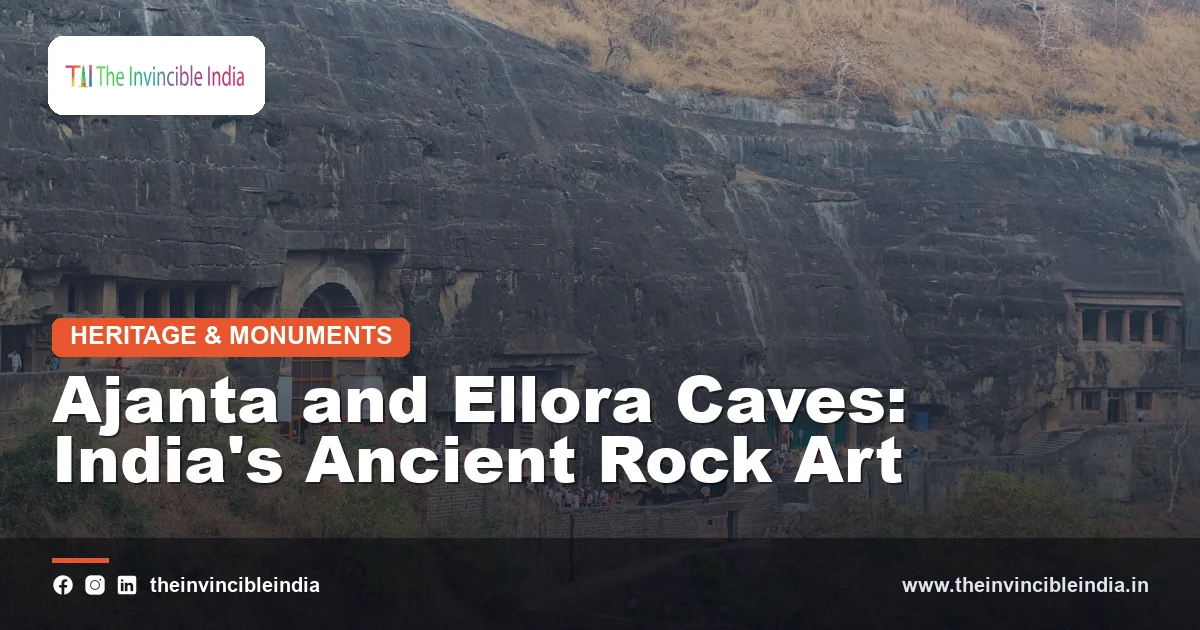
Carved into the volcanic rock of Maharashtra centuries ago, the caves of Ajanta and Ellora are among the greatest artistic and architectural achievements of the ancient world. Both are UNESCO World Heritage Sites, and together they showcase the extraordinary skill of Indian craftsmen who, using only hand tools, transformed sheer cliffs into breathtaking temples, monasteries and galleries of painting and sculpture. Ajanta is celebrated for its exquisite Buddhist murals, while Ellora astonishes with its colossal rock-cut temples spanning three great religions. This guide explores the history, art and wonder of both sites.
Quick Facts: Ajanta and Ellora
| Detail | Information |
|---|---|
| Location | Near Aurangabad (Chhatrapati Sambhajinagar), Maharashtra |
| Ajanta caves | 30 Buddhist caves, famous for murals |
| Ellora caves | 34 caves — Buddhist, Hindu and Jain |
| Ajanta period | 2nd century BCE to about 6th century CE |
| Ellora period | Roughly 6th to 10th century CE |
| Status | Both UNESCO World Heritage Sites |
The Ajanta Caves: Masterpieces of Buddhist Art
The Ajanta Caves comprise around 30 rock-cut Buddhist cave monuments set in a dramatic horseshoe-shaped gorge above the Waghora River. They were excavated in two great phases, the earliest dating back to around the 2nd century BCE and a later flourishing during the Gupta period around the 5th century CE. The caves served as monasteries (viharas) and prayer halls (chaityas) for Buddhist monks, who lived, studied and worshipped here.
After centuries of abandonment, the caves were hidden by dense jungle until 1819, when a British officer, John Smith, stumbled upon them while on a tiger hunt, rediscovering one of the world’s great art treasures. Their remote location had helped preserve the delicate paintings within.
The Murals of Ajanta
Ajanta is celebrated above all for its magnificent murals, considered the finest surviving examples of ancient Indian painting. Executed on the walls and ceilings of the caves, these paintings depict the Jataka tales — stories of the previous lives of the Buddha — along with divine beings, royal courts, everyday scenes and richly detailed depictions of people, animals and nature.
Created using natural mineral pigments on a specially prepared plaster surface, the murals are remarkable for their grace, emotional depth, subtle expression and sophisticated use of colour and shading. Iconic images such as the compassionate Bodhisattva Padmapani have become symbols of Indian art. Despite the passage of many centuries, their beauty continues to move visitors from around the world.
The Ellora Caves: A Confluence of Faiths
About a hundred kilometres from Ajanta lie the Ellora Caves, a complex of 34 monasteries and temples carved into a long escarpment. What makes Ellora unique is that it represents three great religions side by side — Buddhist, Hindu and Jain — a remarkable testament to the religious harmony and tolerance of ancient India. The caves were created over several centuries, roughly between the 6th and 10th centuries CE, when the site lay on an important trade route.
The Buddhist caves at the southern end include grand monasteries and a magnificent prayer hall. The Hindu caves in the centre are the most dramatic and numerous, while the Jain caves at the northern end are smaller but renowned for their exquisitely detailed carving.
The Kailasa Temple: A Wonder Carved from a Single Rock
The undisputed masterpiece of Ellora, and one of the most astonishing structures on earth, is the Kailasa Temple (Cave 16). Dedicated to Lord Shiva and designed to represent Mount Kailash, his sacred Himalayan abode, it is the largest single monolithic rock excavation in the world. Astonishingly, it was carved from the top down out of a single massive rock, with an estimated 200,000 tonnes of stone removed by hand.
The result is a full-sized, multi-storeyed temple complex, complete with a central shrine, gateway, assembly hall, courtyards and life-sized elephant sculptures, all adorned with intricate carvings depicting scenes from Hindu epics. The scale, precision and vision of the Kailasa Temple, achieved without modern technology, continues to astound engineers, artists and visitors alike.
Planning Your Visit
Both sites are reached from the city of Aurangabad (Chhatrapati Sambhajinagar), which has an airport and rail connections. Ajanta is about 100 kilometres away and Ellora about 30 kilometres, and the two are usually visited on separate days due to the distance between them. Note that the Ajanta caves are typically closed on Mondays and the Ellora caves on Tuesdays, so plan accordingly. The best time to visit is during the cool season from October to March, and comfortable footwear is essential for the walking and climbing involved.
The Architecture of the Rock-Cut Caves
The genius of Ajanta and Ellora lies not only in their art but in their very method of construction. Unlike ordinary buildings, which are assembled from separate pieces, these caves were carved out of solid rock, working from the top downwards and from the front inwards, so that pillars, ceilings, sculptures and shrines were all shaped from the same living stone. This subtractive technique left no room for error, as a single misjudged cut could not be undone. The chaitya halls, with their vaulted ceilings and ribbed decoration mimicking wooden construction, and the vihara monasteries, with their central halls surrounded by monks’ cells, reveal an astonishing mastery of design, proportion and engineering achieved entirely by hand.
Daily Life of the Monks
The caves were not merely works of art but living communities. At Ajanta and the Buddhist caves of Ellora, generations of monks lived, meditated, studied and taught. The viharas provided cells for sleeping, halls for gathering and teaching, and shrines for worship, while cisterns cut into the rock collected rainwater. These monastic universities were also centres of learning and pilgrimage, sustained by the patronage of kings, wealthy merchants and guilds whose donations are recorded in inscriptions on the cave walls. Understanding this human dimension — the quiet routines of study and devotion that filled these halls for centuries — adds depth to the experience of visiting them.
Art and Iconography of Ellora
Beyond the Kailasa Temple, Ellora is rich in sculptural masterpieces. The Hindu caves are filled with dynamic, dramatic reliefs depicting scenes from mythology — Shiva dancing the cosmic dance, the demon king Ravana shaking Mount Kailash, and Vishnu in his various incarnations — carved with tremendous energy and movement. The Jain caves at the northern end, though smaller, are exquisite in their fine, detailed carving, featuring lotus ceilings, elaborate pillars and serene images of the Tirthankaras. This progression through Buddhist, Hindu and Jain caves offers a remarkable visual journey through the religious and artistic evolution of ancient India.
Preserving a World Treasure
The paintings of Ajanta are extremely fragile, and preserving them presents an ongoing challenge. Exposure to light, humidity and the breath of countless visitors can damage the delicate pigments, and considerable effort goes into conservation, including controlled lighting and visitor management. Both Ajanta and Ellora were inscribed as UNESCO World Heritage Sites in 1983 in recognition of their outstanding value to humanity. Visitors can help protect these treasures by following the rules, refraining from flash photography where prohibited, not touching the paintings or carvings, and treating the sites with the respect due to some of the greatest achievements of human creativity.
The Rediscovery and Global Fame
The story of how these caves returned to the world’s attention is itself remarkable. Ajanta lay hidden and forgotten in dense forest for over a thousand years until 1819, when a British officer, John Smith, chanced upon the horseshoe gorge during a hunting expedition and glimpsed the arch of a cave through the foliage. His discovery sparked scholarly excitement, and over the following decades the caves were cleared, studied and celebrated, their murals copied and their significance recognised worldwide. Ellora, by contrast, had never been entirely forgotten, its grand temples having drawn travellers and pilgrims through the centuries. Together, their rediscovery and study transformed the understanding of ancient Indian art and history.
Tips for Visiting Ajanta and Ellora
To make the most of a visit, plan the two sites on separate days, as they lie about 100 kilometres apart, and remember that Ajanta is closed on Mondays and Ellora on Tuesdays. Start early to avoid both the heat and the crowds, wear comfortable shoes for the considerable walking and climbing, and carry water, a hat and sunscreen. At Ajanta, a shuttle bus ferries visitors from the car park to the caves, and the lighting inside is deliberately dim to protect the fragile paintings, so patience allows the eyes to adjust and the artistry to reveal itself. Hiring a knowledgeable guide greatly enriches the experience at both sites.
The Enduring Legacy
Ajanta and Ellora stand as eternal testaments to the artistic and spiritual genius of ancient India. In their painted halls and carved temples, we see not only supreme craftsmanship but the deep devotion, philosophical vision and cultural sophistication of the civilisations that created them. That such wonders could be conjured from solid rock, with simple hand tools and boundless imagination, continues to inspire awe in every visitor. As protected World Heritage Sites, they belong not just to India but to all humanity, offering a timeless window into a golden age of art and faith that speaks across the centuries to all who stand before them.
Where to Stay and Nearby Attractions
Most visitors base themselves in Aurangabad (Chhatrapati Sambhajinagar), which offers a wide range of hotels from budget to luxury and serves as a convenient hub for both cave sites. The city itself holds notable attractions, including the Bibi Ka Maqbara, a striking mausoleum resembling the Taj Mahal, and the ancient Daulatabad Fort, a formidable hilltop citadel. The intricate water-lifting system of the medieval water mills and the Aurangabad Caves add further interest. Combining a visit to Ajanta and Ellora with these sites makes for a rich two- or three-day journey through the history and heritage of the Deccan region.
Best Time to Visit the Caves
The ideal time to visit Ajanta and Ellora is during the cooler months from October to March, when the weather is pleasant for exploring the open, sometimes steep, cave complexes. The monsoon season, from June to September, transforms the surrounding landscape into lush green and brings the seasonal waterfall at Ajanta to life, offering dramatic scenery, though rain can occasionally disrupt travel. Summers, from April to June, are extremely hot and best avoided if possible. Whatever the season, an early start helps visitors beat both the heat and the crowds and allows ample time to absorb the wonders of these extraordinary sites.
Frequently Asked Questions
What is the difference between Ajanta and Ellora?
Ajanta consists of around 30 Buddhist caves famous for their ancient murals, while Ellora has 34 caves representing Buddhist, Hindu and Jain faiths and is renowned for rock-cut sculpture, including the monolithic Kailasa Temple.
How old are the Ajanta and Ellora caves?
The Ajanta caves date from the 2nd century BCE to about the 6th century CE, while the Ellora caves were created roughly between the 6th and 10th centuries CE.
Can Ajanta and Ellora be visited in one day?
It is not recommended, as the two sites are about 100 kilometres apart and each deserves several hours. They are best visited on separate days, keeping in mind Ajanta is closed on Mondays and Ellora on Tuesdays.
What is the Kailasa Temple?
The Kailasa Temple at Ellora is the world’s largest monolithic rock-cut structure, a full temple complex carved from a single rock from the top down, dedicated to Lord Shiva and representing Mount Kailash.


