

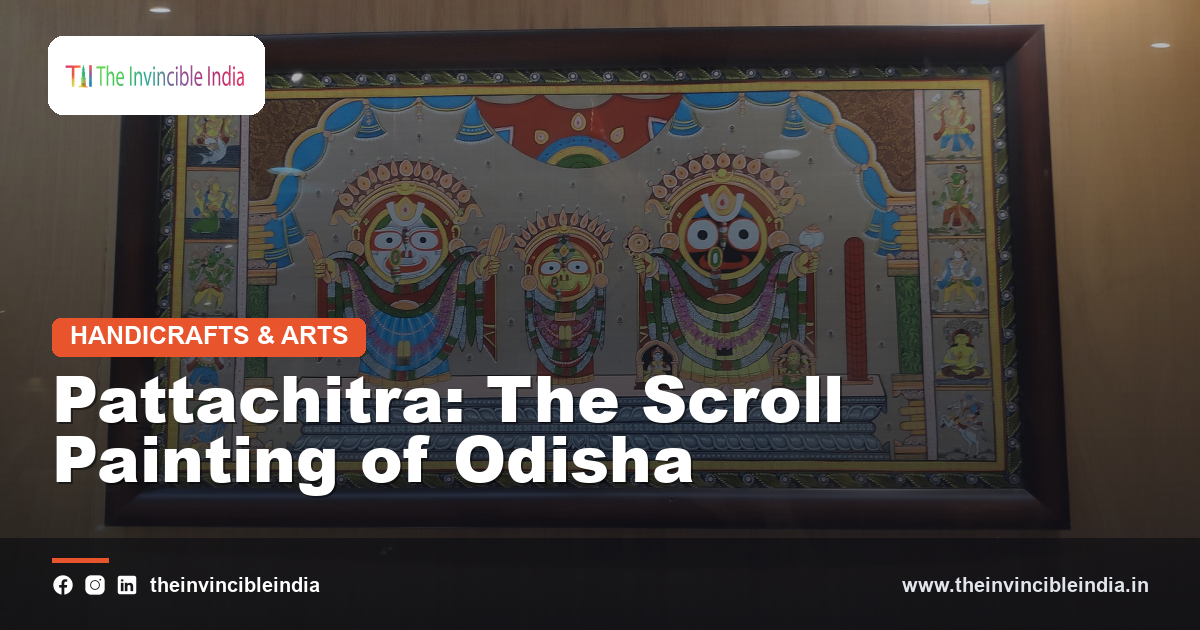
Pattachitra is the traditional cloth-based painting of Odisha, made by hereditary artists called chitrakars and closely linked with the worship of Lord Jagannath at Puri. The name, also written Patta Chitra, Pattachitra or Odisha pata painting, comes from the Sanskrit words for cloth and picture. Its hallmarks are fine black outline, flat natural colour, decorative borders and a strong narrative sense, shown most famously in the village of Raghurajpur near Puri. Like the folk tradition explained in Madhubani painting, it is a community craft with deep religious roots, yet its cloth scrolls, temple connections and storytelling manner give it a character entirely its own.
Quick answer: Pattachitra is a traditional painting style of Odisha made on specially prepared cloth or palm leaf, with fine outlines and natural colours, and depicting Jagannath, Krishna, Rama and other sacred themes. Practised by hereditary chitrakar families, especially at Raghurajpur near Puri, it grew in close association with the Jagannath temple. The craft holds a Geographical Indication and is valued both as devotional art and as a collectible handicraft.
Key Takeaways
- Pattachitra is the cloth-based painting tradition of Odisha, whose name means picture on cloth.
- It is closely connected with the Jagannath temple at Puri, and chitrakars paint images of Jagannath, Balabhadra and Subhadra.
- Raghurajpur, a heritage craft village near Puri, is the best-known centre of the art.
- Colours are traditionally made from natural materials such as shell, soot, minerals and plants.
- The cloth is prepared with a paste of tamarind seed gum and chalk, and polished with a smooth stone before painting.
- Odisha Pattachitra has been recognised with a Geographical Indication, and the craft includes related forms such as palm leaf engraving.
The sections below describe the history, themes, materials, techniques and living practice of this Odisha tradition.
Quick Facts
| Detail | Information |
|---|---|
| Type | Cloth and palm leaf painting |
| Region | Odisha, especially Puri and Raghurajpur |
| Artists | Hereditary chitrakar families |
| Main themes | Jagannath, Krishna, Rama and Dashavatara |
| Colours | Natural pigments from shell, minerals, plants and soot |
| Recognition | Geographical Indication for Odisha Pattachitra |
What Is Pattachitra?
Pattachitra is a traditional painting of Odisha created on cloth that has been prepared with a stiff, smooth coating. The word combines patta, meaning cloth, and chitra, meaning picture, so the name describes the art very directly. Paintings are known for their precise black outline, flat bands of colour and ornate borders, and they usually present gods, legends and temple scenes. Some works are made as scrolls that unroll to show a sequence of scenes, while others are single panels for display or worship. The style is highly stylised, with fixed ways of drawing faces, eyes and bodies. These conventions give Pattachitra a calm, devotional character that is recognisable at once.
Where Is Pattachitra Made?
Pattachitra is made mainly in the coastal region of Odisha around Puri, with Raghurajpur, Puri town and nearby villages as leading centres. Raghurajpur is a heritage craft village where houses are decorated with painted walls and many families work as artists in their courtyards. Related painting traditions are found in other parts of Odisha as well. The closeness of the Jagannath temple at Puri has shaped the style, since much of the work serves pilgrims who wish to take home an image of the deity. Visitors can see artists at work, which makes the region an important destination for craft and cultural tourism.
How Did Pattachitra Begin?
Pattachitra has a long history in Odisha, rooted in temple art and the traditions of painting that accompanied worship at Puri. Its exact beginnings cannot be dated precisely, because the craft was passed down in families without early written records. Scholars connect it with the temple culture of the Jagannath cult, in which painters supplied images for ritual use and decorated sacred objects. Over time the art developed regional features, including its linear style, its colour range and its repertoire of subjects. While details of early development are debated, the continuity of the tradition is clear from its stable conventions and from the families who still practise it today.
Why Is Pattachitra Linked to Jagannath?
Pattachitra is linked to Jagannath because the chitrakars of Puri have long served the temple by painting its deities and ritual images. Jagannath, together with his brother Balabhadra and sister Subhadra, is the central figure of worship in Odisha, and their simple, round-eyed forms appear again and again in Pattachitra. Painters supply pictures used in temple rituals, festivals and in the homes of devotees. The art is therefore not decoration alone but an expression of devotion with a ritual purpose. This close bond with the temple gives the craft its identity and explains why Jagannath imagery dominates both traditional and modern Pattachitra production.
What Are Anasara Paintings?
Anasara paintings are special Pattachitra works made for the period when the deities of Puri are traditionally said to be away from public view after a ritual bath. During this time devotees cannot see the wooden images in the sanctum, so painted panels of the deities, called anasara pattis, are used as substitutes for worship. Chitrakars create these panels with great care, following the established forms of Jagannath, Balabhadra and Subhadra. The practice shows how Pattachitra can stand in for the sacred image itself, which is a mark of the importance placed on the art. It also highlights the close working relationship between the temple and the painters of Puri.
What Themes Does Pattachitra Depict?
Pattachitra depicts Jagannath and the Puri deities, the life of Krishna, episodes from the Ramayana and the Mahabharata, and the ten avatars of Vishnu known as Dashavatara. Scenes from the Gita Govinda, the poem by Jayadeva that is dear to Odisha, are also favourite subjects, as are the stories of local temples and legends. The mythical Navagunjara, a creature composed of parts of several animals, appears in a well-known Mahabharata episode and is a popular motif. Each theme follows established conventions of pose and colour, so devotees recognise the figures at once. The wide range of subjects shows how the art serves both worship and narrative.
Who Are the Chitrakars of Odisha?
The chitrakars of Odisha are hereditary painters whose families have practised Pattachitra for generations. Training begins in childhood, when young members help with grinding colours, preparing cloth and drawing simple outlines under the guidance of elders. Roles are often divided within a household, with senior artists drawing the main figures and others filling in colour or painting borders. Women contribute to preparation and to painting, and many have become recognised artists. The chitrakar identity combines craft skill with a sense of religious service, since the work often connects with the temple. This family-based system has maintained quality and consistency across many generations.
How Is the Cloth Prepared?
The cloth for Pattachitra is prepared by coating it with a paste made from tamarind seed gum and chalk powder, which turns the soft fabric into a firm painting surface. Two pieces of cloth are often pasted together to give extra strength, and then layers of the paste are applied and dried in the sun. The surface is polished with a smooth stone until it becomes even and slightly glossy. This preparation is slow and demands patience, since a flawed surface would spoil the finished painting. The treated cloth resembles stiff parchment and can take fine lines without bleeding. Careful preparation is therefore the foundation of every good Pattachitra.
What Colours Are Used in Pattachitra?
Pattachitra traditionally uses natural colours made from shell, minerals, plants and soot. White is prepared from powdered conch shell, black from lamp soot, red from a mineral known as hingula, yellow from a mineral called haritala, and blue from indigo. These materials are ground and mixed with a binder derived from a natural gum so that they adhere to the cloth. The palette is limited but powerful, dominated by red, yellow, white, black and blue-green tones. Modern artists sometimes use synthetic colours for convenience, yet many still prize natural pigments for their depth and cultural value. The restrained palette gives the paintings their characteristic harmony.
How Is a Pattachitra Painted?
A Pattachitra is painted by drawing the outline directly on the prepared cloth with a brush, filling the areas with flat colour and finishing with fine black lines. The artist usually begins with a light red or white outline and then works across the surface from the main figures to the background. Borders, often filled with floral and geometric patterns, are painted around each work and are an essential feature of the style. Brushes are made from animal hair or bamboo and are handled with great steadiness. Finally, the painting may be heated or coated to give a gentle sheen. Each step follows an established order that produces the clean, balanced look of the art.
What Are the Features of the Pattachitra Style?
The Pattachitra style is marked by bold outline, flat colour, elongated eyes, rounded faces and richly patterned borders. Figures follow fixed conventions, so a deity can be identified by posture, ornament and colour, and the background is often filled with leaves, flowers and architectural frames. Space is shown in a flat, decorative manner rather than through deep perspective. Narrative scenes are arranged in neat bands or panels so that the eye moves smoothly from one episode to the next. The restraint and symmetry of the compositions give them a serene, devotional tone. These consistent features make Pattachitra easy to distinguish from other Indian folk painting styles.
What Is Palm Leaf Engraving in Odisha?
Palm leaf engraving, known as talapatra or tala pata chitra, is a related Odisha craft in which designs are incised on dried palm leaves and then coloured with ink. Artists scratch fine lines with a sharp iron stylus and rub black or coloured pigment into the grooves so that the pattern appears clearly. The leaves may be joined into fans, manuscripts or concertina-like sets that unfold to show a continuous story. This craft shares many subjects and conventions with Pattachitra, and the same families often practise both. Palm leaf manuscripts also have a long role in Odia literature and religion, which gives the engraved work an additional historical dimension.
What Is Raghurajpur Known For?
Raghurajpur is known as a heritage craft village near Puri where nearly every household is involved in painting and related arts. Its streets are lined with houses whose walls bear painted designs, and visitors can watch artists preparing cloth, grinding colours and painting in open verandas. Besides Pattachitra, the village is associated with palm leaf engraving, painted papier-mache, wooden toys and stone work. It is also linked with the heritage of Odissi dance and with the Gotipua tradition, in which boys trained as dancers perform devotional pieces. This blend of crafts and performance makes Raghurajpur a living museum of Odia culture and a major attraction for travellers.
Pattachitra and Geographical Indication
Odisha Pattachitra has been given a Geographical Indication, a form of legal recognition that links a product with its region and its traditional makers. This status helps protect the name from misuse and encourages buyers to look for genuine handmade work. It also supports the artists by giving their craft a recognised identity in domestic and international markets. A Geographical Indication does not itself guarantee quality, but it strengthens the claim of Odisha artisans to their heritage. Alongside training and marketing support, it helps sustain livelihoods. For buyers, the recognition is a reminder that authentic Pattachitra comes from a specific cultural landscape and a long chain of skilled hands.
How Is Pattachitra Being Preserved?
Pattachitra is being preserved through craft fairs, exhibitions, training programmes, museum collections and the support of cultural and government bodies. Artists take part in national and international exhibitions, where their work reaches new audiences. Workshops in Raghurajpur and elsewhere teach younger people the full process, from preparing cloth to painting borders. Cooperative groups and direct sales help artists receive fair payment, and online platforms widen access to buyers. Documentation and recognition of senior masters add prestige to the craft. These combined measures keep Pattachitra economically viable and culturally respected, giving younger family members good reason to continue the tradition of their elders.
Pattachitra Today
Pattachitra today thrives as both a devotional art and a celebrated handicraft that adapts to new uses while keeping its heritage. Artists make traditional scrolls and panels, and also apply the style to book covers, home furnishings, fashion textiles and decorative objects. Visitors to Puri and Raghurajpur can see the work in progress and buy directly from the makers. Contemporary themes occasionally appear, although sacred subjects remain central. The art continues to express the faith and imagination of Odisha, and its blend of discipline and beauty explains its lasting appeal. Pattachitra remains one of the finest living examples of India’s cloth painting heritage.
Sources & Further Reading
- Ministry of Culture, Government of India (indiaculture.gov.in).
- Sangeet Natak Akademi (sangeetnatak.gov.in).
Frequently Asked Questions
What is Pattachitra?
Pattachitra is a traditional cloth-based painting of Odisha, whose name means picture on cloth. It is known for fine outlines, flat natural colours and sacred subjects such as Jagannath and Krishna.
Where is Pattachitra made?
Pattachitra is made mainly in the Puri region of Odisha, with Raghurajpur as its best-known village. Artists in other parts of the state also practise related painting traditions.
What colours are used in Pattachitra?
Pattachitra traditionally uses natural colours made from conch shell, lamp soot, minerals and plants. White, black, red, yellow and blue are the main hues, bound with a natural gum.
How is the Pattachitra canvas prepared?
The Pattachitra canvas is prepared by pasting cloth together and coating it with a paste of tamarind seed gum and chalk powder. The surface is then dried and polished with a smooth stone before painting.
What is the link between Pattachitra and Jagannath?
Pattachitra is closely linked to Jagannath because the chitrakars of Puri have long painted the deities of the temple. Images of Jagannath, Balabhadra and Subhadra are among its most important subjects.
Is Pattachitra the same as Bengal Patachitra?
No, Odisha Pattachitra and Bengal Patachitra are different traditions with a shared name. Odisha Pattachitra is a cloth painting tied to Jagannath worship, while the Bengal Patua scroll is a sung narrative scroll.


