

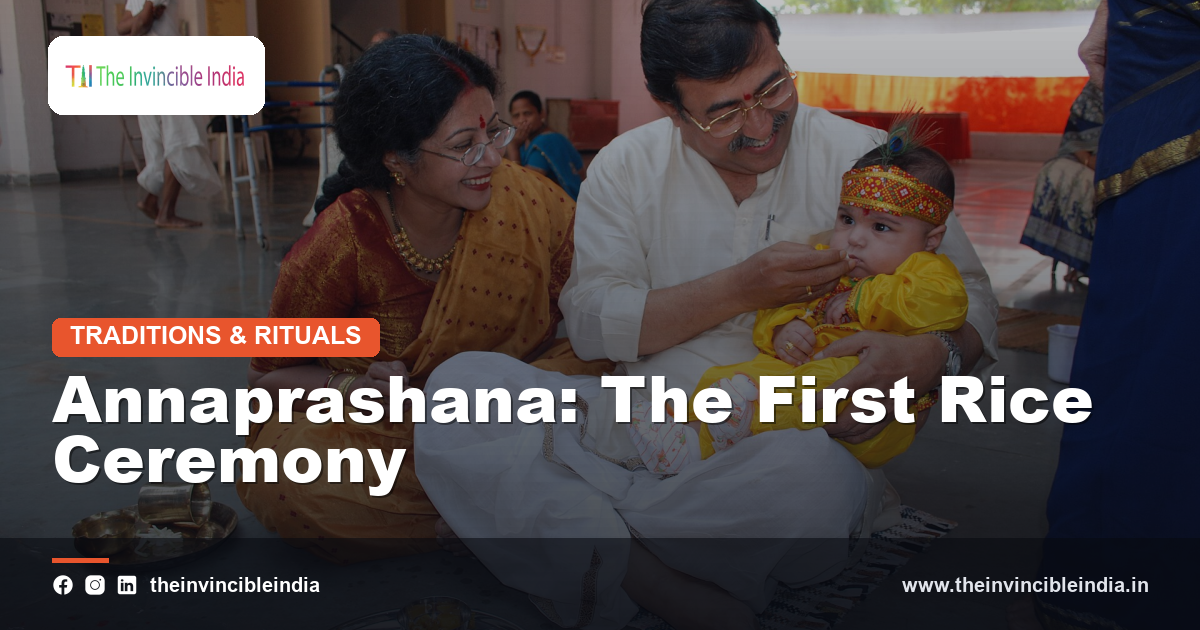
Annaprashana marks one of the earliest formal milestones in a child’s life within Hindu tradition, the ceremonial introduction of solid food, most often rice, to an infant who has so far been nourished only on milk. As one of the sixteen traditional samskaras, or life-cycle rites, that mark significant transitions from birth to death, it sits alongside occasions such as those observed in Indian wedding traditions as part of a broader framework of ritual passage. Celebrated with family gatherings, blessings from elders, and regional variations in custom, Annaprashana reflects deep-rooted beliefs about nourishment, growth, and the wellbeing of a child entering a new stage of life. This guide examines its meaning, practice, and continuing place in Indian households.
Quick Facts
| Detail | Information |
|---|---|
| Ceremony Type | Hindu life-cycle rite (samskara) |
| Also Known As | First rice-feeding ceremony |
| Typical Age | Around six months, varies by region |
| Key Ritual | Feeding of cooked rice, often with ghee |
| Associated Custom | Object-selection game for the child |
| Family Role | Elders often feed the first morsel |
What Is Annaprashana?
Annaprashana is a Hindu ceremony marking the first occasion on which an infant is formally given solid food, typically cooked rice, after a period of being fed only milk. The word itself combines terms relating to food and eating, and the rite is understood as both a practical milestone in a child’s development and a religious occasion requiring appropriate rituals and blessings. It is traditionally conducted with the involvement of family elders and, in many households, a priest who performs the associated prayers. The ceremony is not treated as a private, incidental event but as a recognised transition, marked with some degree of festivity depending on family means and regional custom. Its significance lies less in the act of eating itself than in the ritual framing around it, through which a child’s move toward greater independence from a mother’s milk is acknowledged and blessed by the wider family circle.
Place Among the Sixteen Samskaras
Annaprashana belongs to a traditional Hindu framework of sixteen samskaras, or sacraments, understood to mark significant stages across an individual’s life from before birth through to the final rites after death. These samskaras are intended to sanctify important transitions, and Annaprashana specifically addresses the stage at which an infant moves beyond exclusive reliance on milk toward solid nourishment. Within this framework, each samskara carries its own associated rituals, prayers, and customary practices, though not every family or community observes all sixteen with equal formality in contemporary times. Annaprashana remains among the more widely continued of these rites, likely because it corresponds to a genuinely significant developmental milestone that most families mark in some way regardless of religious observance. Its place within this larger sequence underscores how Hindu tradition has historically approached the stages of childhood as occasions worthy of structured ritual attention rather than purely private family matters.
Timing and Age Considerations
The timing of Annaprashana is generally guided by a combination of the child’s developmental readiness for solid food and auspicious considerations drawn from the family’s religious or astrological practice. Many families choose to perform the ceremony around the sixth month of an infant’s life, broadly corresponding to when solid foods are commonly introduced, though the exact age can vary between communities and individual families. In some regional traditions, the timing may differ slightly according to the child’s gender, reflecting broader patterns of customary practice rather than any fixed universal rule. Families consulting a priest or family astrologer may also seek guidance on a specific auspicious date and time considered favourable for the ceremony. This flexibility in timing illustrates how the rite, while rooted in longstanding tradition, has always accommodated a degree of regional and familial variation rather than following one single rigid schedule across all Hindu communities.
Preparing for the Ceremony
Preparations for Annaprashana typically begin with the family selecting a date, arranging for a priest if one is to be involved, and inviting close relatives to attend the occasion. The home is often cleaned and decorated in a manner similar to other family celebrations, and specific items required for the ritual, including cooked rice, ghee, and any objects to be used in accompanying customs, are gathered in advance. Some families choose to hold the ceremony at home, while others prefer a temple setting, depending on personal preference and local custom. Clothing for the infant may also be selected specially for the occasion, reflecting the ceremonial importance attached to the event. As with many Hindu life-cycle rites, the preparation itself is treated as part of the observance, an opportunity for the family to come together in anticipation of a milestone considered significant for the child’s wellbeing and future.
Role of the Priest and Family Elders
Where a priest is involved, their role typically includes reciting appropriate prayers, guiding the family through the sequence of the ritual, and offering blessings intended for the child’s health and prosperity. Family elders, particularly grandparents, often play a central part in the ceremony itself, with the honour of feeding the child the first morsel of rice frequently given to the most senior family member present. This structure reflects a broader pattern in Hindu domestic ritual, in which religious specialists and family elders share responsibility for guiding important life-cycle occasions. The involvement of elders also carries a symbolic dimension, linking the newest member of the family to its older generations through a shared ritual moment. In households where a priest is not engaged, family members may still follow a simplified version of the customary sequence, preserving the essential elements of the rite even without formal priestly guidance.
The Rice-Feeding Ritual Itself
At the centre of the ceremony is the act of feeding the infant a small quantity of cooked rice, usually prepared with ghee and sometimes mixed with a little sugar or honey depending on family custom. This first feeding is often accompanied by prayers or blessings, and the moment is treated with particular attention by those present, who may offer their own good wishes for the child. In many households, photographs or recordings are taken to mark the occasion, reflecting its significance as a milestone within family memory. The ritual is generally brief in itself, but it is embedded within a larger sequence of preparation, blessing, and celebration that can extend over a longer period on the day. The simplicity of the core act, feeding a small amount of rice, stands in contrast to the depth of meaning attached to it within the broader framework of Hindu life-cycle observance.
Choice of First Foods
While rice is the most commonly associated food with Annaprashana, giving the ceremony its alternate description as a rice-feeding rite, some regional traditions incorporate other foods into the ritual sequence, such as small quantities of ghee, honey, or mild preparations considered suitable for an infant. The choice of rice as the primary food reflects its broader status in Indian dietary and cultural life as a staple associated with nourishment and prosperity. In households following particular regional or community customs, the exact preparation, whether plain boiled rice, a rice pudding, or another rice-based dish, may vary, though the underlying significance of introducing solid food remains consistent. The emphasis throughout is on a food considered gentle enough for a young child while still carrying symbolic weight within the family’s cultural and religious framework, rather than on any single fixed recipe followed uniformly across all communities.
The Object-Selection Tradition
A well-known custom associated with Annaprashana in many households involves placing a small selection of symbolic objects, such as a book, a pen, money, or other items representing different future paths, in front of the child during the ceremony. The item the child reaches for or picks up first is popularly interpreted as an indication of inclinations or interests they might develop later in life, though families generally treat this playfully rather than as a serious prediction. This lighthearted addition to the ceremony is one of its most memorable elements for those attending, often generating amusement and conversation among relatives. While not observed in every family or region, the tradition remains widely recognised as part of the broader Annaprashana custom. It reflects a wider tendency within Indian family ritual to blend solemn religious observance with elements of play and communal enjoyment.
Regional Variations Across India
Annaprashana is observed across most Hindu communities in India, though the specific customs surrounding it vary considerably by region, language, and local tradition. In some parts of the country the ceremony is closely tied to particular temple visits, while in others it remains primarily a home-based family occasion. The choice of foods offered, the objects used in the selection custom, and even the terminology used for the ceremony can differ from one region to another, reflecting India’s broader diversity of ritual practice within a shared religious framework. Some communities mark the occasion with greater festivity and a larger gathering of relatives, while others observe it more modestly within the immediate family. Despite these differences, the underlying purpose, the ceremonial introduction of solid food to an infant, remains a consistent thread connecting the many regional expressions of the tradition across the country.
Symbolic Meaning of Rice in Indian Culture
Rice occupies a significant place in Indian cultural and religious life well beyond its role as a dietary staple, often serving as a symbol of nourishment, fertility, and prosperity in rituals across many regions and communities. Its use in Annaprashana draws on this broader symbolic association, positioning the first feeding of rice as more than a nutritional milestone but also a moment charged with hopes for the child’s future wellbeing. Rice appears in numerous other Hindu ceremonies and customs, from wedding rituals to harvest festivals, reinforcing its status as one of the most culturally resonant foods in Indian tradition. This layered symbolism helps explain why the ceremony has retained its name and central rice-feeding element even in households that might otherwise introduce a wider variety of foods to an infant’s diet in daily practice. The rite thus functions as a ritual expression of values extending well beyond nutrition alone.
Blessings, Mantras, and Prayers
Prayers and blessings form an important part of Annaprashana, whether offered formally by a priest or informally by family members gathered for the occasion. Where a priest is present, recitations may invoke general wellbeing, health, and prosperity for the child, following patterns common to other Hindu life-cycle ceremonies. Family members, too, often offer their own verbal blessings as they witness the child’s first feeding, a practice that reinforces the communal character of the event. These blessings are typically general in nature, expressing hope for the child’s health, long life, and future happiness rather than referencing highly specific outcomes. The combination of structured religious recitation and informal family blessing reflects the dual character of the ceremony as both a formal religious rite and an intimate family celebration, with each element reinforcing the sense of collective goodwill directed toward the child at this early stage of life.
Family and Community Gathering
Annaprashana is rarely observed in isolation, and most families treat it as an occasion for gathering relatives, close friends, and sometimes neighbours to share in the celebration. Depending on the family’s resources and preferences, the event can range from a small, intimate gathering to a larger celebration involving a shared meal and more extensive hospitality. This communal dimension reflects a broader pattern in Indian family life, in which important personal milestones are marked collectively rather than treated purely as private family matters. The presence of extended family, particularly grandparents and other elders, is often considered especially significant, given their traditional role in performing key parts of the ritual. For many families, the gathering itself, as much as the ritual content, is remembered as the defining feature of the occasion, strengthening bonds among relatives who might otherwise have limited opportunity to come together.
Gifts and Customary Exchanges
It is common for relatives attending an Annaprashana ceremony to bring small gifts for the child, ranging from clothing and jewellery to symbolic items intended to convey good wishes for the child’s future. These gestures follow a broader pattern seen across many Indian family celebrations, in which gift-giving reinforces social bonds and marks the significance of the occasion. In some families, the gifts exchanged also carry a practical dimension, providing useful items for the child’s early years alongside their symbolic value. Hosts, in turn, may offer small tokens or sweets to guests as a gesture of hospitality and gratitude for their attendance. While the specifics of what is exchanged vary widely by family and region, the underlying custom of marking the occasion through mutual gift-giving remains a consistent feature of how Annaprashana is celebrated within the wider family and community context.
Comparable Rituals in Other Traditions
The impulse to mark an infant’s transition to solid food with some form of ceremony is not unique to Hindu tradition, and comparable customs can be found in various cultures around the world, each shaped by its own religious and social context. While the specific rituals, foods, and symbolism differ considerably, the underlying recognition of this developmental milestone as worthy of family attention reflects a broader human tendency to ritualise significant early-life transitions. Within India itself, other communities and faiths may observe their own distinct customs around infant feeding and early childhood milestones, contributing to the country’s wider diversity of family ritual practice. Recognising these parallels helps situate Annaprashana within a broader pattern of human customs surrounding childhood, while still appreciating the specific religious and cultural framework, rooted in Hindu samskara tradition, that gives the Indian ceremony its particular form and meaning.
Continuity in Modern Households
Despite changes in family structure, urban living, and lifestyle across much of India, Annaprashana continues to be observed by many Hindu families, though often in adapted forms suited to contemporary circumstances. Smaller family sizes and busier schedules have, in some cases, led to more modest observances than in previous generations, while in other households the ceremony continues to be marked with considerable festivity, sometimes even more elaborately than before given greater access to resources for celebration. Some families now combine the ceremony with other occasions or hold it at a convenient time for relatives to travel, reflecting practical adjustments rather than any abandonment of the underlying tradition. The continued popularity of the object-selection custom, in particular, suggests that the more playful elements of the ceremony have helped sustain its appeal even as strict adherence to older ritual detail has, in some households, become more relaxed over time.
Annaprashana Today
Annaprashana remains one of the more widely practised of the traditional Hindu samskaras, valued by many families as a meaningful way to mark an important early milestone in a child’s life. Whether observed with an elaborate gathering and full priestly ritual or in a simplified form within the immediate family, the ceremony continues to express longstanding beliefs about nourishment, blessing, and the collective involvement of family in a child’s growth. Its persistence across generations, despite considerable social change, reflects the strength of its underlying symbolism and the genuine developmental milestone it marks. As Indian families continue to balance tradition with contemporary life, Annaprashana stands as an example of a ritual that has proven flexible enough to adapt in form while retaining its essential purpose. It remains, for many households, a cherished occasion that brings generations together around one of a child’s earliest recognised transitions.
Sources & Further Reading
- Ministry of Culture, Government of India (indiaculture.gov.in).
- Ministry of Women and Child Development, Government of India (wcd.nic.in).
Frequently Asked Questions
What does Annaprashana mean?
Annaprashana refers to the Hindu ceremony marking an infant’s first formal feeding of solid food, typically cooked rice, after a period of being nourished only on milk.
At what age is Annaprashana typically performed?
Many families perform the ceremony around six months of age, though the exact timing can vary by region, family custom, and considerations of auspicious timing.
What is the object-selection tradition during Annaprashana?
In many households, symbolic objects such as a book, a pen, or money are placed before the child, and the item they reach for first is playfully interpreted as a hint toward future interests.
Is Annaprashana observed differently across India?
Yes, while the core rite of first feeding is widespread, specific customs, foods, and the scale of celebration vary considerably between regions and communities.
Why is rice specifically used in the ceremony?
Rice holds broad symbolic associations with nourishment and prosperity in Indian culture, making it a fitting choice for a ceremony centred on a child’s transition to solid food.


