

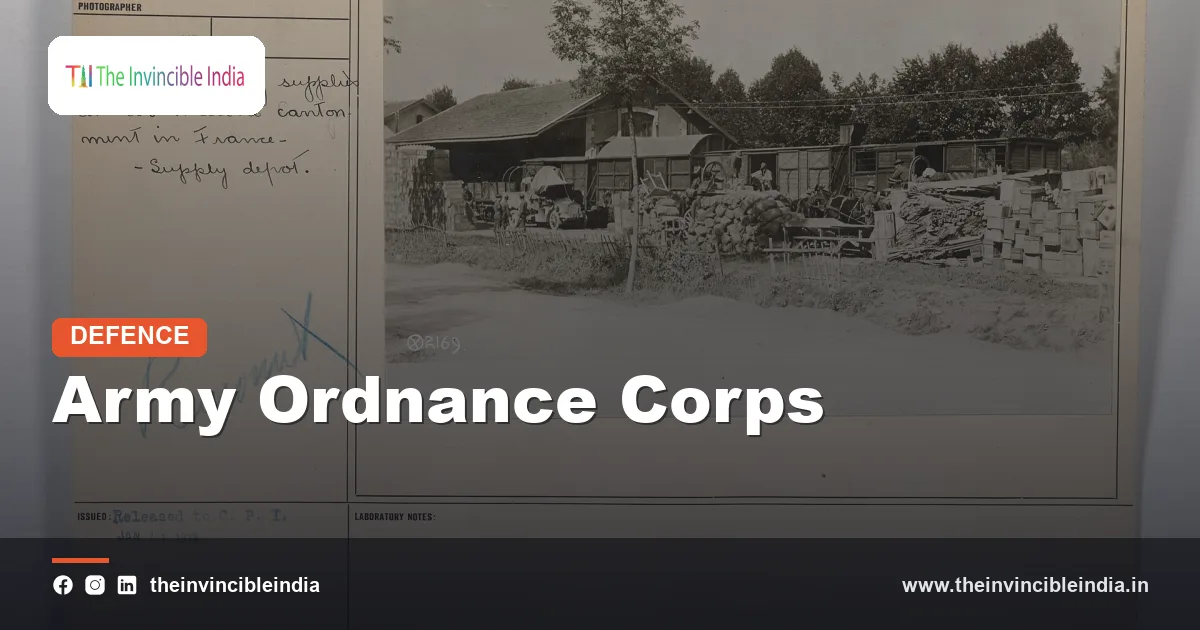
The Army Ordnance Corps (AOC) is the logistics and materiel arm of the Indian Army, responsible for procuring, storing, managing and issuing weapons, ammunition, vehicles, clothing and general military stores to the Army. The Army Ordnance Corps works in the background of every operation and exercise, ensuring that soldiers receive the equipment they need at the right place and time.
The AOC is a service of the Army, not a fighting arm, and it is separate from the Ordnance Factories that manufacture defence equipment. This explainer describes the corps’ role, history, organisation, depots and training centres, how inventory is managed and modernised, and how the AOC differs from related logistics and engineering services.
| Attribute | Details |
|---|---|
| Full name | Army Ordnance Corps (AOC) |
| Parent force | Indian Army, under the Ministry of Defence |
| Category | A service (logistics) corps rather than a combat arm |
| Core role | Procurement support, storage, accounting and issue of ordnance stores: weapons, ammunition, vehicles, clothing and equipment |
| Heritage | Traces its roots to the ordnance departments of the East India Company and the Indian Army Ordnance Corps of the early twentieth century |
| Policy direction | Master General of Ordnance (MGO) Branch at Army Headquarters |
| Training establishments | AOC Centre and School at Secunderabad and a training centre at Jabalpur |
| Related services | Army Service Corps (supplies and transport) and Corps of Electronics and Mechanical Engineers (repair and maintenance) |
Key Takeaways
- The Army Ordnance Corps is the Indian Army’s logistics corps for materiel, handling weapons, ammunition, vehicles, clothing and general stores.
- The Army Ordnance Corps is a service corps and not a combat arm, so its work centres on supply, storage, accounting and issue rather than fighting.
- The Indian Army’s ordnance services descend from the ordnance establishments of the East India Company and from the Indian Army Ordnance Corps formed in the early twentieth century.
- The repair and maintenance functions that once sat with the ordnance services were separated in 1943 with the creation of the Corps of Electrical and Mechanical Engineers, now called the Corps of Electronics and Mechanical Engineers (EME).
- The Army Ordnance Corps is different from the Ordnance Factories, which manufacture equipment under the Department of Defence Production.
- The corps is modernising through computerised inventory control, better storage practices and closer coordination with Indian defence industry.
What is the Army Ordnance Corps?
The Army Ordnance Corps is a corps of the Indian Army that manages the supply of ordnance, meaning weapons, ammunition, military vehicles, clothing, equipment and the many items that make up the stores of a modern army. It is one of the logistics services that allow the Army to operate far from its bases.
The word “ordnance” historically referred to cannon and artillery stores, but over time it has come to mean the broad category of military materiel. In the Indian context, the Army Ordnance Corps forms the link between the producers of defence equipment, such as factories and private suppliers, and the field units that use it.
Officers and soldiers of the corps work in depots, ammunition storage areas, transit facilities and field units. They also serve at Army Headquarters and in the commands, where they plan stock levels and support the Army’s equipment needs.
What does the Army Ordnance Corps do?
The Army Ordnance Corps provides, stores, accounts for and issues the equipment and ammunition that the Army needs, and it supports the procurement of those items. Its work covers the full life of a stock item, from receipt through storage and issue to disposal.
Main functions
- Procurement support: Assisting in the acquisition of stores and maintaining the demand and supply cycle for the Army.
- Storage and preservation: Holding stores in depots under proper conditions so that equipment and ammunition remain serviceable.
- Issue and distribution: Sending stores to units, formations and field areas on the basis of authorised scales.
- Ammunition management: Handling the storage, inspection, supply and safe disposal of ammunition and explosives.
- Clothing and personal equipment: Providing uniforms, special clothing for high-altitude and cold regions, and individual equipment.
- Accounting and records: Keeping accurate records of stores and controlling stock levels.
Because the Army operates in deserts, plains, jungles and high mountains, ordnance planning must take account of climate, distance and seasonal limits on transport.
What kinds of stores does the Army Ordnance Corps handle?
The Army Ordnance Corps handles stores that fall into broad categories such as weapons and ammunition, vehicles and spare parts, clothing and general equipment. The scale and variety of these items is very large, from small items such as batteries to major assemblies.
| Category | Examples of stores |
|---|---|
| Weapons and ammunition | Small arms, artillery and tank ammunition, explosives and related components |
| Vehicles and spares | Military vehicles, engines, tyres and spare parts for field units |
| Clothing and personal equipment | Uniforms, boots, extreme-cold-weather clothing, tents, sleeping gear and load-carrying equipment |
| General stores | Tools, hardware, furniture and items used in barracks and camps |
| Technical stores | Electronic and mechanical components and equipment parts needed by repair units |
Some categories, such as petrol, oil and lubricants (POL) and food rations, are traditionally handled by the Army Service Corps rather than the ordnance services, which shows how responsibilities are divided between the logistics corps.
What is the history of the Army Ordnance Corps?
The history of the Army Ordnance Corps goes back to the ordnance departments of the East India Company, which maintained arsenals and stores for its armies in the eighteenth and nineteenth centuries. These establishments were later reorganised under the British Indian Army.
In the early twentieth century, the ordnance services were consolidated into the Indian Army Ordnance Corps. The corps supported Indian troops during the First and Second World Wars, when armies required very large quantities of arms, ammunition and equipment for theatres in Europe, the Middle East, Africa and Burma.
Key milestones
- Eighteenth and nineteenth centuries: Ordnance departments of the East India Company supply the Presidency armies.
- Early twentieth century: The Indian Army Ordnance Corps takes shape as a distinct service.
- 1943: Repair and maintenance duties are separated to form the Corps of Electrical and Mechanical Engineers.
- 1947: The corps becomes part of the Indian Army after independence and partition, with its stores and depots divided between India and Pakistan.
- Post-independence period: The corps supports the Army in the wars of 1947-48, 1962, 1965, 1971 and the Kargil conflict of 1999.
Since independence the corps has also adapted to new technology, from better ammunition handling to computer-based stock control.
How is the Army Ordnance Corps organised?
The Army Ordnance Corps is organised through the Master General of Ordnance (MGO) Branch at Army Headquarters, regional and command-level ordnance staffs, depots and field units. This structure lets the corps manage stores from the central level down to the soldiers in the field.
- Army Headquarters: The MGO Branch sets policy and plans for ordnance services, equipment and ammunition management.
- Commands and areas: Ordnance staff at command and formation headquarters plan and coordinate local supply.
- Depots: Central and regional ordnance depots, and ammunition depots, store and issue large quantities of stores.
- Field units: Ordnance units move with the formations they support, providing forward holdings in operational areas.
- Training centres: The AOC Centre and School at Secunderabad and the centre at Jabalpur train officers and soldiers.
The corps works closely with the Army Service Corps, the Corps of EME and the Directorate responsible for procurement, and it depends on the Ministry of Defence for budgets and procurement approvals.
What are ordnance depots and how do they work?
Ordnance depots are large storage and distribution establishments where the Army Ordnance Corps holds stores of a particular type and issues them to units on demand. They act as the warehouses of the Army and are usually located in places with good rail and road connections.
A depot receives stores from suppliers or factories, inspects and records them, stores them under suitable conditions and issues them against demands from units. Ammunition depots hold explosives and follow strict safety rules, with stores separated and protected according to type. The Central Ammunition Depot at Pulgaon in Maharashtra is one of the best-known ammunition storage establishments in the country.
Typical depot activities
- Receiving and inspecting stores
- Binning, stacking and preserving items
- Maintaining records and accounts of every item
- Issuing stores to units and formations
- Disposing of obsolete or unserviceable items under rules
Alongside depots, field workshops and base workshops belong to the EME and handle repair, while the ordnance depots supply the spares that those workshops need.
How does the Army Ordnance Corps manage inventory?
The Army Ordnance Corps manages inventory by tracking every item through demand, stock levels, issue and replenishment, using standard stock numbers, scales of issue and increasingly digital systems. The aim is to avoid both shortages that harm operations and surplus that wastes money and storage space.
Inventory management in the Army has traditionally relied on a codification system, in which each item is assigned a unique identity so that stores can be tracked across depots. Modern systems add computerised records, which allow better visibility of holdings and consumption patterns.
- Codification: A uniform item identity system helps avoid duplication and confusion.
- Scales of issue: Authorised quantities for each unit or role, which guide demands.
- Provisioning: Forecasting future needs so that stocks are available in time.
- Stock verification: Periodic physical checks to confirm records match actual holdings.
- Disposal: Condemnation and disposal of stores that are no longer fit for use.
How is the Army Ordnance Corps modernising?
The Army Ordnance Corps is modernising by adopting information technology for inventory control, improving the safety and capacity of storage, and aligning supply with the government’s drive for indigenous defence production. These changes aim to make supply faster, more transparent and less wasteful.
The Army has encouraged the use of enterprise-style software for tracking stores and has worked to reduce paper-based processes. Better data on consumption also helps planners decide what to order and when.
Modernisation also involves the shift to Indian-made equipment, in line with the Atmanirbhar Bharat policy of self-reliance in defence. As more indigenous weapons and equipment enter service, ordnance planners have to manage new spares chains and storage needs.
- Digitisation of records and stock control
- Safer and more efficient ammunition storage practices
- Greater use of Indian industry for spares and stores
- Training in modern supply-chain methods
How does the Army Ordnance Corps differ from other services?
The Army Ordnance Corps differs from other services in that it concentrates on the supply and storage of ordnance stores, while neighbouring services handle food and transport, repair, or manufacturing. Understanding these differences helps avoid confusion, because the names sound similar.
| Organisation | Main role | Part of |
|---|---|---|
| Army Ordnance Corps (AOC) | Supply, storage and issue of weapons, ammunition, vehicles, clothing and stores | Indian Army |
| Army Service Corps (ASC) | Supplies such as rations and fuel, and road transport | Indian Army |
| Corps of Electronics and Mechanical Engineers (EME) | Repair, recovery and maintenance of equipment | Indian Army |
| Ordnance Factories and successor defence public sector units | Manufacture of arms, ammunition and equipment | Ministry of Defence, Department of Defence Production |
In 2021 the Ordnance Factory Board was restructured into seven defence public sector undertakings. This change affected the factories that make equipment, and it did not change the role of the Army Ordnance Corps as the user-side supply service of the Army.
What is the corps identity and career path in the Army Ordnance Corps?
The corps identity of the Army Ordnance Corps rests on its service role, its traditions of reliability and its training at the Corps centres, with officers commissioned through the usual Army routes and allotted to the corps. The corps’ members take pride in being the ones who ensure that the soldier in the field has the equipment he needs.
Officers join the Army through the National Defence Academy, the Indian Military Academy, the Officers Training Academy and other schemes, and are then allotted to arms and services. Those who join the AOC receive technical and managerial training in supply chain management, ammunition handling and logistics.
Soldiers of the corps are trained in trades such as storekeeping, ammunition handling, vehicle and equipment handling and clerical work. The corps also takes part in sports, adventure activities and community service, which build its identity. Senior ordnance officers rise to head the ordnance services at Army Headquarters and in commands.
Bottom Line
The Army Ordnance Corps is the Indian Army’s materiel and logistics arm, ensuring that weapons, ammunition, vehicles, clothing and stores are procured, held and issued when needed. With roots in the East India Company’s ordnance departments and a modern identity as a service corps, the AOC remains central to the Army’s readiness. Its current focus is on digitised inventory, safer storage and supporting the shift to Indian-made equipment.
Frequently Asked Questions
What is the Army Ordnance Corps?
The Army Ordnance Corps is the logistics and materiel arm of the Indian Army. It procures, stores, manages and issues weapons, ammunition, vehicles, clothing and other stores to Army units.
Is the Army Ordnance Corps a combat arm?
No, the Army Ordnance Corps is a service corps and not a combat arm. Its personnel are soldiers and officers of the Army, but their main job is supply and storage rather than direct fighting.
What is the difference between the Army Ordnance Corps and the Ordnance Factories?
The Army Ordnance Corps supplies and stores equipment for the Army, while the Ordnance Factories manufacture it. The factories fall under the Department of Defence Production and were restructured in 2021 into defence public sector undertakings, whereas the AOC is part of the Indian Army.
What is the difference between the AOC, the ASC and the EME?
The AOC handles weapons, ammunition, clothing and general stores, the Army Service Corps handles rations, fuel and transport, and the Corps of EME handles repair and maintenance. All three are logistics and support services of the Indian Army.
Where is the Army Ordnance Corps trained?
The Army Ordnance Corps is trained at the AOC Centre and School in Secunderabad and at its training establishment in Jabalpur. These centres train officers and soldiers in stores management, ammunition handling and logistics.
What are ordnance depots?
Ordnance depots are large storage establishments run by the Army Ordnance Corps to hold and issue military stores. They receive and inspect items, store them safely, keep accurate records and issue them to units, with separate ammunition depots following strict safety rules.
{“@context”:”https://schema.org”,”@graph”:[{“@type”:”FAQPage”,”mainEntity”:[{“@type”:”Question”,”name”:”What is the Army Ordnance Corps?”,”acceptedAnswer”:{“@type”:”Answer”,”text”:”The Army Ordnance Corps is the logistics and materiel arm of the Indian Army. It procures, stores, manages and issues weapons, ammunition, vehicles, clothing and other stores to Army units.”}},{“@type”:”Question”,”name”:”Is the Army Ordnance Corps a combat arm?”,”acceptedAnswer”:{“@type”:”Answer”,”text”:”No, the Army Ordnance Corps is a service corps and not a combat arm. Its personnel are soldiers and officers of the Army, but their main job is supply and storage rather than direct fighting.”}},{“@type”:”Question”,”name”:”What is the difference between the Army Ordnance Corps and the Ordnance Factories?”,”acceptedAnswer”:{“@type”:”Answer”,”text”:”The Army Ordnance Corps supplies and stores equipment for the Army, while the Ordnance Factories manufacture it. The factories fall under the Department of Defence Production and were restructured in 2021 into defence public sector undertakings, whereas the AOC is part of the Indian Army.”}},{“@type”:”Question”,”name”:”What is the difference between the AOC, the ASC and the EME?”,”acceptedAnswer”:{“@type”:”Answer”,”text”:”The AOC handles weapons, ammunition, clothing and general stores, the Army Service Corps handles rations, fuel and transport, and the Corps of EME handles repair and maintenance. All three are logistics and support services of the Indian Army.”}},{“@type”:”Question”,”name”:”Where is the Army Ordnance Corps trained?”,”acceptedAnswer”:{“@type”:”Answer”,”text”:”The Army Ordnance Corps is trained at the AOC Centre and School in Secunderabad and at its training establishment in Jabalpur. These centres train officers and soldiers in stores management, ammunition handling and logistics.”}},{“@type”:”Question”,”name”:”What are ordnance depots?”,”acceptedAnswer”:{“@type”:”Answer”,”text”:”Ordnance depots are large storage establishments run by the Army Ordnance Corps to hold and issue military stores. They receive and inspect items, store them safely, keep accurate records and issue them to units, with separate ammunition depots following strict safety rules.”}}]}]}


