

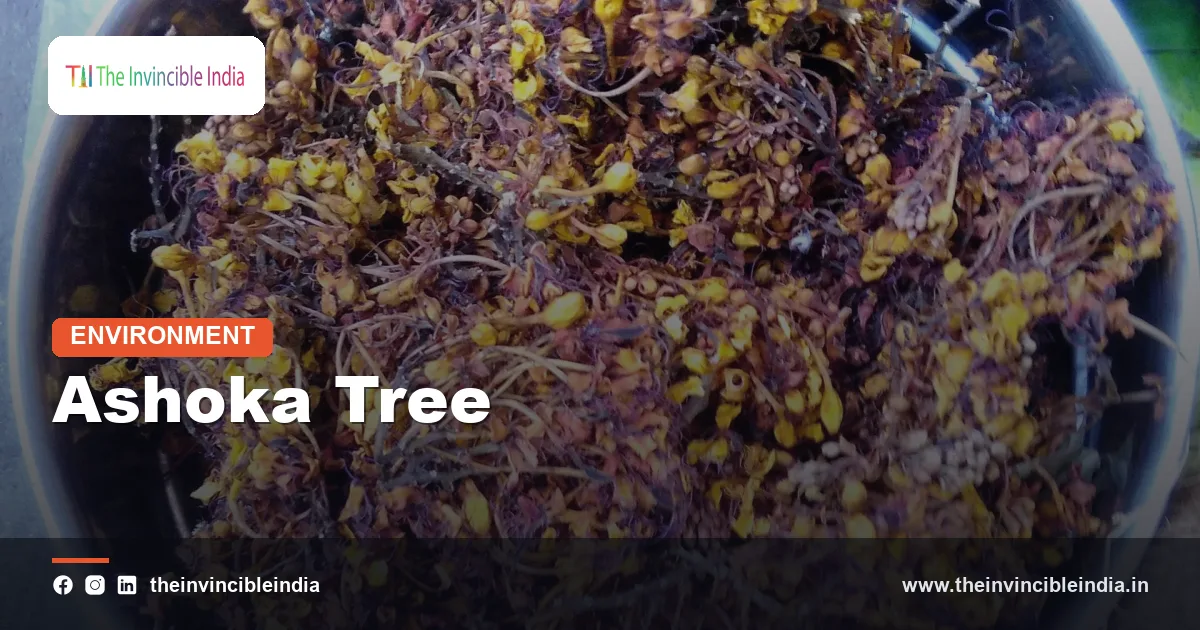
The ashoka tree (Saraca asoca) is a sacred evergreen tree of the Indian subcontinent, recognised by its drooping glossy leaves and dense clusters of orange-red flowers, and revered in Hindu, Buddhist and Jain traditions as the “sorrowless” tree. Its Sanskrit name, ashoka, literally means “without sorrow”, and the tree is closely tied to Sita’s captivity in the Ashoka Vatika of the Ramayana, to temple courtyards and to spring festivals.
The ashoka tree is also an ecological concern today. Wild populations have declined because of habitat loss and heavy bark collection for traditional medicine, and the true ashoka is regularly confused with the tall, columnar “false ashoka” (Polyalthia longifolia) planted along Indian roads. This explainer separates the two trees, describes the real ashoka tree’s biology, symbolism and uses, and notes where the facts are firm and where traditional claims need caution. Last updated: 23 October 2026.
Quick Facts: Ashoka Tree at a Glance
| Common name | Ashoka tree, sorrowless tree, Ashok |
|---|---|
| Scientific name | Saraca asoca (also written Saraca indica in older books) |
| Plant family | Fabaceae (the legume or pea family), subfamily Caesalpinioideae |
| Type | Small to medium evergreen tree, usually 6 to 10 metres tall |
| Native range | Indian subcontinent, including the Himalayan foothills, central and eastern India and the Western Ghats, extending into Sri Lanka and parts of Southeast Asia |
| Flowering season | Roughly February to April, in dense clusters that change from orange-yellow to red |
| Conservation status | Assessed as Vulnerable on the IUCN Red List |
| Cultural significance | Linked to Sita in the Ramayana, to Buddhist and Jain traditions, to Kamadeva and to the festival Ashokashtami |
| Often confused with | False ashoka or Indian mast tree (Polyalthia longifolia), a different species of the custard-apple family |
Key Takeaways
- The ashoka tree (Saraca asoca) is a true member of the legume family Fabaceae and is native to the Indian subcontinent.
- The word ashoka means “without sorrow” in Sanskrit, and the ashoka tree is considered an emblem of love, fertility and freedom from grief.
- The ashoka tree in the Ramayana is associated with the Ashoka Vatika, the garden in Lanka where Sita is said to have been held.
- The ashoka tree is assessed as Vulnerable by the IUCN, mainly because of habitat loss and bark harvesting for traditional medicine.
- The “false ashoka” (Polyalthia longifolia) is an unrelated, tall and narrow tree that is commonly planted along roads and is often wrongly called ashoka.
- Ayurvedic texts use ashoka bark in formulations such as Ashokarishta, but scientific evidence is limited and the tree’s products should be used only on qualified advice.
What is the ashoka tree?
The ashoka tree is a medium-sized evergreen tree, scientifically named Saraca asoca, that belongs to the legume family and is native to the Indian subcontinent. It is valued as an ornamental, a sacred tree and a traditional medicinal plant, and it appears in Sanskrit literature, temple architecture and folk custom across India.
Botanists place the ashoka tree in the family Fabaceae, the same large family that includes peas, beans, tamarind and the gulmohar. Older Indian books often list it under the name Saraca indica, and some floras treat the two names as the same plant. The tree is shade-tolerant, prefers moist and humus-rich ground, and typically grows as an understorey species along streams, in ravines and in moist evergreen or semi-evergreen forest.
The ashoka tree is sometimes confused with Emperor Ashoka of the Maurya dynasty. The emperor’s name shares the same Sanskrit word, meaning “without sorrow”, but the two are unrelated; the tree was revered long before and long after his reign.
What does the ashoka tree look like?
The ashoka tree looks like a dense, rounded tree with drooping, glossy, compound leaves and rounded bunches of fragrant orange-to-red flowers that appear directly on the branches in spring. Knowing a few features makes it simple to separate the true ashoka tree from look-alikes.
Leaves
- The leaves are pinnately compound, usually with four to six pairs of long, oblong leaflets arranged along a central stalk.
- Young leaves emerge in a soft, limp, copper-red or purplish state and hang downwards before turning a deep, glossy green.
- The leaflets have a smooth, slightly wavy surface and give the crown its characteristic drooping, curtained look.
Flowers
- The flowers form dense, rounded clusters, often described as corymbs, that sit on the branches and sometimes on the trunk.
- Individual flowers have no true petals; the colour comes from a tubular, petal-like calyx that opens orange-yellow and deepens to scarlet or red as the cluster ages.
- The flowers are mildly fragrant, and the scent is noticeably stronger in the evening and at night.
Pods and seeds
- The fruit is a flat, leathery, flattened pod that can be roughly 10 to 25 centimetres long.
- Pods ripen from green to dark purplish-black and hold a few large, flat seeds.
The bark is dark brown to greyish, fairly smooth and relatively thin, which is one reason the tree is vulnerable to over-stripping.
Where does the ashoka tree grow in India?
The ashoka tree grows naturally in the moist and sheltered forests of the Himalayan foothills, parts of central and eastern India, and the Western Ghats, and it is widely planted in gardens, temples and avenues throughout the country. Natural stands are patchy because the species depends on moist, shaded, stream-side habitats.
In the wild, the species is recorded in the Western Ghats and the neighbouring coastal belt, in parts of the Deccan, and in the eastern plains and foothills, and it extends into Sri Lanka, Bangladesh, Nepal and parts of Myanmar. Because it is a long-cultivated tree, it is difficult in many places to tell wild trees from planted ones. Temple gardens, old homesteads and botanical gardens hold many of the trees that people see today.
The ashoka tree does best in warm, humid climates with well-drained, fertile soil. It does not tolerate hard frost or prolonged drought, so in cooler northern areas it is usually grown in sheltered spots.
Why is the ashoka tree sacred in India?
The ashoka tree is sacred in India because it is linked to love, fertility and the absence of grief in Hindu mythology, and it appears in Buddhist and Jain accounts as well. This religious standing is a major reason the tree is planted near temples and homes.
Hindu associations
In Hindu tradition the ashoka tree is connected with Kamadeva, the god of love, whose five flower-arrows include the ashoka blossom in many classical lists. The tree is also associated with the goddess and with fertility, and the festival Ashokashtami, observed on the eighth day of the bright fortnight of the month of Chaitra, involves worshipping the tree. A well-known observance on that day involves consuming a few of the tree’s buds with water, in the belief that this keeps sorrow away.
Buddhist and Jain associations
Buddhist traditions mention the ashoka tree in connection with the Buddha’s birth garden, although accounts differ and many sources name the sal tree instead for the same event. In Jainism, an ashoka tree is counted among the eight auspicious attendant features (the ashtamahapratiharya) that traditionally accompany a Tirthankara, and statues and temple art often show a tree canopy of ashoka above the figure.
Classical poetry
Classical Sanskrit poets described a charming convention in which the ashoka was said to burst into bloom when touched by the foot of a beautiful young woman wearing anklets. This poetic motif, linked to the idea of dohada or “longing of a plant”, appears repeatedly in kavya literature and temple sculpture, where a woman is shown placing her foot against the trunk.
What is the connection between the ashoka tree and Sita?
The ashoka tree is connected to Sita through the Ashoka Vatika, the grove in Lanka where, in the Ramayana, Ravana kept Sita captive and where Hanuman first met her. The grove is named for its ashoka trees, and the narrative presents the tree as a quiet witness to her sorrow and her resolve.
Because of this story, the ashoka tree became an emblem of enduring faith in the face of separation. Later tellings of the epic, regional retellings and folk songs frequently invoke the grove. In Sri Lanka, sites in the Nuwara Eliya region are traditionally identified with the Ashoka Vatika, and local temples and tourist literature present the area in that light. These identifications rest on tradition and devotion rather than archaeological proof, and visitors should treat them as part of living religious heritage.
How is the ashoka tree used in Ayurveda?
In Ayurveda the bark of the ashoka tree is the main part used, and it appears in traditional formulations meant mainly for women’s reproductive health, such as Ashokarishta, a fermented preparation. These uses are part of classical practice, and modern clinical evidence remains limited, so they should not be treated as proven medical treatment.
Traditional texts describe the bark as having astringent and cooling qualities, and also mention the flowers and seeds in remedies for conditions as varied as heavy menstrual bleeding, digestive complaints and skin disorders. Laboratory studies have reported various chemical constituents in the bark, including tannins and flavonoid-type compounds, but laboratory findings in cells or animals do not establish a safe dose or an effective treatment in people.
- Preparations such as Ashokarishta are sold as licensed Ayurvedic products in India and are usually taken under practitioner guidance.
- Pregnant and breastfeeding women, and people on regular medication, are generally advised to consult a doctor before using any herbal bark preparation.
- Bark from wild trees is a conservation problem, and products made from cultivated or ethically sourced material are preferable.
- Look-alike barks and adulteration are a known problem in the herbal trade, which is another reason to buy only from reliable, licensed sources.
Is the ashoka tree endangered?
The ashoka tree is not formally listed as Endangered, but it is assessed as Vulnerable on the IUCN Red List, meaning it faces a high risk of decline in the wild. The main pressures are loss of its moist forest habitat and the large-scale harvesting of bark for the herbal medicine trade.
Stripping bark from a tree can damage or kill it, and the species is slow to recover when stands are repeatedly harvested. Forest clearing for farmland and settlements has also reduced the shaded stream-side habitats where the tree naturally grows. Researchers and forest departments have encouraged cultivation, nursery propagation and the use of planted material, so that medicine makers can rely less on wild bark.
Seed-based propagation is possible but relatively slow, because the seeds lose viability quickly and need to be sown fresh. Botanical gardens, medicinal-plant boards and community nurseries have promoted saplings, and planting the tree in temple grounds, school campuses and home gardens helps keep living populations in cultivation.
| Threat | What it does to the ashoka tree |
|---|---|
| Bark harvesting | Removes the protective layer and can kill trees, especially when wild stands are repeatedly stripped |
| Habitat loss | Clearing of moist forest and stream-side land removes the natural homes of the species |
| Slow natural regeneration | Fresh seeds lose viability quickly, so natural replacement is limited when mature trees disappear |
| Mislabelling and adulteration | Substitute barks in the herbal trade distort demand and hide the true pressure on the species |
What is the false ashoka tree?
The false ashoka tree is Polyalthia longifolia, an unrelated Indian tree of the custard-apple family (Annonaceae) with a tall, narrow, columnar crown and long, wavy-edged leaves, and it is also called the Indian mast tree. It is the tree that most people actually see lining roads, school grounds and compound walls under the name “ashoka”.
The confusion is old and widespread, and the two trees are easy to tell apart once the key features are known. The true ashoka is a spreading, rounded tree with compound leaves and showy orange-red flower clusters, while the false ashoka is a slender pyramid with simple, lance-shaped leaves and small, pale yellowish-green, star-shaped flowers.
| Feature | True ashoka (Saraca asoca) | False ashoka (Polyalthia longifolia) |
|---|---|---|
| Family | Fabaceae (legume family) | Annonaceae (custard-apple family) |
| Shape | Rounded, spreading crown, usually 6 to 10 metres | Tall, narrow, columnar or pyramid shape, often taller |
| Leaves | Compound, with several pairs of drooping leaflets | Simple, long, lance-shaped with wavy margins |
| Flowers | Dense orange-to-red clusters, showy | Small, pale green to yellowish, star-shaped |
| Fruit | Flat, leathery pod | Small, oval berries that turn dark purple and attract birds |
| Typical use | Sacred and ornamental tree, bark in Ayurveda | Avenue and screening tree, sometimes used for decoration at festivals |
| Conservation | Assessed as Vulnerable | Widely planted and not a conservation concern |
The false ashoka is a useful urban tree because it takes little space, gives dense greenery and does not shed large branches easily. Its leaves are often cut for festival garlands and door-hangings. It is, however, not the tree of the Ramayana or the tree that Ayurveda uses, so purchasing “ashoka bark” or planting a “sacred ashoka” requires checking which species is actually on offer.
How do you grow and care for an ashoka tree?
An ashoka tree grows best in a warm, humid, partly shaded spot with rich, moist but well-drained soil, and it is easiest to start from a nursery-raised sapling or fresh seed. It is a slow starter but becomes a graceful, low-maintenance garden tree once established.
- Climate: Warm and humid conditions suit the tree best; it is sensitive to frost and to long dry spells.
- Light: Young trees prefer partial shade, while established trees tolerate more sun if they are watered well.
- Soil: Fertile, humus-rich, moisture-retentive soil with good drainage is ideal; heavy waterlogging should be avoided.
- Water: Regular watering is needed in the first few years and in dry months.
- Propagation: Fresh seeds should be sown soon after collection, because old seeds germinate poorly; air-layering and cuttings are used less often.
- Pruning: Minimal pruning is required, mostly to remove dead or crossing branches after flowering.
Planting the true ashoka rather than the false one is itself a modest conservation act, because it adds living trees of a threatened species to gardens and temple grounds. Buyers should ask nurseries for the botanical name Saraca asoca to avoid receiving a Polyalthia sapling.
What role does the ashoka tree play in Indian culture today?
The ashoka tree plays a continuing role in Indian culture as a festival tree, a temple and garden tree, and an emblem of hope and endurance. Its flowers are used in worship, and its image appears in sculpture, miniature painting and poetry.
During spring, the bright flower clusters are offered in some temples, and the leaves are strung as auspicious door-hangings, a custom that many households follow at weddings and festivals, though it is more commonly done with the false ashoka leaves because they are easier to obtain. Early Buddhist and Jain sculpture shows the tree, and the woman-and-tree motif is one of the most recognisable subjects of classical Indian art. Modern writers and environmental groups use the tree as a symbol in discussions of medicinal-plant conservation.
Bottom Line
The ashoka tree (Saraca asoca) is a beautiful, sacred and threatened Indian evergreen, not to be mixed up with the tall roadside false ashoka. Appreciating the real tree means knowing how to identify it, respecting its cultural meaning and supporting cultivated rather than wild-harvested sources of its bark.
Frequently Asked Questions
What is the scientific name of the ashoka tree?
The scientific name of the ashoka tree is Saraca asoca, and older Indian books often write it as Saraca indica. It belongs to the legume family, Fabaceae. The false ashoka, by contrast, is Polyalthia longifolia and belongs to a different family.
Why is it called the ashoka tree?
It is called the ashoka tree because the Sanskrit word ashoka means “without sorrow”. The tree has long symbolised love, fertility and freedom from grief in Hindu, Buddhist and Jain traditions. The name is the same as that of Emperor Ashoka, but the two are not otherwise related.
What is the difference between the real ashoka and the false ashoka?
The real ashoka is a rounded legume tree with compound leaves and showy orange-red flower clusters, while the false ashoka is a tall, narrow tree of the custard-apple family with simple, wavy leaves and small green flowers. The false ashoka is the tree commonly planted along Indian roads. Only the real ashoka is the sacred tree of the Ramayana and the source of the bark used in Ayurveda.
When does the ashoka tree flower?
The ashoka tree flowers mainly in the late winter and spring, roughly from February to April in much of India. The flower clusters open orange-yellow and turn red as they age. The exact timing varies with local climate and altitude.
Is the ashoka tree endangered?
The ashoka tree is assessed as Vulnerable on the IUCN Red List rather than formally Endangered. Its wild population has declined because of habitat loss and the heavy harvesting of bark for herbal medicine. Planting nursery-raised trees and using cultivated material helps reduce pressure on wild stands.
Is ashoka bark safe to use as medicine?
Ashoka bark is used in traditional Ayurvedic preparations such as Ashokarishta, but modern clinical evidence is limited and it is not a proven treatment. Anyone who is pregnant, breastfeeding, on regular medication or managing a medical condition should consult a qualified doctor first. It is safest to buy only licensed products from reliable sources, since adulteration with other barks is a known problem.
{“@context”:”https://schema.org”,”@graph”:[{“@type”:”FAQPage”,”mainEntity”:[{“@type”:”Question”,”name”:”What is the scientific name of the ashoka tree?”,”acceptedAnswer”:{“@type”:”Answer”,”text”:”The scientific name of the ashoka tree is Saraca asoca, and older Indian books often write it as Saraca indica. It belongs to the legume family, Fabaceae. The false ashoka, by contrast, is Polyalthia longifolia and belongs to a different family.”}},{“@type”:”Question”,”name”:”Why is it called the ashoka tree?”,”acceptedAnswer”:{“@type”:”Answer”,”text”:”It is called the ashoka tree because the Sanskrit word ashoka means “without sorrow”. The tree has long symbolised love, fertility and freedom from grief in Hindu, Buddhist and Jain traditions. The name is the same as that of Emperor Ashoka, but the two are not otherwise related.”}},{“@type”:”Question”,”name”:”What is the difference between the real ashoka and the false ashoka?”,”acceptedAnswer”:{“@type”:”Answer”,”text”:”The real ashoka is a rounded legume tree with compound leaves and showy orange-red flower clusters, while the false ashoka is a tall, narrow tree of the custard-apple family with simple, wavy leaves and small green flowers. The false ashoka is the tree commonly planted along Indian roads. Only the real ashoka is the sacred tree of the Ramayana and the source of the bark used in Ayurveda.”}},{“@type”:”Question”,”name”:”When does the ashoka tree flower?”,”acceptedAnswer”:{“@type”:”Answer”,”text”:”The ashoka tree flowers mainly in the late winter and spring, roughly from February to April in much of India. The flower clusters open orange-yellow and turn red as they age. The exact timing varies with local climate and altitude.”}},{“@type”:”Question”,”name”:”Is the ashoka tree endangered?”,”acceptedAnswer”:{“@type”:”Answer”,”text”:”The ashoka tree is assessed as Vulnerable on the IUCN Red List rather than formally Endangered. Its wild population has declined because of habitat loss and the heavy harvesting of bark for herbal medicine. Planting nursery-raised trees and using cultivated material helps reduce pressure on wild stands.”}},{“@type”:”Question”,”name”:”Is ashoka bark safe to use as medicine?”,”acceptedAnswer”:{“@type”:”Answer”,”text”:”Ashoka bark is used in traditional Ayurvedic preparations such as Ashokarishta, but modern clinical evidence is limited and it is not a proven treatment. Anyone who is pregnant, breastfeeding, on regular medication or managing a medical condition should consult a qualified doctor first. It is safest to buy only licensed products from reliable sources, since adulteration with other barks is a known problem.”}}]}]}


