

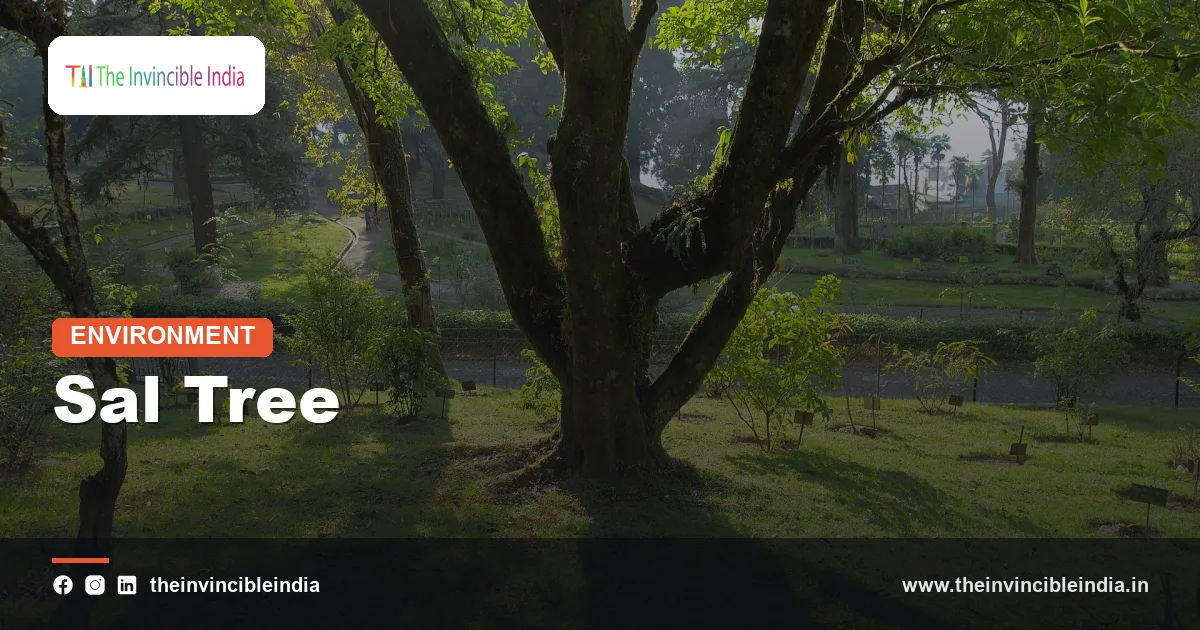
The sal tree (Shorea robusta) is a large, hardwood-yielding deciduous tree that dominates the forests of central, eastern and sub-Himalayan India, and it is one of the country’s most important timber trees and the backbone of many tribal forest economies. Sal wood is heavy, strong and durable, its seeds yield an edible-grade fat, and its leaves are stitched into plates, which makes the sal tree both a commercial and a cultural resource.
Sal forests cover large belts from the foothills of the Himalaya through Uttar Pradesh, Bihar, Jharkhand, Odisha, Chhattisgarh, Madhya Pradesh and West Bengal to Assam, and the tree is the state tree of Jharkhand and Chhattisgarh. This explainer covers what the sal tree is, where it grows, how its timber and seeds are used, why it is sacred in tribal and Buddhist tradition, and what threatens it. Last updated: 23 October 2026.
Quick Facts: Sal Tree at a Glance
| Common names | Sal, Sakhua, Sakhu, Sarai, Shala, Sal tree |
|---|---|
| Scientific name | Shorea robusta |
| Plant family | Dipterocarpaceae, the family of the tall tropical “two-winged-fruit” trees |
| Type | Large deciduous to semi-evergreen hardwood tree, commonly 30 metres or more in height |
| Main range in India | Sub-Himalayan belt, plains and plateaus of Uttar Pradesh, Uttarakhand, Bihar, Jharkhand, Odisha, Chhattisgarh, Madhya Pradesh, West Bengal and Assam |
| Leaf fall and flowering | Leaves shed in late winter and spring; creamy-yellow flowers around March to April; winged seeds ripen around May to June |
| Key products | Heavy construction timber, sal seed oil (sal butter), dammar-type resin, sal leaves for plates and cups |
| State tree of | Jharkhand and Chhattisgarh |
| Cultural significance | Sacred grove (sarna) tree of tribal communities; associated in Buddhist tradition with the Buddha’s birth and passing |
Key Takeaways
- The sal tree (Shorea robusta) is a large hardwood tree of the family Dipterocarpaceae that dominates the forests of central and eastern India and the sub-Himalayan belt.
- Sal timber is dense, strong and durable, and has long been used for beams, doors, bridges, railway sleepers and heavy construction.
- Sal seeds yield a vegetable fat known as sal butter, which is used in cosmetics, soaps and, in some countries, as a cocoa-butter equivalent in confectionery.
- Sal leaves are stitched into plates (patravali) and cups that support the livelihoods of thousands of forest-dwelling families.
- The sal tree is central to the tribal festival Sarhul and to sarna sacred groves in Jharkhand, and it is the state tree of Jharkhand and Chhattisgarh.
- Sal forests face pressure from conversion to farmland and mining, from over-felling, and from sal borer beetle outbreaks.
What is the sal tree?
The sal tree is a tall, straight-trunked hardwood tree, scientifically named Shorea robusta, that forms the main canopy of the so-called sal forests of the Indian subcontinent. It belongs to the Dipterocarpaceae family, the same group that supplies much of Southeast Asia’s tropical timber.
The name sal comes from the Sanskrit word shala. The tree is known as sakhua or sakhu in parts of Odisha and Jharkhand and as sarai in Chhattisgarh. Foresters have long ranked sal among the three or four most valuable timber species in India, alongside teak, deodar and a few others, and sal forests are described as one of the major forest types in standard Indian forest classifications.
A mature sal can reach 30 to 35 metres in height and, under good conditions, more. It has a long, straight, clean bole that makes it ideal for sawn timber, and a deeply furrowed, dark brown bark. Its leaves are large, oval to oblong, glossy and leathery, and it is deciduous only for a short time in the dry season, so a sal forest often looks nearly evergreen.
Where does the sal tree grow in India?
The sal tree grows in a broad arc across northern, central and eastern India, from the Himalayan foothills in Uttarakhand and Himachal Pradesh through the plains and plateaus of central India to Assam and the north-eastern states. It also extends into Nepal, Bangladesh and Bhutan.
Sal forests are generally divided into two broad classes by moisture. Moist sal is found in areas of higher rainfall, such as the Terai and Duars, West Bengal, Assam and parts of Odisha, while dry sal grows on drier tracts in central India, Chhattisgarh and parts of Madhya Pradesh. The tree prefers deep, well-drained, sandy to loamy soils, and it needs a distinct dry season but cannot withstand prolonged waterlogging.
- Himalayan foothills and Terai: Tall, dense stands with a rich understorey, found in Uttarakhand, Uttar Pradesh and the northern edge of Bihar.
- Chota Nagpur and eastern plateau: Jharkhand, Odisha and Chhattisgarh hold some of the largest contiguous sal tracts and the highest concentration of sal-linked tribal communities.
- Duars and the north-east: Sal grows along the foothills of West Bengal and Assam, in forests that shelter elephants and a range of other wildlife.
- Central India: Parts of Madhya Pradesh and Chhattisgarh contain dry sal forests that grade into teak-bearing forests.
What is sal wood used for?
Sal wood is used mainly for heavy structural work, such as beams, posts, doors, window frames, bridges, railway sleepers, boat construction and furniture, because it is hard, heavy and resistant to decay and termites. It is one of the standard strong timbers of the Indian building trade.
The heartwood is light brown when freshly cut and darkens to a deeper brown with age. It is dense, with seasoned timber commonly cited as weighing around 800 to 900 kilograms per cubic metre, and it has an interlocked grain that makes it strong but difficult to season and to work by hand. Careful seasoning is needed, because sal can crack or warp if dried too quickly.
Common uses of sal timber
- Beams, rafters and posts in houses, temples and bridges.
- Railway sleepers, a major historical use that shaped the management of sal forests.
- Door and window frames, especially in northern and eastern India.
- Agricultural implements, cart wheels and ploughs in rural areas.
- Plywood, flooring and packing material from smaller or lower-grade logs.
Sal is naturally resistant to termites and fungal decay because of the resin and extractives in its heartwood, though it is sometimes treated for outdoor and ground-contact use. Teak is more stable and easier to work, while sal is generally stronger and cheaper, so builders often choose sal for structure and teak for finish.
What is sal butter and how is it made?
Sal butter is a solid vegetable fat extracted from the seeds of the sal tree, and it is used in soaps, cosmetics and certain confectionery as a cocoa-butter equivalent. The seeds are collected from the forest floor in early summer, dried, processed and pressed to yield the fat.
Sal seeds are one of the biggest items of non-timber forest produce, known in India as minor forest produce, collected by local families and sold through traders, cooperatives and state forest corporations. After collection, the winged seeds are dried, de-husked and sold to oil mills, which extract the fat by pressing or solvent extraction and then refine and fractionate it.
The refined fat is hard at room temperature and melts near body temperature, which makes it suitable as an ingredient in cosmetics and, in some regulatory systems, as a cocoa-butter equivalent. Chocolate manufacturers in certain markets, including the European Union, are allowed to use specified quantities of such vegetable fats, including sal fat, under defined rules. The residual seed cake is used as animal feed or fuel after treatment.
Because the seed harvest depends on a short fruiting season in May and June, income from sal seed is highly seasonal. It matters most to forest-dwelling families during the pre-monsoon months, when other work is scarce.
How do sal leaves support livelihoods?
Sal leaves support livelihoods by being collected, dried and pressed into disposable plates (patravali or pattal) and bowls (dona), a cottage industry that employs many forest-dwelling families, especially women. These biodegradable plates are widely used at weddings, community meals and temple feasts.
Collectors pluck mature leaves from sal trees and stitch several together with thin sticks or bamboo splinters to make a plate, which is then dried and often pressed by hand or by small machines to give it shape. Later products include machine-pressed plates, and the trade has grown in some states as a plastic-free alternative. The sal leaf plate is regarded as a natural, compostable item, and the leaves are rarely stripped in a way that kills a tree, although heavy lopping can stress young plants.
The right to collect minor forest produce for subsistence and sale is recognised for eligible forest dwellers under the Scheduled Tribes and Other Traditional Forest Dwellers (Recognition of Forest Rights) Act, 2006, commonly called the Forest Rights Act. Sal leaves and seeds are among the best-known examples of such produce.
Why is the sal tree sacred?
The sal tree is sacred because it stands at the centre of tribal nature worship in eastern India, it is closely linked to the life of the Buddha in Buddhist tradition, and it is regarded as a revered tree in several Hindu practices. Its religious standing has helped protect many individual trees and groves.
Sarna groves and Sarhul
Among the Oraon, Munda, Ho and several other tribal communities of Jharkhand, Odisha and neighbouring states, a patch of sal forest called a sarna or jaher is kept as a sacred grove. The spring festival Sarhul, held when the sal tree flowers, celebrates the new year of nature; the village priest (pahan) offers sal flowers and prays for rain and a good harvest. The tree is seen as the home of the deity and as a symbol of the community’s bond with the forest.
Buddhist tradition
Buddhist tradition holds that Queen Maya gave birth to Siddhartha Gautama in a sal grove at Lumbini, and that the Buddha attained mahaparinirvana at Kushinagar between two sal trees. For this reason sal is regarded as one of the most revered trees in Buddhist countries, and sal trees are planted in many monasteries.
Hindu use
Sal resin, known as ral or raal in Hindi, is burned as incense in rituals, and sal wood and leaves are used in worship and at festivals in several regions. In classical literature sal is praised as a mighty, enduring tree.
What is the ecological role of sal forests?
Sal forests act as important habitats and carbon stores, supporting a layered community of trees, shrubs, grasses, mammals, birds and insects, and they help regulate rainfall runoff and soil in some of India’s most densely populated regions. They are one of the largest tropical deciduous forest types in the country.
The canopy of Shorea robusta shelters species such as the Asian elephant, tiger, leopard, sloth bear, gaur, spotted deer and numerous birds. In the north, sal forests of the Terai and Duars support species such as the Indian rhinoceros in neighbouring grasslands, and several of India’s well-known national parks and tiger reserves contain large sal tracts, including Corbett, Dudhwa and Kanha in various forms.
Natural regeneration of sal depends on seedlings that survive the dry season and fire. The tree can regrow from stumps (coppicing), which made it suitable for repeated management, but over-harvesting, grazing and uncontrolled fire reduce seedling survival. Forest departments often use selection felling, protection and regeneration planting in sal working plans.
| Ecological function | How sal forests provide it |
|---|---|
| Wildlife habitat | Tall canopy and layered understorey for elephants, tigers, deer and birds |
| Soil and water | Deep roots and leaf litter reduce erosion and help recharge groundwater |
| Carbon storage | Large, long-lived trees store carbon in wood and soil |
| Livelihoods | Seeds, leaves, resin, fuel and timber for forest-fringe communities |
| Seasonal pulse | Annual leaf fall and spring flush set the rhythm for insects, birds and festivals |
What threatens the sal tree?
The sal tree is threatened mainly by conversion of forest to farmland, mining and infrastructure, by illegal or excessive felling, by uncontrolled fire and grazing, and by outbreaks of the sal heartwood borer beetle. The species is not globally threatened, but the quality and extent of mature sal forest has declined in many regions.
- Land-use change: Eastern and central India’s sal belt overlaps with coal, iron-ore and other mineral deposits, so mining, roads and industrial projects have cleared forest in some districts.
- Over-felling and theft: High-value timber attracts illegal logging, and heavy, uncontrolled harvesting reduces the number of mature seed-bearing trees.
- Sal borer: The heartwood borer Hoplocerambyx spinicornis has caused large outbreaks in sal forests in the past, killing many trees across extensive areas.
- Fire and grazing: Repeated burning and livestock browsing damage seedlings and prevent regeneration.
- Climate variability: Changes in rainfall and prolonged dry spells may stress sal, which depends on reliable seasonal moisture.
Conservation measures include joint forest management with village committees, protected-area networks, regulated harvest of seeds and leaves, and community protection of sacred groves.
How can sal forests be managed sustainably?
Sal forests can be managed sustainably by combining scientific working plans with community participation, so that timber felling, seed and leaf collection and wildlife protection stay within the forest’s regeneration capacity. In India, this approach is delivered mainly through state forest departments and Joint Forest Management committees.
Key practices include selective harvesting of mature trees, protecting seed-bearing trees, controlled burning and fire lines, planting in gaps, and restricting grazing in regenerating compartments. Sal seed and leaf collection can be sustainable if collectors leave enough seed for natural regeneration and avoid cutting young branches. Certification of forest products, community forest rights and fair-price purchase by cooperatives can add economic incentive for conservation.
Bottom Line
The sal tree (Shorea robusta) is the dominant hardwood of central and eastern Indian forests, valued for its strong timber, its seed fat and leaf plates, and its place in tribal and Buddhist tradition. Its future depends on keeping sal forests intact, managing harvest sustainably and respecting the communities who rely on them.
Frequently Asked Questions
What is the scientific name of the sal tree?
The scientific name of the sal tree is Shorea robusta, and it belongs to the Dipterocarpaceae family. The name sal comes from the Sanskrit shala. It is also known as sakhua, sakhu and sarai in different regions.
Where is the sal tree found in India?
The sal tree is found across a broad belt from the Himalayan foothills through Uttar Pradesh, Bihar, Jharkhand, Odisha, Chhattisgarh and Madhya Pradesh to West Bengal and Assam. Jharkhand and Chhattisgarh have adopted it as their state tree. Moist sal grows in higher-rainfall areas, while dry sal occurs on drier plateaus.
Is sal wood better than teak?
Sal wood is generally harder, heavier and cheaper than teak, but teak is more dimensionally stable and easier to work. Builders often use sal for structural parts such as beams, posts and frames, and teak for fine furniture and finishing. Which is better depends on the use and budget.
What is sal butter used for?
Sal butter is a vegetable fat from sal seeds that is used in soaps, cosmetics and, in some countries, as a cocoa-butter equivalent in chocolate and confectionery. Its melting behaviour is similar to cocoa butter, which makes it commercially useful. Its use in food is regulated differently in different markets.
Why is the sal tree sacred?
The sal tree is sacred because tribal communities in eastern India worship it in sarna groves and celebrate it during the festival Sarhul, and because Buddhist tradition links it to the Buddha’s birth and passing. Its resin is also used as incense. These beliefs have helped protect many sal groves.
Is the sal tree endangered?
The sal tree is not globally classified as endangered, but mature sal forests have shrunk in many places because of mining, land conversion, illegal felling and pest outbreaks. Sustainable management and community protection help keep sal forests healthy. Conservation efforts focus on the forests and their regeneration rather than on the species alone.
{“@context”:”https://schema.org”,”@graph”:[{“@type”:”FAQPage”,”mainEntity”:[{“@type”:”Question”,”name”:”What is the scientific name of the sal tree?”,”acceptedAnswer”:{“@type”:”Answer”,”text”:”The scientific name of the sal tree is Shorea robusta, and it belongs to the Dipterocarpaceae family. The name sal comes from the Sanskrit shala. It is also known as sakhua, sakhu and sarai in different regions.”}},{“@type”:”Question”,”name”:”Where is the sal tree found in India?”,”acceptedAnswer”:{“@type”:”Answer”,”text”:”The sal tree is found across a broad belt from the Himalayan foothills through Uttar Pradesh, Bihar, Jharkhand, Odisha, Chhattisgarh and Madhya Pradesh to West Bengal and Assam. Jharkhand and Chhattisgarh have adopted it as their state tree. Moist sal grows in higher-rainfall areas, while dry sal occurs on drier plateaus.”}},{“@type”:”Question”,”name”:”Is sal wood better than teak?”,”acceptedAnswer”:{“@type”:”Answer”,”text”:”Sal wood is generally harder, heavier and cheaper than teak, but teak is more dimensionally stable and easier to work. Builders often use sal for structural parts such as beams, posts and frames, and teak for fine furniture and finishing. Which is better depends on the use and budget.”}},{“@type”:”Question”,”name”:”What is sal butter used for?”,”acceptedAnswer”:{“@type”:”Answer”,”text”:”Sal butter is a vegetable fat from sal seeds that is used in soaps, cosmetics and, in some countries, as a cocoa-butter equivalent in chocolate and confectionery. Its melting behaviour is similar to cocoa butter, which makes it commercially useful. Its use in food is regulated differently in different markets.”}},{“@type”:”Question”,”name”:”Why is the sal tree sacred?”,”acceptedAnswer”:{“@type”:”Answer”,”text”:”The sal tree is sacred because tribal communities in eastern India worship it in sarna groves and celebrate it during the festival Sarhul, and because Buddhist tradition links it to the Buddha’s birth and passing. Its resin is also used as incense. These beliefs have helped protect many sal groves.”}},{“@type”:”Question”,”name”:”Is the sal tree endangered?”,”acceptedAnswer”:{“@type”:”Answer”,”text”:”The sal tree is not globally classified as endangered, but mature sal forests have shrunk in many places because of mining, land conversion, illegal felling and pest outbreaks. Sustainable management and community protection help keep sal forests healthy. Conservation efforts focus on the forests and their regeneration rather than on the species alone.”}}]}]}


