

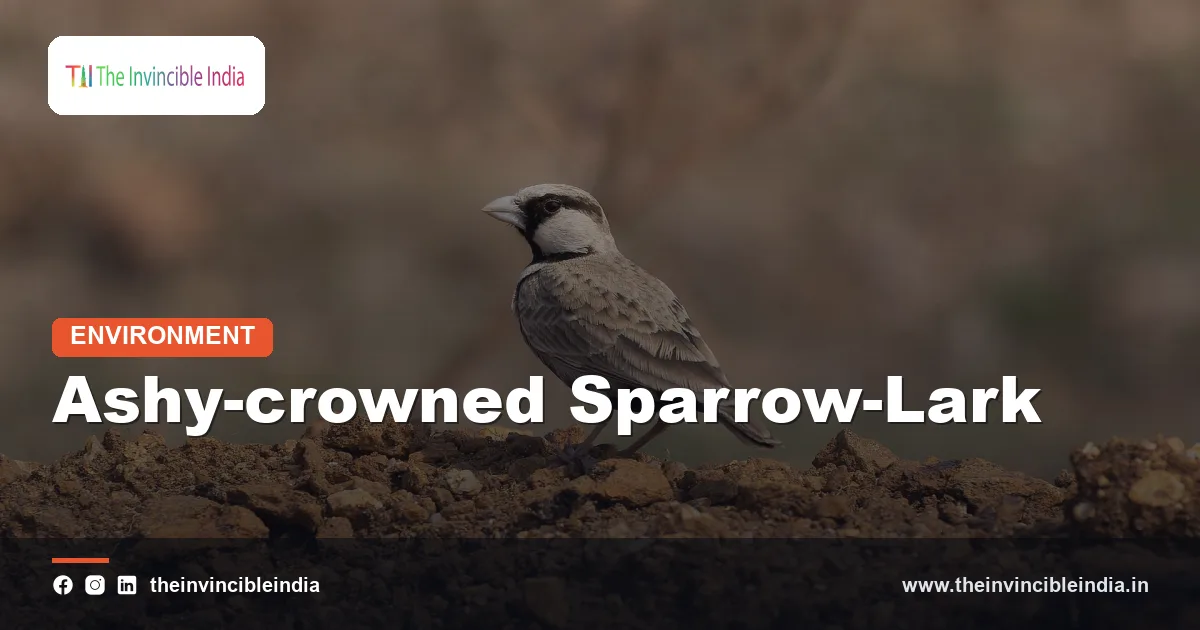
The ashy-crowned sparrow-lark (Eremopterix griseus) is a small, stubby-billed lark of the Indian subcontinent that lives on dry, open ground such as fallow fields, scrubby wasteland and bare tracks, where the male is easily recognised by his black underparts, white cheeks and ash-grey crown. It is a resident species across much of peninsular and northern India, spending its whole life on or close to the ground and feeding mainly on seeds and small insects.
Because the ashy-crowned sparrow-lark looks more like a tiny finch or sparrow than a typical lark, many people overlook it or mistake it for another small brown bird. This explainer describes how to identify the species, where it occurs in India, what it eats, how the male’s parachuting song-flight works, how it nests, and how it compares with the other larks of the Indian plains.
| Quick Fact | Detail |
|---|---|
| Common name | Ashy-crowned sparrow-lark (also called ashy-crowned finch-lark) |
| Scientific name | Eremopterix griseus |
| Family | Alaudidae (larks) |
| Size | About 11 to 13 cm long, a little smaller than a house sparrow |
| Range and habitat in India | Dry open country, fallow and stubble fields, scrub and semi-arid plains across much of the subcontinent |
| Diet | Seeds of grasses and weeds, with small insects, especially when feeding young |
| Breeding | Ground nest, usually two eggs; breeds mostly in the dry months; the male performs a display flight |
| Movements | Mainly resident, with local movements linked to rain and food |
| Conservation status | Least Concern on the IUCN Red List |
Key Takeaways
- The ashy-crowned sparrow-lark is a small lark of dry, open Indian ground, about the size of a small sparrow, with a short, thick, finch-like bill.
- The male ashy-crowned sparrow-lark has a black belly and breast, white cheeks and an ash-grey crown, while the female is a streaked, sandy-brown bird.
- The ashy-crowned sparrow-lark feeds mainly on the seeds of grasses and weeds, and adds insects to its diet during the breeding season.
- The male ashy-crowned sparrow-lark advertises his territory with a rising song-flight that ends in a swooping, parachuting descent.
- The ashy-crowned sparrow-lark nests on bare ground in a shallow scrape, usually laying two eggs, and its nest is often shaded by a clod or small plant.
- The ashy-crowned sparrow-lark is classified as Least Concern by the IUCN, although conversion of open land to buildings and intensive farming can reduce local numbers.
What is the ashy-crowned sparrow-lark?
The ashy-crowned sparrow-lark is a small ground-dwelling songbird in the lark family, Alaudidae, found across the plains and dry country of the Indian subcontinent. Its scientific name is Eremopterix griseus, and it has long been known in older Indian field guides as the ashy-crowned finch-lark, a name that describes its sparrow-like build and thick bill.
Larks are a family of mostly brown, streaked birds that live on open ground, sing in flight and nest on the earth. The ashy-crowned sparrow-lark belongs to a group called sparrow-larks or finch-larks, which differ from the larger crested larks and bush larks by their compact bodies, short tails and strongly sexual plumage differences. In most larks the sexes look alike, but in sparrow-larks the male and female are quite different.
The genus name Eremopterix comes from Greek roots that suggest a bird of the desert or empty places, which fits the group well. Sparrow-larks are found in the drier parts of Africa, the Middle East and South Asia, and the ashy-crowned sparrow-lark is the species that represents the group across most of India and neighbouring countries such as Pakistan, Nepal, Bangladesh and Sri Lanka.
How can you identify the ashy-crowned sparrow-lark?
The easiest way to identify the ashy-crowned sparrow-lark is to look at the male’s colouring: a black belly and breast, white or pale cheeks and a pale grey crown, all set against a sandy-brown back. The short, thick, pale bill and compact shape also separate the bird from slimmer, longer-tailed larks.
The male
The adult male ashy-crowned sparrow-lark has a dark, almost black underside from the chin down to the belly, which is unusual because most ground birds are pale underneath. The cheeks and ear region are whitish, forming a clear patch against the dark chin and throat, and the crown is pale ash-grey. The back and wings are sandy brown, and the tail is dark with pale outer edges. When the male flies low over bare ground, the black underside is often the first feature that catches the eye.
The female and young birds
The female ashy-crowned sparrow-lark is far plainer, with sandy-brown upperparts, a streaked breast and a pale belly, and she lacks the black underparts and the grey crown. Her colouring matches dry soil and stubble so well that she can be difficult to see until she moves. Young birds resemble the female but have pale fringes to the feathers, which give the upperparts a scaly look.
Other useful field marks
- Bill: short, thick and conical, much stouter than the bills of most larks.
- Posture: low and horizontal, with a compact outline and a short tail.
- Behaviour: runs or walks in short bursts on the ground and rarely perches in trees.
- Flight: undulating and rather weak, usually low over the ground and over a short distance.
- Calls: short, soft, dry notes given in flight or when flushed.
Where does the ashy-crowned sparrow-lark live in India?
The ashy-crowned sparrow-lark lives in dry, open habitats across much of India, including fallow and ploughed fields, short-grass scrub, dry riverbeds, gravelly wasteland and the edges of roads and tracks. The bird generally avoids dense forest, tall grassland and wet or heavily irrigated land.
Its range stretches across the Indian peninsula and the northern plains, and extends into Pakistan, Nepal, Bangladesh and Sri Lanka. The species is usually found at low elevations and is more common in drier regions than in humid ones. In the Himalayan foothills it appears mainly on lower, open ground rather than in high forest.
Several features of a habitat attract the ashy-crowned sparrow-lark:
- Bare or sparsely vegetated soil where seeds are easy to find and predators can be seen from a distance.
- Scattered clods, stones or short tufts that provide shade for resting and nesting.
- A nearby source of water, because the bird drinks regularly, often at puddles, pools or irrigation edges.
- Low disturbance from vehicles and from building work during the breeding season.
The bird often feeds on harvested fields, where spilled grain and weed seeds are plentiful, and in newly ploughed land where insects are exposed. These human-made landscapes have allowed the ashy-crowned sparrow-lark to remain widespread in farming regions of India, provided that some open, unsealed ground persists.
What does the ashy-crowned sparrow-lark eat?
The ashy-crowned sparrow-lark eats mostly small seeds, especially those of grasses and field weeds, and supplements them with small insects such as ants, beetles and grasshoppers. Seeds form the bulk of the diet for most of the year, while insects become more important when adults are feeding chicks.
Its thick bill is well suited to picking up and cracking small seeds. The bird forages by walking slowly over bare soil, picking items from the surface and from just beneath loose earth. Outside the breeding season, ashy-crowned sparrow-larks often feed in loose flocks, sometimes alongside other ground-feeding birds such as other larks, pipits and munias.
Like many desert-edge birds, the ashy-crowned sparrow-lark depends on seed supply and occasional water. In hot weather it visits water sources in the morning and evening. This habit makes the bird easier to observe near village ponds, canal edges and temporary pools, where several individuals may drink within minutes of each other.
How does the male ashy-crowned sparrow-lark perform its song-flight?
The male ashy-crowned sparrow-lark performs a song-flight by rising a short distance from the ground, circling or hovering while giving a simple, repeated song, and then dropping in a swooping or parachuting descent back to the ground. The display marks his territory and attracts a female.
The song itself is not elaborate. It consists of a few short, rather dry and sparrow-like notes repeated in a series. What makes the performance noticeable is the movement: the male flaps upward, sometimes with fluttering wing beats, holds the air for a moment and then glides or dives with wings partly raised. The black underparts show clearly during the descent, which may add to the visual effect.
Display flights are most frequent at the start of the breeding season, when territories are being set up. Males may also sing from a low perch such as a clod, a stone, a fence post or a wire. Song-flights are a feature of many lark species, but the ashy-crowned sparrow-lark’s display is short, low and often repeated many times in a morning.
How does the ashy-crowned sparrow-lark breed?
The ashy-crowned sparrow-lark breeds on the ground, building a small, shallow nest scrape on bare soil, normally laying two eggs. Breeding is closely linked to the dry months and to the availability of insects, so the exact timing varies from region to region within India.
The nest is a simple cup or scrape, often lined with a little grass, and is usually placed beside a clod of earth, a stone or a small plant that casts shade. Observers have often noted that the bird places small pebbles or earth lumps near the nest, which may help to hide it or to shade the eggs. The eggs are whitish or pale and marked with brown speckles, and they blend well with the soil.
The key stages of the breeding cycle can be summarised as follows:
| Stage | What happens |
|---|---|
| Courtship | The male performs song-flights and displays his black underparts to a female |
| Nest building | A shallow scrape is made on open ground, often in the shade of a clod or plant |
| Egg laying | Usually two eggs, pale and speckled to match the soil |
| Incubation | Mainly by the female, with the male staying close and defending the area |
| Feeding the chicks | Both parents bring insects and softened seeds to the nestlings |
| Fledging | Young leave the nest while still small and weak-flying, then stay hidden on the ground |
Because the nest lies in the open, it is vulnerable to trampling by livestock, to ploughing and to predators such as snakes, lizards, crows and mongooses. The parents often leave the nest quietly and run before flying, which helps to avoid drawing attention to its position. Adults may also give distraction displays if a predator comes close.
Is the ashy-crowned sparrow-lark a migratory bird?
The ashy-crowned sparrow-lark is not a long-distance migrant; it is mainly a resident bird in India, although it makes local movements in response to rainfall, food supply and the farming calendar. A pair or flock may leave an area after harvest or heavy rain and return when conditions suit them again.
Such short-range movement is common among birds of dry open country. In arid regions, rain can transform bare ground into green cover within days, which makes the habitat less suitable for a bird that prefers exposed soil. Flocks then shift to drier, barer places. In more regularly cultivated districts, the same birds may simply move between neighbouring fields.
Observers sometimes record sudden increases or decreases in numbers at a single site. These changes usually reflect local movements and not true migration. Banding and long-term survey data are limited for this species, so detailed movement patterns are still not fully mapped.
How does the ashy-crowned sparrow-lark differ from similar larks and sparrows?
The ashy-crowned sparrow-lark differs from other small Indian larks and sparrows chiefly by its short thick bill, compact body and, in males, its black underparts and pale grey crown. Females can resemble other small streaked birds, so bill shape and behaviour are the best clues.
| Bird | Key difference from the ashy-crowned sparrow-lark |
|---|---|
| Rufous-tailed lark | Slightly larger and longer-tailed; rufous patches show on the tail and wings in flight; both sexes look alike |
| Singing bush lark | Heavier streaking and a more upright stance; often perches on bushes and sings from them |
| House sparrow female | Longer tail, a pale stripe behind the eye and a more upright posture; lives near buildings |
| Crested lark | Larger, with a conspicuous crest and a longer, thinner bill |
A reliable approach is to check three things in order: the bill (short and thick suggests the sparrow-lark), the underparts (black in the male) and the behaviour (a low, ground-hugging bird that rarely perches high). With practice, the black-bellied male stands out even at a distance, while the female is best identified by her company, since she usually stays near a male.
What threats does the ashy-crowned sparrow-lark face?
The main threats to the ashy-crowned sparrow-lark are the loss of open, unsealed ground to buildings, roads and industrial land, and changes in farming that remove fallow patches and weed seeds. Even so, the species is widespread and is classified as Least Concern by the International Union for Conservation of Nature (IUCN).
Several pressures can affect local populations:
- Land conversion: grazing land, wasteland and fallows are often turned into housing, factories or plantations.
- Intensive agriculture: heavy herbicide use reduces weed seeds, and tight crop rotation leaves fewer bare patches.
- Nest disturbance: ground nests can be destroyed by ploughing, grazing animals and vehicles.
- Predation: stray dogs, crows, snakes and mongooses take eggs and chicks.
- Extreme weather: very heavy rain can flood nests, and extreme heat can overheat unshaded eggs.
Open habitats are often undervalued in conservation planning because they look empty. Yet scrub, fallows and dry grazing lands support a distinct group of birds, including larks, pipits, wheatears and courser-like waders. Protecting patches of unsealed open ground is therefore one of the simplest ways to keep species like the ashy-crowned sparrow-lark on the landscape.
How can you watch the ashy-crowned sparrow-lark?
The best way to watch the ashy-crowned sparrow-lark is to walk slowly along the edge of a dry field or track in the early morning or late afternoon and scan the bare ground with binoculars. The bird is easiest to find when it is feeding, drinking or displaying, and it tolerates distance better than close approach.
A few practical tips improve the chances of a good sighting:
- Visit open, semi-arid country with fallow fields or short scrub, and look for small flocks on bare soil.
- Watch the edges of ponds, canals and troughs, where birds come to drink in the hotter hours.
- Listen for short dry calls and look for a male rising in a low song-flight during the breeding season.
- Stay on tracks and avoid walking across open ground where nests may be hidden.
- Use a vehicle or a parked car as a hide; the birds are often less wary of vehicles than of walkers.
Photographers and birdwatchers should avoid flushing birds repeatedly in the breeding season, because adults leaving the nest expose eggs to heat and predators. Records of sightings can be uploaded to citizen science platforms such as eBird, which help researchers track the status of widespread but little-studied birds.
Why does the ashy-crowned sparrow-lark matter?
The ashy-crowned sparrow-lark matters because it is a common indicator of the health of open, dry-land ecosystems and because it helps control insects and weed seeds in farmland. Its presence suggests that a landscape still contains bare, uncovered ground that many specialised species need.
Open-country birds in India have received less attention than forest species, yet many depend on habitats that are shrinking. By watching widespread species such as the ashy-crowned sparrow-lark, naturalists can detect early changes in land use. A steady decline of such a bird in a district can point to the loss of fallow fields, grazing land or unpaved margins before more obvious damage appears.
Bottom Line
The ashy-crowned sparrow-lark is a small, black-bellied lark of dry Indian plains that lives on open ground, eats seeds and insects, and nests in a simple ground scrape. It is secure at the species level, but it depends on bare, unsealed land that is steadily being converted, so noticing and valuing such habitat helps its long-term survival.
Frequently Asked Questions
What is the ashy-crowned sparrow-lark?
The ashy-crowned sparrow-lark is a small lark, Eremopterix griseus, found in dry open country across the Indian subcontinent. It is about the size of a small sparrow, has a thick conical bill, and the male is easily identified by black underparts, white cheeks and an ash-grey crown. It is also known as the ashy-crowned finch-lark.
What does the ashy-crowned sparrow-lark eat?
The ashy-crowned sparrow-lark eats mainly small seeds from grasses and field weeds. It also takes small insects such as ants, beetles and grasshoppers, particularly when feeding its young. It forages on foot over bare ground, often in small flocks outside the breeding season.
Is the ashy-crowned sparrow-lark found all over India?
The ashy-crowned sparrow-lark is found across much of India’s plains and dry country, but it is not present everywhere. It prefers open, semi-arid habitats such as fallow fields and scrub and generally avoids dense forest, tall grassland and permanently wet land. It also occurs in Pakistan, Nepal, Bangladesh and Sri Lanka.
How can you tell a male from a female ashy-crowned sparrow-lark?
A male ashy-crowned sparrow-lark has black underparts, white cheeks and an ash-grey crown, while a female is sandy brown with a streaked breast and a pale belly. The difference is much stronger than in most larks, where the sexes look alike. Young birds resemble females but have scaly-looking feather edges.
How does the ashy-crowned sparrow-lark nest?
The ashy-crowned sparrow-lark nests on the ground in a shallow scrape, often beside a clod, stone or small plant that offers shade. It usually lays two pale, speckled eggs, and both parents feed the chicks. The nest is vulnerable to trampling, ploughing and predators.
Is the ashy-crowned sparrow-lark endangered?
The ashy-crowned sparrow-lark is not endangered; the IUCN lists it as Least Concern because it is widespread and fairly common. Local numbers can fall where open land is built over or farmed intensively. Protecting fallow fields and unsealed dry ground helps the species continue to thrive.
{“@context”:”https://schema.org”,”@graph”:[{“@type”:”FAQPage”,”mainEntity”:[{“@type”:”Question”,”name”:”What is the ashy-crowned sparrow-lark?”,”acceptedAnswer”:{“@type”:”Answer”,”text”:”The ashy-crowned sparrow-lark is a small lark, Eremopterix griseus, found in dry open country across the Indian subcontinent. It is about the size of a small sparrow, has a thick conical bill, and the male is easily identified by black underparts, white cheeks and an ash-grey crown. It is also known as the ashy-crowned finch-lark.”}},{“@type”:”Question”,”name”:”What does the ashy-crowned sparrow-lark eat?”,”acceptedAnswer”:{“@type”:”Answer”,”text”:”The ashy-crowned sparrow-lark eats mainly small seeds from grasses and field weeds. It also takes small insects such as ants, beetles and grasshoppers, particularly when feeding its young. It forages on foot over bare ground, often in small flocks outside the breeding season.”}},{“@type”:”Question”,”name”:”Is the ashy-crowned sparrow-lark found all over India?”,”acceptedAnswer”:{“@type”:”Answer”,”text”:”The ashy-crowned sparrow-lark is found across much of India’s plains and dry country, but it is not present everywhere. It prefers open, semi-arid habitats such as fallow fields and scrub and generally avoids dense forest, tall grassland and permanently wet land. It also occurs in Pakistan, Nepal, Bangladesh and Sri Lanka.”}},{“@type”:”Question”,”name”:”How can you tell a male from a female ashy-crowned sparrow-lark?”,”acceptedAnswer”:{“@type”:”Answer”,”text”:”A male ashy-crowned sparrow-lark has black underparts, white cheeks and an ash-grey crown, while a female is sandy brown with a streaked breast and a pale belly. The difference is much stronger than in most larks, where the sexes look alike. Young birds resemble females but have scaly-looking feather edges.”}},{“@type”:”Question”,”name”:”How does the ashy-crowned sparrow-lark nest?”,”acceptedAnswer”:{“@type”:”Answer”,”text”:”The ashy-crowned sparrow-lark nests on the ground in a shallow scrape, often beside a clod, stone or small plant that offers shade. It usually lays two pale, speckled eggs, and both parents feed the chicks. The nest is vulnerable to trampling, ploughing and predators.”}},{“@type”:”Question”,”name”:”Is the ashy-crowned sparrow-lark endangered?”,”acceptedAnswer”:{“@type”:”Answer”,”text”:”The ashy-crowned sparrow-lark is not endangered; the IUCN lists it as Least Concern because it is widespread and fairly common. Local numbers can fall where open land is built over or farmed intensively. Protecting fallow fields and unsealed dry ground helps the species continue to thrive.”}}]}]}


