

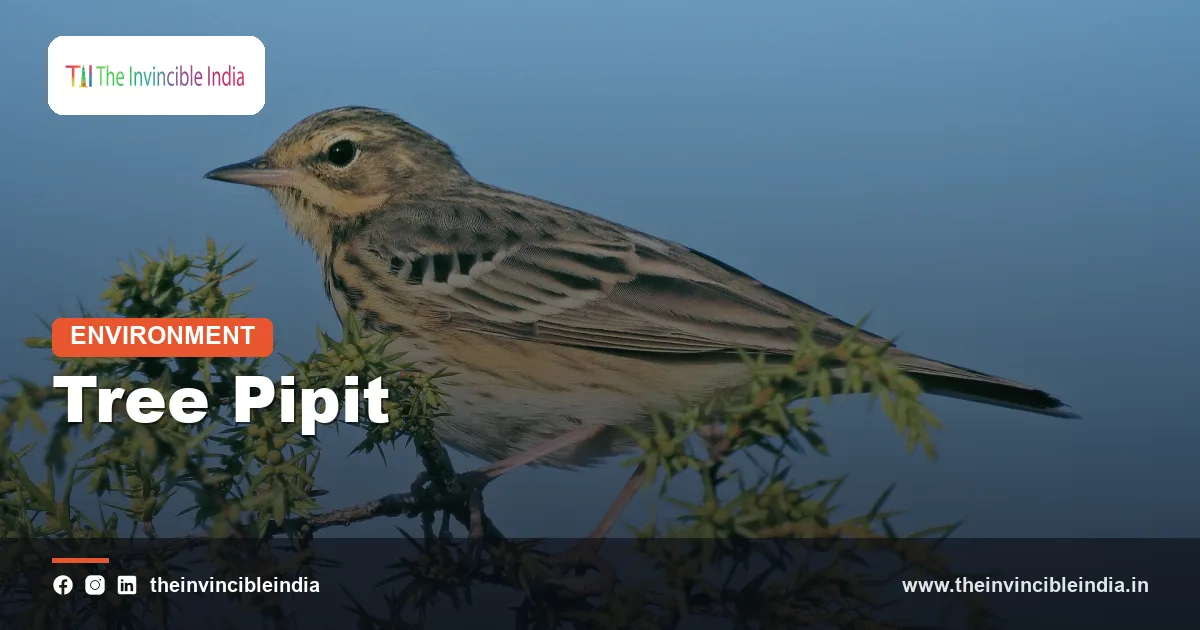
The tree pipit (Anthus trivialis) is a slim, streaky, brown songbird of open woodland and forest edges that breeds across Europe and parts of Asia and spends the winter in warmer regions, including the plains and hills of India. In India it is mainly a winter visitor, recognised by its streaked breast, pale pinkish legs and habit of walking on the ground, pumping its tail and flying up into a tree when disturbed.
The tree pipit is easily confused with several other pipits, especially the olive-backed pipit, and careful observation is needed to tell them apart. This explainer covers what the tree pipit is, how to identify it, where it lives in India, what it eats, how its famous song-flight works, how it breeds and migrates, and how it differs from similar species.
| Quick Fact | Detail |
|---|---|
| Common name | Tree pipit |
| Scientific name | Anthus trivialis |
| Family | Motacillidae (pipits, wagtails and longclaws) |
| Size | About 15 cm long, similar to a sparrow but slimmer |
| India status and habitat | Winter visitor to open woodland, orchards, plantations, scrub and grassy clearings |
| Diet | Mainly small insects and other invertebrates; some seeds, especially in winter |
| Breeding and migration | Breeds in Eurasia in summer; migrates south in autumn and returns north in spring |
| Nest | Ground nest hidden in grass or under a tussock, usually with four to six eggs on the breeding grounds |
| Conservation status | Least Concern on the IUCN Red List |
Key Takeaways
- The tree pipit is a small, streaky, brownish songbird of the pipit family that reaches India mainly as a winter visitor from its breeding grounds in Eurasia.
- The tree pipit favours open woodland, orchards and forest edges, and flies up into a tree when disturbed, which is the habit that gives the species its name.
- The tree pipit can be told from the olive-backed pipit by its browner back, finer flank streaks, plainer face and the absence of a bold black-and-white spot behind the ear.
- The tree pipit feeds mainly on insects and other small invertebrates picked from the ground, and takes some seeds in winter.
- The male tree pipit has a well-known song-flight, in which he rises from a tree, sings and then parachutes down on spread wings to the same perch or another tree.
- The tree pipit is listed as Least Concern by the IUCN, though several European breeding populations have declined with habitat change.
What is the tree pipit?
The tree pipit is a small songbird in the family Motacillidae, which also includes the wagtails, and its scientific name is Anthus trivialis. It belongs to the genus Anthus, the true pipits, a group of slim, brown, streaked ground-feeding birds found on almost every continent.
Pipits are named for their thin, high calls and are generally plain in colour, which makes them a challenge for new birdwatchers. The tree pipit is one of the most widespread of these birds in the Old World. Several subspecies are recognised, and the form that visits the Indian subcontinent is usually associated with Himalayan and Central Asian breeding populations as well as birds from farther west and north.
Unlike many pipits that live in open grassland and avoid trees, the tree pipit is a bird of woodland edges and sparse trees. It uses trees as song posts, as lookouts and as quick escape routes. This association with trees is the main reason for its English name.
How can you identify the tree pipit?
The tree pipit is identified by its olive-brown upperparts with dark streaks, a buff breast with bold black streaks, finer streaks along the flanks, a whitish belly and pinkish legs. It also shows a pale eyebrow and a short, stout bill with a pale base, and it carries itself rather horizontally.
Several features, taken together, make identification more reliable:
- Upperparts: brownish with fairly weak streaking, less heavily marked than those of the meadow pipit.
- Breast and flanks: a buff-tinged breast with strong, well-spaced streaks that stop abruptly at the white belly, and thinner streaks on the sides.
- Face: a rather plain face with a pale buffish eyebrow and a faint pale spot behind the ear, but no strong black-and-white spot.
- Legs and claws: pinkish legs, with a short, curved hind claw compared with the long, straight hind claw of some other pipits.
- Tail: white outer tail feathers show in flight, and the bird often pumps its tail slowly downward when it lands.
- Behaviour: perches readily in trees and bushes, which sets it apart from pipits that stay on bare ground.
The call is a quiet, buzzy, rasping note, often rendered as a short “teez”, given in flight or when the bird is flushed. This call helps to separate the species from similar pipits, which usually give thinner, higher or more sharply defined notes.
Where does the tree pipit live in India?
The tree pipit lives in India mainly as a winter visitor and is found in open woodland, plantations, orchards, forest clearings, grassy scrub and the edges of cultivation. It occurs widely in the plains and lower hills, and some populations also breed in the western Himalaya and neighbouring mountain regions.
During winter, birds arrive in India from September to November and generally depart by March to April. They are encountered across a broad range of habitats, usually where there is a mix of low ground cover and scattered trees. A typical Indian winter site would include:
- Light deciduous woodland with grassy openings.
- Orchards and mango groves with bare or lightly vegetated soil.
- Tea, coffee and other plantations with shade trees.
- Scrub and farmland edges with scattered trees or tall hedges.
- Riverbanks and dry streambeds lined with trees.
The species is generally solitary or found in small, loose groups in winter. It rarely forms large flocks, unlike some wagtails and meadow-pipit-type species, and may be seen walking quietly on the ground under trees with its head bobbing gently.
What does the tree pipit eat?
The tree pipit eats mostly small insects and other invertebrates, including beetles, flies, ants, caterpillars, spiders and small snails, which it picks from the ground or from low vegetation. It also eats seeds, especially in cooler months when insects are fewer.
The bird feeds by walking with a steady, deliberate gait, scanning the ground and pausing to snatch prey. It occasionally makes short runs or flutters to catch a flying insect. Because it forages on bare patches under trees and along tracks, it is easy to observe when it is feeding in the open, though its streaky plumage blends well with dry leaves and soil.
The diet changes with the season. In the breeding season, insects dominate and are carried back to the nest in the bill to feed the chicks. During migration and winter, the bird takes whichever small invertebrates and seeds are most easily available. In this way, the tree pipit helps to control insect numbers in orchards, plantations and woodland edges.
How does the tree pipit’s song-flight work?
The tree pipit’s song-flight works as a display in which the male flies up from a treetop perch, sings a long, loud, trilling song, and then glides or parachutes back down with wings and tail spread, ending with a sweet, descending “see-a, see-a” phrase. The performance is used to claim territory and attract a mate on the breeding grounds.
The flight begins with the male launching steeply from a branch, and climbing while singing. At the peak he spreads his wings and tail and descends in a controlled glide, finishing with a drawn-out ending as he lands on the same tree or a neighbouring one. The song is a rich mix of trills, whistles and chirps that is much more musical than the weak calls heard in winter.
In India, the full song-flight is heard less often because most birds are winter visitors and do not breed there. However, birds may occasionally sing short snatches of song before they leave in spring, and populations that breed in the Himalaya can be heard in full display during the summer months in suitable habitat.
How does the tree pipit breed?
The tree pipit breeds on the ground, making a cup-shaped nest of grass and moss hidden in a grass tussock or hollow, usually close to the edge of woodland or a clearing. The female lays about four to six eggs, which are variably coloured with dark markings, and incubates them for around two weeks.
The key breeding facts are summarised in the table below.
| Feature | Detail |
|---|---|
| Nest site | On the ground, concealed in grass, bracken or under a bush |
| Nest material | Grass, moss and fine roots, lined with finer grass and hair |
| Clutch size | Typically four to six eggs |
| Incubation | Mainly by the female, around 12 to 14 days |
| Chick care | Both parents feed the chicks with insects |
| Nestling period | The young leave the nest at around 12 to 13 days and then stay hidden nearby |
| Breeding range | Europe and temperate Asia, including some Himalayan and Central Asian regions |
Most tree pipits seen in the Indian plains are not breeding. They are winter visitors that have travelled from breeding areas farther north, so observers in the plains usually see non-breeding behaviour.
Is the tree pipit a migratory bird?
The tree pipit is a migratory bird: most populations breed in the northern summer across Eurasia and travel south for the winter, reaching sub-Saharan Africa from the west and the Indian subcontinent from the east. Birds that reach India arrive in autumn and leave in spring.
Migration is usually carried out at night, and birds follow broad flyways across Central Asia and the Himalaya. Some move in short hops and rest in woodland patches along the way. Arrival in India tends to be gradual, with birds first appearing in the north and then moving across the plains and peninsula. A few individuals may also move up and down mountain slopes with the seasons.
The timing of migration depends on weather and food supply. A cold, early winter in the northern breeding grounds triggers an earlier departure, while a warm, insect-rich autumn may delay it. Ringing studies in Europe have shown that the species undertakes long journeys, and similar studies in Asia are helping to map the Indian routes in more detail.
How is the tree pipit different from the olive-backed pipit and other pipits?
The tree pipit differs from the olive-backed pipit mainly by its browner upperparts, plainer face and finer flank streaks, whereas the olive-backed pipit is greener above and has a distinct black-and-white spot behind the ear. Comparing face pattern, back colour, streaking and call gives the clearest separation.
| Feature | Tree pipit | Olive-backed pipit | Meadow pipit |
|---|---|---|---|
| Back colour | Olive-brown, faintly streaked | Olive-green, faintly streaked | Browner and more heavily streaked |
| Face pattern | Plain with a pale eyebrow | Bold eyebrow and black-and-white ear spot | Plain, with a weak eyebrow |
| Flank streaks | Fine and sparse | Bold and dark | Fine but extensive |
| Hind claw | Short and curved | Short and curved | Long and nearly straight |
| Habitat | Open woodland and woodland edges | Shaded woodland and gardens | Open grassland and marsh edges |
| Typical call | Buzzy “teez” | Thin “tseep” | Weak, thin “pip-it” |
The behaviour of the bird adds another clue. Both the tree pipit and the olive-backed pipit fly up into trees, but the olive-backed pipit is more of a shaded-ground specialist, whereas the tree pipit prefers brighter, more open spots among scattered trees. Many experienced observers rely on a combination of call and face pattern, because plumage alone can be misleading in poor light.
What threats does the tree pipit face?
The tree pipit faces threats mainly on its breeding grounds, where loss of open woodland, scrub and grassy clearings has reduced numbers in parts of Europe, while on wintering grounds in India the effects of habitat change are less well documented. Globally, the species is classified as Least Concern by the IUCN because it is widespread and numerous.
The main pressures can be listed as follows:
- Habitat change: maturing or heavily managed woodland loses the open, grassy structure that the bird needs.
- Loss of open ground in winter: conversion of orchards, plantations and woodland edges to dense buildings or monoculture reduces foraging areas.
- Pesticide use: insecticides cut the supply of insect prey.
- Climate shifts: changing weather can disrupt the timing of migration and of insect abundance.
- Collisions: night-flying migrants may strike lit buildings and towers.
Because the tree pipit is widespread and winters in many habitats, it is not considered at risk in India. Even so, it benefits from the protection of old orchards, wooded farmland and forest edges, which also support many other insect-eating birds.
How can you watch the tree pipit in India?
The best way to watch the tree pipit in India is to visit open woodland, orchards or forest edges between October and March and look quietly for a streaky bird walking on the ground under trees. When it is disturbed, it usually flies up into a nearby branch, where it can be studied with binoculars.
These practical steps improve the chances of a clear view:
- Search early in the morning, when pipits are active on bare ground and tracks.
- Walk slowly and stop frequently, since sudden movement sends the bird flying into the trees.
- Watch the tail: the slow downward pumping is a good clue.
- Note the face, back colour and flank streaks, and listen for the buzzy call.
- Take photographs of the head and breast to compare with the olive-backed pipit later.
Birdwatchers who record sightings on citizen science platforms such as eBird help to fill gaps in knowledge about where the species winters and how its numbers change from year to year.
Bottom Line
The tree pipit is a streaky, tree-perching pipit that reaches India as a winter visitor from its breeding grounds in Eurasia. It is widespread and not threatened globally, and careful attention to face pattern, back colour and call is the key to separating it from the olive-backed pipit and other lookalikes.
Frequently Asked Questions
What is the tree pipit?
The tree pipit is a small, streaky songbird, Anthus trivialis, in the pipit and wagtail family. It breeds across Europe and temperate Asia and winters in Africa and the Indian subcontinent. It is named for its habit of perching in trees and flying into them when disturbed.
Is the tree pipit a resident or a visitor in India?
The tree pipit is mainly a winter visitor to India. Most birds arrive between September and November and leave by March or April. Some populations also breed in the western Himalaya and neighbouring mountain regions, so a few birds are present in summer in suitable habitat.
How do you tell a tree pipit from an olive-backed pipit?
A tree pipit has browner upperparts, a plainer face and fine flank streaks, while an olive-backed pipit is greener above and has a bold black-and-white spot behind the ear. The olive-backed pipit also has bolder, darker flank streaks. The calls differ too, with the tree pipit giving a buzzy note and the olive-backed pipit a thin tseep.
What does the tree pipit eat?
The tree pipit eats mainly small insects and other invertebrates, such as beetles, ants, flies, caterpillars and spiders. It picks them from the ground while walking. In winter it also eats some small seeds when insects are scarce.
Why is it called a tree pipit?
It is called the tree pipit because it habitually perches in trees and flies up into them when flushed, unlike many pipits that stay on open ground. The male also uses a tree as the starting point for his song-flight. The name separates it from grassland species such as the meadow pipit.
Is the tree pipit endangered?
The tree pipit is not endangered; the IUCN lists it as Least Concern because it has a very large range and population. Some European breeding populations have declined with habitat change. In India it remains a regular winter visitor.
{“@context”:”https://schema.org”,”@graph”:[{“@type”:”FAQPage”,”mainEntity”:[{“@type”:”Question”,”name”:”What is the tree pipit?”,”acceptedAnswer”:{“@type”:”Answer”,”text”:”The tree pipit is a small, streaky songbird, Anthus trivialis, in the pipit and wagtail family. It breeds across Europe and temperate Asia and winters in Africa and the Indian subcontinent. It is named for its habit of perching in trees and flying into them when disturbed.”}},{“@type”:”Question”,”name”:”Is the tree pipit a resident or a visitor in India?”,”acceptedAnswer”:{“@type”:”Answer”,”text”:”The tree pipit is mainly a winter visitor to India. Most birds arrive between September and November and leave by March or April. Some populations also breed in the western Himalaya and neighbouring mountain regions, so a few birds are present in summer in suitable habitat.”}},{“@type”:”Question”,”name”:”How do you tell a tree pipit from an olive-backed pipit?”,”acceptedAnswer”:{“@type”:”Answer”,”text”:”A tree pipit has browner upperparts, a plainer face and fine flank streaks, while an olive-backed pipit is greener above and has a bold black-and-white spot behind the ear. The olive-backed pipit also has bolder, darker flank streaks. The calls differ too, with the tree pipit giving a buzzy note and the olive-backed pipit a thin tseep.”}},{“@type”:”Question”,”name”:”What does the tree pipit eat?”,”acceptedAnswer”:{“@type”:”Answer”,”text”:”The tree pipit eats mainly small insects and other invertebrates, such as beetles, ants, flies, caterpillars and spiders. It picks them from the ground while walking. In winter it also eats some small seeds when insects are scarce.”}},{“@type”:”Question”,”name”:”Why is it called a tree pipit?”,”acceptedAnswer”:{“@type”:”Answer”,”text”:”It is called the tree pipit because it habitually perches in trees and flies up into them when flushed, unlike many pipits that stay on open ground. The male also uses a tree as the starting point for his song-flight. The name separates it from grassland species such as the meadow pipit.”}},{“@type”:”Question”,”name”:”Is the tree pipit endangered?”,”acceptedAnswer”:{“@type”:”Answer”,”text”:”The tree pipit is not endangered; the IUCN lists it as Least Concern because it has a very large range and population. Some European breeding populations have declined with habitat change. In India it remains a regular winter visitor.”}}]}]}


