

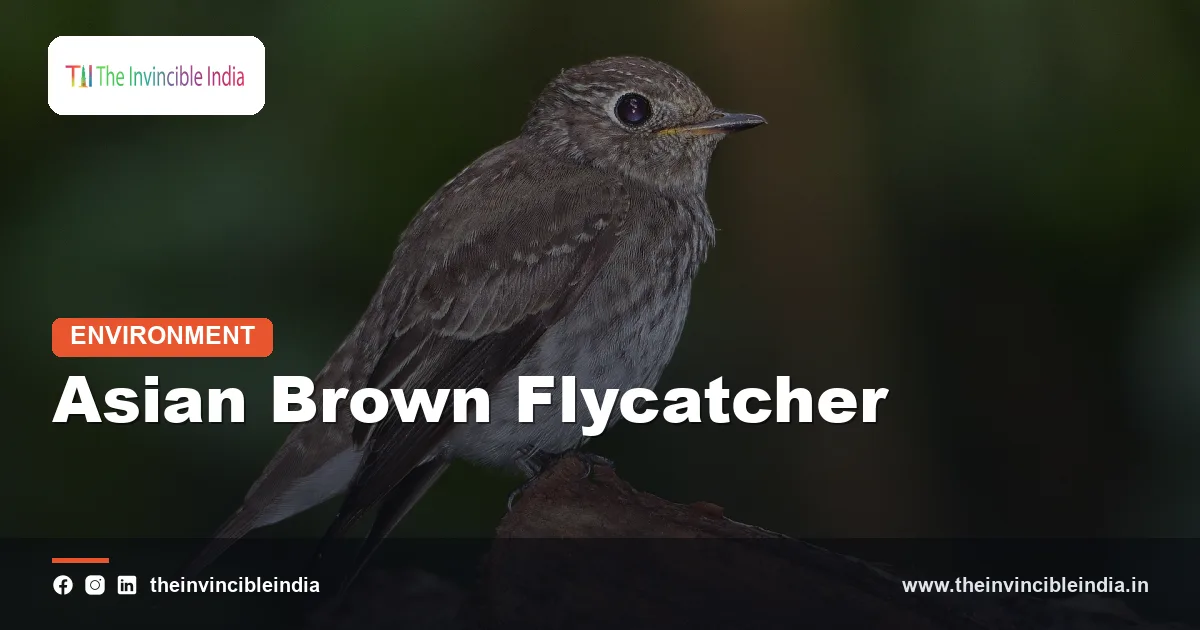
The Asian brown flycatcher (Muscicapa dauurica) is a small, plain grey-brown songbird of the Old World flycatcher family that visits India in large numbers each winter, perching quietly in gardens, groves and forest edges to hawk flying insects. Despite its modest plumage, the bird is easy to recognise once its large dark eye, pale eye-ring and flat, wide-based bill have been noticed.
Many Indian bird watchers meet the Asian brown flycatcher in the cooler months, when migrants from northern Asia settle in wooded areas across the country. This article explains how to identify the species, where it lives and breeds, how it feeds, how it differs from similar brown flycatchers and what is known about its conservation status.
Quick Facts
| Common name | Asian brown flycatcher |
|---|---|
| Scientific name | Muscicapa dauurica |
| Family | Muscicapidae (Old World flycatchers and chats) |
| Size | About 12 to 13 cm, a little smaller than a sparrow |
| Range in India | Widespread winter visitor across much of the country; some breeding in the Himalayan hills |
| Habitat | Open woodland, groves, gardens, orchards, forest edges and plantations |
| Diet | Flying and perched insects, caught by sallying from a perch |
| Breeding season | Summer, mainly in northern Asia and the Himalayan hills |
| Conservation status | Least Concern on the IUCN Red List; wild birds are protected under the Wildlife (Protection) Act, 1972 |
Key Takeaways
- The Asian brown flycatcher is a small grey-brown flycatcher with whitish underparts, a prominent pale eye-ring and a relatively large dark eye.
- The Asian brown flycatcher is chiefly a winter visitor to India, arriving from its northern Asian breeding grounds in autumn and leaving in spring.
- The Asian brown flycatcher hunts by sallying from a low or mid-level perch to catch flying insects and then returning to a favoured branch.
- The Asian brown flycatcher has a broad, flat bill with a pale base to the lower mandible, a feature that helps distinguish it from several similar brown flycatchers.
- The Asian brown flycatcher is common and widespread, and the IUCN classifies it as Least Concern.
- The Asian brown flycatcher occupies a wide range of wooded habitats, including city gardens, orchards and plantations, which makes it one of the easiest winter flycatchers to find.
What is the Asian brown flycatcher?
The Asian brown flycatcher is a small migratory insect-eating bird belonging to the genus Muscicapa, the group of spotted and brown flycatchers within the family Muscicapidae. It breeds across a very large part of eastern and northern Asia, from the Himalaya and Siberia to China, Korea and Japan, and winters in South and South-East Asia.
The bird is plain and unobtrusive, and for this reason it is often overlooked by beginners who prefer to look for colourful species. Experienced observers value it because it is a reliable indicator of the winter bird community in gardens and woodlands, and because separating it from other brown flycatchers is a classic identification exercise.
Several subspecies are recognised across the range, and they differ slightly in size and in the tone of the plumage. Birds that reach India include populations from northern Asia as well as birds from the Himalaya that move to lower ground after the breeding season.
How do you identify an Asian brown flycatcher?
An Asian brown flycatcher is identified by its plain grey-brown upperparts, whitish throat and belly, a dusky wash on the sides of the breast, a large dark eye ringed in pale and a short, broad bill. The bird sits upright on an exposed perch and looks compact and rounded in the head.
Key field marks
- The upperparts are an even greyish-brown, without streaks or bright patches.
- The underparts are pale, from the whitish chin to the belly, with a soft grey-brown shading on the breast sides.
- The eye looks large and dark, with a thin pale ring around it and a short pale area in front of the eye.
- The bill is flat and wide at the base, black on top and pale yellowish or flesh-coloured at the base of the lower mandible.
- The wings show a faint pale edging on the flight feathers, and the folded wing tip reaches a short way down the tail.
Sexes and age
The male and female Asian brown flycatcher look alike, which means that no sex can be told from plumage alone. Young birds in autumn show buff spotting on the back and wing coverts and are therefore easy to mistake for another species until the spots wear off.
How is it different from similar brown flycatchers?
The Asian brown flycatcher differs from other brown flycatchers mainly in its pale-based lower bill, the pale eye-ring, the plain and unstreaked breast and its smaller size compared with several close relatives. Telling these species apart is one of the common tests of winter bird identification in India.
| Species | Main distinguishing features |
|---|---|
| Asian brown flycatcher | Plain grey-brown, large dark eye with a pale ring, pale lower bill base, whitish underparts |
| Brown-breasted flycatcher | Warmer brown breast band and a more pronounced brownish wash on the sides of the breast |
| Dark-sided flycatcher | Darker and larger, with dark streaks on the sides of the breast and a “vested” look |
| Rusty-tailed flycatcher | Rufous tail and rump, giving a warmer look in flight |
| Spotted flycatcher | Lightly streaked crown and breast, a less common visitor to India |
Observers should compare the bill, the breast tone and the overall size before naming a bird. A slow and patient look at the lower bill and at the eye-ring generally settles the question.
Where does the Asian brown flycatcher live in India?
The Asian brown flycatcher lives across most of India in winter, in wooded habitats from the Himalayan foothills and northern plains to the peninsular states and the hills of the Western Ghats. It is among the more widespread winter flycatchers and appears in nearly every well-wooded region.
The bird favours light and open woodland with a mix of tall trees and low perches. It is found in forest edges, groves, mango orchards, tea and coffee plantations, village woodlots and city parks. In many Indian cities, the species can be found in older neighbourhoods with mature trees, since such places offer perches and a regular supply of small insects.
A small breeding population is reported from the Himalayan hills, where some birds nest in the forest in summer. However, most birds seen in the plains and peninsula in winter are visitors from northern Asia that have flown long distances to reach warmer ground.
Because the species spends several months of the year in India, it forms a regular part of the winter bird community. Many individuals return to the same wintering site year after year, and a bird that holds a favourite perch in a garden may be observed there throughout the season.
When does the Asian brown flycatcher visit India?
The Asian brown flycatcher visits India from about September or October until March or April, arriving in autumn from its northern breeding areas and leaving in spring. The earliest birds are often seen in the northern and north-eastern parts of the country, and the movement then spreads south.
Migration is mostly at night, and the birds are inconspicuous during passage. After arrival they settle down quickly and defend a small winter territory around a group of perches, chasing away other flycatchers that come too close.
In March and April the birds become restless and begin to feed more actively, building up reserves for the journey north. Within a few weeks the winter birds disappear, and gardens that were busy with flycatchers return to a quieter state until the following autumn.
This seasonal pattern makes the Asian brown flycatcher a useful species for citizen-science projects that track the timing of arrival and departure. Over many years, records of such migrants help researchers understand whether the timing of migration is changing with climate.
How does the Asian brown flycatcher feed?
The Asian brown flycatcher feeds mainly on small insects, which it catches in a short, quick flight from a perch. After the capture the bird usually returns to the same branch or to another nearby, and it repeats the cycle many times an hour.
The diet includes flies, small beetles, moths, ants with wings, bugs and other soft-bodied insects, as well as spiders on occasion. The bird sometimes picks prey from leaves or the ground by hovering briefly, although aerial sallies are the most common method. The wide bill and the stiff bristles at the gape help the bird to grasp prey that is flying fast.
The choice of perch is important. The bird prefers a low or mid-level branch with a clear view, often a dead twig with few leaves. From such a point, it can see insects against the sky and has space to fly out without hitting foliage. In gardens, the bird also uses fence posts, wires and the rims of walls in the same way.
Winter foraging is often most active early in the morning and again in the late afternoon, when insects are on the wing. In the heat of the day, the flycatcher may rest in shade and sit quietly with its feathers slightly fluffed.
What sounds does the Asian brown flycatcher make?
The Asian brown flycatcher makes a thin, high-pitched, dry call, often described as a short “tsit” or a soft rattle, and the male sings a quiet and simple, high-pitched warbling song in the breeding season. In winter the bird is mostly silent apart from its occasional contact calls.
Because the vocalisations are weak, the bird is usually located by sight rather than by sound. Observers who know the call can use it to detect the bird in thick foliage, and the sound is sometimes the first clue that a flycatcher is in the area.
The wing flick and tail movement are also part of the species’ behaviour. The bird often flicks its wings slightly and moves its tail while perched, which helps it to attract attention to itself when other birds are nearby and may signal alertness.
How does the Asian brown flycatcher breed?
The Asian brown flycatcher breeds in summer, building a small, neat cup nest on a branch or in a fork of a tree, and laying a clutch of pale, spotted eggs. Most breeding takes place far north of India, but the Himalayan hills also hold nesting birds.
The nest is made of fine grasses, moss, lichen and plant fibres, bound together with spider silk, and the outer layer is often decorated so that it blends with the branch. The female lays about three to five eggs and does most of the incubation, while the male defends the territory and brings food. After hatching, both parents feed the young with insects until they fledge.
Since India sees the species mainly outside the breeding season, nests are rarely observed in the plains. Bird watchers who visit the Himalaya in spring and summer have the best chance of finding breeding behaviour, but should keep a distance and avoid disturbing the nest.
Is the Asian brown flycatcher threatened?
The Asian brown flycatcher is not threatened, and the International Union for Conservation of Nature (IUCN) lists it as Least Concern because of its very large range and large population. In India, the species is protected like other wild birds under the Wildlife (Protection) Act, 1972.
Habitat quality still matters. The bird depends on trees for perches, and on healthy insect numbers for food. Loss of tree cover in towns, the removal of old garden trees and the heavy use of pesticides can reduce the supply of insects and the number of suitable wintering sites.
Gardeners and community groups can support the species by planting native trees, leaving some dead branches as perches, avoiding the spraying of chemicals in green spaces and keeping patches of shrubs and leaf litter that harbour insects.
Bottom Line
The Asian brown flycatcher is a plain but fascinating winter visitor whose habits and field marks reward careful watching. It is common, widespread and adaptable, and the sight of one sallying from a bare twig is a familiar part of the Indian winter in gardens and woodlands.
Frequently Asked Questions
What does an Asian brown flycatcher look like?
An Asian brown flycatcher is a small, plain grey-brown bird with whitish underparts, a dusky wash on the breast sides and a large dark eye with a pale ring. Its flat, broad bill has a pale base to the lower half.
Is the Asian brown flycatcher a resident or a migrant in India?
The Asian brown flycatcher is mainly a winter migrant to India. Most birds arrive from northern Asia between September and October and leave by March or April, though a small number breed in the Himalayan hills.
What does the Asian brown flycatcher eat?
The Asian brown flycatcher eats mainly small insects such as flies, beetles, moths and winged ants. It catches them in the air by sallying from a perch, and it occasionally takes spiders and other tiny invertebrates.
How can I tell an Asian brown flycatcher from other brown flycatchers?
The Asian brown flycatcher can be told apart by its pale lower bill base, its pale eye-ring around a large dark eye and its plain, unstreaked breast. Similar species such as the brown-breasted and dark-sided flycatchers show a stronger breast band or streaking.
Where is the Asian brown flycatcher found in India?
The Asian brown flycatcher is found in light woodland, groves, orchards, plantations and gardens across most of India in winter. It is widespread from the Himalayan foothills to the peninsular states, including the Western Ghats.
Is the Asian brown flycatcher protected?
Yes, the Asian brown flycatcher is protected like other wild birds in India under the Wildlife (Protection) Act, 1972. The IUCN lists it as Least Concern, because its large range and population make a serious decline unlikely.
{“@context”:”https://schema.org”,”@graph”:[{“@type”:”FAQPage”,”mainEntity”:[{“@type”:”Question”,”name”:”What does an Asian brown flycatcher look like?”,”acceptedAnswer”:{“@type”:”Answer”,”text”:”An Asian brown flycatcher is a small, plain grey-brown bird with whitish underparts, a dusky wash on the breast sides and a large dark eye with a pale ring. Its flat, broad bill has a pale base to the lower half.”}},{“@type”:”Question”,”name”:”Is the Asian brown flycatcher a resident or a migrant in India?”,”acceptedAnswer”:{“@type”:”Answer”,”text”:”The Asian brown flycatcher is mainly a winter migrant to India. Most birds arrive from northern Asia between September and October and leave by March or April, though a small number breed in the Himalayan hills.”}},{“@type”:”Question”,”name”:”What does the Asian brown flycatcher eat?”,”acceptedAnswer”:{“@type”:”Answer”,”text”:”The Asian brown flycatcher eats mainly small insects such as flies, beetles, moths and winged ants. It catches them in the air by sallying from a perch, and it occasionally takes spiders and other tiny invertebrates.”}},{“@type”:”Question”,”name”:”How can I tell an Asian brown flycatcher from other brown flycatchers?”,”acceptedAnswer”:{“@type”:”Answer”,”text”:”The Asian brown flycatcher can be told apart by its pale lower bill base, its pale eye-ring around a large dark eye and its plain, unstreaked breast. Similar species such as the brown-breasted and dark-sided flycatchers show a stronger breast band or streaking.”}},{“@type”:”Question”,”name”:”Where is the Asian brown flycatcher found in India?”,”acceptedAnswer”:{“@type”:”Answer”,”text”:”The Asian brown flycatcher is found in light woodland, groves, orchards, plantations and gardens across most of India in winter. It is widespread from the Himalayan foothills to the peninsular states, including the Western Ghats.”}},{“@type”:”Question”,”name”:”Is the Asian brown flycatcher protected?”,”acceptedAnswer”:{“@type”:”Answer”,”text”:”Yes, the Asian brown flycatcher is protected like other wild birds in India under the Wildlife (Protection) Act, 1972. The IUCN lists it as Least Concern, because its large range and population make a serious decline unlikely.”}}]}]}


