

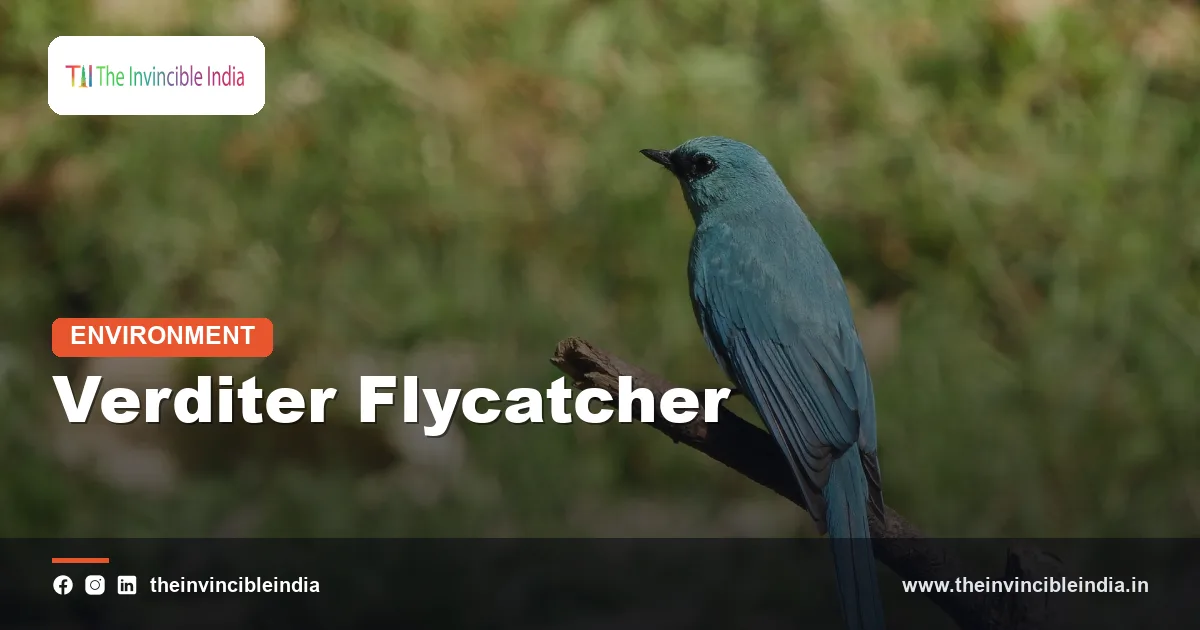
The verditer flycatcher (Eumyias thalassinus) is a small songbird of the Old World flycatcher family, Muscicapidae, whose plumage is a uniform soft blue-green, the colour of the copper pigment verditer after which it is named. It breeds in the forested hills of the Indian Himalaya and moves down to the foothills, plains and some peninsular hills in winter, where it hunts flying insects from open perches.
Among the birds that visit Indian gardens and woodlands, the verditer flycatcher is one of the easiest to recognise because no other common small bird looks like a single wash of turquoise. This article explains how to identify the species, where it lives in India, what it eats, how it breeds and why it is considered a bird of least conservation concern.
Quick Facts
| Common name | Verditer flycatcher |
|---|---|
| Scientific name | Eumyias thalassinus |
| Family | Muscicapidae (Old World flycatchers and chats) |
| Size | About 15 to 16 cm, roughly the size of a sparrow |
| Range in India | Breeds in the Himalaya from the west to the north-east; winters in the foothills, plains, north-eastern hills and parts of the peninsula |
| Habitat | Broadleaved and mixed hill forest, forest edges, wooded gardens and orchards |
| Diet | Mainly flying insects caught in mid-air, sometimes small fruits |
| Breeding season | Roughly April to July in the Himalayan hills |
| Conservation status | Least Concern on the IUCN Red List; wild birds are protected under the Wildlife (Protection) Act, 1972 |
Key Takeaways
- The verditer flycatcher is a sparrow-sized bird with an almost uniform turquoise-blue or blue-green body, which makes it unmistakable among Indian flycatchers.
- The male verditer flycatcher has a dark patch on the face between the bill and the eye, while the female is paler and greyer with a less vivid blue-green tone.
- The verditer flycatcher breeds in Himalayan hill forests and descends to lower elevations, including the plains, during the winter months.
- The verditer flycatcher feeds by sallying from a perch to snatch flying insects and then usually returns to the same or a nearby perch.
- The verditer flycatcher nests in holes and hollows in banks, rock faces and trees, lining a cup of moss with soft material.
- The IUCN lists the verditer flycatcher as Least Concern because it has a very large range and is not known to be in serious decline.
What is the verditer flycatcher?
The verditer flycatcher is a small insect-eating songbird of South and South-East Asia, placed in the genus Eumyias within the Old World flycatcher family. Its common name comes from verditer, a blue-green pigment once made from copper compounds and used in paints, and the bird indeed looks as if it had been dipped in that colour.
Old World flycatchers are a large family that also contains robins, chats, redstarts and forktails. Most are small, upright birds with thin bills and good eyesight, and many hunt by watching from a perch and darting out after prey. The verditer flycatcher follows this pattern closely, and in India it is commonly noticed on fences, bare twigs and wires at the edge of wooded areas.
The species has several recognised subspecies across its wide range, which extends from the Himalaya eastwards through South-East Asia and into the islands of Indonesia. The birds seen in India belong mainly to the Himalayan and north-eastern populations, and a good portion of them are altitudinal migrants that shift their position with the seasons.
How can you identify a verditer flycatcher?
A verditer flycatcher is identified by its overall turquoise to blue-green plumage, its small size, its short and fairly broad bill and its habit of sitting upright on an open perch. At a distance in poor light the bird can look simply dark, but in sunlight the colour glows and is hard to confuse with anything else.
The adult male
The adult male has a bright verditer-blue body with a slightly greener sheen on the underparts. A black or dark patch lies on the lores, the small area between the bill and the eye, giving the face a faintly masked look. The wings and tail are darker and edged with the body colour, and the undertail carries pale scaling that is visible when the tail is raised or fanned.
The female and young birds
The female verditer flycatcher is paler and greyer than the male, with a duller blue-green wash and a less obvious dark patch near the bill. Young birds are spotted with pale buff or whitish dots and have a brownish tone, so they can be confused with other young flycatchers until the blue colour begins to appear.
Similar species to rule out
- The Tickell’s blue flycatcher is smaller and darker, with an orange or rufous breast, so its underparts are never uniformly blue.
- The blue-throated and white-tailed blue flycatchers are deeper blue with distinct throat or tail patterns.
- The Nilgiri flycatcher of the Western Ghats is a much darker, glossier blue bird with a restricted southern range.
- The female and young of the verditer flycatcher can look like a dull blue-grey bird, but the lack of a rusty breast and the pale scaling under the tail help in identification.
Where does the verditer flycatcher live in India?
The verditer flycatcher lives mainly in the hill forests of the Indian Himalaya during the breeding season and spreads to the foothills, the plains and several hill ranges of the country in winter. It is therefore a resident in some places and a seasonal visitor in others, depending on the elevation and the time of year.
In summer the species is associated with moist broadleaved forest, mixed oak and rhododendron woodland and forest edges at mid-hill elevations, generally between the foothills and the lower reaches of the temperate belt. In the north-east, birds occur across the hill states and are seen in forest clearings, tea-garden margins and wooded villages.
During winter many verditer flycatchers descend to lower ground. They then appear in the Himalayan foothills, in wooded areas of the northern plains and in hill forests elsewhere in the country, including parts of the peninsular hills. In these places the bird often shows up in gardens with tall trees, in orchards and along avenues, since these habitats supply perches and insects.
The overall range is wide and the habitat flexible, which is why bird watchers can see the species in a great variety of locations. Hill stations, forest rest houses and large campus gardens are all places where the bird is regularly recorded in the cooler months.
What does the verditer flycatcher eat?
The verditer flycatcher eats mainly flying insects, which it catches in the air after launching from a perch. The diet includes flies, small beetles, moths, winged ants, termites and similar small prey that move through the open space near the tree canopy or forest edge.
The hunting method is called hawking or sallying. The bird sits upright and alert on a bare twig, watches for movement, flies out in a short curve to seize the insect with a snap of its bill and then often returns to the same perch. This sit-and-wait approach uses little energy and works well in the clearings and edges where insects are visible against the sky.
Besides aerial insects, the verditer flycatcher occasionally picks prey from foliage or the ground and may take small berries, especially in winter when insect numbers drop in cooler hill areas. The wide bill base and the bristles around the mouth help the bird to hold struggling insects and are typical features of flycatchers.
The species therefore plays a quiet ecological role as a natural controller of small insect populations. A single bird, repeating its sallies over many hours, removes a large number of flies and other tiny insects from its patch over a season.
How does the verditer flycatcher behave and sing?
The verditer flycatcher behaves like a typical perching flycatcher: it is alert, usually solitary or in pairs, and defends a small patch of woodland edge against other birds of its kind. It commonly sits upright, flicks its wings and tail and makes short aerial dashes before returning.
The song of the male is a pleasant, rambling series of thin, sweet notes, delivered from a high perch, usually at dawn and in the breeding season. The call is a short, sharp note that can be mistaken for the call of other small forest birds until one learns to match the sound with the colour of the singer.
In winter the bird becomes quieter but remains territorial, and a bird that holds a good perch in a garden may return to the same tree for several months. Because the plumage is bright, the bird is easily found if it sits in the sun, although it can vanish into the shade of dense foliage when it chooses to.
Verditer flycatchers can also join mixed hunting parties in hill forests, where small groups of different species travel together through the trees. This behaviour reduces the risk from predators and increases the amount of disturbed insect prey.
How does the verditer flycatcher breed?
The verditer flycatcher breeds in the Himalayan hills from about April to July, building a cup nest in a hole, hollow or sheltered ledge and laying a small clutch of eggs. The exact timing varies with altitude, since birds in higher forests start later than those in the lower hills.
The nest is a neat cup of moss, lichen, fine roots and grass, usually lined with softer fibres, hair or feathers. Sites include a natural hole in a tree trunk, a crevice in a rock face or earth bank, a gap in an old wall or building and even a ledge under an overhanging rock. The use of cavities protects the eggs and young from weather and from many predators.
The female usually lays a clutch of about three to five eggs, which are pale and finely marked, and does most of the incubation. Both parents feed the chicks with insects. The young leave the nest after a couple of weeks and remain close to the parents for some time while they learn to hunt on their own.
| Stage | Approximate pattern |
|---|---|
| Territory and song | Males sing from high perches in spring |
| Nest building | Moss cup in a hole, bank or crevice |
| Eggs | A small clutch, incubated mainly by the female |
| Chick feeding | Both parents bring insects to the nest |
| Winter movement | Many birds move to lower elevations after breeding |
Is the verditer flycatcher a migratory bird?
The verditer flycatcher is partly migratory, because many Himalayan breeders make an altitudinal movement down to the foothills and plains in winter rather than a long international journey. This pattern is typical of several hill birds in India that follow the changing availability of insects.
When temperatures drop and insects become scarce in the higher hills, the birds move to warmer elevations, and bird watchers in the plains begin to record them from autumn. The return movement takes place in spring, as the hills warm, with birds climbing to their breeding forests again.
Some populations in the southern parts of the species’ range and in other Asian regions are resident, and bird records show that the exact route and distance differ from one population to another. Because the movements are short and flexible, the verditer flycatcher is able to adapt to local changes in habitat and weather.
For those who watch birds in the plains, the arrival of the first verditer flycatcher of the cold season is a small seasonal event. The bird often settles in the same garden each winter, which suggests that individual birds return to favourite sites.
How can people watch and study verditer flycatchers?
People can watch verditer flycatchers by visiting wooded hill areas in spring and summer or tree-rich gardens, campuses and orchards in winter, and by looking for an upright blue-green bird on an open perch. Early morning and late afternoon are the best times, because insect activity and singing are at their peak.
A few practical habits improve the chances of a good sighting:
- Look along forest edges, clearings and roadside trees rather than inside dense forest.
- Scan bare twigs, fence posts and wires, since the bird prefers exposed perches.
- Watch for short sallies into the air and a quick return to the same perch.
- Keep a respectful distance during the nesting season and avoid disturbing holes or banks where birds may be breeding.
- Use binoculars rather than approaching closely, and record the date and place so that the sighting can be shared with community bird databases.
Citizen-science platforms and local bird clubs in India collect sightings of common species like the verditer flycatcher. Such records help scientists understand seasonal movement and whether the bird’s range is shifting with climate and land use.
What is the conservation status of the verditer flycatcher?
The verditer flycatcher is classified as Least Concern by the International Union for Conservation of Nature (IUCN), because its range is very large and its overall population is not believed to be declining fast enough to be threatened. In India, wild birds of this kind are covered by the general protection provided under the Wildlife (Protection) Act, 1972.
The bird still depends on healthy forest cover. Clearing of hill forests, loss of old trees with natural holes, excessive use of pesticides that reduce insect numbers and growing development in the hills can all affect local populations. The species is adaptable and uses gardens and orchards, which gives it some resilience, but it benefits most where mature trees and native forest patches remain.
Conservation of this flycatcher therefore overlaps with the protection of hill forests in general. Keeping old and hollow trees standing, retaining forest corridors between hills and plains, and limiting chemical sprays near wooded areas all help birds that depend on insects and natural cavities.
Bottom Line
The verditer flycatcher is a small, strikingly turquoise insect-eater that breeds in the forests of the Indian Himalaya and winters across lower country. It is common, adaptable and easy to enjoy, and its presence in a garden is a good sign of a healthy insect supply and tree cover.
Frequently Asked Questions
What colour is a verditer flycatcher?
A verditer flycatcher is a uniform turquoise-blue or blue-green bird. The male is brighter and has a dark patch between the bill and the eye, while the female is paler and greyer with a softer blue-green wash.
Where can I see a verditer flycatcher in India?
The verditer flycatcher can be seen in the Himalayan hill forests in summer and in foothill forests, wooded gardens and orchards in winter. It also occurs in the hill states of the north-east and in several forested hill ranges elsewhere in the country.
What does the verditer flycatcher eat?
The verditer flycatcher eats mainly flying insects such as flies, moths, small beetles and winged ants. It catches them in the air during short flights from a perch and sometimes takes small berries in winter.
Is the verditer flycatcher a migratory bird?
The verditer flycatcher is partly migratory, moving mostly from higher Himalayan breeding forests to lower elevations and plains in winter. The journey is mostly altitudinal, so the bird does not usually leave the subcontinent.
How does the verditer flycatcher build its nest?
The verditer flycatcher builds a cup nest of moss, lichen and fine plant material in a hole, crevice, bank or sheltered ledge. The cup is lined with softer fibres, and the female lays a small clutch of pale, finely marked eggs.
Is the verditer flycatcher endangered?
No, the verditer flycatcher is not endangered, and the IUCN lists it as Least Concern. Its wide range and flexible habitat keep the population stable, although loss of hill forests and old nesting trees can still affect local numbers.
{“@context”:”https://schema.org”,”@graph”:[{“@type”:”FAQPage”,”mainEntity”:[{“@type”:”Question”,”name”:”What colour is a verditer flycatcher?”,”acceptedAnswer”:{“@type”:”Answer”,”text”:”A verditer flycatcher is a uniform turquoise-blue or blue-green bird. The male is brighter and has a dark patch between the bill and the eye, while the female is paler and greyer with a softer blue-green wash.”}},{“@type”:”Question”,”name”:”Where can I see a verditer flycatcher in India?”,”acceptedAnswer”:{“@type”:”Answer”,”text”:”The verditer flycatcher can be seen in the Himalayan hill forests in summer and in foothill forests, wooded gardens and orchards in winter. It also occurs in the hill states of the north-east and in several forested hill ranges elsewhere in the country.”}},{“@type”:”Question”,”name”:”What does the verditer flycatcher eat?”,”acceptedAnswer”:{“@type”:”Answer”,”text”:”The verditer flycatcher eats mainly flying insects such as flies, moths, small beetles and winged ants. It catches them in the air during short flights from a perch and sometimes takes small berries in winter.”}},{“@type”:”Question”,”name”:”Is the verditer flycatcher a migratory bird?”,”acceptedAnswer”:{“@type”:”Answer”,”text”:”The verditer flycatcher is partly migratory, moving mostly from higher Himalayan breeding forests to lower elevations and plains in winter. The journey is mostly altitudinal, so the bird does not usually leave the subcontinent.”}},{“@type”:”Question”,”name”:”How does the verditer flycatcher build its nest?”,”acceptedAnswer”:{“@type”:”Answer”,”text”:”The verditer flycatcher builds a cup nest of moss, lichen and fine plant material in a hole, crevice, bank or sheltered ledge. The cup is lined with softer fibres, and the female lays a small clutch of pale, finely marked eggs.”}},{“@type”:”Question”,”name”:”Is the verditer flycatcher endangered?”,”acceptedAnswer”:{“@type”:”Answer”,”text”:”No, the verditer flycatcher is not endangered, and the IUCN lists it as Least Concern. Its wide range and flexible habitat keep the population stable, although loss of hill forests and old nesting trees can still affect local numbers.”}}]}]}


