

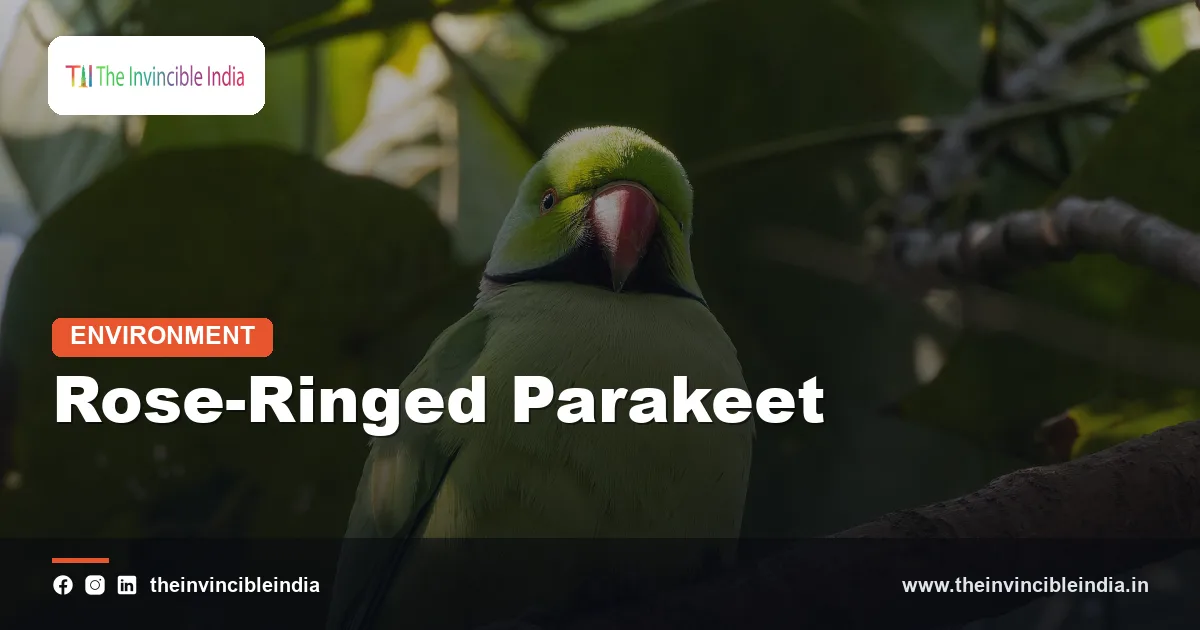
The rose-ringed parakeet (Psittacula krameri) is a bright green, long-tailed parrot, also called the ring-necked parakeet, that is among the most common and recognisable wild birds across India. Flocks of rose-ringed parakeets screech across city skies at dawn and dusk, crowd fruiting trees and farm fields, and nest in holes in old trees and walls, which has made them familiar to almost every Indian, known simply as the tota.
This explainer covers how to identify the rose-ringed parakeet, where it lives, what it eats, how its noisy roosts work, why it is a crop pest in some regions, how feral populations became established around the world, and why keeping native parakeets as pets is illegal in India. Information was last reviewed on 22 October 2026.
| Quick Fact | Detail |
|---|---|
| Common name | Rose-ringed parakeet, also ring-necked parakeet (Hindi: tota) |
| Scientific name | Psittacula krameri |
| Family | Psittaculidae (Old World parrots) |
| Typical length | About 38 to 42 cm including the long tail |
| Native range | The Indian subcontinent and a belt of sub-Saharan Africa |
| Habitat | Open woodland, farmland, orchards, gardens, parks and cities |
| Diet | Fruits, seeds, grain, flowers, buds and nectar |
| Global IUCN status | Least Concern |
| Introduced range | Feral populations in Europe, the Middle East, North America and other regions |
Key Takeaways
- The rose-ringed parakeet (Psittacula krameri) is a green parrot about 38 to 42 cm long, with a red bill and a long tapering tail.
- Adult male rose-ringed parakeets develop a black chin stripe and a pink-and-black neck ring, while females and young birds lack the full ring.
- The rose-ringed parakeet eats fruit, seeds, grain and flowers, and large flocks can damage crops such as sunflower, maize, millets and orchard fruit.
- Rose-ringed parakeets nest in tree cavities and gather in noisy communal roosts of hundreds or thousands of birds at dusk.
- Escaped and released pet birds have created feral rose-ringed parakeet populations in many countries outside the species’ native range.
- Capturing, trading and keeping native Indian parakeets as pets is prohibited under Indian wildlife law, even though the birds are common.
What is the rose-ringed parakeet?
The rose-ringed parakeet is a medium-sized parrot native to the Indian subcontinent and parts of Africa, belonging to the genus Psittacula. Its scientific name is Psittacula krameri, and it is one of the most adaptable members of the parrot family.
The species thrives close to people. It lives happily in leafy cities, on farms and in forest edges, and it is one of the few parrots that has built up large populations in towns. Several subspecies are recognised, and the form commonly seen across much of India is usually called Psittacula krameri manillensis.
In India, the rose-ringed parakeet is so familiar that many people think of it as the default parrot. It appears in children’s rhymes, pictures, proverbs and temple art.
How can you identify a rose-ringed parakeet?
A rose-ringed parakeet can be identified by its bright grass-green plumage, strong curved red bill and long, pointed tail. In flight it looks fast and slender, with quick wingbeats and a loud, repeated, high-pitched call.
Male rose-ringed parakeet
- A black chin and throat, bordered by a narrow ring that fades from black to rose-pink on the nape.
- A bluish tinge on the back of the neck in mature birds.
- A red bill with a darker lower mandible.
Female and young birds
- Green plumage without the full black-and-pink neck ring, although a faint paler ring may sometimes show.
- A shorter tail in young birds, which grows longer as they mature.
- Males usually take about two to three years to develop the complete ring.
Larger parakeets such as the Alexandrine parakeet (Psittacula eupatria) have a bigger body, a heavier bill and a maroon shoulder patch, which makes them distinguishable from the rose-ringed parakeet.
Where does the rose-ringed parakeet live in India?
The rose-ringed parakeet lives across most of India, in plains, farmland, scrub, parks and cities, and it avoids only dense wet forest and high mountain areas. It is found from Punjab and Rajasthan to Kerala and from Gujarat to the north-east, and it is one of the most visible wild birds in many urban areas.
It prefers places with a mix of old trees for nesting and fruiting trees or fields for food. Avenues of mature trees, temple groves, university campuses, monuments and old city gardens commonly host large populations, which is why parakeets are often easy to see in places such as Delhi, Mumbai, Kolkata and Bengaluru.
The rose-ringed parakeet is non-migratory, although flocks move daily between roosting and feeding sites and may shift locally with the seasons, following ripening fruit and grain.
What does the rose-ringed parakeet eat?
The rose-ringed parakeet eats a wide range of plant foods, including fruits, seeds, grain, nuts, flower buds and nectar. This broad diet is one reason the species adapts so well to human-modified landscapes.
- Wild foods: figs and other tree fruits, neem berries, pods and flowers of many trees such as silk cotton and coral tree.
- Farm foods: sunflower heads, maize, sorghum (jowar), millets, wheat, rice, guava, mango, pomegranate and other orchard fruit.
- Urban foods: seeds put out by feeders and grain scattered at temples or markets.
A parakeet holds food in one foot and bites into it with a strong bill, often dropping half-eaten fruit. Birds also visit mineral-rich clay or wall surfaces at times, which may help them cope with chemicals in some seeds. Parakeets are usually seed predators rather than seed dispersers, because they crush most seeds.
Why do rose-ringed parakeets form noisy roosts?
Rose-ringed parakeets form noisy communal roosts because gathering in large groups at night offers protection from predators and helps birds share information about food. At dusk, small flocks stream in from feeding areas and settle in dense trees, often creating a deafening chorus.
A roost can contain from a few dozen to many thousands of birds. Favoured roost trees are often tall, leafy and sited in busy urban places where lights and traffic deter predators. At dawn, birds disperse in small groups to feeding areas that may lie several kilometres away.
The noise causes occasional friction with residents, since droppings and screeching near homes can be a nuisance. Pruning drastic enough to disturb nesting trees during the breeding season, however, can harm the birds, so cautious, seasonal management is better than harassment.
How does the rose-ringed parakeet breed?
The rose-ringed parakeet breeds by laying eggs in a tree hole or wall cavity, usually in the cooler months when the weather is mild. In much of India the nesting season begins around the winter and early spring, though timing varies with region and climate.
A typical clutch has two to four white eggs. The female incubates them for roughly three weeks, and the chicks stay in the nest for around six to seven weeks before fledging. The male feeds the female during incubation and brings food for the young.
Competition for holes is intense. Rose-ringed parakeets often enlarge existing woodpecker or barbet holes and may compete with mynas, owls and other cavity nesters, which can make nest-site availability an important limit on local numbers.
Why are rose-ringed parakeets a problem for farmers?
Rose-ringed parakeets are a problem for farmers because large flocks can strip ripening grain, sunflower heads and fruit in a short time. Losses vary widely from field to field, and they are typically concentrated in small areas at the time when the crop ripens.
Farmers have used scarecrows, reflective tapes, nets, noise devices and early harvest to reduce losses. Netting on orchards and covering sunflower heads can help, though cost can make these options hard for small farmers. Because losses depend on local conditions, it is difficult to give a reliable national figure, and the actual damage should be judged field by field.
Parakeets are also protected birds, so harming them is not a lawful way to protect crops. Non-lethal deterrents are the recommended route.
How did the rose-ringed parakeet become established around the world?
The rose-ringed parakeet became established worldwide mainly through escaped or deliberately released pet birds that formed breeding groups in new countries. Its tolerance of cold, its flexible diet and its use of tree cavities have helped feral groups survive far outside the tropics.
| Region | Status of rose-ringed parakeets |
|---|---|
| Indian subcontinent | Native, widespread and common |
| Sub-Saharan Africa (belt) | Native in a band south of the Sahara |
| Western Europe, including the UK, France, Germany and Belgium | Introduced; established feral populations, mainly in cities |
| Middle East | Introduced and established in several countries |
| North America | Small introduced populations reported in some warm regions |
| Other parts of Asia, Africa and islands | Introduced in various places, with varying success |
In some introduced regions, scientists worry that rose-ringed parakeets compete with native cavity-nesting birds and bats and damage orchards. Because status changes over time, the exact spread and effects should be checked in current research for any given country.
Is it legal to keep a rose-ringed parakeet as a pet in India?
No, keeping a native Indian parakeet, including the rose-ringed parakeet, as a pet is generally illegal in India under wildlife protection law. The Wild Life (Protection) Act, 1972 prohibits capturing, trading and keeping most native wild birds, and the trade in native Indian birds has been banned since the early 1990s.
The schedule placement of parrots has been revised through amendments to the Act, so anyone needing the exact current legal position should consult the latest text or a wildlife official. Penalties can include fines and imprisonment, and the law applies to birds taken from nests as chicks.
Despite this, illegal trapping continues in many places, and the birds may be sold as pets or used by street fortune-tellers. Anyone who finds a caged native parakeet can contact the state forest department or a recognised wildlife rescue organisation.
What is the cultural importance of the parakeet in India?
The parakeet is culturally important in India as a symbol of speech, love and companionship, and it appears widely in art, literature and religion. In Hindu tradition, a parrot is often shown with the goddess Meenakshi in Madurai, and it is associated with Kamadeva, the god of love.
Sanskrit and folk literature often feature talking parrots as storytellers, as in the classic collection known as the Shuka Saptati, or Seventy Tales of the Parrot. In everyday language, “tota” appears in songs, idioms and folk art. This long cultural history sits uneasily with the fact that the birds are best kept free.
How can people live alongside rose-ringed parakeets?
People can live alongside rose-ringed parakeets by protecting old trees with natural cavities, tolerating seasonal noise and using non-harmful crop protection. Mature trees give the birds nesting holes and roost sites, so felling them removes the very resources that attract large flocks to a locality.
- Keep dead or hollow branches that do not endanger people, since cavities are valuable nest sites.
- Avoid feeding large amounts of processed food, which can make flocks dependent on people.
- Report caged native parakeets to the forest department rather than buying or releasing them.
Bottom Line
The rose-ringed parakeet is a common, adaptable and noisy bird that thrives across India and has also spread around the world through the pet trade. Appreciating the rose-ringed parakeet in the wild, using non-harmful ways to protect crops and avoiding the purchase of native parakeets as pets are the most responsible approaches.
Frequently Asked Questions
How can I tell a male rose-ringed parakeet from a female?
A male rose-ringed parakeet can be told from a female by the black chin stripe and the pink-and-black ring around his neck. Females and young birds are green without a full ring, although a faint pale collar can sometimes be seen. Males usually take about two to three years to develop the full ring.
Can you keep a rose-ringed parakeet as a pet in India?
No, keeping a native Indian parakeet as a pet is generally illegal under the Wild Life (Protection) Act, 1972. Trapping and trade in native wild birds is prohibited, and penalties can include fines and imprisonment. Schedule placements have been amended over time, so the current text of the Act should be checked.
Why are rose-ringed parakeets so noisy?
Rose-ringed parakeets are noisy because they use loud calls to keep flocks together in flight and at communal roosts. At dusk, hundreds or thousands of birds may gather in a few trees and call continuously. The noise is strongest at dawn and dusk.
What do rose-ringed parakeets eat?
Rose-ringed parakeets eat fruits, seeds, grain, flower buds and nectar. In farmland they feed on sunflower, maize, sorghum, millets and orchard fruit, which can cause crop damage. In cities they also visit trees with fruit and feeders with seeds.
Are rose-ringed parakeets found outside India?
Yes, rose-ringed parakeets are found outside India, both as native birds and as introduced feral populations. They are native to parts of Africa and the Indian subcontinent. Escaped pets have formed breeding groups in Europe, the Middle East and other regions.
Do rose-ringed parakeets harm crops?
Yes, rose-ringed parakeets can harm crops when large flocks feed on ripening grain, sunflower heads and fruit. The damage is usually local and varies by field and season. Non-lethal methods such as netting, covering sunflower heads and scare devices are recommended, since the birds are legally protected.
{“@context”:”https://schema.org”,”@graph”:[{“@type”:”FAQPage”,”mainEntity”:[{“@type”:”Question”,”name”:”How can I tell a male rose-ringed parakeet from a female?”,”acceptedAnswer”:{“@type”:”Answer”,”text”:”A male rose-ringed parakeet can be told from a female by the black chin stripe and the pink-and-black ring around his neck. Females and young birds are green without a full ring, although a faint pale collar can sometimes be seen. Males usually take about two to three years to develop the full ring.”}},{“@type”:”Question”,”name”:”Can you keep a rose-ringed parakeet as a pet in India?”,”acceptedAnswer”:{“@type”:”Answer”,”text”:”No, keeping a native Indian parakeet as a pet is generally illegal under the Wild Life (Protection) Act, 1972. Trapping and trade in native wild birds is prohibited, and penalties can include fines and imprisonment. Schedule placements have been amended over time, so the current text of the Act should be checked.”}},{“@type”:”Question”,”name”:”Why are rose-ringed parakeets so noisy?”,”acceptedAnswer”:{“@type”:”Answer”,”text”:”Rose-ringed parakeets are noisy because they use loud calls to keep flocks together in flight and at communal roosts. At dusk, hundreds or thousands of birds may gather in a few trees and call continuously. The noise is strongest at dawn and dusk.”}},{“@type”:”Question”,”name”:”What do rose-ringed parakeets eat?”,”acceptedAnswer”:{“@type”:”Answer”,”text”:”Rose-ringed parakeets eat fruits, seeds, grain, flower buds and nectar. In farmland they feed on sunflower, maize, sorghum, millets and orchard fruit, which can cause crop damage. In cities they also visit trees with fruit and feeders with seeds.”}},{“@type”:”Question”,”name”:”Are rose-ringed parakeets found outside India?”,”acceptedAnswer”:{“@type”:”Answer”,”text”:”Yes, rose-ringed parakeets are found outside India, both as native birds and as introduced feral populations. They are native to parts of Africa and the Indian subcontinent. Escaped pets have formed breeding groups in Europe, the Middle East and other regions.”}},{“@type”:”Question”,”name”:”Do rose-ringed parakeets harm crops?”,”acceptedAnswer”:{“@type”:”Answer”,”text”:”Yes, rose-ringed parakeets can harm crops when large flocks feed on ripening grain, sunflower heads and fruit. The damage is usually local and varies by field and season. Non-lethal methods such as netting, covering sunflower heads and scare devices are recommended, since the birds are legally protected.”}}]}]}


