

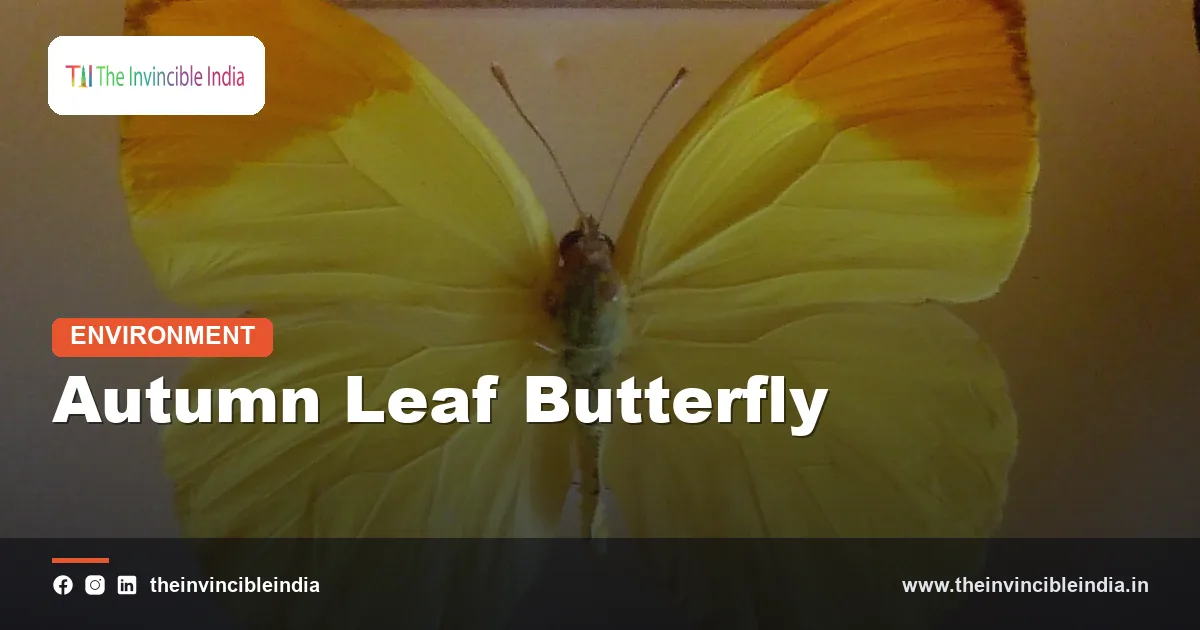
The autumn leaf is a medium-sized, orange-and-black forest butterfly (Doleschallia bisaltide) of the family Nymphalidae, famous for the underside of its closed wings, which looks almost exactly like a withered, mid-ribbed leaf. In India the autumn leaf butterfly is a species of humid evergreen and semi-evergreen forest, found mainly in the eastern Himalayan foothills, the north-eastern states and the Andaman and Nicobar Islands. It flies fast and low, and when it lands and folds its wings it seems to vanish into the leaf litter.
This guide explains how the autumn leaf butterfly is built, why its camouflage works, where it lives, what its caterpillars eat and how it differs from other leaf-mimicking butterflies of the Indian forests. It is written as a plain reference for students, nature walkers and anyone who has ever wondered what that “dead leaf” on the forest path actually was.
Quick Facts: Autumn Leaf Butterfly
| Attribute | Detail |
|---|---|
| Common name | Autumn leaf (also called the leafwing) |
| Scientific name | Doleschallia bisaltide |
| Family | Nymphalidae (brush-footed butterflies) |
| Wingspan | Roughly 70 to 85 millimetres |
| Host plants | Herbs and shrubs of the acanthus family (Acanthaceae), such as Asystasia and Pseuderanthemum |
| Range and habitat in India | Moist forest, forest edges and clearings in the eastern Himalayan foothills, north-east India and the Andaman and Nicobar Islands |
| Flight season and broods | Several broods in a year in suitable warm, humid areas; most easily seen in and after the monsoon |
| Notable feature | Dead-leaf mimicry on the underside, with a small tail-like point on each hindwing that looks like a leaf stalk |
Key Takeaways
- The autumn leaf butterfly (Doleschallia bisaltide) is a brush-footed butterfly whose closed wings imitate a dry, veined leaf.
- The upper side of the autumn leaf butterfly is bright orange with dark borders, so the insect flashes a warm colour in flight and then seems to disappear on landing.
- Caterpillars of the autumn leaf feed on acanthus-family plants, which grow in the damp undergrowth of tropical forest.
- In India the autumn leaf butterfly is mostly a species of the north-eastern hills, the eastern Himalayan foothills and the Andaman and Nicobar Islands.
- Adult autumn leaf butterflies prefer rotting fruit, tree sap, animal droppings and damp mud over flower nectar.
- The autumn leaf is an indicator of healthy, humid forest, because its life depends on intact undergrowth and leaf litter.
What is the autumn leaf butterfly?
The autumn leaf butterfly is a medium-sized nymphalid butterfly, scientifically named Doleschallia bisaltide, that belongs to a small genus of leaf-mimicking butterflies found across the Indo-Australian region. The genus name honours a nineteenth-century naturalist, and the species is spread over a wide arc from north-east India through South-East Asia to New Guinea and northern Australia, with many local forms.
Like all members of the family Nymphalidae, the autumn leaf is a “brush-footed” butterfly. Its front pair of legs is greatly reduced and held against the body, so it appears to walk on only four legs. This feature is shared by familiar butterflies such as the tigers, crows, castors and map butterflies, and it is one of the simplest ways to place the autumn leaf within the wider butterfly family tree.
The English name is a descriptive one. Seen from above, the butterfly is a warm autumn orange. Seen from below, it is the brown of a fallen leaf. The name captures both faces of the insect, which is the whole point of its survival strategy.
How does the autumn leaf butterfly look?
The autumn leaf butterfly has two very different appearances: a vivid orange upper side and a dull, leaf-like brown underside. The upper surface of both wings is tawny orange, edged with broad dark brown to black borders, with the darkest area near the tip of each forewing. The shape is slightly angular, with an outward bulge on the forewing tip and a short, blunt projection on the hindwing.
The underside is where the disguise lies. The ground colour ranges from ochre and dull brown to grey-brown, and it is marked with a darker line that runs across both wings like the midrib of a leaf. Fine streaks, mottling and tiny dark spots imitate the blemishes, fungal specks and veins of an old leaf. The small hindwing projection works as the “leaf stalk”, so that with the wings closed the whole insect has the outline of a single leaf attached to a twig.
Size and sexes
Adults measure roughly 70 to 85 millimetres across the open wings, although individuals vary with food quality and locality. Males and females look broadly alike, but females tend to be a little larger and may show a slightly paler or more rounded wing outline. Careful observation, ideally with a photograph, is usually needed to separate the sexes in the field.
Variation between populations
The species varies across its large range. Island and mainland populations differ in the size of the dark borders and in the shade of the underside, and several subspecies have been described. Within India, individuals from the humid north-east tend to be darker and richer in colour, while the underside pattern varies from one individual to another. This individual variation is itself useful for camouflage, because a predator cannot learn a single fixed pattern.
Why does the autumn leaf butterfly look like a dead leaf?
The autumn leaf butterfly resembles a dead leaf because this disguise, called cryptic mimicry or camouflage, helps it avoid birds, lizards and other predators that hunt by sight. When the butterfly settles with its wings folded upright, only the leaf-like underside is visible, and the insect becomes very hard to detect among fallen leaves.
Several features work together to make the trick effective:
- Shape: the pointed forewing tip and the stalk-like hindwing tail give the folded wings the silhouette of a leaf with a petiole.
- Pattern: a dark central line imitates the leaf midrib, and lateral lines imitate side veins.
- Colour: shades of brown, buff and grey match forest leaf litter in the shade.
- Posture: the butterfly rests motionless with the wings closed and the body tilted, often on a twig, a tree trunk or the ground, as a hanging or fallen leaf would lie.
- Behaviour: when disturbed, it takes off in an erratic dash and then drops abruptly, so any predator that follows the bright orange flash loses the target as soon as the wings close.
This pairing of a bright upper side and a hidden under side is sometimes called a “flash and hide” strategy. The orange flash may also startle a predator for a moment, giving the butterfly time to escape.
Where does the autumn leaf butterfly live in India?
In India the autumn leaf butterfly lives mainly in the humid forests of the eastern Himalayan foothills, the north-eastern states and the Andaman and Nicobar Islands. It is a lowland and foothill species that prefers warm, moist conditions, and it is generally absent from dry, open or heavily degraded country.
Its typical habitats include:
- moist evergreen and semi-evergreen forest with a well-developed shrub layer;
- forest edges, clearings and shaded trails where host plants grow in the undergrowth;
- stream banks and damp ravines, where soil stays moist all year;
- old plantations and village woodlots that preserve some native undergrowth.
Within these habitats it usually occurs at low to moderate elevations, in the warm belt below the cooler mountain forests. Outside India it extends through Myanmar and the rest of South-East Asia and on into the island groups of the Pacific. Because its survival depends on humid undergrowth, it is vulnerable to the clearing of forest understorey and to the drying of forest streams.
What do autumn leaf caterpillars eat?
Caterpillars of the autumn leaf butterfly feed on the leaves of plants in the acanthus family, Acanthaceae, which are common herbs and shrubs of the shaded forest floor. Recorded host plants include species of Asystasia and Pseuderanthemum, together with related genera of the same family, and the exact plant used depends on what grows in the local forest.
The female lays her small, pale eggs on the leaves of these plants, usually singly or in small groups. The young caterpillars feed at first on the soft leaf tissue and then eat steadily through the leaf blades as they grow. A mature caterpillar is dark, with a banded appearance and rows of branched spines along the back. The spines look fierce, but they are a passive defence and a caterpillar handled gently is not dangerous to people.
Because acanthus plants are so widespread in damp undergrowth, they are rarely a limiting factor in intact forest. The more serious constraint on the butterfly is the loss of the shady, humid microhabitat in which these plants thrive.
What is the life cycle of the autumn leaf butterfly?
The autumn leaf butterfly goes through complete metamorphosis in four stages: egg, caterpillar, pupa and adult. The whole cycle can take a few weeks in warm weather, which allows several overlapping generations in a year in humid regions.
| Stage | What happens | Approximate appearance |
|---|---|---|
| Egg | Laid on the leaves of an acanthus host plant | Small, rounded, pale |
| Caterpillar (larva) | Feeds on host leaves and moults several times | Dark, banded, with branched spines |
| Pupa (chrysalis) | Hangs from a twig or leaf while the body reorganises | Angular, brownish, resembling a dead leaf or bud |
| Adult | Mates, feeds on fruit, sap and minerals, and lays eggs | Orange above, leaf-like brown below |
The pupa also mimics dead plant matter. Hanging motionless from a support, it resembles a small shrivelled leaf or a bud, which protects it during the days when it cannot move. Adults live for a few weeks, and the timing of emergence is usually linked to the rains, when new growth supplies fresh food for the next generation of caterpillars.
How does the autumn leaf butterfly behave?
The autumn leaf butterfly is a fast, wary flier that spends most of its day resting on tree trunks, branches or the forest floor with the wings closed. It flies in short, powerful bursts, with rapid wingbeats and brief glides, and often settles again within a few metres.
Males are somewhat territorial. They choose a perch, often a sunlit patch near a trail or clearing, and chase intruders from it. Females are seen less often, since they spend more time in the undergrowth searching for host plants. Both sexes are most active in the warmer, brighter parts of the day and tend to retreat to shade when the sun is harsh or when rain approaches.
The butterfly is also very approachable once it is settled. Its confidence in its camouflage means a patient observer can sometimes come close, but a clumsy approach sends it flying at once. Slow movement and a shadow kept off the insect are the best ways to watch it.
What do adult autumn leaf butterflies feed on?
Adult autumn leaf butterflies feed mainly on rotting fruit, oozing tree sap, animal droppings and moist mineral-rich soil rather than on flower nectar. These foods supply sugars, amino acids and salts that the insect needs for flight and, in males, for reproduction.
This feeding habit is shared by many forest nymphalids. The butterflies gather at fallen fruit, rotting bark wounds and damp riverbank mud, where several species may sit side by side. The behaviour of drinking minerals from mud is called “mud-puddling”, and it is mostly done by males. A cleared and watered patch of ground, or a piece of overripe banana placed at the edge of a forest trail, often attracts such species for observation.
How is the autumn leaf different from other leaf-mimic butterflies?
The autumn leaf differs from the better-known oakleaf butterflies (Kallima) mainly in size, shape and colour, although both groups imitate dead leaves. The oakleaves are larger, with a long pointed forewing tip and a distinct tail, while the autumn leaf is smaller and more compact with a shorter hindwing projection.
| Feature | Autumn leaf (Doleschallia) | Oakleaf (Kallima) |
|---|---|---|
| Upper side | Orange with dark borders | Blue or orange band on dark ground, depending on species |
| Underside | Brown, ochre or grey with a midrib-like line | Very detailed dead-leaf pattern in many shades of brown |
| Size | Medium | Medium to large |
| Hindwing tail | Short, blunt projection | Longer, leaf-stalk-like tail |
| Typical Indian areas | North-east, eastern Himalayan foothills, Andaman and Nicobar | Western Ghats, Himalayan foothills and north-east, depending on species |
Nature observers who see an orange butterfly vanish into the leaf litter should look closely at the size, the tail and the underside pattern. A photograph of the underside, taken before the insect flies away, is the most reliable way to confirm the identification later.
Why does the autumn leaf butterfly matter for forests?
The autumn leaf butterfly matters because its presence signals intact, humid forest undergrowth, and because it plays small but real roles as a food source, a decomposer-linked feeder and an indicator species. Butterflies respond quickly to changes in temperature, humidity and vegetation, so they are widely used to monitor habitat quality.
- Food web link: the caterpillars and adults are prey for birds, lizards, spiders and other insectivores.
- Nutrient cycling: by feeding on rotting fruit, dung and sap, the adults take part in the turnover of forest material.
- Environmental indicator: a thriving population suggests that the shaded understorey, host plants and moist soil are still in place.
- Learning value: as one of the clearest examples of camouflage, the autumn leaf is often used to teach adaptation and natural selection.
Protecting the species means protecting the forest it lives in. Clearing undergrowth, draining wet patches and converting natural forest to monoculture all remove the conditions that its life cycle needs. Wildlife laws in India restrict the collection of butterflies from protected areas, so photography is the responsible way to enjoy the species.
Bottom Line
The autumn leaf butterfly is one of the most striking examples of camouflage in the Indian forest, a bright orange insect that turns into a dead leaf the moment it lands. Its dependence on humid undergrowth and acanthus host plants makes it a useful sign of healthy forest in the north-east and the islands. Careful, quiet observation and photography are the best ways to appreciate it.
Frequently Asked Questions
What is the autumn leaf butterfly?
The autumn leaf butterfly is a medium-sized orange-and-black forest butterfly, Doleschallia bisaltide, of the family Nymphalidae. Its folded wings look like a dead leaf on the underside. It lives in humid forests of north-east India and the Andaman and Nicobar Islands.
Why is it called the autumn leaf?
It is called the autumn leaf because its orange upper side recalls autumn colour and its brown underside imitates a fallen leaf. The name describes both faces of the butterfly. The disguise helps it avoid predators that rely on sight.
Where can the autumn leaf butterfly be seen in India?
The autumn leaf butterfly can be seen mainly in the north-eastern states, the eastern Himalayan foothills and the Andaman and Nicobar Islands. It prefers moist forest, shady trails, clearings and stream banks. It is rarely found in dry or open country.
What do autumn leaf caterpillars eat?
Autumn leaf caterpillars eat the leaves of plants in the acanthus family, such as Asystasia and Pseuderanthemum. These herbs and shrubs grow in the shady undergrowth of tropical forest. The females lay their eggs directly on these plants.
Is the autumn leaf butterfly the same as the oakleaf butterfly?
No, the autumn leaf butterfly is a different genus from the oakleaf butterflies, although both imitate dead leaves. The autumn leaf (Doleschallia) is smaller and orange above, while the oakleaves (Kallima) are larger with longer tails. Looking at size, tail and underside pattern helps to tell them apart.
Is it safe to touch or collect the autumn leaf butterfly?
The butterfly is harmless to people, but touching it can damage its delicate wings, and collecting it from protected areas is restricted under Indian wildlife law. Photography is the best way to enjoy the species. Leaving host plants and leaf litter undisturbed helps it survive.
{“@context”:”https://schema.org”,”@graph”:[{“@type”:”FAQPage”,”mainEntity”:[{“@type”:”Question”,”name”:”What is the autumn leaf butterfly?”,”acceptedAnswer”:{“@type”:”Answer”,”text”:”The autumn leaf butterfly is a medium-sized orange-and-black forest butterfly, Doleschallia bisaltide, of the family Nymphalidae. Its folded wings look like a dead leaf on the underside. It lives in humid forests of north-east India and the Andaman and Nicobar Islands.”}},{“@type”:”Question”,”name”:”Why is it called the autumn leaf?”,”acceptedAnswer”:{“@type”:”Answer”,”text”:”It is called the autumn leaf because its orange upper side recalls autumn colour and its brown underside imitates a fallen leaf. The name describes both faces of the butterfly. The disguise helps it avoid predators that rely on sight.”}},{“@type”:”Question”,”name”:”Where can the autumn leaf butterfly be seen in India?”,”acceptedAnswer”:{“@type”:”Answer”,”text”:”The autumn leaf butterfly can be seen mainly in the north-eastern states, the eastern Himalayan foothills and the Andaman and Nicobar Islands. It prefers moist forest, shady trails, clearings and stream banks. It is rarely found in dry or open country.”}},{“@type”:”Question”,”name”:”What do autumn leaf caterpillars eat?”,”acceptedAnswer”:{“@type”:”Answer”,”text”:”Autumn leaf caterpillars eat the leaves of plants in the acanthus family, such as Asystasia and Pseuderanthemum. These herbs and shrubs grow in the shady undergrowth of tropical forest. The females lay their eggs directly on these plants.”}},{“@type”:”Question”,”name”:”Is the autumn leaf butterfly the same as the oakleaf butterfly?”,”acceptedAnswer”:{“@type”:”Answer”,”text”:”No, the autumn leaf butterfly is a different genus from the oakleaf butterflies, although both imitate dead leaves. The autumn leaf (Doleschallia) is smaller and orange above, while the oakleaves (Kallima) are larger with longer tails. Looking at size, tail and underside pattern helps to tell them apart.”}},{“@type”:”Question”,”name”:”Is it safe to touch or collect the autumn leaf butterfly?”,”acceptedAnswer”:{“@type”:”Answer”,”text”:”The butterfly is harmless to people, but touching it can damage its delicate wings, and collecting it from protected areas is restricted under Indian wildlife law. Photography is the best way to enjoy the species. Leaving host plants and leaf litter undisturbed helps it survive.”}}]}]}


