

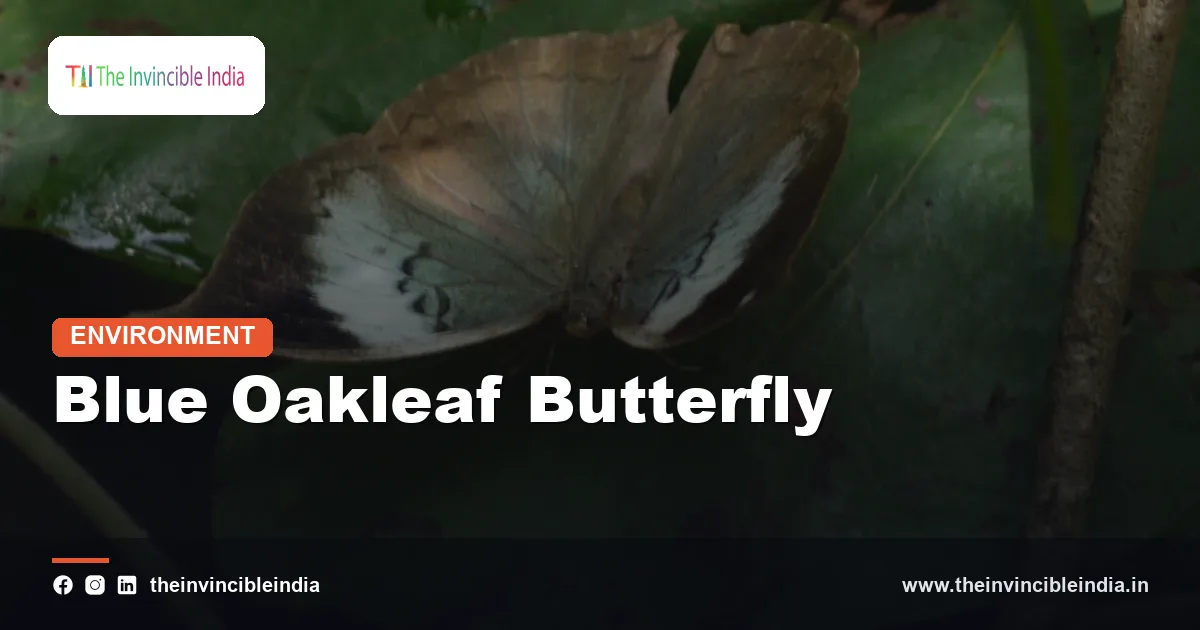
The blue oakleaf (Kallima horsfieldii) is a large forest butterfly of the family Nymphalidae that looks exactly like a dry, dead leaf when its wings are closed, yet shows a brilliant blue upperside with an orange-yellow band when it opens them in flight. In India it lives in hill and rainforest habitats, notably in the Western Ghats and in forested parts of the north-east, and it is among the best-known examples of leaf mimicry in the animal world.
The butterfly relies on this disguise to escape birds, lizards and other predators, resting motionless on twigs with its wings folded together. This explainer describes how the blue oakleaf looks, how its camouflage works, where it lives, what it feeds on and how its life cycle unfolds.
Quick Facts
| Common names | Blue oakleaf, southern blue oakleaf or Sahyadri blue oakleaf (Western Ghats form), dead leaf butterfly |
|---|---|
| Scientific name | Kallima horsfieldii |
| Family | Nymphalidae (the brush-footed butterflies) |
| Wingspan | Roughly 8 to 11 centimetres, among the larger Indian forest butterflies |
| Host plants | Caterpillars feed on species of Strobilanthes, a group of understorey plants in the family Acanthaceae |
| Range and habitat | Moist evergreen and semi-evergreen hill forests, including the Western Ghats and forested hills of north-eastern India |
| Broods | Several broods in a year, with most activity during and after the monsoon |
| Adult feeding | Rotting fruit, tree sap and moist minerals rather than flower nectar |
Key Takeaways
- The blue oakleaf (Kallima horsfieldii) is a large nymphalid butterfly whose closed wings imitate a dead leaf, complete with a midrib, veins and a leaf stalk.
- The upperside of the blue oakleaf is bright blue with a broad orange-yellow band, which is visible only in flight or when the butterfly opens its wings.
- The blue oakleaf feeds as an adult on rotting fruit and tree sap, and its caterpillars feed on Strobilanthes plants of the forest understorey.
- The blue oakleaf lives in moist hill forests, and its dependence on this habitat makes it a good indicator of intact woodland.
- The sudden change from a flash of colour to a leaf-like shape when the blue oakleaf lands helps confuse predators that are chasing it.
- Kallima butterflies were cited by the naturalist Alfred Russel Wallace in the nineteenth century as a classic case of protective resemblance.
What is the blue oakleaf?
The blue oakleaf is a medium-large to large butterfly in the genus Kallima, a group of leaf-mimicking butterflies found across tropical Asia, with Kallima horsfieldii being the species commonly called the blue oakleaf in India. It belongs to Nymphalidae, the brush-footed family, whose members hold the first pair of legs folded up and mostly use only four legs for walking.
The common name “oakleaf” refers to the shape and colour of the closed wings, which resemble a dried oak leaf lying in leaf litter or hanging on a branch. The word “blue” refers to the upperside colour. Butterfly watchers also call the group “leafwings” or “dead leaf butterflies”, names which describe the same trick.
The species is recognised in several regional forms. A form found in the Western Ghats is often called the southern blue oakleaf or Sahyadri blue oakleaf, while related forms of the species occur in the forests of the Himalayan region and the north-east. Related species such as the orange oakleaf (Kallima inachus) also occur in India, and the differences between them are mostly in the colour of the band and details of the wing pattern.
What does the blue oakleaf look like?
The blue oakleaf has two completely different faces: a bright blue and orange upperside, and a drab brown, leaf-like underside. A viewer can see only one at a time, because the butterfly holds its wings tightly closed over its back when it rests.
The upperside
When the wings are open, the forewing is deep blue, often with a violet sheen, and is crossed by a broad, slanting band of orange or yellow-orange. The wing tips are dark, with a pale spot near the tip. The hindwing is mostly blue-brown and ends in a short, tail-like extension. The upperside is bright and conspicuous, and is revealed mainly in flight.
The underside
The underside is brown, grey or reddish-brown, patterned with fine streaks and speckles. A dark line runs from the base of the hindwing, along the body, to the pointed tip of the forewing, and it looks very much like the midrib of a leaf. Lighter and darker lines branch off it like side veins. Small dark dots and patches look like fungal spots or insect damage on an old leaf.
The shape of the wing supports the illusion. The forewing tip is drawn out and pointed, like the tip of a leaf, and the short tail on the hindwing resembles the leaf stalk, known botanically as the petiole.
How does the blue oakleaf mimic a dead leaf?
The blue oakleaf mimics a dead leaf by combining colour, shape, pattern and posture so closely that predators fail to recognise it as an insect. This kind of disguise is called leaf masquerade or protective resemblance, and it relies on the butterfly looking like something predators ignore rather than looking like nothing at all.
- Colour: The underside copies the brown, grey and rust shades of dead leaves, and different individuals vary so that no two look the same.
- Midrib and veins: A dark central line and branching side lines imitate the veins of a leaf.
- Outline: The pointed forewing tip and the tail on the hindwing form the leaf’s tip and stalk.
- Surface marks: Dots, specks and patches look like mould, holes or blemishes.
- Posture: The butterfly perches with its tail touching the twig and its body tilted, so that the folded wings hang like a single leaf.
- Stillness: The butterfly remains motionless, often for long periods, and may sway slightly as though moved by wind.
The nineteenth-century naturalist Alfred Russel Wallace described a related Kallima butterfly in his book on the Malay Archipelago as a striking example of how an insect can match its surroundings. Since then, the genus has become a standard teaching example of natural selection acting on appearance, because individuals that resemble leaves more closely are more likely to survive and breed.
Why does the blue oakleaf flash blue and then vanish?
The blue oakleaf flashes blue and then vanishes because it flies with its bright upperside visible and then lands abruptly, closing its wings to show only the leaf-like underside. A predator chasing the flash of colour loses its target the instant the colour disappears, and it looks for a blue butterfly that no longer exists.
This technique is sometimes called a flash or startle display, and it works because the predator forms a mental image of the prey while it is moving. When the image changes completely, the predator may search the surroundings without recognising the perched leaf-like shape as the same animal.
The oakleaf is a strong, fast and erratic flier, which adds to the effect. It often shoots up from the forest floor or a tree trunk when disturbed, flies a short distance and drops into leaf litter or onto a branch, where it settles head-down and blends in again.
Where does the blue oakleaf live in India?
The blue oakleaf lives in moist evergreen and semi-evergreen hill forests in India, with populations in the Western Ghats and in the forested hills of the Himalayan region and the north-east. It prefers shaded woodland with a thick understorey, clearings with streams, and forest edges where fallen fruit and tree sap are available.
In the Western Ghats it occurs across the hill forests of Kerala, Karnataka, Tamil Nadu, Goa and Maharashtra, usually at low to mid elevations. Its range depends heavily on intact forest, since the caterpillars need particular understorey plants and the adults need shaded trees and fruit.
Because the species is not found in open farmland or dry scrub, a healthy population of blue oakleaf butterflies generally points to a well-preserved forest patch. For this reason, naturalists treat leafwings as useful indicators of forest quality.
What does the blue oakleaf eat?
The adult blue oakleaf eats fermenting fruit, tree sap and other moist, mineral-rich substances, whereas its caterpillar eats the leaves of Strobilanthes plants. Adults almost never visit flowers for nectar, which sets them apart from many other butterflies.
Adult food
- Overripe and rotting fruit that has fallen to the forest floor.
- Sap oozing from wounded trees.
- Animal droppings and damp soil, from which the butterflies take salts and minerals.
This habit explains why the butterfly is often seen on the ground or on tree trunks rather than on blossoms. Feeding on fermenting fruit also means that the butterfly sits still for long periods, which again benefits from its leaf disguise.
Caterpillar food
The caterpillar feeds on Strobilanthes, a large genus of understorey plants in the acanthus family, found widely in Indian hill forests. Some of these plants flower in synchronised cycles lasting several years, which may influence local butterfly numbers, though the details vary between places and species.
What is the life cycle of the blue oakleaf?
The blue oakleaf goes through complete metamorphosis in four stages: egg, caterpillar, pupa and adult. Each stage has its own appearance and role, and the entire cycle may be repeated several times in a year in favourable weather.
| Stage | What happens |
|---|---|
| Egg | The female lays eggs singly or in small numbers on the leaves of the host plant |
| Caterpillar | The larva feeds on host leaves, grows through several moults and is typically dark with small spines |
| Pupa (chrysalis) | The caterpillar hangs from a support and transforms inside a hardened case, often green or brownish |
| Adult | The butterfly emerges, dries its wings, feeds on fruit and sap, mates and lays eggs |
Adults can be seen for much of the year in suitable habitats, with peak numbers in and after the monsoon, when host plants are fresh and fruit is plentiful. Unlike many small butterflies, adult oakleaves can live for several weeks, helped by their effective disguise.
How can you tell the blue oakleaf from similar leaf butterflies?
The blue oakleaf can be told from similar leaf butterflies mainly by the blue colour and orange band on its upperside and by its larger size and its Kallima wing shape. Several Indian butterflies mimic leaves, and they are often confused when seen only with their wings closed.
| Butterfly | Genus | Upperside | Notes |
|---|---|---|---|
| Blue oakleaf | Kallima | Blue with an orange-yellow band | Large; pointed forewing and a tail-like hindwing stalk |
| Orange oakleaf | Kallima | Orange with a dark tip | Similar shape; found in Himalayan and north-eastern forests |
| Autumn leaf | Doleschallia | Orange-brown with black | Smaller; a leaf mimic with a less elongated outline |
| Common map or other nymphalids | Various | Patterned, not leaf-like | Do not copy dead leaves when resting |
A reliable field clue is the strong, quick flight followed by a sudden disappearance. If a large butterfly vanishes on landing and a “leaf” then appears on a branch, it is likely to be an oakleaf.
How can you see a blue oakleaf in the wild?
The best way to see a blue oakleaf is to visit a hill forest in the monsoon or post-monsoon period and look for it at forest edges, along streams and near fallen fruit. Early morning and late afternoon are usually better than the heat of midday, when the butterfly rests among foliage.
- Walk slowly along forest trails and watch tree trunks and low branches for something that looks like a hanging dead leaf.
- Look for butterflies feeding on fallen fruit, sap flows or damp ground.
- If a large butterfly bursts into flight and then vanishes, note where it dropped and scan the area quietly.
- Do not touch or disturb the butterfly, and avoid trampling understorey plants that serve as caterpillar food.
Photographers often wait near fermenting fruit, where oakleaves return regularly. The upperside colours are very hard to photograph because the butterfly rarely opens its wings while at rest, so patience is essential.
Why does the blue oakleaf matter for conservation?
The blue oakleaf matters for conservation because it depends on intact moist forest and so serves as an indicator of habitat quality, and because it shows how a single species can illustrate natural selection to the public. Loss of forest cover, fragmentation of the Western Ghats and clearing of understorey plants all reduce the places where it can breed.
Butterflies as a group are sensitive to changes in vegetation, temperature and rainfall, and monitoring their numbers helps scientists track the health of forests. Citizen-science projects in India, in which birdwatchers and naturalists record sightings of butterflies, add to the knowledge of where species like the blue oakleaf occur and when they fly.
Protecting forest patches, keeping native understorey plants and avoiding pesticide use near forest edges are the practical steps that help leafwing butterflies and many other forest species at the same time.
Bottom Line
The blue oakleaf (Kallima horsfieldii) is a large forest butterfly that shows a bold blue and orange upperside in flight but disappears into a perfect dead-leaf shape when it lands. Its survival depends on moist, intact hill forest, which makes it both a natural wonder and a quiet indicator of woodland health.
Frequently Asked Questions
Why is it called the blue oakleaf butterfly?
It is called the blue oakleaf because its closed wings look like a dried oak leaf, while its upperside is bright blue. The butterfly belongs to the genus Kallima. The name describes both the disguise and the hidden colour.
How does the blue oakleaf look like a dead leaf?
The blue oakleaf looks like a dead leaf because its underside is brown with a dark midrib line, branching veins and spotted markings. The pointed forewing tip and tail-like hindwing form the leaf tip and stalk. The butterfly also rests motionless on twigs, which completes the illusion.
Where is the blue oakleaf found in India?
The blue oakleaf is found in moist hill forests, including the Western Ghats and forested hills of the Himalayan region and the north-east. A form in the Western Ghats is called the southern or Sahyadri blue oakleaf. It does not occur in open farmland or dry scrub.
What do blue oakleaf butterflies eat?
Adult blue oakleaf butterflies eat rotting fruit, tree sap and minerals from damp soil rather than flower nectar. The caterpillars feed on the leaves of Strobilanthes plants. This diet ties the species to well-wooded forest.
Is the blue oakleaf the same as the autumn leaf butterfly?
No, the blue oakleaf is not the same as the autumn leaf butterfly. The blue oakleaf belongs to the genus Kallima, while the autumn leaf belongs to Doleschallia. Both mimic dead leaves, but they differ in colour, size and wing outline.
How big is the blue oakleaf butterfly?
The blue oakleaf has a wingspan of roughly 8 to 11 centimetres, making it one of the larger Indian forest butterflies. Females are generally slightly larger than males. The size is measured across the opened wings, although the butterfly is usually seen with them closed.
{“@context”:”https://schema.org”,”@graph”:[{“@type”:”FAQPage”,”mainEntity”:[{“@type”:”Question”,”name”:”Why is it called the blue oakleaf butterfly?”,”acceptedAnswer”:{“@type”:”Answer”,”text”:”It is called the blue oakleaf because its closed wings look like a dried oak leaf, while its upperside is bright blue. The butterfly belongs to the genus Kallima. The name describes both the disguise and the hidden colour.”}},{“@type”:”Question”,”name”:”How does the blue oakleaf look like a dead leaf?”,”acceptedAnswer”:{“@type”:”Answer”,”text”:”The blue oakleaf looks like a dead leaf because its underside is brown with a dark midrib line, branching veins and spotted markings. The pointed forewing tip and tail-like hindwing form the leaf tip and stalk. The butterfly also rests motionless on twigs, which completes the illusion.”}},{“@type”:”Question”,”name”:”Where is the blue oakleaf found in India?”,”acceptedAnswer”:{“@type”:”Answer”,”text”:”The blue oakleaf is found in moist hill forests, including the Western Ghats and forested hills of the Himalayan region and the north-east. A form in the Western Ghats is called the southern or Sahyadri blue oakleaf. It does not occur in open farmland or dry scrub.”}},{“@type”:”Question”,”name”:”What do blue oakleaf butterflies eat?”,”acceptedAnswer”:{“@type”:”Answer”,”text”:”Adult blue oakleaf butterflies eat rotting fruit, tree sap and minerals from damp soil rather than flower nectar. The caterpillars feed on the leaves of Strobilanthes plants. This diet ties the species to well-wooded forest.”}},{“@type”:”Question”,”name”:”Is the blue oakleaf the same as the autumn leaf butterfly?”,”acceptedAnswer”:{“@type”:”Answer”,”text”:”No, the blue oakleaf is not the same as the autumn leaf butterfly. The blue oakleaf belongs to the genus Kallima, while the autumn leaf belongs to Doleschallia. Both mimic dead leaves, but they differ in colour, size and wing outline.”}},{“@type”:”Question”,”name”:”How big is the blue oakleaf butterfly?”,”acceptedAnswer”:{“@type”:”Answer”,”text”:”The blue oakleaf has a wingspan of roughly 8 to 11 centimetres, making it one of the larger Indian forest butterflies. Females are generally slightly larger than males. The size is measured across the opened wings, although the butterfly is usually seen with them closed.”}}]}]}


