

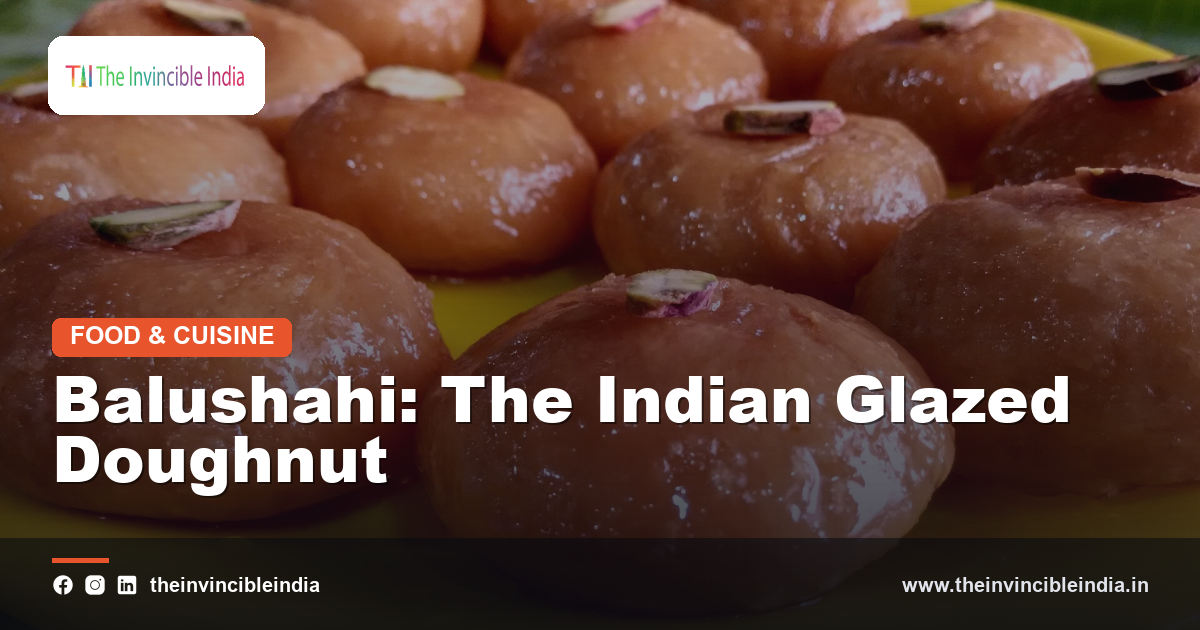
Few confections in the repertoire of famous sweets of India are as instantly recognizable as balushahi, a round, flaky, deep-fried sweet coated in a hardened glaze of sugar syrup. Often described in English as an Indian doughnut, balushahi differs from its Western namesake in almost every way that matters: it is denser and more layered, it is fried gently in ghee or oil rather than puffed quickly, and it is finished in a syrup that sets into a pale, crystalline shell. The dough is simple, built from refined flour, fat, and a souring agent, yet the result is a sweet of remarkable character, crumbly inside and delicately crisp at the surface. Balushahi appears at weddings, Diwali tables, and sweet-shop counters across the subcontinent. This guide examines its identity, preparation, regional forms, and enduring cultural place.
Quick Facts
| Detail | Information |
|---|---|
| Type | Deep-fried, sugar-glazed sweet |
| Main Ingredients | Refined flour, ghee, curd, sugar syrup |
| Texture | Flaky, layered and crumbly inside |
| Typical Garnish | Chopped pistachios or almonds |
| Regional Spread | North, West and South India |
| Festive Association | Diwali, weddings and celebrations |
What Is Balushahi
Balushahi is a traditional Indian sweet made from a dough of refined flour and fat, shaped into small rounds, fried slowly, and then dipped in sugar syrup until it acquires a thin, glossy, hardened coating. Its round shape, slight central hollow, and golden-brown colour explain the frequent comparison with a doughnut, although the comparison is only visual. The interior of a well-made balushahi is not soft and bready but flaky and layered, with a gentle crumble that yields easily to the bite. The outer glaze adds sweetness and a faint crispness that contrasts with the tender inside. Because it keeps well compared with milk-based sweets, balushahi has long been a favourite for gifting and for festive spreads. In short, balushahi is a deep-fried, syrup-glazed sweet whose flaky texture and sugar shell make it a distinctive member of the Indian mithai family.
Origins and History
The precise origin of balushahi is not recorded with certainty, and its history is best described in general terms. It is widely regarded as a sweet of the northern parts of the subcontinent that developed within the long tradition of syrup-soaked and fried confections, a tradition shaped by Indian halwais and by the culinary exchanges of many centuries. The name itself is often explained as a combination of words suggesting a refined or royal sweet, which fits its long association with festive and courtly food culture. Over time the sweet travelled across regions, adapting to local tastes and acquiring new names, so that today versions of it are made from Punjab and Uttar Pradesh to Gujarat and the southern states. What remains consistent is the core idea of a fried, fat-rich dough finished in sugar. Balushahi therefore stands as a long-established product of Indian confectionery rather than the invention of any single moment.
The Dough and Its Ingredients
The foundation of balushahi is a deliberately simple dough made from refined flour, a generous amount of ghee or other fat, and a souring or leavening element such as curd, often with a pinch of baking soda. Each component has a clear purpose. The fat coats the flour and shortens the dough, producing the crumbly, layered interior that defines the sweet. The curd adds gentle tang and softness while supporting the light rise during frying. Sugar and water form the syrup used for the final glaze, frequently scented with cardamom, and sometimes a little saffron. Because the ingredient list is so short, the quality of the ghee and the care taken in handling the dough matter greatly to the final flavour. Balushahi thus shows how a handful of humble ingredients, combined with precise technique, can yield a sweet of surprising richness and refinement.
The Art of Handling the Dough
Unlike bread dough, balushahi dough is handled lightly and briefly. The flour, fat, and curd are brought together just until a soft, cohesive mass forms, without prolonged kneading that would develop gluten and make the finished sweet tough and chewy. Cooks therefore speak of a gentle, almost reluctant touch, mixing only until the dough holds together. The dough is commonly rested for a short while so that it relaxes and becomes easier to shape. It is then divided into small portions, rolled lightly between the palms, and flattened slightly, with a small depression pressed into the centre of each piece. This depression helps the sweet cook evenly and gives it the characteristic doughnut-like look. Careful, minimal handling is the quiet secret behind balushahi, because the tender, flaky crumb depends far more on restraint than on effort, and over-working the dough is the surest way to lose it.
Shaping and the Central Depression
Shaping balushahi is a modest but important step. Small portions of dough are rolled into smooth balls and pressed flat into thick discs, after which a gentle thumb impression is made in the middle. This indentation is far more than decoration. As the sweet fries, the thicker outer ring cooks at a pace similar to the centre, helping the interior set evenly rather than staying raw while the surface darkens. The hollow also provides a place for the syrup to gather, so that the finished sweet carries a little extra sweetness at its heart. Uniform size matters as well, since pieces of different thickness cook at different rates, and a well-made batch has pieces that look almost identical. In that sense the shaping stage combines function and appearance: it ensures even cooking, creates the recognizable ring-like form, and signals the care that a skilled maker brings to this deceptively simple sweet.
Slow Frying in Ghee
The frying of balushahi is where patience matters most. The shaped pieces are slipped into ghee or oil that is warm rather than fiercely hot, and they are cooked slowly over gentle heat. This gradual process allows the heat to penetrate to the centre, so that the layers of dough set and the interior becomes dry, flaky, and cooked through. If the fat is too hot, the outside browns quickly while the inside remains dense or raw, and the sweet may crack or harden. Cooks often add the pieces to fat at a moderate temperature and raise the heat only gradually, turning them occasionally until they reach an even golden-brown colour. The slow method also contributes to the rich, nutty aroma that ghee lends to the finished sweet. Balushahi is therefore a lesson in gentle heat, and its signature crumbly texture is earned through unhurried frying rather than speed.
Sugar Syrup and the Glaze
The glaze is what turns a fried dough ring into balushahi. After frying, the pieces are dipped, usually while still warm, into a prepared sugar syrup of moderate thickness, often flavoured with cardamom. The syrup clings to the surface and, as it cools and dries, forms a thin, pale, slightly crystalline coating that gives the sweet its characteristic frosted appearance. Syrup consistency is important: if it is too thin, it soaks into the sweet and leaves no glaze, while if it is too thick, it forms a heavy, uneven crust. Skilled makers judge the syrup by experience and by simple tests rather than by measurement. Once coated, the pieces are set aside to dry so the glaze hardens. This final step contributes sweetness, a delicate crispness, and visual appeal, and it is the stage most responsible for the shining, sugar-dusted look that makes balushahi so easy to identify.
Balushahi, Doughnut and Jalebi Compared
Comparisons help clarify what balushahi is. Set beside a Western doughnut, it is denser, flakier, and richer in fat, and it is glazed with sugar syrup rather than topped with icing or filled with cream. Set beside jalebi, another syrup-soaked fried sweet, balushahi is firmer and drier, because jalebi is made from a fermented batter that is fried in spirals and soaked until it is juicy and chewy. Compared with gulab jamun, which is milk-based and served immersed in syrup, balushahi is a flour-based sweet that is only coated, not steeped. Each of these sweets shares a love of frying and sugar, yet each develops a distinct texture through its own dough and finishing method. Balushahi occupies its own niche as the flaky, crumbly, glazed member of the family, and understanding these differences explains why it is never confused with its relatives by those who know it well.
Regional Variations Across India
Balushahi is made in many parts of India, and regional preferences have shaped its form. In the northern plains it is typically a firm, flaky sweet with a white sugar glaze, served at weddings and festivals. In parts of western India it appears in sweet-shop selections alongside other fried confections. In the south, particularly in Karnataka, Tamil Nadu, and Andhra Pradesh, a closely related sweet is widely known as badusha, which is often somewhat softer and may be soaked a little more thoroughly in syrup, with a rich, ghee-forward flavour. Differences also appear in size, in the choice of fat, and in the flavouring of the syrup, with cardamom, saffron, or rose sometimes added. These variations reveal how a single idea can be reinterpreted from one kitchen to the next. Balushahi and badusha, though they differ in detail, belong to one shared family of fried, syrup-finished sweets enjoyed across the country.
Balushahi and Badusha in the South
In southern India, the sweet is commonly called badusha, and it has become a familiar feature of local sweet shops, wedding menus, and festive gift boxes. Southern versions are often described as softer and more thoroughly soaked than their northern counterparts, with a glossy sheen from the syrup and a tender interior that yields readily. Ghee is frequently used for frying, giving the sweet a rich aroma, and it is often topped with finely chopped nuts for colour and texture. The shared ancestry with northern balushahi is easy to recognize in the dough, the shape, and the sugar finish, even where the final texture differs. Badusha demonstrates how culinary ideas travel and settle, taking on local character without losing their essential identity. The southern badusha and the northern balushahi are best understood as regional expressions of the same beloved sweet rather than as separate dishes.
Garnishes and Flavourings
While balushahi is often served plain, garnishes and flavourings add variety. The most common finishing touch is a scattering of chopped pistachios or almonds pressed onto the glaze while it is still tacky, which adds colour and a gentle crunch. Cardamom is the traditional aromatic in the syrup, valued for its warm, slightly floral fragrance, and saffron may be added for a golden hue and a more luxurious character on special occasions. Some makers add a trace of rose water or use thin silver leaf to mark celebratory sweets. A few modern versions experiment with additional flavours, though the classic expression remains the most popular. The restrained use of garnish reflects the balance of the sweet itself, in which the flaky texture and ghee flavour are meant to stand at the front. Good garnishing enhances balushahi without overshadowing the simple pleasures of its dough and glaze.
Balushahi at Festivals and Weddings
Balushahi holds a firm place in the festive food culture of India. During Diwali, sweet boxes are exchanged among families, friends, and colleagues, and balushahi frequently appears among the assortments because it keeps its quality for some days and travels well. At weddings, it is commonly included in the elaborate sweet counters and dessert tables that form part of the hospitality. It also features at other family celebrations and religious occasions where sweets are offered or shared. Its sturdy character makes it practical for such uses, since it does not depend on refrigeration the way many milk-based sweets do. Beyond practicality, its sugar-white glaze and golden form carry an air of festivity that suits celebratory settings. Balushahi is thus woven into the rhythms of Indian social life, where sharing sweets expresses welcome, goodwill, and the joy of coming together on important days.
The Role of the Halwai
The traditional sweet-maker, known as the halwai, is central to the story of balushahi. In a classic sweet shop, the halwai prepares large batches in wide pans of ghee, judging the temperature of the fat, the readiness of the pieces, and the consistency of the syrup through years of accumulated experience rather than by instruments. This knowledge is typically passed down within families and through apprenticeship, preserving techniques that have changed little over generations. A halwai knows by sight and smell when the sweets have reached the right colour, and by touch when the dough has the proper softness. The craft also involves rhythm and timing, because frying, dipping, and drying must follow in the right order. Balushahi, like many Indian sweets, therefore represents not only a recipe but a body of skilled practice, and the halwai remains its custodian, keeping a living culinary tradition alive in shops across the country.
Common Mistakes and How Cooks Avoid Them
Balushahi looks simple but is known among cooks as a sweet that rewards care and punishes haste. A frequent problem is a dough that has been over-kneaded, which produces a hard, chewy result instead of a flaky one. Another is frying at too high a temperature, which darkens the surface before the centre has cooked, leaving the inside dense and raw. A third is a syrup of the wrong consistency, which either fails to form a glaze or coats the sweet too heavily. Cracks may appear if the dough is too dry, while a dough that is too soft can lose its shape in the fat. Experienced cooks avoid these pitfalls by mixing lightly, frying gently, and testing the syrup carefully. These habits show that technique matters more than ingredients in this sweet. Mastery of balushahi depends on restraint, patience, and attention to small details at every stage.
Serving and Storing Balushahi
Balushahi is usually served at room temperature, arranged on a platter and often accompanied by other sweets as part of a larger selection. Because the glaze is meant to be dry and slightly crisp, it is best kept in an airtight container, away from moisture, so that the coating stays intact and the interior remains flaky. Compared with many fresh milk sweets, it holds its quality for a longer time, which is one of the reasons it is favoured for gifting and for making in advance of festivals. Some people enjoy it with a cup of tea, while at celebratory meals it is offered as one of several desserts. Presentation is generally simple, sometimes with a topping of nuts or a thin sheet of silver leaf for special occasions. Good storage and thoughtful serving preserve the textures that define balushahi: a delicate sugar shell and a crumbly, ghee-rich centre.
Balushahi Within India's Sweet Traditions
India’s confectionery heritage is broad, encompassing milk-based sweets, fried sweets, lentil sweets, and many more, and balushahi belongs to the fried, syrup-finished branch. Alongside the regional cuisines of India, sweets reflect local ingredients, climate, and festival customs. Balushahi shows the importance of ghee and flour in the northern tradition, while its southern relative badusha shows how that tradition adapted to local taste. Sweets such as these also reveal the social role of food, since they mark births, weddings, festivals, and moments of gratitude. They are rarely eaten merely for sustenance; they carry meaning in the act of offering. Balushahi is a modest example of that role, a sweet whose simple ingredients and careful craft express generosity and celebration. Understanding it adds depth to any appreciation of how Indian communities use sweetness to mark the significant moments of shared life.
Balushahi Today
Today balushahi remains a beloved sweet, found in neighbourhood sweet shops, in festive gift boxes, and on wedding dessert counters throughout India and in Indian communities abroad. Its popularity rests on a combination of qualities: a satisfying flaky texture, a rich ghee flavour, a sugar glaze that looks as appealing as it tastes, and a shelf life that suits busy modern households. Home cooks continue to prepare it for festivals, often following family methods, while professional sweet-makers maintain the traditional techniques on a larger scale. Some contemporary kitchens experiment with smaller sizes or new flavours, yet the classic form endures. In a world of changing tastes, balushahi has kept its place because it offers something increasingly valued, a handmade sweet rooted in craft and tradition. As both a treat and a cultural symbol, balushahi continues to bring sweetness to the celebrations of Indian life.
Sources & Further Reading
- Ministry of Culture, Government of India (indiaculture.gov.in).
- Ministry of Food Processing Industries, Government of India (mofpi.gov.in).
Frequently Asked Questions
What is balushahi?
Balushahi is a traditional Indian sweet made from a dough of refined flour, ghee, and curd, shaped into rounds, fried slowly, and glazed in sugar syrup. It is flaky and crumbly inside with a thin, hardened sugar coating.
How is balushahi different from a doughnut?
Although it looks somewhat like a doughnut, balushahi is denser, flakier, and richer in fat. It is fried gently and finished in sugar syrup rather than being puffed quickly and topped with icing or filling.
Is balushahi the same as badusha?
Badusha is the name commonly used in southern India for a closely related sweet. The two share the same basic dough and syrup finish, though the texture and degree of syrup soaking can differ by region.
Why is balushahi fried slowly?
Slow frying over gentle heat lets the centre cook through while the outside colours evenly. If the fat is too hot, the surface browns quickly and the inside stays dense or raw.
When is balushahi usually served?
Balushahi is a popular choice at Diwali, weddings, and other family celebrations, and it is widely sold in sweet shops. Its good keeping quality makes it suitable for gifting as well.


