

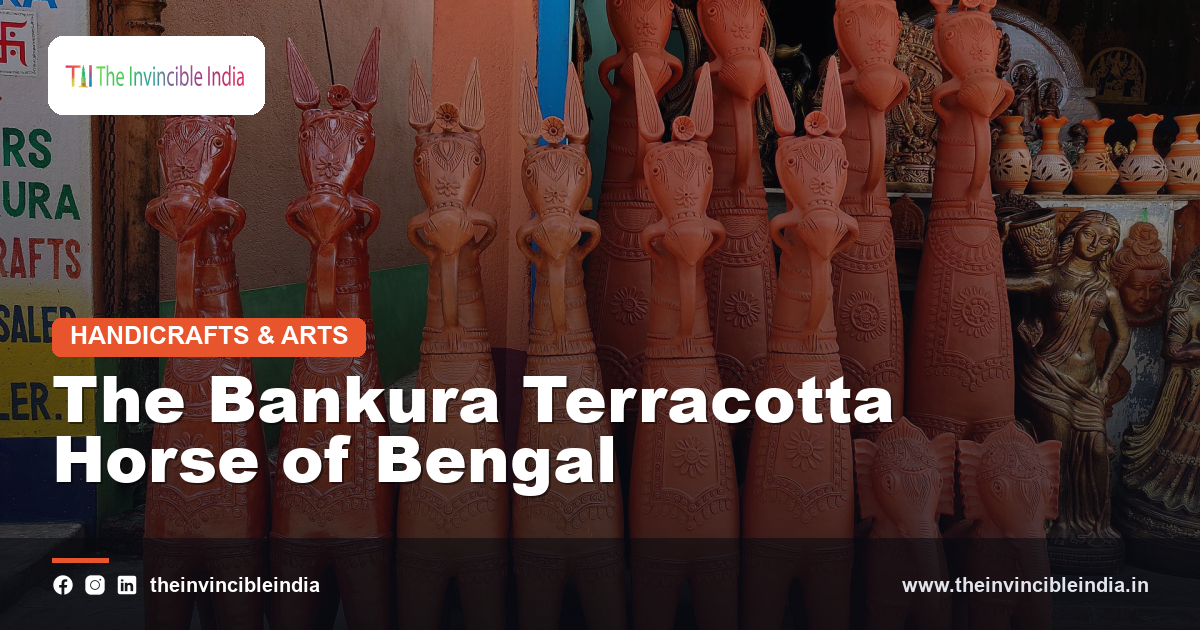
The Bankura terracotta horse is the iconic elongated clay horse of Panchmura village in Bankura district, in the state of West Bengal, widely regarded as one of the most recognisable symbols of Indian handicrafts. Shaped by hand from local clay and fired to a warm reddish-brown, the horse is known for its stylised, elongated form, long neck, upright pointed ears and dignified bearing. The craft belongs to the kumbhakar, or potter, community of the region, who have made terracotta figures and pottery over generations. Originally created as votive and ritual offerings connected to folk worship, the Bankura horse has become a celebrated decorative object and a motif adopted as an emblem of Indian craft. Readers who enjoy the breadth of India’s clay and craft traditions may also explore the traditional handicrafts of Rajasthan. This guide describes the horse, its home, its origins, its clay, its technique, its motifs, its makers and its present-day place.
Quick answer: The Bankura terracotta horse is the iconic elongated clay horse of Panchmura village in Bankura district, West Bengal, India, made by the kumbhakar (potter) community. Shaped by hand and fired to a reddish-brown, it is known for its stylised, elongated body, long neck and upright ears. Originally made as votive and ritual offerings, it is now celebrated as a symbol of Indian handicrafts, and the Panchmura terracotta craft has been recognised with a Geographical Indication.
Key Takeaways
- The Bankura terracotta horse is the elongated terracotta horse of Panchmura village, Bankura district, West Bengal.
- It is made by the kumbhakar, or potter, community from local clay and fired to a warm reddish-brown.
- It is known for its stylised, elongated body, long neck, upright pointed ears and dignified stance.
- It was originally created as votive and ritual offerings connected to folk worship.
- Today it is celebrated as a decorative object and a widely recognised symbol of Indian handicrafts.
- The Panchmura terracotta craft has been recognised with a Geographical Indication.
The sections below explain what the Bankura horse is, where Panchmura lies, where the form comes from, how it is made, what it means, who makes it and why it still matters.
Quick Facts
| Detail | Information |
|---|---|
| Craft type | Terracotta (fired clay) figure and pottery |
| Region of origin | Panchmura village, Bankura district, West Bengal |
| Also known as | Bankura horse, Panchmura horse |
| Materials | Local clay, fired to a reddish-brown terracotta |
| Technique | Hand-building and wheel-work, assembled, dried and kiln-fired |
| Known for | Elongated stylised horse with long neck and upright ears |
| GI status | Panchmura terracotta craft has been recognised with a Geographical Indication; confirm details with the Registry |
| Community | Kumbhakar (potter) community of the region |
What Is the Bankura Terracotta Horse?
The Bankura terracotta horse is a stylised, elongated horse made of fired clay in the village of Panchmura in Bankura district, West Bengal, and counted among the most recognisable emblems of Indian handicraft. Unlike a naturalistic model, the Bankura horse is highly stylised, with a long, slender neck, a small head crowned by upright pointed ears, a lean body and straight legs, giving it an alert, dignified bearing. It is shaped by hand from local clay, assembled from parts, dried and fired to the warm reddish-brown colour of terracotta. The horse is made in many sizes, from small figures to large decorative pieces. Once a votive and ritual object, it is now prized as a work of folk art and a decorative symbol. The elongated clay horse of Panchmura defines the craft. Its stylised form and terracotta finish give it its distinctive character.
Where Is the Bankura Horse Made?
The Bankura horse is made in Panchmura, a village in Bankura district in the western part of West Bengal, long known as a centre of terracotta craft. Panchmura is particularly associated with the horse and with terracotta pottery, and the potters of this village are celebrated for the craft. Bankura district as a whole lies in a region rich in clay and in a deep tradition of working it, which supported the growth of the craft. The craft became identified with Panchmura because its potter community developed and sustained the distinctive form over generations. The availability of suitable clay and the skill of the local potters made the village a renowned terracotta centre. The village and the horse are closely bound together, so that the craft is known by the name of Bankura and Panchmura. Panchmura is therefore both a place and a byword for the terracotta horse.
Where Does the Bankura Horse Come From?
The Bankura horse comes from the folk and ritual life of the Bankura region, where terracotta horses were traditionally made as votive offerings, though its precise early origins are matters of tradition rather than documented record. In the folk worship of the region, terracotta horses and other clay figures were offered at shrines and sacred groves, dedicated to local deities as acts of devotion, thanksgiving or vow. The horse thus began not as decoration but as a ritual object, part of the religious life of rural Bengal. Over time, the distinctive elongated form of the Panchmura horse developed and became admired beyond its ritual use. Because much of this early history rests on tradition, it should be understood as living folk heritage rather than precisely dated fact. What is clear is that the horse grew from devotion and folk practice. Its roots lie in ritual offering.
What Clay Is Used for the Bankura Horse?
The Bankura horse is made from local clay, chosen and prepared so that it can be shaped, hold its form and fire to the characteristic reddish-brown terracotta. Potters of the region use the clay found in and around their village, which they clean, knead and prepare to the right consistency for building the figures. Well-prepared clay is essential, as it must be plastic enough to shape yet firm enough to hold the long neck and legs of the horse without collapsing. The natural iron content of the clay gives terracotta its warm reddish-brown colour once fired. Because the craft depends on local materials, the clay ties the horse directly to its home in Bankura. The preparation of the clay is the first skilled step in the craft. The quality of the clay shapes the quality of the finished horse. Good clay is the foundation of the work.
What Is the History of the Panchmura Terracotta Craft?
The Panchmura terracotta craft has a long history rooted in the pottery and ritual traditions of the Bankura region, though its precise early development is not documented in exact detail. Terracotta, or fired clay, has an ancient place in Bengal, used for figures, pottery, roof tiles and the famous terracotta temples of the region. In this setting, the potters of Panchmura developed their own tradition of making terracotta horses, elephants and other figures, both for ritual offering and for daily use. Over time, the distinctive elongated horse emerged as the signature of the village and came to be admired as folk art far beyond Bengal. Like many folk crafts, it has passed from ritual use towards wider recognition and decorative appeal. Because much of the early story rests on tradition, it is best described in general terms as part of Bengal’s terracotta heritage. What is clear is that Panchmura became a renowned terracotta centre.
How Is the Bankura Horse Made?
The Bankura horse is made by shaping parts of the figure from clay, assembling them, drying the horse and firing it in a kiln to produce the finished terracotta. Potters build the horse from separately formed components, using both hand-building and the potter’s wheel to make the body, the long neck, the head and the legs, which are then joined together. The characteristic long neck and upright ears are carefully shaped and attached, and surface detail is added. The assembled horse is dried slowly, which is important given its slender form, and then fired in a kiln, where the heat hardens the clay and brings out the reddish-brown terracotta colour. Large horses demand particular skill to build and fire without cracking. The whole process is done by hand and relies on the potter’s command of clay, assembly and firing. Each horse is the product of patient craftsmanship. The making unites building and firing.
Why Is the Bankura Horse Shaped the Way It Is?
The Bankura horse is shaped in its distinctive elongated, stylised form through the folk artistic tradition of Panchmura rather than any attempt at realism. Its long, slender neck, small head, upright pointed ears, lean body and straight legs give it an alert, upright and dignified bearing that is instantly recognisable. This stylisation is a hallmark of folk art, which simplifies and heightens the form to express character and meaning rather than to copy nature. The proportions of the horse, developed and refined over generations, have become the accepted and admired form of the craft. The upright ears and raised neck lend the horse a sense of poise and nobility. Because the form is traditional, it carries the identity of the Panchmura potters. The stylised shape is the signature of the Bankura horse. It is what makes the figure a work of folk art. The form is the craft.
What Did the Bankura Horse Mean in Folk Worship?
In folk worship, the Bankura horse was a votive offering, made and dedicated at shrines and sacred groves as an act of devotion, vow or thanksgiving. In the religious life of rural Bengal, clay figures of horses, elephants and other forms were offered to local deities, and the terracotta horse held a special place among them. Devotees would offer the horses in fulfilment of vows or in hope of blessings, so that shrines sometimes gathered many such figures. The horse thus carried spiritual and emotional meaning, linking the maker and the devotee to the divine. This ritual purpose explains why the horse was made and gave the craft its original demand. Though the horse is now widely decorative, this devotional root remains part of its meaning. The horse began as an offering. Its ritual role is at the heart of its story. Devotion gave the craft its first purpose.
What Sizes and Forms of the Bankura Horse Are Made?
The Bankura horse is made in a wide range of sizes, from small figures that sit on a shelf to large, imposing pieces that stand as striking decorative objects. Small horses serve as ornaments, gifts and souvenirs, while large horses, sometimes substantial in height, are prized as showpieces and for display in homes, offices and public spaces. The same stylised form, with its long neck and upright ears, is kept across the sizes, so that the horse is recognisable whether small or large. The potters of Panchmura also make terracotta elephants and other figures and objects in the same tradition. Making the larger horses calls for particular skill in building and firing. This range allows the craft to serve many uses and tastes. Whatever the size, the hallmark remains the elongated stylised horse. The variety is part of the craft’s appeal. The form unites them all.
How Did the Bankura Horse Become a Symbol of Indian Craft?
The Bankura horse became a symbol of Indian craft because its striking, dignified form captured attention far beyond its village and came to stand for the richness of Indian folk art. As interest in India’s handicrafts grew, the elongated terracotta horse of Panchmura, with its distinctive and memorable shape, was widely admired, displayed and reproduced. Its image has been adopted as an emblem associated with Indian handicrafts and craft promotion, so that the horse represents not only its own tradition but the wider world of folk craft. This recognition brought the Panchmura potters renown and a wider market for their work. The horse thus moved from ritual object to celebrated icon. Its elevation to a symbol is a mark of its artistic power. The Bankura horse now stands for Indian craft itself. Its fame reaches far beyond Bengal. It is an ambassador for folk art.
Who Are the Panchmura Potters?
The Panchmura potters are the kumbhakar, or potter, community of the village and region who make the Bankura horse and the other terracotta of the tradition. The craft requires skill in preparing the clay, building and assembling the figures, shaping the distinctive form, and drying and firing the terracotta without cracking, and this knowledge is passed down within potter families over generations. For these families, the craft is both an inherited tradition and a livelihood, tied to their identity and their place in the village. The potters now supply decorative horses, elephants and other terracotta to a market that values handmade folk art, as well as making pieces in the older tradition. Like many craft communities, they depend on keeping skilled potters in the trade and on fair returns for their labour. The knowledge and handwork of the Panchmura potters are the craft’s living heart. Their skill sustains the tradition. The community carries the craft.
What Makes the Bankura Horse Distinctive?
The Bankura horse is distinctive for its elongated, stylised form, its warm terracotta finish, its roots in folk worship and its standing as a symbol of Indian craft. Its long, slender neck, small head, upright pointed ears and dignified bearing make it instantly recognisable and unlike any naturalistic model of a horse. The warm reddish-brown of the fired clay gives it the characteristic look of terracotta. Its origin as a votive offering connects it to the devotional folk life of Bengal, adding depth to its meaning. Its adoption as an emblem of Indian handicrafts sets it apart as more than a local craft. These qualities together make the Bankura horse recognisable and celebrated. Its blend of stylised form, terracotta craft and cultural meaning is central to its appeal. The horse is a proud emblem of Bengal and of Indian folk art.
Does the Bankura Horse Have a GI Tag?
The Panchmura terracotta craft, which includes the Bankura horse, has been recognised with a Geographical Indication, marking it as a distinctive product rooted in its region. Such recognition identifies the craft with Panchmura and Bankura and with the potter community that makes it, and helps protect the name and the tradition. Buyers and readers seeking the precise terms, scope and current status of the recognition should confirm the details with the official Geographical Indications Registry, since the particulars of such tags are best checked rather than assumed. Whatever the formal specifics, the terracotta horse is clearly and strongly identified with Panchmura and its potters. Recognition and heritage interest help protect the craft and sustain its makers. They also encourage the making and buying of genuine work. The bond between the horse and its village remains central to its identity. The craft is a cherished emblem of West Bengal.
How Does the Bankura Horse Compare with Other Terracotta Traditions?
The Bankura horse shares the ancient art of terracotta with many traditions across India, but it is distinguished by its uniquely elongated, stylised form. India has a rich and widespread heritage of terracotta, from votive figures and pottery to the carved terracotta temples of Bengal and the clay craft of many other regions. Within this heritage, the Panchmura horse stands out for its highly stylised shape, with the long neck and upright ears that have made it famous. Comparing these traditions shows the great variety of ways in which Indian craftspeople have worked fired clay, each region developing its own forms and uses. The Bankura horse contributes a distinctive, instantly recognisable voice from West Bengal. Each terracotta tradition has its own character. The Panchmura horse, with its elongated form, is distinctly its own. It holds a special place among India’s clay crafts.
How Can You Buy an Authentic Bankura Horse?
An authentic Bankura horse can be bought from the Panchmura potters, West Bengal handicraft emporiums, recognised cooperatives, craft fairs and trusted stores that name Panchmura or Bankura as the source. A genuine piece is made of handworked terracotta, showing the warm reddish-brown fired-clay finish and the slight natural variation that marks it as handwork, with the distinctive elongated form, long neck and upright ears of the tradition. Mass-produced or imitation pieces may be cast, moulded in other materials, or finished to look perfectly uniform, and may lack the true terracotta character and the correct stylised form. Buyers can examine the clay and finish, check the proportions of the horse, handle it carefully as terracotta is fragile, and ask about the maker and village. Buying directly from the Panchmura potters or recognised emporiums helps income reach the makers. Careful buying rewards genuine craftsmanship. It also ensures a true example of the craft.
The Bankura Terracotta Horse Today
The Bankura terracotta horse today stands as a celebrated emblem of Bengal’s terracotta craft and of Indian folk art as a whole. Having grown from votive offerings dedicated at shrines, the horse is now made by the Panchmura potters in many sizes, from small figures to large showpieces, prized as decorative objects and symbols of handicraft. Its adoption as an emblem associated with Indian handicrafts, together with the Geographical Indication recognition of the Panchmura terracotta craft, has brought the horse and its makers lasting renown. At the same time, the craft faces real challenges of competition from imitations, fair returns for potters and the need to pass skills to new makers. Readers can support the tradition by learning its story, visiting craft outlets and choosing genuine terracotta from Panchmura. The Bankura horse endures as a dignified expression of Bengal’s clay craft. Its elongated form keeps the tradition alive.
Sources & Further Reading
- Development Commissioner (Handicrafts), Ministry of Textiles, Government of India (handicrafts.nic.in).
- Geographical Indications Registry, Government of India (ipindia.gov.in).
- Department of Micro, Small & Medium Enterprises and Textiles, Government of West Bengal.
Frequently Asked Questions
What is the Bankura terracotta horse?
The Bankura terracotta horse is the iconic elongated clay horse of Panchmura village in Bankura district, West Bengal, made by the potter community from local clay and fired to a reddish-brown. It is known for its stylised long neck and upright ears. Once a votive offering, it is now a celebrated symbol of Indian handicrafts.
Where is the Bankura horse made?
The Bankura horse is made in Panchmura, a village in Bankura district in western West Bengal, long famous as a terracotta centre. The potters, or kumbhakar community, of the village are renowned for the craft. The village and district give the horse its name.
What was the Bankura horse originally used for?
The Bankura horse was originally made as a votive and ritual offering, dedicated at shrines and sacred groves in the folk worship of rural Bengal. Devotees offered the clay horses to local deities in devotion, vow or thanksgiving. Only later did the horse become a celebrated decorative object.
Why is the Bankura horse shaped the way it is?
The Bankura horse has its distinctive elongated, stylised form through the folk artistic tradition of Panchmura, not through any attempt at realism. Its long neck, small head and upright pointed ears give it an alert, dignified bearing. This stylised shape, refined over generations, is the signature of the craft.
Does the Bankura horse have a GI tag?
Yes, the Panchmura terracotta craft, which includes the Bankura horse, has been recognised with a Geographical Indication. This identifies the craft with Panchmura and its potters. The precise terms and current status are best confirmed with the official Geographical Indications Registry.
How can I identify an authentic Bankura horse?
An authentic Bankura horse is made of handworked terracotta with a warm reddish-brown fired-clay finish and the distinctive elongated form, long neck and upright ears of the tradition, showing the slight variation of handwork. Imitations may be cast, made in other materials, or look perfectly uniform. Buying from Panchmura potters or West Bengal emporiums helps ensure authenticity.


