

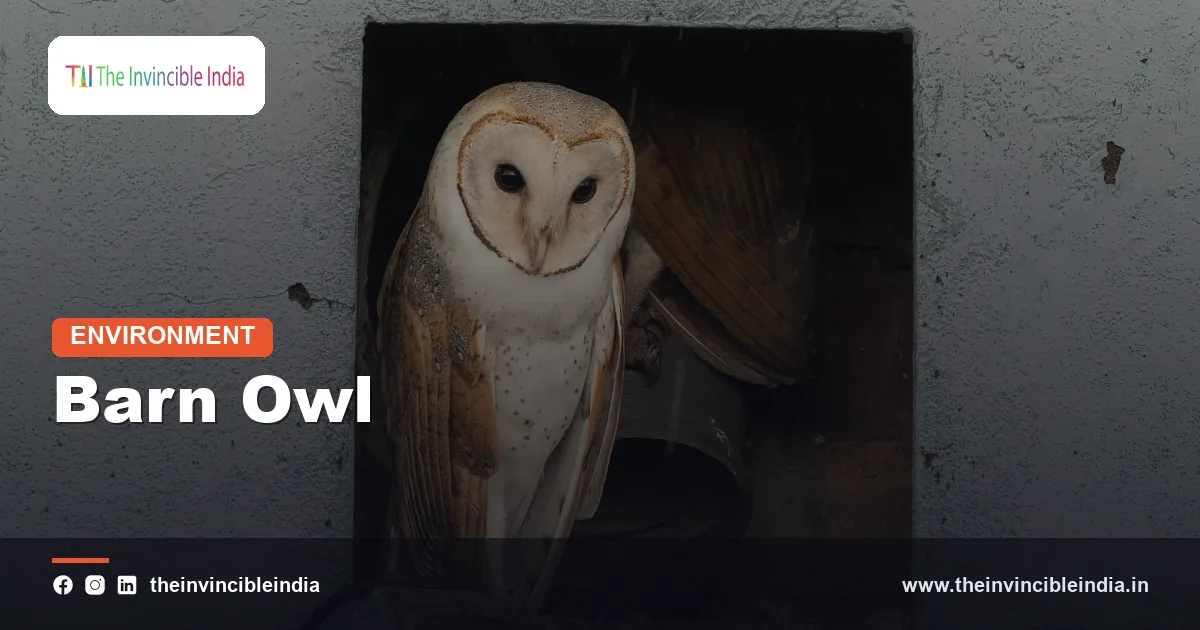
The barn owl (Tyto alba) is a medium-sized, pale nocturnal owl with a white heart-shaped face that hunts rats, mice and other small animals around farms, villages and old buildings, and it is one of the most widespread land birds in the world. In India it is a familiar but rarely seen neighbour, roosting by day in ruins, roof spaces and tree hollows and emerging after dusk with a silent, ghostly flight.
The barn owl is valued by farmers and conservationists as a natural rodent controller, because a single nesting pair can remove a large number of rats and field mice in a year. Despite this useful role, the bird is still surrounded by superstition in parts of the country, which makes public awareness especially important for its protection.
| Scientific name | Tyto alba |
|---|---|
| Family and order | Tytonidae (barn owls); order Strigiformes |
| Size | About 33 to 39 cm long, with a wingspan of roughly 80 to 95 cm |
| Habitat and range in India | Farmland, villages, towns, ruins, temples, old buildings and open woodland across most of the country |
| Diet | Mainly rodents such as rats, mice and bandicoots; also shrews, bats, small birds, lizards, frogs and large insects |
| Breeding | Nests in tree hollows, building cavities and ledges; several eggs; incubation of about a month; long nestling period |
| Ecological role | Top nocturnal predator of rodents and a natural pest controller |
| Status | Widespread and of low global concern, but affected by habitat loss, rodenticides, road accidents and illegal trade |
Key Takeaways
- The barn owl (Tyto alba) is a pale, heart-faced nocturnal owl found across India that feeds mostly on rats, mice and other small rodents.
- Barn owls hunt by sound as well as sight, and their heart-shaped facial disc funnels faint noises to ears that sit at slightly different heights on the skull.
- A barn owl does not hoot; it gives a long, harsh, hissing screech, which is why it is sometimes called the screech owl in popular speech.
- Barn owls nest in tree hollows, ruins, temples, roof spaces and farm buildings, and the female lays several eggs that hatch at intervals.
- Nest boxes and owl perches are used in several countries, and trials in India, to encourage barn owls to hunt rats in crops and plantations.
- Owls are protected under the Wildlife (Protection) Act, 1972, and rat poisons are a serious indirect threat because they pass up the food chain.
What is the barn owl?
The barn owl is a long-legged, long-winged owl of the family Tytonidae, which is separate from the family Strigidae of “typical” owls. Barn owls are recognised by their heart-shaped faces, dark eyes and lack of ear tufts.
The upperparts of the Indian barn owl are a soft mix of golden-buff and pale grey, finely speckled with black and white spots, while the underparts and face are white to pale cream, sometimes with small dark spots. The face is framed by a thin brown rim. The legs are long and feathered, the toes are bristly, and the middle claw has a comb-like edge used in grooming. In flight the bird looks very pale, almost white, in car headlights or torchlight.
The same species occurs on every continent except Antarctica, and many geographic forms or subspecies are recognised. Indian birds belong to a South Asian form often listed as stertens. Barn owls differ from many other Indian owls such as the spotted owlet, which is small, bold and active in daylight, and the brown fish owl, which is much larger and has ear tufts.
Where does the barn owl live in India?
The barn owl lives across most of India, from the plains and the peninsula to the lower hills, wherever there is open ground to hunt and a quiet place to roost. It is often found close to human settlements.
It roosts and nests in old and abandoned buildings, temple towers, fort walls, wells, bridges, barns, grain stores, roof spaces and large hollow trees. Hunting grounds include paddy fields, sugarcane, wheat and pulse fields, grassland, village outskirts and road verges. The bird avoids dense, closed forest and very high mountains.
The barn owl is mainly a resident bird. Individuals keep to a home range and usually return to the same roosts and nest sites year after year, which is why a known nesting building can be an owl home for decades if left undisturbed.
How does the barn owl hunt in the dark?
The barn owl hunts in the dark mainly by hearing, using its heart-shaped facial disc to collect faint rustles and squeaks and locate prey with great precision, then dropping silently onto it. It can find prey even in near-total darkness.
The facial disc and ears
The stiff feathers of the face act like a satellite dish, reflecting sound toward the ear openings hidden beneath the feathers. In barn owls the ears are asymmetrical, which means that they sit at slightly different heights, so a sound reaches each ear at a slightly different time and loudness. The brain uses these differences to work out the direction and the height of the source.
Silent flight
The wing feathers have soft, fringed edges and a velvety surface that break up the air flow and muffle the sound of flapping. As a result, the owl glides almost soundlessly, which helps it hear prey and prevents the prey from hearing it.
The strike
The barn owl typically quarters low over open ground, flying slowly and tilting its head, or it watches from a post. On detecting prey, it swings its legs forward, spreads its talons and grabs the animal, often killing it with a bite to the back of the head. It swallows small prey whole, head first.
What does the barn owl eat?
The barn owl eats mostly small rodents, including field rats, house mice, bandicoot rats and gerbils, and it takes other small animals when rodents are scarce. Rodents often make up the large majority of its prey.
- Rodents: field mice, house mice, rats, gerbils and voles.
- Insectivores: shrews and similar small mammals.
- Others: bats, small birds, lizards, frogs and big insects such as grasshoppers.
After a meal, the owl coughs up an oval pellet of undigested fur and bones. Pellets collect beneath roosts and are studied by biologists, because the skulls and jaw bones reveal exactly what the owl has eaten and give a picture of the local small-mammal community. Barn owl pellets are black and shiny when fresh, and they are a major tool in rodent research.
How does a barn owl help control rats?
A barn owl helps control rats by hunting them nightly in fields, grain stores and plantations, and a nesting pair with young can remove very large numbers of rodents in a year. This natural predation reduces crop damage and food spoilage without chemicals.
Rodents damage a significant share of stored and standing crops in India, and farmers often respond with poison baits. Barn owls offer a biological alternative, and the idea of encouraging them has been applied widely. In parts of Southeast Asia, for example, nest boxes were put up in oil palm plantations to reduce rat damage, and the approach has been tested in rice fields and plantations elsewhere. Agricultural scientists and conservation groups in India have also trialled nest boxes and perches in farmland and plantations.
Barn owls are not a magic bullet. They work best as part of integrated pest management, together with field hygiene, safe grain storage and habitat for owls. Where rats breed in huge numbers, owls alone cannot control an outbreak, but they limit population growth over time.
| Method | How it works | Main drawback |
|---|---|---|
| Barn owl nest boxes | Give owls safe nest sites near rodent-rich fields | Needs correct placement and protection from disturbance |
| Perches in fields | Let owls hunt from a vantage point | Effect is local and modest |
| Rodenticides | Poison baits kill rodents quickly | Poison passes to owls and other predators |
| Traps and field hygiene | Remove food, burrows and shelter | Needs steady labour and community effort |
How does the barn owl breed?
The barn owl breeds by laying several white eggs in a tree hollow, building crevice or ledge, with the female incubating them for roughly a month. The eggs hatch at intervals, so the chicks in a nest differ in size.
Barn owls build no real nest. They use the pile of old pellets and debris in a hollow or ledge. The female lays eggs a day or two apart, and she begins incubating after the first egg, which is why the oldest chick is much larger than the youngest. The male hunts and brings food while she incubates and broods. In years of plenty, a pair may raise a large brood, and in years of scarcity the smallest chicks may not survive.
The young stay in the nest for around two months, begging with hissing, snoring calls, and become independent a few weeks after fledging. The breeding season in India varies by region and follows the rodent supply, and some pairs may nest more than once in a good year.
What does a barn owl sound like?
A barn owl sounds like a long, rasping, hissing screech rather than a hoot, which is a difference from many other owls. The call is usually given in flight or near the roost.
The screech is eerie and unexpected, and it has contributed to the bird’s reputation as a spirit or omen. Barn owls also hiss, snore, click their bills and make a tongue-clicking sound when disturbed. Young owls give a continuous rasping, snoring call to beg for food, which can sound alarming to people who hear it from a roof space.
Why do people fear owls, and how does that affect the barn owl?
Many people in India associate owls with bad luck, death or black magic, while others regard the owl as the vehicle of Goddess Lakshmi, a symbol of wealth and wisdom. This mixed cultural image has harmed the bird in some places.
In the worst cases, owls are captured and killed for superstitious rituals, with demand reported to rise around certain festivals. Wildlife groups have documented the illegal trade in owls and the harm it does, and they run awareness campaigns to explain that owls are harmless and beneficial. Because the barn owl lives near buildings, it is exposed to persecution when people fear a roosting bird.
All owls in India are protected under the Wildlife (Protection) Act, 1972, which prohibits hunting, capture, keeping and trading. Educating people about the barn owl’s rat-eating value is one of the most effective ways to protect it.
What threatens the barn owl?
The barn owl is threatened mainly by loss of nesting and roosting sites, poisoning from rodenticides, road collisions and persecution, although the species as a whole is widespread and not globally threatened. Local declines can still occur.
- Rat poison: Owls eat poisoned rodents and can die from secondary poisoning, and sub-lethal doses can weaken them.
- Roost loss: Renovation, sealing of old buildings and felling of hollow trees remove nesting places.
- Roads and wires: Barn owls hunt low over road verges and are often killed by vehicles.
- Persecution and trade: Superstition drives capture and killing.
- Farming change: Loss of grassland and field margins reduces hunting areas.
Practical help is straightforward. People can leave old roof spaces or hollows accessible, avoid anticoagulant rat poisons, install nest boxes where appropriate, and report illegal capture to the forest department or to wildlife authorities.
How can you tell a barn owl from other Indian owls?
You can tell a barn owl from other Indian owls by its pale colour, heart-shaped white face, dark eyes, absence of ear tufts and hissing screech. Other owls are usually darker, rounder-faced or tufted.
The spotted owlet is small and stocky with a round face and bright yellow eyes. The brown fish owl is a big, tufted owl of waterside trees. The collared scops owl is small and has ear tufts and a rhythmic call. The barn owl’s pale plumage and long wings, together with its habit of hunting over open ground, set it apart. Seeing one in flight at dusk, with its white underside gleaming, is often the clearest identification.
Bottom Line
The barn owl is a farmer’s ally and a remarkable hunter that works silently at night to limit rat numbers. Protecting its roosts, avoiding rodent poison and challenging superstition will help this widespread but vulnerable-in-places bird to keep serving fields and villages across India.
Frequently Asked Questions
What does a barn owl eat in India?
A barn owl in India eats mainly rats, mice and other small rodents. It also takes shrews, bats, small birds, lizards, frogs and large insects when rodents are scarce.
Does the barn owl hoot?
No, the barn owl does not hoot. It gives a long, harsh, hissing screech, along with snores, hisses and bill-clicks.
Is the barn owl good for controlling rats?
Yes, the barn owl is an effective natural predator of rats and mice and helps limit rodent numbers around farms and buildings. It works best as part of a wider pest-management plan rather than as a stand-alone solution.
Where does the barn owl nest?
The barn owl nests in tree hollows, old buildings, temple towers, roof spaces, wells and other sheltered cavities. It builds no proper nest and uses the debris and pellets that gather at the site.
Is the barn owl protected in India?
Yes, all owls, including the barn owl, are protected in India under the Wildlife (Protection) Act, 1972. Hunting, capturing, keeping or trading them is illegal.
How can I tell if a barn owl is nesting nearby?
Signs of a nesting barn owl include hissing or snoring sounds from a roof space or hollow at night, white droppings and dark pellets below a perch, and a pale bird flying low at dusk. If you find a nest, avoid disturbing it and, if needed, contact the local forest department for advice.
{“@context”:”https://schema.org”,”@graph”:[{“@type”:”FAQPage”,”mainEntity”:[{“@type”:”Question”,”name”:”What does a barn owl eat in India?”,”acceptedAnswer”:{“@type”:”Answer”,”text”:”A barn owl in India eats mainly rats, mice and other small rodents. It also takes shrews, bats, small birds, lizards, frogs and large insects when rodents are scarce.”}},{“@type”:”Question”,”name”:”Does the barn owl hoot?”,”acceptedAnswer”:{“@type”:”Answer”,”text”:”No, the barn owl does not hoot. It gives a long, harsh, hissing screech, along with snores, hisses and bill-clicks.”}},{“@type”:”Question”,”name”:”Is the barn owl good for controlling rats?”,”acceptedAnswer”:{“@type”:”Answer”,”text”:”Yes, the barn owl is an effective natural predator of rats and mice and helps limit rodent numbers around farms and buildings. It works best as part of a wider pest-management plan rather than as a stand-alone solution.”}},{“@type”:”Question”,”name”:”Where does the barn owl nest?”,”acceptedAnswer”:{“@type”:”Answer”,”text”:”The barn owl nests in tree hollows, old buildings, temple towers, roof spaces, wells and other sheltered cavities. It builds no proper nest and uses the debris and pellets that gather at the site.”}},{“@type”:”Question”,”name”:”Is the barn owl protected in India?”,”acceptedAnswer”:{“@type”:”Answer”,”text”:”Yes, all owls, including the barn owl, are protected in India under the Wildlife (Protection) Act, 1972. Hunting, capturing, keeping or trading them is illegal.”}},{“@type”:”Question”,”name”:”How can I tell if a barn owl is nesting nearby?”,”acceptedAnswer”:{“@type”:”Answer”,”text”:”Signs of a nesting barn owl include hissing or snoring sounds from a roof space or hollow at night, white droppings and dark pellets below a perch, and a pale bird flying low at dusk. If you find a nest, avoid disturbing it and, if needed, contact the local forest department for advice.”}}]}]}


