

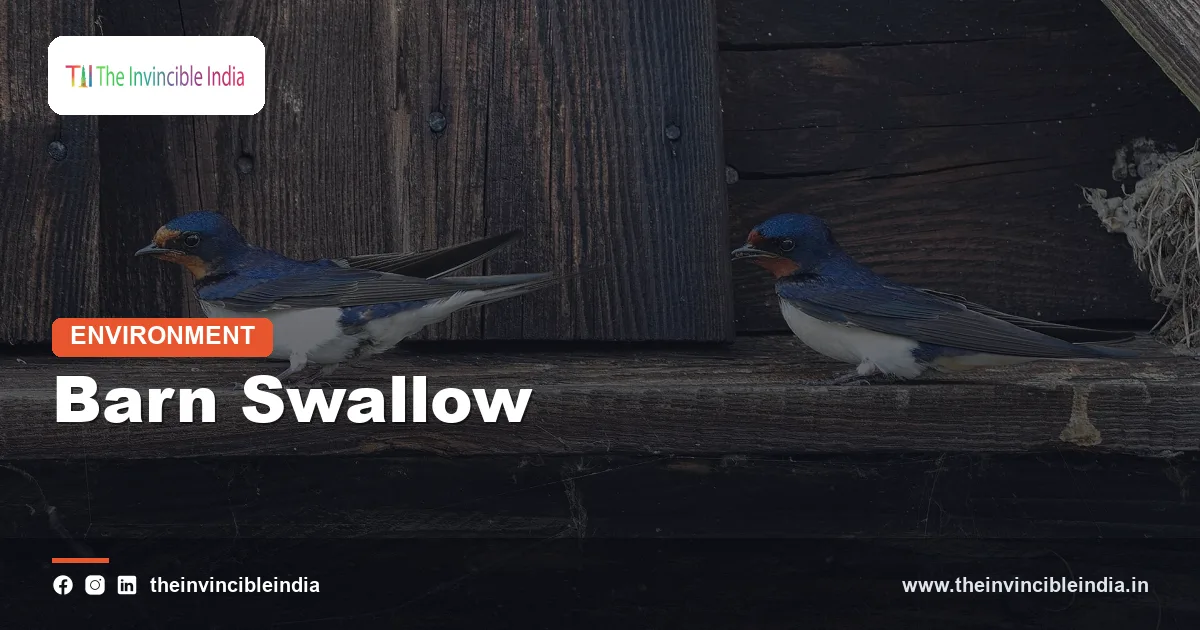
The barn swallow (Hirundo rustica) is a slender, long-tailed songbird of the family Hirundinidae that spends the cooler months in India after migrating from its breeding grounds across Europe and Asia. Every autumn and winter it can be seen wheeling low over fields, lakes and rooftops and resting in rows on telephone wires.
The barn swallow is the most widespread swallow in the world and one of the best-known migratory birds. This explainer describes how to recognise the barn swallow in India, when and where it arrives, what it eats on the wing, how it builds its mud nest, and why its long journeys matter.
| Fact | Detail |
|---|---|
| Common name | Barn swallow (also called the common swallow in parts of South Asia) |
| Scientific name | Hirundo rustica |
| Family | Hirundinidae (swallows and martins) |
| Size | About 17 to 19 cm including the long forked tail streamers |
| Status in India | Abundant winter visitor from roughly August or September to April or May; a few breed in the north-western Himalaya |
| Habitat | Open country, farmland, wetlands, lakeshores, villages, towns and coasts |
| Diet | Flying insects such as flies, mosquitoes, beetles and small bugs, caught in flight |
| Breeding | Mud-and-grass cup nest on a beam or ledge, mainly outside India in Europe, Asia and North America |
| Conservation status | Least Concern on the IUCN Red List |
Key Takeaways
- The barn swallow (Hirundo rustica) is a migratory swallow that visits India in large numbers from autumn to spring.
- The barn swallow is identified by its glossy steel-blue upperparts, chestnut forehead and throat, dark breast band and deeply forked tail with long outer streamers.
- The barn swallow catches all its food in flight, feeding on flies, mosquitoes, beetles and other small flying insects.
- The barn swallow breeds mostly in Europe, Asia and North America, so the birds seen in India in winter are not nesting there.
- Barn swallows gather in huge evening roosts in reed beds, trees and on wires, sometimes numbering thousands of birds.
- The barn swallow is classified as Least Concern, with one of the largest ranges of any songbird.
What is the barn swallow?
The barn swallow is a small, agile, insect-eating bird of the swallow and martin family, Hirundinidae. It is placed in the genus Hirundo as Hirundo rustica, and the Latin species name “rustica” means “of the countryside”.
The common name comes from the bird’s habit, across Europe and North America, of building mud nests inside barns, sheds and other open buildings. In India the same bird is mainly a visitor and not a nester, so people here know it by its flight and its perching behaviour rather than its barn nests.
Swallows are built for life in the air. The barn swallow has long, pointed wings, a streamlined body, a tiny bill that opens into a wide gape, and very short legs that are used mostly for perching and for gathering nest mud.
What does the barn swallow look like?
The barn swallow has glossy dark steel-blue upperparts, a chestnut forehead and throat, a blue-black band across the chest, and pale buff to whitish underparts. Its most distinctive feature is the deeply forked tail, whose outer feathers extend into long, thin streamers.
Adults are about 17 to 19 cm long, including the tail. Males usually have longer tail streamers than females, and studies of European birds suggest that females often prefer males with longer, more symmetrical tails.
The colour of the underparts varies between populations, and several subspecies reach India. The main points to notice are these.
- Birds of the nominate form from Europe and western Asia are pale cream or whitish below.
- Eastern birds, such as the form called gutturalis, are typically whiter below with a complete or nearly complete dark breast band.
- Tytler’s form, which breeds in Siberia and winters in the eastern part of the subcontinent, has deep rufous underparts.
- Juveniles are duller, with a paler forehead and throat and shorter tail streamers.
When and where can you see the barn swallow in India?
The barn swallow can be seen across most of India from about August or September until April or May. Numbers are highest from October to March, and the species is recorded from the Himalaya and the plains to the coasts and the southern tip of the peninsula.
It is especially common over open ground. Good places include paddy fields, river valleys, reservoirs, grassy plains and the edges of towns, where flying insects are plentiful. Birds also feed above water bodies, taking insects just above the surface.
A small number of barn swallows breed in the north-western Himalaya, notably in the valleys of Jammu and Kashmir and neighbouring hill areas. In most other regions, the birds present in winter have come from breeding grounds in northern Asia and Europe, and they leave again before the heat of summer.
How far does the barn swallow migrate?
The barn swallow migrates thousands of kilometres each year, travelling between northern breeding grounds and tropical wintering areas. The birds that reach India come mainly from central and northern Asia, crossing high mountain ranges and deserts on their way south.
Barn swallows migrate by day, feeding on insects as they go. They fly low and steadily, moving in loose streams that can include many birds at a time, and they stop to rest and feed at wetlands, fields and coasts along the route.
Ringing programmes in several countries have shown how precise this migration is. European barn swallows winter in Africa, eastern Asian birds winter in South-East Asia, and the populations that visit India winter in the subcontinent and sometimes beyond. Individual birds often return to the same breeding site the next spring, which is the reason swallows have long symbolised the return of warm weather in Europe.
What does the barn swallow eat?
The barn swallow eats flying insects that it captures in the air with its wide-opening bill. Common prey includes flies, mosquitoes, small beetles, flying ants, bugs and moths, and the birds pick whichever insects are most abundant at a given height.
The barn swallow feeds with a skilful, swooping flight. It often hunts low above grass, crops or water, and it follows grazing cattle and tractors to catch insects that are disturbed. Over lakes and rivers, it also dips down to drink, scooping water from the surface in flight.
Because it eats so many small flies and mosquitoes, the barn swallow is considered a helpful species. Large flocks over farmland can remove very large numbers of small insects every day, though their effect on pest control has not been precisely measured in India.
How does the barn swallow build its nest?
The barn swallow builds an open, cup-shaped nest from mud pellets mixed with grass, attached to a beam, rafter or ledge, usually under shelter. Both sexes carry mud in their bills and place it layer by layer, and the finished cup is lined with feathers and soft grass.
Most nesting takes place far from India, in the northern summer in Europe, Asia and North America. Female barn swallows lay about four to five white eggs with reddish-brown speckles, and both parents feed the young, which fledge after about three weeks.
The nesting habit is the reason for the barn swallow’s close relationship with people. Barns, bridges, culverts and porches provide dry, protected places for the cup, and the species has increased with human construction. In India, the closely related red-rumped swallow and wire-tailed swallow are the swallows more often seen nesting on buildings and bridges.
Why do barn swallows sit on wires and roost together?
Barn swallows sit on wires because open perches give them a place to rest, preen and watch for insects between feeding flights. Rows of birds on telephone lines, especially in the morning and evening, are one of the most familiar winter sights in Indian towns and villages.
At night, the birds gather in communal roosts. Reed beds, sugarcane fields, bamboo clumps and tall trees in town centres can host hundreds or thousands of swallows, and the birds arrive in dense swirling flocks at dusk.
Roosting together probably offers safety from predators such as owls and hawks, and it keeps individuals warm on cold nights. Birdwatchers often visit large roosts around wetlands and city edges to watch the flocks settle.
How is the barn swallow different from other Indian swallows?
The barn swallow differs from other Indian swallows chiefly in its dark chest band, chestnut throat and long tail streamers. Three swallows are common around bridges, wires and fields, and the table below compares them.
| Feature | Barn swallow | Red-rumped swallow | Wire-tailed swallow |
|---|---|---|---|
| Scientific name | Hirundo rustica | Cecropis daurica | Hirundo smithii |
| Most distinctive mark | Chestnut throat and dark breast band | Chestnut rump and collar | Chestnut cap and wire-thin tail feathers |
| Underparts | White to buff | Buff, finely streaked | Clean white |
| Status in India | Mainly winter visitor | Resident and visitor | Resident |
| Nest type | Open mud cup | Mud retort with tunnel | Open mud cup |
If a swallow shows a dark band across its chest and a chestnut throat in good light, it is almost certainly a barn swallow.
Is the barn swallow in danger?
The barn swallow is not globally endangered. The IUCN Red List rates it as Least Concern because its range and population are very large, and it occupies many kinds of open, human-altered habitat.
Some regional populations have declined, especially in parts of Europe and North America, where the loss of nesting sites, intensive farming and fewer insects have reduced numbers. Migration also carries risks such as storms, droughts and hunting or trapping along flyways.
In India, the bird benefits from rice fields, ponds and lakes that produce insects, though the use of pesticides and the draining of wetlands could reduce its food. Protecting reed beds and wetlands, which also provide roost sites, is one of the simplest ways to help the species and many other migrants.
How long does a barn swallow live?
A barn swallow usually lives only a few years in the wild, although some individuals live much longer. Many young birds die in their first year, because migration, storms and food shortages are demanding, and ringing records show that a barn swallow that survives to adulthood commonly lives for around three to four years.
The oldest ringed barn swallows on record have exceeded ten years of age. Each year, adults must complete two long journeys and also raise young, so survival depends heavily on good weather and plentiful insects at key stops along the route.
Why is the barn swallow important in culture and science?
The barn swallow is important in culture because it has long been a sign of seasons, travel and home, and it matters in science because it is a classic subject for the study of migration and mate choice. Its arrival in spring is celebrated in the folklore of many countries, and it is the national bird of Estonia.
Researchers have used the barn swallow to study how females choose mates, since tail length and symmetry seem to influence success in some populations. The bird has also been a model for tracking migration with rings and modern light-sensitive loggers.
In the Indian subcontinent, swallows in general appear in poetry and everyday speech, and the Hindi and Urdu name ababeel is often applied to swallow-like birds. The sight of swallows on wires is a common marker of the winter season in many cities.
How do you watch barn swallows in India?
You can watch barn swallows in India by visiting open fields, lakes, rivers and wetland edges during the cooler months, preferably in the early morning or just before dusk. The birds are bold and tolerant, so they can be observed from a short distance without difficulty.
A few simple tips make observation easier.
- Look at overhead wires and fence lines, where tired birds perch in neat rows.
- Scan the sky above lakes and rice fields at dusk, when swallows gather before roosting.
- Use binoculars to check the throat colour and chest band, which separate the barn swallow from other swallows.
- Visit reed beds and sugarcane fields near towns in the evening to see mass roosts form.
Bottom Line
The barn swallow (Hirundo rustica) is an elegant long-distance migrant that fills Indian skies in the cooler months, feeding on flying insects and gathering in great roosts. It is secure globally, and it remains a clear signal of healthy open country and wetlands.
Frequently Asked Questions
Is the barn swallow found in India?
Yes, the barn swallow is found across India as an abundant winter visitor, present from about August or September until April or May. A few birds breed in the north-western Himalaya, but most Indian sightings are of migrants from northern Asia and Europe.
How can I identify a barn swallow?
A barn swallow is identified by its glossy steel-blue back, chestnut forehead and throat, dark chest band and long forked tail with thin streamers. The pale underparts and the swooping, low flight over fields or water also help.
Does the barn swallow nest in India?
The barn swallow mostly does not nest in India, since most birds seen here are winter visitors that breed in Europe and Asia. Only a small number nest in the north-western Himalaya, building mud cups on beams and ledges.
What does the barn swallow eat?
The barn swallow eats flying insects such as flies, mosquitoes, small beetles and flying ants. It catches them in flight, often low over fields, grassland and water, and it also drinks by skimming the surface.
Why do barn swallows sit on electric wires?
Barn swallows sit on electric wires because wires give them a clear perch to rest, preen and watch for insects between feeding flights. The birds are not harmed by the wires because they do not touch two conductors at once.
How far do barn swallows migrate?
Barn swallows migrate thousands of kilometres each year between northern breeding areas and tropical wintering grounds. The birds that winter in India travel from central and northern Asia and return north in spring.
{“@context”:”https://schema.org”,”@graph”:[{“@type”:”FAQPage”,”mainEntity”:[{“@type”:”Question”,”name”:”Is the barn swallow found in India?”,”acceptedAnswer”:{“@type”:”Answer”,”text”:”Yes, the barn swallow is found across India as an abundant winter visitor, present from about August or September until April or May. A few birds breed in the north-western Himalaya, but most Indian sightings are of migrants from northern Asia and Europe.”}},{“@type”:”Question”,”name”:”How can I identify a barn swallow?”,”acceptedAnswer”:{“@type”:”Answer”,”text”:”A barn swallow is identified by its glossy steel-blue back, chestnut forehead and throat, dark chest band and long forked tail with thin streamers. The pale underparts and the swooping, low flight over fields or water also help.”}},{“@type”:”Question”,”name”:”Does the barn swallow nest in India?”,”acceptedAnswer”:{“@type”:”Answer”,”text”:”The barn swallow mostly does not nest in India, since most birds seen here are winter visitors that breed in Europe and Asia. Only a small number nest in the north-western Himalaya, building mud cups on beams and ledges.”}},{“@type”:”Question”,”name”:”What does the barn swallow eat?”,”acceptedAnswer”:{“@type”:”Answer”,”text”:”The barn swallow eats flying insects such as flies, mosquitoes, small beetles and flying ants. It catches them in flight, often low over fields, grassland and water, and it also drinks by skimming the surface.”}},{“@type”:”Question”,”name”:”Why do barn swallows sit on electric wires?”,”acceptedAnswer”:{“@type”:”Answer”,”text”:”Barn swallows sit on electric wires because wires give them a clear perch to rest, preen and watch for insects between feeding flights. The birds are not harmed by the wires because they do not touch two conductors at once.”}},{“@type”:”Question”,”name”:”How far do barn swallows migrate?”,”acceptedAnswer”:{“@type”:”Answer”,”text”:”Barn swallows migrate thousands of kilometres each year between northern breeding areas and tropical wintering grounds. The birds that winter in India travel from central and northern Asia and return north in spring.”}}]}]}


