

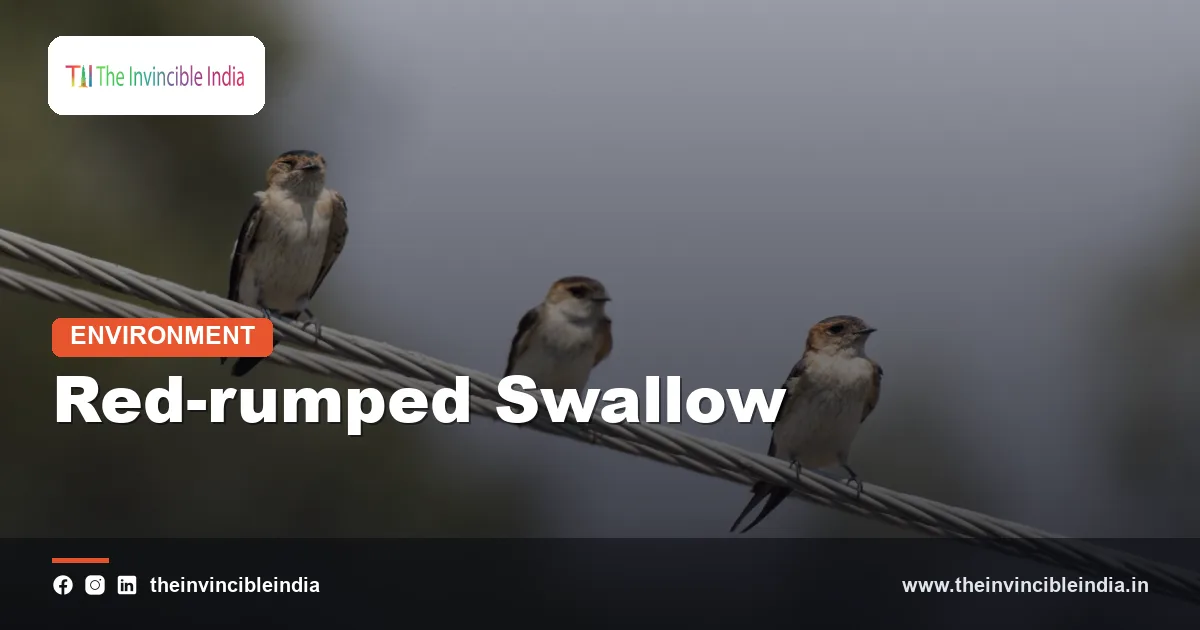
The red-rumped swallow (Cecropis daurica) is a graceful, long-tailed swallow of the family Hirundinidae, recognised by its chestnut rump and its flask-shaped mud nests built under bridges, culverts and eaves across India. It is a familiar sight in open country, hills and towns, gliding slowly over fields and water in search of flying insects.
The red-rumped swallow is both a resident and a seasonal visitor in the subcontinent, with different populations behaving differently from region to region. This explainer covers how to identify the red-rumped swallow, where it lives in India, what it eats, how it constructs its unusual nest, and how it compares with the barn swallow and wire-tailed swallow.
| Fact | Detail |
|---|---|
| Common name | Red-rumped swallow (also called the rufous-rumped swallow in older texts) |
| Scientific name | Cecropis daurica (formerly Hirundo daurica) |
| Family | Hirundinidae (swallows and martins) |
| Size | About 16 to 17 cm including the long forked tail |
| Status in India | Resident in many regions, with additional winter visitors and local movements |
| Habitat | Open country, hills, river valleys, villages, towns, bridges and cliffs |
| Diet | Flying insects, including flies, beetles, ants and small bugs, caught in flight |
| Breeding | Retort-shaped mud nest with an entrance tunnel, usually from about March to August |
| Conservation status | Least Concern on the IUCN Red List |
Key Takeaways
- The red-rumped swallow (Cecropis daurica) is an Indian swallow identified by its chestnut rump, rufous nape and deeply forked tail.
- The red-rumped swallow builds a distinctive retort-shaped mud nest with a narrow entrance tunnel, usually fixed under a bridge, culvert or overhang.
- The red-rumped swallow lacks the dark breast band of the barn swallow and has pale buff underparts finely streaked with brown.
- The red-rumped swallow feeds on flying insects such as flies, ants and beetles, taken in slow, gliding flight at low to moderate height.
- Red-rumped swallows frequently reuse and repair old mud nests, and they sometimes nest in small loose colonies.
- The red-rumped swallow is assessed as Least Concern, with a very wide range across Africa, Europe and Asia.
What is the red-rumped swallow?
The red-rumped swallow is a medium-sized aerial insect-eater of the swallow and martin family that is named for its chestnut-coloured rump. Its scientific name is Cecropis daurica, and it was formerly included in the genus Hirundo with the barn swallow.
The species is widespread across southern Europe, Africa, the Middle East and Asia, and several subspecies are recognised. Birds in India belong to a few of these forms, some of which stay in the country all year while others breed in the north and move south or lower down in the cold season.
Like all swallows, the red-rumped swallow spends most of its day on the wing. It has long pointed wings, a small bill with a very wide gape, and weak feet that are used mainly for perching and handling mud.
What does the red-rumped swallow look like?
The red-rumped swallow has glossy blue-black upperparts, a chestnut-orange rump and nape, and pale buff underparts that are finely streaked with dark brown. The tail is long, black and deeply forked, with outer feathers that taper to points.
A few details are useful for quick recognition.
- The chestnut rump shows clearly as a pale band across the lower back when the bird is flying away.
- The rufous patch behind the eye and across the nape forms a pale collar, which contrasts with the dark cap.
- There is no dark chest band, which separates it immediately from the barn swallow.
- The underparts are buff and finely streaked rather than clean white, which separates it from the wire-tailed swallow.
Males and females look alike, and juveniles are duller with shorter tails and a paler, more buff rump. In flight, the red-rumped swallow seems heavier and slower than the barn swallow, with a gliding, floating style.
Where does the red-rumped swallow live in India?
The red-rumped swallow lives across most of India, from the foothills of the Himalaya through the plains and Deccan plateau to the southern peninsula. It prefers open or semi-open country with cliffs, rocky hills, river valleys and man-made structures that offer nest sites.
In the Himalaya, some birds breed at moderate and higher elevations during summer and move to lower ground in winter. In the peninsula and plains, many populations are resident, and their numbers are boosted in the cooler months by visitors from the north.
The bird often hunts around towns and villages. Bridges over rivers and canals, railway culverts, temple porches and old forts are all typical places. It also frequents forest clearings and hill stations, where it feeds over open slopes and valleys.
What does the red-rumped swallow eat?
The red-rumped swallow eats flying insects, including flies, small beetles, flying ants, termites and bugs, which it captures in its wide bill during flight. It hunts mostly by flying slowly over open ground, water and slopes and snapping up prey as it comes within reach.
Compared with the barn swallow, the red-rumped swallow tends to feed higher and with more gliding, and it often forages in loose groups. Foraging flocks may form where insects rise in the air, such as above a freshly ploughed field or along the edge of a rain shower.
Insects can become scarce in cold or wet spells, and swallows then struggle to feed. Some red-rumped swallows move to lower elevations or warmer regions in such weather, and cold snaps in the hills can cause local losses of birds.
How does the red-rumped swallow build its nest?
The red-rumped swallow builds a retort-shaped nest of mud pellets, which looks like a small flask with a curved entrance tunnel. The nest is attached to the underside of a bridge, culvert, rock overhang or building eave, and the tunnel opens downward or sideways.
Both sexes take part in the work. They collect wet mud in their bills from puddles, riverbanks and fields, and they add it pellet by pellet to form the chamber and the tunnel. The inside is lined with fine grass, feathers and hair, and the whole structure can take one to two weeks to build, depending on mud supply and weather.
The unusual shape gives some protection from predators and weather. The narrow tunnel makes it harder for snakes, crows and squirrels to reach the eggs, and the thick walls help to control temperature. Old nests are commonly repaired and reused in later seasons, and they may also be taken over by house sparrows and other opportunistic birds.
Why do swallows build with mud?
Swallows build with mud because it is a strong, free and easily shaped material that hardens into a durable shell when dry. The red-rumped swallow mixes each pellet with saliva, which helps the mud stick together and cling to a vertical or overhead surface.
Mud nests need a sheltered site where rain will not wash them away. Bridges, culverts, eaves and rock overhangs match this need, and old nests that remain intact can last for several seasons. The need for damp mud also explains why the red-rumped swallow is often seen at the edges of puddles, canals and rivers in the weeks before breeding.
How does the red-rumped swallow breed?
The red-rumped swallow breeds mainly from about March to August in India, with timing varying by region and altitude. The female usually lays three to five white eggs inside the nest chamber, sometimes faintly marked with reddish spots.
Both parents incubate the eggs and feed the young. The chicks hatch after roughly two weeks and remain in the nest for about three weeks, fed on a constant supply of small insects. After they leave, family groups often gather on wires and ledges near the nest for a time.
Some pairs raise a second brood in a season. Nesting is sometimes loosely colonial, and several nests may be built close together on the same bridge or building when mud and insects are plentiful.
How is the red-rumped swallow different from other Indian swallows?
The red-rumped swallow is different from other Indian swallows chiefly in its chestnut rump, rufous nape and streaked buff underparts. The table below compares the three swallows most often seen around bridges and fields.
| Feature | Red-rumped swallow | Barn swallow | Wire-tailed swallow |
|---|---|---|---|
| Scientific name | Cecropis daurica | Hirundo rustica | Hirundo smithii |
| Rump | Chestnut | Blue-black | Blue-black |
| Underparts | Buff, finely streaked | White to buff with chestnut throat | Clean white |
| Tail | Long, deeply forked | Long streamers | Hair-thin wire-like streamers |
| Nest | Retort with tunnel | Open cup | Open cup |
The rump colour and the tunnel-shaped nest are the most reliable differences.
What does the red-rumped swallow sound like?
The red-rumped swallow has a soft, nasal call and a quiet twittering song. The commonest call is a short, low “kvit” or “djrrt” given in flight, while the song is a weak, rambling mixture of chirps and trills that is rarely loud.
The bird is much less vocal than many swallows. Its calls are most often heard near the nest, where the pair keep in contact, or when a flock is feeding together over an open field.
Is the red-rumped swallow in danger?
The red-rumped swallow is not in danger. The IUCN Red List classifies it as Least Concern because it has a very large range across several continents and a large, stable or increasing population.
Local threats include the destruction of mud nests during bridge cleaning or building repairs, and the loss of mud sources when puddles and soft banks are paved over. Pesticides that reduce insect numbers can also reduce food supplies.
Leaving nests in place during maintenance, avoiding the removal of nests during the breeding season, and keeping some bare, damp ground nearby can all help. Because the red-rumped swallow nests on structures built by people, it often benefits from simple tolerance.
Where else in the world does the red-rumped swallow live?
The red-rumped swallow lives across a vast region that includes southern Europe, Africa, the Middle East and large parts of Asia. Some populations breed in southern Europe and winter in Africa, while others, including those of southern Asia, are resident or move only locally.
In recent decades, the species has spread in parts of southern Europe, a change that has been linked with warmer conditions and the availability of man-made structures for nesting. Its wide range is one reason why it is regarded as secure on a global scale.
How does weather affect the red-rumped swallow?
Weather strongly affects the red-rumped swallow because its food supply depends on flying insects. During cold, windy or rainy spells, insects stay close to the ground or out of sight, and the swallows can find little to eat.
The bird responds by moving to lower ground, feeding closer to water and sheltered slopes, or gathering in groups at places where insects are active. Severe weather in the hills can cause deaths, but populations usually recover when conditions improve. Hot, dry spells can also harden mud and make nest building difficult, so many pairs time their nesting to the season when mud is easy to find.
How can you watch red-rumped swallows in India?
You can watch red-rumped swallows by visiting bridges, culverts, temple porches and rocky hillsides where nests are fixed, especially in the breeding months. Standing at a safe distance with binoculars gives a clear view of the birds as they bring mud and insects to the nest.
- Look at the underside of bridges and culverts for the flask-shaped mud nests.
- Watch flocks that glide over hill slopes and fields in the morning and late afternoon.
- Check the rump colour when birds fly away, since the chestnut band is the clearest mark.
- Avoid touching or disturbing nests, because the birds may abandon them if frightened.
Bottom Line
The red-rumped swallow (Cecropis daurica) is a widely seen Indian swallow with a chestnut rump and a flask-shaped mud nest. It is secure, adaptable and closely tied to bridges, hills and open country, and it is easy to tell from other swallows once its rump colour and nest are known.
Frequently Asked Questions
What is the red-rumped swallow?
The red-rumped swallow is a long-tailed swallow, scientifically Cecropis daurica, recognised by its chestnut rump and nape and its flask-shaped mud nest. It is found across much of India and feeds on flying insects caught in flight.
How do you tell a red-rumped swallow from a barn swallow?
A red-rumped swallow has a chestnut rump, a rufous nape and streaked buff underparts, while a barn swallow has a blue-black rump, a chestnut throat and a dark chest band. The red-rumped swallow also flies more slowly and builds an enclosed nest.
Why does the red-rumped swallow build a tunnel-shaped nest?
The red-rumped swallow builds a tunnel-shaped nest because the narrow entrance protects the eggs and chicks from predators and weather. The retort shape makes it hard for snakes, crows and squirrels to reach inside.
Is the red-rumped swallow a resident or a migrant in India?
The red-rumped swallow is both. Some populations stay in India all year, while others breed in the hills and move south or to lower ground in the cold season, and winter visitors from outside the country also arrive.
What does the red-rumped swallow eat?
The red-rumped swallow eats flying insects, including flies, small beetles, flying ants and termites. It catches them in the air with its wide bill while gliding over fields, water and open slopes.
Where does the red-rumped swallow nest?
The red-rumped swallow nests under bridges, culverts, building eaves and rock overhangs. It attaches a mud nest to the underside of the structure, often reusing the nest in later years.
{“@context”:”https://schema.org”,”@graph”:[{“@type”:”FAQPage”,”mainEntity”:[{“@type”:”Question”,”name”:”What is the red-rumped swallow?”,”acceptedAnswer”:{“@type”:”Answer”,”text”:”The red-rumped swallow is a long-tailed swallow, scientifically Cecropis daurica, recognised by its chestnut rump and nape and its flask-shaped mud nest. It is found across much of India and feeds on flying insects caught in flight.”}},{“@type”:”Question”,”name”:”How do you tell a red-rumped swallow from a barn swallow?”,”acceptedAnswer”:{“@type”:”Answer”,”text”:”A red-rumped swallow has a chestnut rump, a rufous nape and streaked buff underparts, while a barn swallow has a blue-black rump, a chestnut throat and a dark chest band. The red-rumped swallow also flies more slowly and builds an enclosed nest.”}},{“@type”:”Question”,”name”:”Why does the red-rumped swallow build a tunnel-shaped nest?”,”acceptedAnswer”:{“@type”:”Answer”,”text”:”The red-rumped swallow builds a tunnel-shaped nest because the narrow entrance protects the eggs and chicks from predators and weather. The retort shape makes it hard for snakes, crows and squirrels to reach inside.”}},{“@type”:”Question”,”name”:”Is the red-rumped swallow a resident or a migrant in India?”,”acceptedAnswer”:{“@type”:”Answer”,”text”:”The red-rumped swallow is both. Some populations stay in India all year, while others breed in the hills and move south or to lower ground in the cold season, and winter visitors from outside the country also arrive.”}},{“@type”:”Question”,”name”:”What does the red-rumped swallow eat?”,”acceptedAnswer”:{“@type”:”Answer”,”text”:”The red-rumped swallow eats flying insects, including flies, small beetles, flying ants and termites. It catches them in the air with its wide bill while gliding over fields, water and open slopes.”}},{“@type”:”Question”,”name”:”Where does the red-rumped swallow nest?”,”acceptedAnswer”:{“@type”:”Answer”,”text”:”The red-rumped swallow nests under bridges, culverts, building eaves and rock overhangs. It attaches a mud nest to the underside of the structure, often reusing the nest in later years.”}}]}]}


