

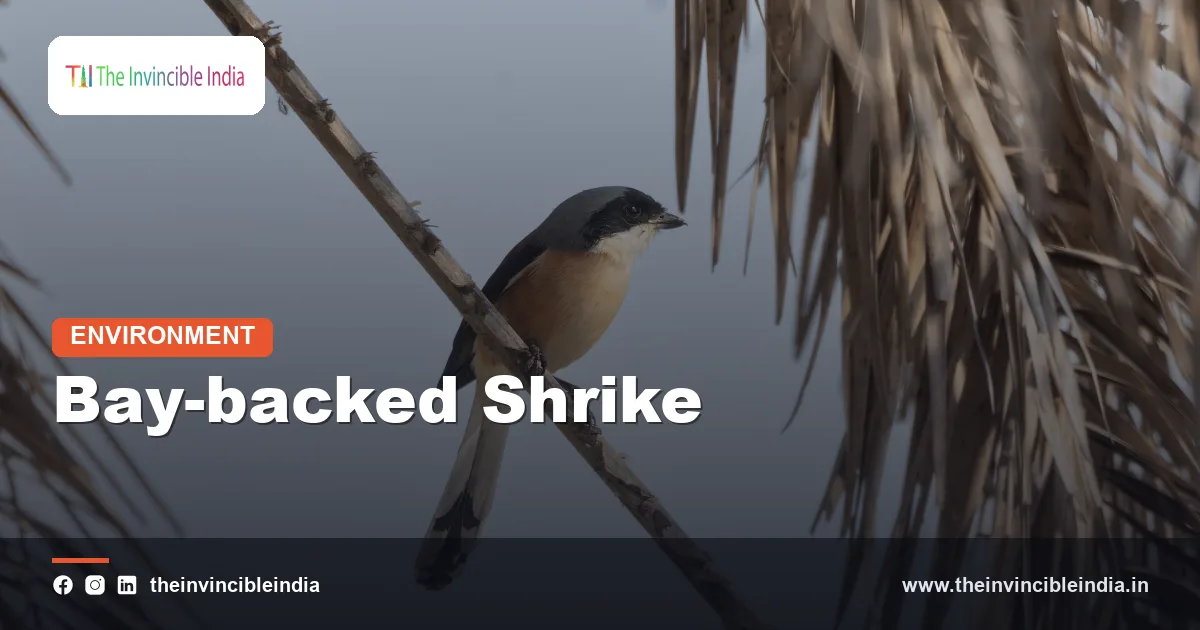
The bay-backed shrike (Lanius vittatus) is a small, black-masked songbird of the family Laniidae, easily recognised by its chestnut-maroon back, grey crown and white wing patch, and found in the dry plains, scrub and gardens of India. It is the smallest of the common resident shrikes of the Indian plains, and like its larger relatives it hunts insects and small animals from an open perch and stores surplus food on thorns.
Because it prefers scrub, wasteland and farm edges, the bay-backed shrike is often seen on roadside wires and low bushes in many parts of the country. This explainer describes how to identify the species, where it lives, what it eats, how it breeds, how it differs from other shrikes and what protection it has.
Quick Facts
| Attribute | Details |
|---|---|
| Common name | Bay-backed shrike |
| Scientific name | Lanius vittatus |
| Family and order | Laniidae (shrikes); order Passeriformes |
| Size | About 17 cm in length; a small shrike with a relatively short tail |
| Range and habitat in India | Dry plains, scrub, thorn forest edges, farmland, orchards and gardens across much of the Indian subcontinent; scarce in wet evergreen forests |
| Diet | Insects such as grasshoppers, beetles, crickets and moths; also small lizards and occasionally small vertebrates |
| Breeding season | Roughly April to August over most of India, with a cup nest placed low in a thorny tree or shrub |
| Conservation status | IUCN Least Concern; protected as a native wild bird under the Wild Life (Protection) Act, 1972 |
Key Takeaways
- The bay-backed shrike (Lanius vittatus) is a small Indian shrike with a black forehead and eye-mask, grey crown, chestnut-maroon back and a white patch on the wing.
- Bay-backed shrikes are open-country predators that perch on bush tops and wires, then drop onto insects, small lizards and other prey on the ground.
- A bay-backed shrike impales surplus prey on thorns, creating food stores often called “larders”, which also help the bird hold prey steady while eating.
- The bay-backed shrike is mainly resident in India, although some birds make local or seasonal movements in response to rainfall and food supply.
- Adult male and female bay-backed shrikes look broadly similar, but females are slightly duller, and juveniles show a finely barred pattern.
- The IUCN lists the bay-backed shrike as Least Concern, because it is widespread across South Asia and does well in scrub and farmland.
What is the bay-backed shrike?
The bay-backed shrike is a small predatory songbird in the shrike family, found mainly in the dry open country of the Indian subcontinent. Its scientific name, Lanius vittatus, places it in the genus Lanius, the “true shrikes”, and the common name refers to its “bay”, or reddish-brown, mantle and back.
Shrikes are unusual because they are songbirds that behave like tiny raptors. The bay-backed shrike has a stout, hooked bill with a small notch, an alert upright posture and a keen eye for movement, but it lacks the powerful talons of a hawk. As a result, it relies on thorns, spikes and forks of twigs to anchor its prey.
In India, the bay-backed shrike is widely distributed and can be seen from Gujarat and Rajasthan to the Deccan and the Gangetic plains. It is a familiar bird to farmers and to birdwatchers, and it is often noticed because it sits in the open, calling and flicking its tail.
How can you identify a bay-backed shrike?
A bay-backed shrike can be identified by its black forehead and mask through the eye, pale grey crown, rich chestnut-maroon back, white underparts with a buff wash on the flanks, and a conspicuous white patch on the black wing. The tail is black with white outer feathers, and the overall impression is of a compact, neatly patterned bird, smaller than the long-tailed shrike.
Key field marks
- A bold black mask that wraps across the forehead and through the eye.
- A grey crown and nape contrasting with a deep reddish-brown (bay) back.
- A white wing patch, clearly visible when the bird flies.
- White underparts, with warm buff on the flanks.
- A short to medium black tail with white edges.
Males, females and juveniles
Adult females resemble males but are generally a little duller, with a brownish tinge to the mask. Juveniles are paler and finely barred on the upperparts and breast, lacking the neat black mask of adults. The barring fades after the first moult. There is also a rare dark, or melanistic, variation, but most birds seen in India show the typical pattern described above.
Where does the bay-backed shrike live in India?
The bay-backed shrike lives mainly in the dry, open plains of India, including scrub jungle, thorn woodland edges, farmland, orchards, gardens and roadsides. It prefers regions with scattered bushes and perches, and it is far less common in thick evergreen forest and in high, cold mountain zones.
Habitats used
- Dry thorn scrub with babul, acacia and ber bushes.
- Farmland with hedgerows, field bunds and scattered trees.
- Village edges, gardens and orchards.
- Roadside wires, fences and fallow land.
- Open, light woodland in the foothills.
Resident and moving birds
The bay-backed shrike is principally a resident in India, but its numbers in a given locality can change through the year. Some birds appear to make local or seasonal movements in response to the monsoon, food and temperature, and populations from cooler northern areas may shift towards the south or lower areas in winter. For this reason, a field that held a shrike in summer may be empty in winter, and vice versa.
What does the bay-backed shrike eat?
The bay-backed shrike eats mainly insects, especially grasshoppers, crickets, beetles, moths and caterpillars, and also takes small lizards and other small animals. Its small size means it mostly targets prey that it can overpower easily, with insects forming the bulk of its diet.
Typical prey
- Grasshoppers, locusts and crickets on the ground.
- Beetles, bugs and flying insects such as termites during swarms.
- Caterpillars and moths from shrubs and grass.
- Small lizards, particularly young geckos and skinks.
- Occasionally other small invertebrates and, rarely, small vertebrates.
Because many of the insects it eats are agricultural pests, the bay-backed shrike is generally regarded as a beneficial bird in farmland. During the monsoon, when insects are plentiful, the bird feeds heavily and impales extra kills. In the dry season, it spends more time hunting lizards and large beetles that remain active.
How does the bay-backed shrike hunt?
The bay-backed shrike hunts using a “perch and pounce” method, sitting on a prominent branch or wire, watching the ground, and then flying down to seize prey before returning to a perch. This sit-and-wait approach saves energy and lets the bird scan a wide area of open land for movement.
Hunting behaviour
- The bird chooses a high but open perch with a clear view of the ground.
- It flicks or twitches its tail, turns its head and scans.
- When prey is seen, it swoops down, grabs it in the bill and often returns to its perch.
- It can also make short aerial chases to catch flying insects such as termites or moths.
- Large insects are killed by a bite to the head or neck and may be impaled before they are eaten.
The bay-backed shrike returns repeatedly to favourite perches, so watching a single perch for some time often rewards an observer with views of the whole hunting cycle.
Why does the bay-backed shrike impale its prey?
The bay-backed shrike impales prey on thorns because its feet are too weak to hold and tear food, so the thorn acts as a fixed holder that allows the bird to pull the prey apart with its hooked bill. The same larder can also serve as a store of food for days when hunting is poor.
The habit is common to the shrike family, and larders can be seen on babul thorns, barbed-wire fences and even the spiny branches of cacti. Scientists have suggested several functions for impaling, and in the bay-backed shrike the first two below are the most easily observed.
- Holding prey: the thorn keeps the item steady while the bird tears it.
- Food storage: surplus insects and lizards are kept for later feeding.
- Territorial display: a well-stocked set of thorns may signal that a male holds a good territory.
- Managing prey defences: in some shrike species, distasteful insects are left to dry for some time before being eaten.
Anyone who finds a dried grasshopper or beetle skewered on a thorny shrub in India’s dry country can be fairly sure that a shrike, quite possibly this species, lives nearby.
What does the bay-backed shrike sound like?
The bay-backed shrike makes a harsh, chattering “chek-chek” call and a softer, melodious, rambling song that often includes mimicry of other birds. The scolding notes are used to warn rivals and predators and are most frequent during territorial disputes and nesting.
During the breeding season, the male perches in the open and sings a quiet, varied warble, interspersed with copied fragments from the songs of other species. The mixture of harsh notes and sweet song is characteristic of shrikes generally. In the field, the sound often reveals the bird’s presence before it is seen, particularly in dense scrub.
Pairs may call to each other near the nest, and both birds scold intruders such as crows, snakes or people who come too close to the nest. Calling is usually most active in the early morning and again in the evening.
How does the bay-backed shrike breed?
The bay-backed shrike breeds mainly from about April to August in most of India, building a cup nest low in a thorny tree or shrub and laying three to five eggs. The timing can vary with local rainfall and food supply, and some pairs nest earlier or later than this period.
Nest and eggs
- The nest is a compact cup of grass, rootlets, twigs and plant down.
- It is usually built in a thorny tree, such as babul or ber, a few metres above the ground.
- The nest is lined with finer fibres, hair or feathers.
- The eggs are creamy or greenish with brown and grey speckles, often forming a ring at the broader end.
Raising the young
Both parents feed the chicks with insects and other small animals. The female does most of the incubation, while the male guards the territory and brings food. Fledglings stay near the nest and are fed for some weeks as they learn to hunt and impale prey. Thorny nest sites help protect against predators, and the adults aggressively mob crows and other threats.
How is the bay-backed shrike different from other Indian shrikes?
The bay-backed shrike differs from other Indian shrikes mainly in its smaller size, chestnut-maroon back and the white wing patch, whereas the long-tailed shrike is larger with a longer tail and a grey back, and the brown shrike lacks a grey crown. India has a mix of resident and winter-visiting shrikes, and the table below summarises the main differences among three of the commonest.
| Species | Approx. length | Main identification features | Status in India |
|---|---|---|---|
| Bay-backed shrike (Lanius vittatus) | About 17 cm | Black mask, grey crown, chestnut-maroon back, white wing patch | Resident with local movements |
| Long-tailed shrike (Lanius schach) | About 25 cm | Long black tail, grey back, rufous rump | Resident, widespread |
| Brown shrike (Lanius cristatus) | About 19 cm | Rufous-brown above, buff below, dark mask | Winter visitor |
The bay-backed shrike’s wing patch is a very useful feature. When the bird takes off, a flash of white on the wing helps separate it quickly from other small shrikes.
Is the bay-backed shrike threatened?
The bay-backed shrike is not globally threatened and is classed as Least Concern by the IUCN, because it occupies a broad range across South Asia and remains common in suitable habitats. In India, it is protected as a native wild bird under the Wild Life (Protection) Act, 1972, which bans hunting and capture.
The species benefits from its ability to live in modified habitats such as farmland, plantations and gardens. However, local declines are possible when scrub is cleared and when farmland becomes more intensive.
Possible pressures
- Clearance of thorn scrub and hedgerows for roads, buildings and large-scale farming.
- Pesticide use, which reduces the insect food supply and may poison birds.
- Collisions with vehicles when hunting along road verges.
- Illegal capture of young birds in some places.
Retaining patches of native thorny scrub and avoiding unnecessary pesticide spraying helps keep shrikes in an area.
Bottom Line
The bay-backed shrike is a compact, handsomely patterned predator of India’s dry open country, recognised by its black mask, grey crown, chestnut back and white wing patch. It hunts from perches, impales extra prey on thorns and remains a widespread Least Concern species, thriving wherever scrub, farmland and insects are available.
Frequently Asked Questions
What is a bay-backed shrike?
A bay-backed shrike is a small, black-masked songbird of the family Laniidae, found across the dry plains and scrub of India. Its scientific name is Lanius vittatus, and it is known for its chestnut-maroon back and white wing patch. It hunts insects and small animals from open perches.
How can I tell a bay-backed shrike from a long-tailed shrike?
The bay-backed shrike is smaller, with a shorter tail, a chestnut-maroon back, a grey crown and a white wing patch. The long-tailed shrike is larger and has a long black tail, a grey back and a rufous rump. Size and tail length are the quickest clues in the field.
What does the bay-backed shrike eat?
The bay-backed shrike eats mainly insects such as grasshoppers, beetles, crickets and moths, along with small lizards and other small animals. It catches most prey on the ground after a short swoop from a perch. Extra kills are often impaled on thorns for later.
Why does the bay-backed shrike impale insects on thorns?
The bay-backed shrike impales insects on thorns because its feet are too weak to hold prey while tearing it apart. The thorn acts as an anchor, and the stored items also serve as a food reserve. Impaled prey may also help advertise a good territory to potential mates.
When does the bay-backed shrike breed in India?
The bay-backed shrike breeds mainly from about April to August in most of India, with some regional variation. It builds a cup-shaped nest low in a thorny tree or shrub and lays around three to five eggs. Both parents help feed the chicks.
Is the bay-backed shrike a protected species?
The bay-backed shrike is protected in India as a native wild bird under the Wild Life (Protection) Act, 1972, and the IUCN lists it as Least Concern. The species is widespread and common in suitable scrub and farmland. Local numbers can fall when thorn scrub is cleared or insect food is lost.
{“@context”:”https://schema.org”,”@graph”:[{“@type”:”FAQPage”,”mainEntity”:[{“@type”:”Question”,”name”:”What is a bay-backed shrike?”,”acceptedAnswer”:{“@type”:”Answer”,”text”:”A bay-backed shrike is a small, black-masked songbird of the family Laniidae, found across the dry plains and scrub of India. Its scientific name is Lanius vittatus, and it is known for its chestnut-maroon back and white wing patch. It hunts insects and small animals from open perches.”}},{“@type”:”Question”,”name”:”How can I tell a bay-backed shrike from a long-tailed shrike?”,”acceptedAnswer”:{“@type”:”Answer”,”text”:”The bay-backed shrike is smaller, with a shorter tail, a chestnut-maroon back, a grey crown and a white wing patch. The long-tailed shrike is larger and has a long black tail, a grey back and a rufous rump. Size and tail length are the quickest clues in the field.”}},{“@type”:”Question”,”name”:”What does the bay-backed shrike eat?”,”acceptedAnswer”:{“@type”:”Answer”,”text”:”The bay-backed shrike eats mainly insects such as grasshoppers, beetles, crickets and moths, along with small lizards and other small animals. It catches most prey on the ground after a short swoop from a perch. Extra kills are often impaled on thorns for later.”}},{“@type”:”Question”,”name”:”Why does the bay-backed shrike impale insects on thorns?”,”acceptedAnswer”:{“@type”:”Answer”,”text”:”The bay-backed shrike impales insects on thorns because its feet are too weak to hold prey while tearing it apart. The thorn acts as an anchor, and the stored items also serve as a food reserve. Impaled prey may also help advertise a good territory to potential mates.”}},{“@type”:”Question”,”name”:”When does the bay-backed shrike breed in India?”,”acceptedAnswer”:{“@type”:”Answer”,”text”:”The bay-backed shrike breeds mainly from about April to August in most of India, with some regional variation. It builds a cup-shaped nest low in a thorny tree or shrub and lays around three to five eggs. Both parents help feed the chicks.”}},{“@type”:”Question”,”name”:”Is the bay-backed shrike a protected species?”,”acceptedAnswer”:{“@type”:”Answer”,”text”:”The bay-backed shrike is protected in India as a native wild bird under the Wild Life (Protection) Act, 1972, and the IUCN lists it as Least Concern. The species is widespread and common in suitable scrub and farmland. Local numbers can fall when thorn scrub is cleared or insect food is lost.”}}]}]}


