

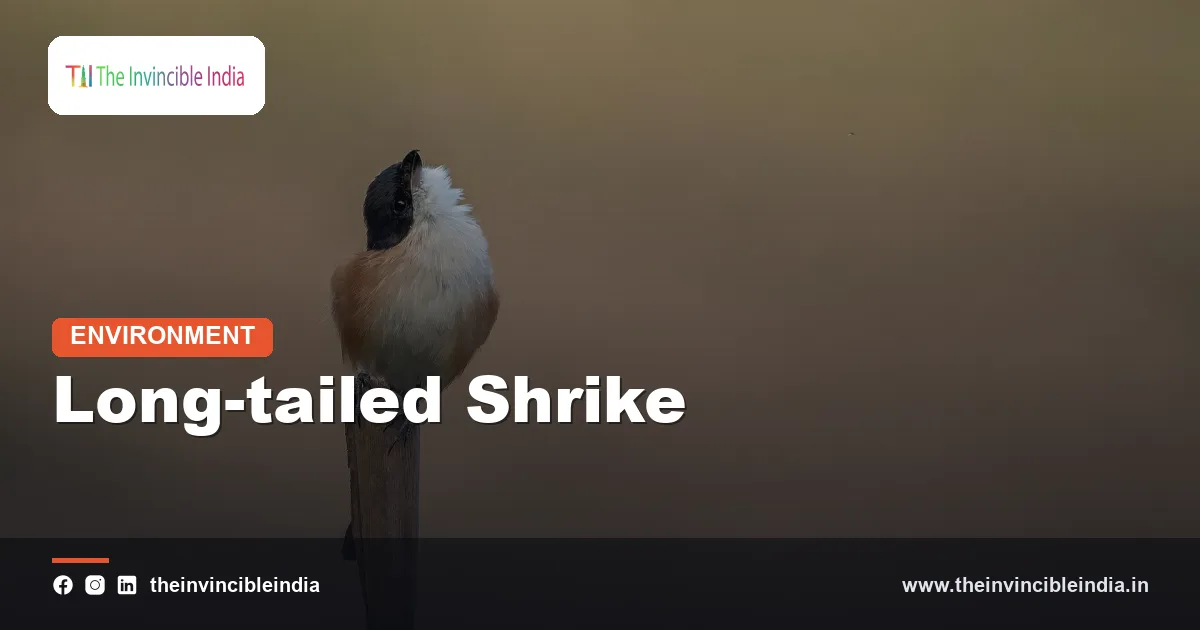
The long-tailed shrike (Lanius schach) is a medium-sized, black-masked songbird of the family Laniidae that is common across open country in India and is famous for impaling its prey on thorns and barbed wire. Often called the rufous-backed shrike or, informally, the “butcher bird”, it is one of the most conspicuous perching birds along Indian roadsides, farm fences and scrub, where it sits upright on an exposed branch and scans the ground for insects, lizards and small vertebrates.
Although it is only about the size of a bulbul with a long tail, the long-tailed shrike behaves like a miniature bird of prey, using a hooked bill and sharp eyesight to hunt. This explainer covers how to identify the species, where it lives in India, what it eats, why it impales its food, how it breeds, how it differs from other Indian shrikes and what its conservation status is.
Quick Facts
| Attribute | Details |
|---|---|
| Common name | Long-tailed shrike (also called rufous-backed shrike, black-headed shrike for one colour form) |
| Scientific name | Lanius schach |
| Family and order | Laniidae (shrikes); order Passeriformes |
| Size | About 25 cm in length, with a long, graduated black tail making up a large part of the body length |
| Range and habitat in India | Widespread across the plains, peninsula, foothills and lower Himalaya; open scrub, farmland, hedgerows, grassland edges and gardens |
| Diet | Insects (mainly grasshoppers, beetles and crickets), lizards, small rodents, frogs and occasionally small birds |
| Breeding season | Mainly April to August across most of India, with local variation; cup nest in a thorny bush or tree |
| Conservation status | IUCN Least Concern; protected as a native wild bird under the Wild Life (Protection) Act, 1972 |
Key Takeaways
- The long-tailed shrike (Lanius schach) is a resident, open-country songbird of India that is easily recognised by its black eye-mask, grey head, rufous rump and long black tail.
- Long-tailed shrikes impale insects, lizards and other small prey on thorns, spikes or barbed wire to hold the food steady while the bird tears it apart with its hooked bill.
- The long-tailed shrike is territorial, defending a perch-rich patch of scrub or farmland, and often sits on wires, fence posts or the tops of bushes to hunt.
- Colour and head pattern in the long-tailed shrike vary by region, from the grey-headed forms of the Indian plains to the black-headed form found along parts of the Himalaya and the north-east.
- The long-tailed shrike is classed as Least Concern by the IUCN because it is widespread and adapts well to farmland, plantations and village edges.
- Long-tailed shrikes are known for mimicry, sometimes imitating the calls of other birds, and for harsh scolding notes that announce their presence on a territory.
What is the long-tailed shrike?
The long-tailed shrike is a passerine (perching) bird in the shrike family, Laniidae, that hunts from a perch and kills prey with a hooked, falcon-like bill. The scientific name, Lanius schach, places it in the genus Lanius, the group of “true shrikes” found across Eurasia and Africa. In India, the species is a familiar sight and one of the commonest shrikes of the country’s plains and low hills.
Shrikes are songbirds, so they lack the strong grasping talons of hawks and owls. To compensate, they have evolved a strong, notched, hooked upper bill and a habit of using external anchors, such as thorns, to hold their food. This unusual combination of songbird anatomy and raptor-like behaviour is the main reason shrikes attract so much attention from birdwatchers and naturalists.
The long-tailed shrike is also known by names such as rufous-backed shrike and, in older literature, the Indian black-headed shrike for the dark-headed form. Hindi and regional-language names differ from place to place, and many farming communities simply refer to it by a local word for a butcher or hunting bird. The English name “long-tailed” refers to the notably long, rounded tail that the bird flicks and fans while perched.
How can you identify a long-tailed shrike?
A long-tailed shrike can be identified by its black mask through the eye, grey crown and back, bright rufous (reddish-orange) rump and flanks, whitish throat and a long, black, graduated tail. The black band from the bill through the eye gives the bird a masked appearance, while the lower back and rump show the warm rusty colour that explains the alternative name “rufous-backed shrike”.
Key field marks
- A broad black mask running from the forehead across the eye to the ear coverts.
- A grey crown and mantle in the common Indian plains forms, shading into a rufous lower back and rump.
- A white or pale throat and breast, with orange-buff wash on the flanks.
- A small white patch at the base of the primaries, visible mainly in flight or when the wing is raised.
- A long, black, stepped tail that is constantly flicked, swung or fanned.
- A stout, hooked, black bill with a small notch near the tip.
Variation in colour forms
The long-tailed shrike shows geographic variation, and ornithologists recognise several subspecies. Birds across much of peninsular and northern India have a grey head with a black mask and a rufous back, while in parts of the Himalaya and the north-east a form with a largely black head, sometimes called the black-headed shrike, is found. There is also a rarer, strongly dark (melanistic) plumage that occurs in a small proportion of birds in some regions. Because of this variation, a bird that looks unusual is still often the same species.
Juveniles and sexes
Male and female long-tailed shrikes look broadly alike, with females only slightly duller. Juvenile birds are paler and often show fine dark barring on the back and breast, along with a less well-defined mask. The barred pattern fades over the first few months as adult plumage develops.
Where does the long-tailed shrike live in India?
The long-tailed shrike lives across most of India, in open habitats ranging from plains and plateaus to the lower Himalaya, where it is a common resident of scrub, farmland, village edges and light woodland. It is largely absent from dense, continuous forest and from the driest, treeless parts of the western deserts, where the smaller and more arid-adapted shrike species take over.
Preferred habitats
- Agricultural fields with hedgerows, bunds and scattered trees.
- Thorny scrub, babul and acacia plantations, and degraded grassland.
- Gardens, orchards and tea or coffee plantation edges.
- Roadsides, railway embankments and areas with power or telephone lines.
- Forest clearings and the margins of woodland, especially in the foothills.
Altitude and movements
The long-tailed shrike is mainly resident across much of India, but birds that breed at higher altitudes in the Himalaya generally move down to the foothills and plains in winter. This altitudinal movement means that a shrike seen on a winter morning in a plains field can be either a local resident or a bird that bred higher in the hills. Wider populations across Asia also show seasonal movements, but in India the species is regarded primarily as a year-round bird of open country.
What does the long-tailed shrike eat?
The long-tailed shrike eats mainly large insects such as grasshoppers, crickets, beetles and caterpillars, along with lizards, small rodents, frogs and, occasionally, small birds. Because it takes vertebrate prey as well as insects, the species is often described as a generalist predator of open habitats.
Typical prey
- Grasshoppers, locusts, crickets and mantises.
- Beetles, moths and their larvae.
- Small lizards such as geckos and garden lizards, particularly young ones.
- Mice, shrews and nestling rodents.
- Frogs and, rarely, small songbirds or nestlings.
In agricultural areas, the long-tailed shrike may help control crop-eating insects such as grasshoppers, though its role in pest control is modest because individual birds hold relatively small territories. Its diet shifts with the season: insects dominate in the monsoon and post-monsoon months when they are abundant, while lizards and small mammals become more important when insect numbers fall in the cooler, drier part of the year.
How does the long-tailed shrike hunt?
The long-tailed shrike hunts mainly by the “sit-and-wait” method, perching on a high, exposed vantage point and then swooping down to seize prey on the ground or in low vegetation. From a fence post, wire or bush top, the bird scans a surrounding area, drops quickly onto an insect or lizard it has spotted, and often returns to the same or another perch to eat.
Hunting techniques
- Pounce from a perch: the most common method, used for ground-dwelling insects and lizards.
- Aerial sally: a short chase to catch large flying insects such as dragonflies or moths.
- Hovering: occasionally the bird hovers briefly over a spot before dropping on prey.
- Bill-kill: larger prey are killed by a sharp bite at the back of the neck, using the notched, tooth-like projection on the upper bill.
The bird’s strong, hooked bill is built for killing and tearing, but its feet are those of a typical perching bird and cannot hold struggling prey for long. That limitation is exactly why impaling behaviour matters to the species.
Why does the long-tailed shrike impale its prey?
The long-tailed shrike impales its prey on thorns, spikes or barbed wire because, as a songbird, it lacks the strong talons needed to hold and tear food, so it uses a fixed anchor instead. By wedging an insect or lizard onto a sharp point, the bird can pull the body apart with its bill and eat it in manageable pieces.
Impaling has given shrikes their popular name “butcher birds”, and the larder of impaled items can be seen on thorn bushes, acacia branches and fencing across Indian farmland. Naturalists have proposed several overlapping explanations for the behaviour.
Reasons commonly given for impaling
- Food handling: the thorn holds prey still so it can be dismembered.
- Food storage: surplus kills are stored as a “larder” for lean days or bad weather.
- Territory and mate signalling: in some shrike species, a well-stocked larder is thought to advertise a male’s quality and territory to potential mates.
- Handling harmful prey: in some shrikes, impaled prey that is distasteful or toxic may be left for a time before being eaten, although this has been studied more in other shrike species than in the long-tailed shrike itself.
Impaled prey is a useful clue for finding a shrike’s territory. A cluster of dried grasshoppers, beetles or a shrivelled lizard hanging from a thorny shrub is a strong sign that a long-tailed shrike has been hunting in the area.
What sounds does the long-tailed shrike make?
The long-tailed shrike makes a harsh, grating “chek-chek” or “shrrr” scolding call, along with a more varied, warbling subsong made of whistles and mimicked notes. The loud, rasping calls are used to declare territory and to alarm other birds, and are often delivered from an open perch while the tail is swung from side to side.
Many shrikes are good mimics, and the long-tailed shrike is no exception. Birdwatchers report that individuals incorporate fragments of the songs and calls of other birds into their subsong, especially during the breeding season. The soft, rambling subsong is quite different from the harsh alarm calls and can surprise an observer who expects a rasping voice from a bird with such a fierce reputation.
Calls are most frequent at dawn and at dusk, and during territorial disputes. Neighbouring birds often stage noisy displays at territory borders, with tail flicks, bowing and raised crown feathers, before settling back on their own perches.
How does the long-tailed shrike breed?
The long-tailed shrike breeds mainly between April and August across most of India, building a neat cup-shaped nest in a thorny bush or small tree and laying around three to six eggs. The exact timing varies with region and rainfall, with some pairs in the hills nesting later and a few in the south starting earlier.
Nest and eggs
- The nest is a compact cup of twigs, grass, roots and plant fibre, lined with softer material such as hair, wool, feathers or rags.
- Nest sites are usually in a dense thorny shrub or a small tree, often a few metres above the ground.
- The eggs are pale greenish or creamy with brown and grey speckling, concentrated around the broader end.
Parental care
Both parents are involved in raising the young, though the female does most of the incubation. The chicks are fed on insects and small vertebrates brought to the nest. After fledging, young birds are fed by the parents for some weeks while they learn to hunt and to impale prey. Pairs may raise more than one brood in a season where conditions allow, and shrikes are fiercely defensive of the nest, chasing off crows and other intruders.
How is the long-tailed shrike different from other Indian shrikes?
The long-tailed shrike differs from other Indian shrikes mainly in its larger size, longer tail, rufous rump and grey back, whereas smaller relatives such as the bay-backed shrike and brown shrike have shorter tails and different back colours. India hosts several shrike species, some resident and some winter visitors, and separating them is a popular exercise for birdwatchers.
| Species | Approx. length | Back and rump colour | Status in India |
|---|---|---|---|
| Long-tailed shrike (Lanius schach) | About 25 cm | Grey back, rufous rump and flanks | Resident; some altitudinal movement |
| Bay-backed shrike (Lanius vittatus) | About 17 cm | Chestnut-maroon back, grey crown | Resident and local migrant |
| Brown shrike (Lanius cristatus) | About 19 cm | Rufous-brown above, pale buff below | Winter visitor |
| Southern grey shrike (Lanius meridionalis) | About 24 cm | Pale grey above, white below | Resident in drier regions |
The tail of the long-tailed shrike is its most reliable feature. At a glance, a large shrike with a very long black tail and a warm rufous rump on a roadside bush in India is very likely to be this species.
Is the long-tailed shrike threatened?
The long-tailed shrike is not threatened and is listed as Least Concern by the International Union for Conservation of Nature (IUCN), because it has an enormous range across Asia and remains common in many areas. In India, it is protected as a native wild bird under the Wild Life (Protection) Act, 1972, which prohibits hunting and trapping.
Several features help the species. It tolerates human-modified landscapes, using farmland, orchards, plantations and gardens, and it needs only scattered perches and thorny shrubs to settle. Even so, long-term pressures can affect local populations.
Possible pressures
- Loss of hedgerows and scrub as farmland is intensified or built over.
- Heavy pesticide use that reduces insect prey and may poison birds that eat contaminated insects.
- Collisions with vehicles on roads where birds hunt from verges and wires.
- Occasional capture of young birds for the pet trade, which is illegal under Indian law.
Retaining thorny hedges and field-edge shrubs, and reducing indiscriminate pesticide use, supports shrikes and many other farmland birds.
How can you watch long-tailed shrikes?
The easiest way to watch a long-tailed shrike is to look at exposed perches such as bush tops, fence posts and wires along farm tracks, preferably early in the morning or late in the afternoon when the bird is actively hunting. Watching quietly from a distance, or from a parked vehicle, helps because shrikes often tolerate vehicles more than people on foot.
- Scan roadside wires and the top branches of acacia and other thorny shrubs.
- Look for the tail being flicked or swung, which draws attention to the bird.
- Check thorny bushes for impaled insects, a tell-tale sign of a territory.
- Listen for harsh scolding notes and the softer, mimicking subsong in the breeding season.
- Avoid approaching nests, as disturbance can lead to abandonment.
Good photographic and observation opportunities exist in almost every Indian state, since the species uses such widespread habitats. Citizen-science platforms and local bird atlas projects collect records of this species, and each sighting helps track the long-term trends of common birds.
Bottom Line
The long-tailed shrike is a common, resident predator of Indian open country, recognised by its black mask, grey back, rufous rump and long tail. Its habit of impaling prey on thorns is a clever adaptation for a songbird with weak feet, and its flexible habits explain why it remains a Least Concern species across India.
Frequently Asked Questions
What is a long-tailed shrike?
A long-tailed shrike is a medium-sized, black-masked songbird of the family Laniidae that hunts insects, lizards and small vertebrates from open perches. Its scientific name is Lanius schach, and it is also called the rufous-backed shrike. It is a common resident of Indian farmland and scrub.
Why is the long-tailed shrike called the butcher bird?
The long-tailed shrike is called the butcher bird because it impales its prey on thorns and barbed wire, creating a larder that looks like a butcher’s hooks. Songbirds lack strong talons, so the bird uses the spike to hold prey while it tears the food apart. Impaled items also serve as a food store.
Where can I see a long-tailed shrike in India?
A long-tailed shrike can be seen across most of India in open scrub, farmland, hedgerows and garden edges, often on a fence post, wire or bush top. It is less likely in dense forest or the driest desert tracts. Early morning and late afternoon are the best times to spot it.
What does a long-tailed shrike eat?
A long-tailed shrike eats mainly large insects such as grasshoppers, crickets and beetles, as well as lizards, small rodents and frogs. It occasionally takes small birds or nestlings. Its diet shifts with the season, depending on how abundant insects are.
Is the long-tailed shrike a migratory bird?
The long-tailed shrike is mainly a resident bird in India, though birds that breed at higher altitudes in the Himalaya generally descend to lower areas in winter. This means that it is not a long-distance migrant to India like the brown shrike. Local movements depend on altitude and weather.
Is the long-tailed shrike protected in India?
The long-tailed shrike is protected as a native wild bird under the Wild Life (Protection) Act, 1972, which prohibits hunting, trapping and trade. The IUCN lists the species as Least Concern because it is widespread and common. Local declines are possible where hedgerows and insects disappear.
{“@context”:”https://schema.org”,”@graph”:[{“@type”:”FAQPage”,”mainEntity”:[{“@type”:”Question”,”name”:”What is a long-tailed shrike?”,”acceptedAnswer”:{“@type”:”Answer”,”text”:”A long-tailed shrike is a medium-sized, black-masked songbird of the family Laniidae that hunts insects, lizards and small vertebrates from open perches. Its scientific name is Lanius schach, and it is also called the rufous-backed shrike. It is a common resident of Indian farmland and scrub.”}},{“@type”:”Question”,”name”:”Why is the long-tailed shrike called the butcher bird?”,”acceptedAnswer”:{“@type”:”Answer”,”text”:”The long-tailed shrike is called the butcher bird because it impales its prey on thorns and barbed wire, creating a larder that looks like a butcher’s hooks. Songbirds lack strong talons, so the bird uses the spike to hold prey while it tears the food apart. Impaled items also serve as a food store.”}},{“@type”:”Question”,”name”:”Where can I see a long-tailed shrike in India?”,”acceptedAnswer”:{“@type”:”Answer”,”text”:”A long-tailed shrike can be seen across most of India in open scrub, farmland, hedgerows and garden edges, often on a fence post, wire or bush top. It is less likely in dense forest or the driest desert tracts. Early morning and late afternoon are the best times to spot it.”}},{“@type”:”Question”,”name”:”What does a long-tailed shrike eat?”,”acceptedAnswer”:{“@type”:”Answer”,”text”:”A long-tailed shrike eats mainly large insects such as grasshoppers, crickets and beetles, as well as lizards, small rodents and frogs. It occasionally takes small birds or nestlings. Its diet shifts with the season, depending on how abundant insects are.”}},{“@type”:”Question”,”name”:”Is the long-tailed shrike a migratory bird?”,”acceptedAnswer”:{“@type”:”Answer”,”text”:”The long-tailed shrike is mainly a resident bird in India, though birds that breed at higher altitudes in the Himalaya generally descend to lower areas in winter. This means that it is not a long-distance migrant to India like the brown shrike. Local movements depend on altitude and weather.”}},{“@type”:”Question”,”name”:”Is the long-tailed shrike protected in India?”,”acceptedAnswer”:{“@type”:”Answer”,”text”:”The long-tailed shrike is protected as a native wild bird under the Wild Life (Protection) Act, 1972, which prohibits hunting, trapping and trade. The IUCN lists the species as Least Concern because it is widespread and common. Local declines are possible where hedgerows and insects disappear.”}}]}]}


