

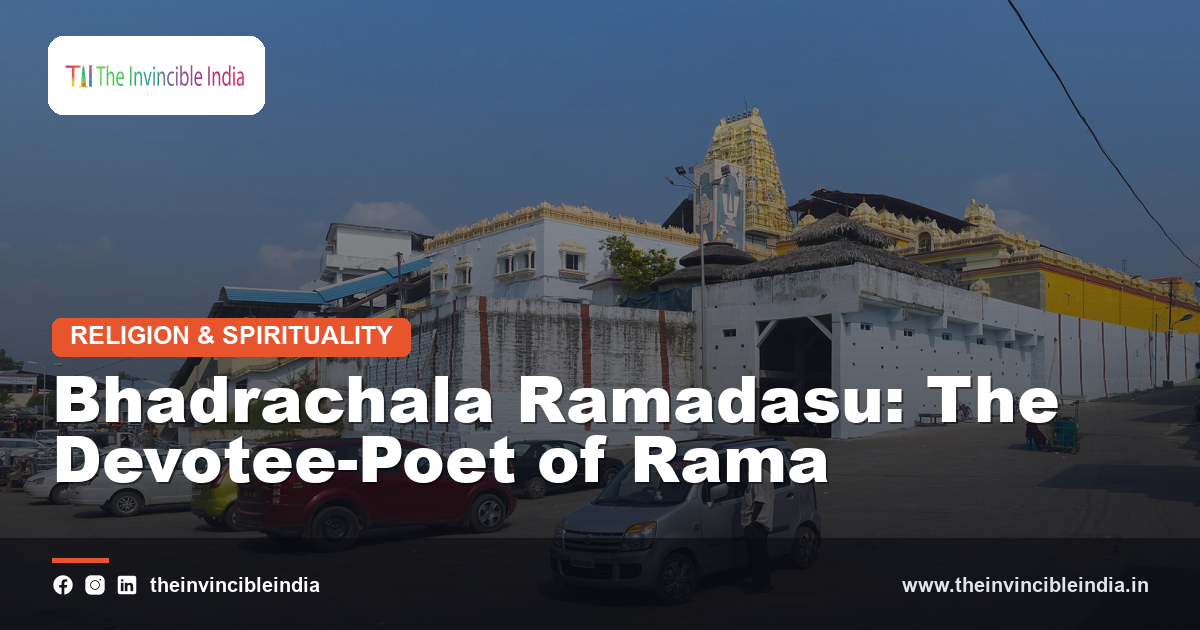
Bhadrachala Ramadasu, also known as Kancherla Gopanna, Bhakta Ramadasu or simply Ramadasu, is a Telugu devotee-poet of the seventeenth century who is remembered for his service to the Rama temple at Bhadrachalam on the banks of the Godavari river in Telangana. He is honoured for the devotional songs called keertanas that he composed, for the poem Dasarathi Satakam and for the stories of devotion that surround his life. Many of these stories are tradition, and details differ between tellings. His devotion to Rama is part of the wider worship of Vishnu described in the guide to Vaishnavism.
Quick answer: Bhadrachala Ramadasu is the devotional name of Kancherla Gopanna, a seventeenth-century Telugu poet and devotee of Lord Rama who is remembered for building up the Rama temple at Bhadrachalam on the Godavari in Telangana. He composed devotional songs called keertanas and the poem Dasarathi Satakam, and his story is told as an example of fearless devotion. Many details of his life are tradition and not documented history.
Key Takeaways
- Bhadrachala Ramadasu, born Kancherla Gopanna, is a Telugu devotee-poet of Lord Rama, traditionally placed in the seventeenth century.
- He is associated with the Sri Sitaramachandraswamy temple at Bhadrachalam on the bank of the Godavari river in Telangana.
- Tradition and historical accounts describe him as a local revenue official of the Golconda period who devoted his energy to the temple.
- His best-known works are his devotional keertanas and the poem Dasarathi Satakam, in which he calls Rama by the name Dasarathi.
- Stories of his imprisonment and release are told in tradition, and they are treated as sacred narrative and not as proved history.
- The Rama Navami celebrations at Bhadrachalam, including the ceremonial wedding of Sita and Rama, draw large numbers of pilgrims.
The sections below explain the life, works, teachings and continuing legacy in more detail.
Quick Facts
| Detail | Information |
|---|---|
| Birth name | Kancherla Gopanna |
| Also known as | Bhakta Ramadasu, Ramadasu, Bhadrachala Ramadasu |
| Place | Bhadrachalam, on the Godavari river, Telangana |
| Deity | Lord Rama with Sita and Lakshmana |
| Language | Telugu |
| Best-known works | Dasarathi Satakam and Ramadasu keertanalu |
| Signature name in songs | Dasarathi, a name of Rama |
| Era | Seventeenth century, Golconda period |
Who Was Bhadrachala Ramadasu?
Bhadrachala Ramadasu was a Telugu devotee-poet of Lord Rama whose real name is remembered as Kancherla Gopanna and who became known as Ramadasu, meaning servant of Rama. He is honoured for his service to the Rama temple at Bhadrachalam and for devotional songs that are sung in Telugu homes and temples to this day.
His story combines the lives of a public servant, a builder and a poet. Because much of the account is passed down by devotion, some details cannot be confirmed from records. What remains certain in the minds of devotees is the picture of a man who gave everything to the worship of Rama, and whose songs carry both love and boldness.
What Are His Names and Titles?
Bhadrachala Ramadasu is the name by which the poet is best known, while Kancherla Gopanna is his birth name and Bhakta Ramadasu is a common respectful form. The word Dasu means servant, so Ramadasu means the servant of Rama, a title that expresses the humility with which he regarded his devotion.
In many songs he addresses the Lord as Dasarathi, a name of Rama that means the son of King Dasaratha, and this name serves as a signature in his poetry. The collection of his songs is called Ramadasu keertanalu in Telugu. These names and titles help readers connect the poet, the temple and the songs as one living tradition of devotion.
Where Is Bhadrachalam?
Bhadrachalam is a temple town on the bank of the Godavari river in the Bhadradri Kothagudem district of Telangana, and it is one of the best-known centres of Rama worship in South India. The town takes its name from the hill, Bhadragiri, on which tradition places the shrine of Rama.
Pilgrims travel there by road from Telangana, Andhra Pradesh and beyond to see the deity and to bathe in the sacred river. The Godavari, one of the major rivers of India, forms a peaceful backdrop. Bhadrachalam is also regarded by many as a southern counterpart of Ayodhya in devotion, a comparison that shows the importance of the place in the religious life of the Telugu region.
What Is the Bhadrachalam Rama Temple?
The Bhadrachalam Rama temple, formally the Sri Sitaramachandraswamy Temple, is the main shrine at the town, where Rama is worshipped together with Sita and Lakshmana. The central image shows Rama with four arms, in a form that devotees associate with Vishnu, which makes the shrine a notable example of Vaishnava worship in the Godavari region.
The temple has a long tradition of rites, festivals and pilgrimage, and it is managed today by a state religious body. Its buildings and rituals reflect the continuous devotion of many centuries. For Ramadasu the temple was both a place of worship and the great work of his life, and his name is inseparable from its story in the memory of the people.
What Does Tradition Say About the Temple's Origins?
Tradition holds that the image of Rama at Bhadrachalam was discovered and first worshipped through the devotion of a woman named Pokala Dammakka, who is said to have found the deity and arranged for a simple shelter to be built. The accounts describe her as a forest dweller of simple faith whose sincerity drew the attention of the community.
These stories belong to temple tradition and legend, and they do not have precise historical dates. They carry the message that the shrine began in humble devotion before it grew into a great temple. Respectful readers honour these traditions as part of the sacred memory of Bhadrachalam while recognising the difference between faith narrative and recorded history.
How Did Gopanna Come to Serve the Temple?
Gopanna is traditionally remembered as a local revenue official of the Golconda rulers who was posted in the Bhadrachalam area and who became deeply moved by the condition of the Rama shrine. According to the accounts, he resolved to build a proper temple for the deity and took up the task with great zeal.
The story presents him as a man whose heart was drawn from official duty to devotion. The tradition adds that his relatives held positions at the Golconda court. The details vary between tellings, and not every part is documented. The central point remains clear, that a public servant became a temple builder through love of Rama, and that he is remembered for it as Ramadasu.
What Is the Story of His Imprisonment?
Tradition says that Ramadasu used funds from the revenue he collected for the construction of the temple, and that he was imprisoned at the Golconda fort when the authorities learned of it. The accounts describe a long period in confinement during which he composed many devotional songs in which he spoke to Rama with both pain and trust.
This story is among the best known in Telugu devotional culture, and it is told as a narrative of faith. Historians and devotees may differ in how they understand the details, and respectful writers describe it as tradition. The songs said to have come from this period remain among his most moving, because they express a sincere cry from the heart.
What Is the Legend of the Rama Coins?
The best-known legend about Ramadasu says that Rama and Lakshmana, in human guise, came to the ruler of Golconda, paid the sum that was owed in gold coins and obtained the release of the devotee. The ruler is said to have been astonished and moved when the truth became clear, and the coins are remembered as the Rama Mudra or Rama Tanka coins in temple tradition.
This account is a legend, offered by tradition as a sign of divine care for a faithful servant. It should be read as sacred story and not as proved history. Even so, it has shaped the devotional picture of Ramadasu, who stands as an example of a devotee whose trust was answered.
What Are Ramadasu Keertanas?
Ramadasu keertanas are the devotional songs in Telugu attributed to Bhadrachala Ramadasu, in which he praises Rama, describes the temple, speaks to the deity directly and sometimes complains in the manner of a loving child. They are sung in a form with a refrain and verses, and many of them are used in Carnatic music concerts.
The songs are known for their emotional range, moving from praise to humility to bold questioning. A few are famous for describing the ornaments of the deity at Bhadrachalam, which are said to have been made in his time. The keertanas show the poet’s closeness to Rama and are among the treasured songs of Telugu devotion.
What Is Dasarathi Satakam?
Dasarathi Satakam is a poem of about a hundred verses in Telugu attributed to Ramadasu, in which each verse addresses Rama by the name Dasarathi. A satakam is a form of Telugu poetry made of one hundred or so verses with a repeating closing line, and this example is among the best-known devotional satakams of the language.
The verses praise Rama, express surrender and ask for his grace. Because they are short and rhythmic, they are easy to memorise and are often recited by devotees. Together with the keertanas, the satakam forms the core of Ramadasu’s literary legacy, and it continues to be taught and recited in Telugu communities.
Which Songs of Ramadasu Are Most Loved?
Among the songs most closely linked with Ramadasu are Paluke Bangaramayena, Ikshvaku Kula Tilaka and Ramachandrulu Napai, each widely sung by concert artists and devotional singers. The first is a tender plea to Rama to speak, while the others address him with praise and trust in different moods.
Singers of Carnatic and devotional music have given these songs many musical settings, and they are heard in temples, concert halls and private homes. Their popularity shows that the poet’s words still speak to listeners of every age. The songs are among the most direct and heartfelt in the Telugu devotional repertoire.
How Is Rama Navami Celebrated at Bhadrachalam?
Rama Navami is the festival of the birth of Rama, and at Bhadrachalam it is marked by the ceremonial wedding of Sita and Rama, known as Sitarama Kalyanam, which draws large numbers of pilgrims every year. The rite is conducted with traditional ceremony at the temple, and it is attended by devotees from many regions.
The festival also honours the memory of Ramadasu, and his songs are sung during the days of celebration. Government and temple authorities arrange facilities for the crowds, and the event is widely reported as a major religious gathering of the Telugu region. The celebration shows how the poet’s temple continues to be a living centre of devotion.
Why Is Ramadasu Important in the Bhakti Tradition?
Ramadasu is important in the Bhakti tradition because he represents the devotee who gives his whole life, work and voice to the worship of a chosen deity. His songs show the main qualities of bhakti, namely love, trust, humility and bold familiarity with the Lord, expressed in the language of ordinary Telugu speakers.
He is often mentioned alongside other devotional composers of the Telugu region, such as Annamacharya, who sang of a different deity and in an earlier century. Together they show the breadth of Telugu devotional music. Ramadasu stands out for linking devotion with practical service, since he is remembered both as a poet and as the builder of a great temple.
How Is Ramadasu Remembered in Music and Culture?
Ramadasu is remembered in music, theatre, film and festival through his songs and through retellings of his life, and he is a familiar figure in Telugu popular culture as well as in classical performance. The songs are part of concerts, Harikatha storytelling and devotional programmes in Andhra Pradesh and Telangana.
Memorials and statues honour him, and educational and cultural groups run programmes in his name. These expressions of respect show that the poet belongs to the shared heritage of Telugu speakers. His story offers a rich subject for performers, while his songs remain a living source of devotional feeling for audiences of every background.
What Lessons Does Ramadasu Offer?
Ramadasu offers the lesson that devotion can be courageous and honest, and that a person of faith may speak to God with trust even in hardship. His songs show that prayer need not be formal to be sincere, and that love for the divine can express itself in praise, in questioning and in service.
The story also teaches that a devotee may serve a community through building and care, not only through personal worship. Respectful readers draw from his life a reminder of steadfast faith. Whether or not every legend is taken literally, the example of constant devotion remains a clear and positive message.
Bhadrachala Ramadasu Today
Bhadrachala Ramadasu today is honoured as one of the great devotee-poets of the Telugu world, and his songs are heard in temples, concerts and homes across Andhra Pradesh and Telangana. The Bhadrachalam temple continues to draw pilgrims, especially at Rama Navami, and his memory is part of every visit.
For students of Indian devotional culture he offers a vivid example of bhakti expressed through poetry and service. The stories told about his life are best understood as tradition, with respect for the faith they express. His keertanas and the Dasarathi Satakam continue to be sung, and they keep alive the voice of a devotee whose love for Rama still inspires.
Sources & Further Reading
- Ministry of Culture, Government of India (indiaculture.gov.in).
- Sangeet Natak Akademi, India’s National Academy of Music, Dance and Drama (sangeetnatak.gov.in).
Frequently Asked Questions
Who was Bhadrachala Ramadasu?
Bhadrachala Ramadasu, born Kancherla Gopanna, was a seventeenth-century Telugu devotee-poet of Lord Rama associated with the temple at Bhadrachalam. He is remembered for his keertanas and for the poem Dasarathi Satakam.
Where is the Bhadrachalam temple located?
The Bhadrachalam temple is located on the bank of the Godavari river in the Bhadradri Kothagudem district of Telangana. It is formally called the Sri Sitaramachandraswamy Temple.
What is Dasarathi Satakam?
Dasarathi Satakam is a Telugu devotional poem of about a hundred verses attributed to Ramadasu, each addressing Rama as Dasarathi. It is one of the best-known devotional satakams in the Telugu language.
What is the legend about Ramadasu and the gold coins?
The legend says Rama and Lakshmana, appearing in human form, paid the debt owed to the ruler of Golconda in gold coins and secured the release of the devotee. It is a tradition and not documented history.
Why is he called Ramadasu?
He is called Ramadasu because the word Dasu means servant, so the name means the servant of Rama. It expresses the humility and total devotion with which he served the deity.
What festival is celebrated at Bhadrachalam?
The major festival at Bhadrachalam is Rama Navami, which includes the ceremonial wedding of Sita and Rama known as Sitarama Kalyanam. It draws large numbers of pilgrims every year.


