

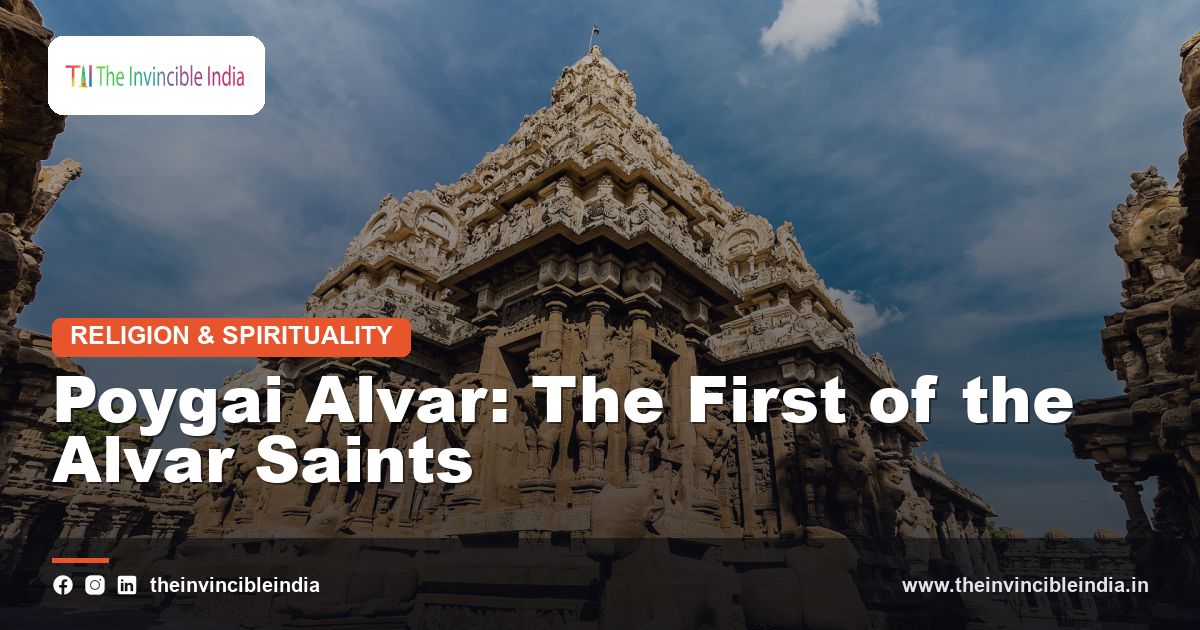
Poygai Alvar, also spelled Poigai Azhwar or Poykai Alvar and known as Poigaiyar, is the first of the twelve Alvar saints, the Tamil poet-devotees of Vishnu whose hymns form the heart of Sri Vaishnava devotion. He is associated by tradition with the temple city of Kanchipuram in Tamil Nadu, and his hundred verses, called Mudal Thiruvandadi, are part of the Nalayira Divya Prabandham. His dates are not firmly established, and much of his story is tradition. He belongs to the stream of devotion described in the guide to Vaishnavism.
Quick answer: Poygai Alvar is the first of the twelve Alvars, the Tamil saint-poets of Vishnu devotion, and is traditionally linked with Kanchipuram in Tamil Nadu. He is credited with Mudal Thiruvandadi, a set of one hundred Tamil verses included in the Nalayira Divya Prabandham. He is counted among the three Mudal Alvars, or first Alvars, and his exact dates are not firmly documented.
Key Takeaways
- Poygai Alvar is the first of the twelve Alvar saints, the Tamil poet-devotees of Vishnu.
- He is counted among the three Mudal Alvars, or first Alvars, together with Bhutattalvar and Peyalvar.
- He is traditionally associated with Kanchipuram, in a place connected with the Thiruvekka temple.
- His hundred Tamil verses, called Mudal Thiruvandadi, are included in the Nalayira Divya Prabandham.
- He is known for verses that use the image of a lamp, in which the world and the sea become the lamp and its oil.
- His dates and many details of his life are tradition and are not firmly documented in history.
The sections below explain the life, works, teachings and continuing legacy in more detail.
Quick Facts
| Detail | Information |
|---|---|
| Also known as | Poigai Azhwar, Poykai Alvar, Poigaiyar |
| Position | First of the twelve Alvars, one of the three Mudal Alvars |
| Place | Kanchipuram, Tamil Nadu, by tradition |
| Tradition | Tamil Vaishnavism, later Sri Vaishnavism |
| Language | Tamil |
| Main work | Mudal Thiruvandadi, one hundred verses |
| Collection | Nalayira Divya Prabandham |
| Era | Early Alvar period, exact dates not firmly documented |
Who Was Poygai Alvar?
Poygai Alvar was a Tamil saint and poet who is regarded as the first of the twelve Alvars, the devotees of Vishnu whose hymns shaped Tamil religious life. He is honoured as a pioneer of the devotional song that praises God in the language of the people, and he is counted among the earliest voices of the Vaishnava devotional movement of the south.
Little is known of his life from documents. What survives is a body of verse and a rich set of traditions told in Sri Vaishnava books and temples. Respectful readers therefore speak of him as a saint of tradition, with a clear picture of devotion and a less certain picture of biography. His verses remain the strongest evidence of his spiritual voice.
What Does the Name Poygai Mean?
The name Poygai comes from the Tamil word for a pond or natural pool, and it refers to the tradition that this saint was found beside a pond in Kanchipuram. In English the name appears as Poygai, Poigai or Poykai, and he is also called Poigai Azhwar, since Alvar and Azhwar are two ways of writing the same Tamil word.
The word Alvar is usually explained as one who is immersed in devotion to God. The name of the saint thus points to a place and a story together. It reminds readers that the Alvars are remembered through the landscape of temples, tanks and towns of Tamil Nadu in which their lives are placed by tradition.
Who Are the Alvars?
The Alvars are twelve Tamil poet-saints who composed hymns in praise of Vishnu and who are revered in Sri Vaishnavism as great devotees. Their names are commonly listed as Poygai, Bhutattalvar, Peyalvar, Tirumalisai, Nammalvar, Madhurakavi, Kulashekhara, Periyalvar, Andal, Tondaradippodi, Tiruppan and Tirumangai.
They lived over a long period in the early medieval centuries, according to common accounts, and came from many walks of life. Their songs are in Tamil and are filled with love for the Lord, for temples and for the people who worship. The Alvars are central to the Vaishnava tradition of the south, and Poygai stands at the head of their line.
Who Are the Mudal Alvars?
The Mudal Alvars, meaning the first Alvars, are the three earliest saints in the traditional list, namely Poygai Alvar, Bhutattalvar and Peyalvar. They are regarded as contemporaries in tradition, and each is connected with a different place, Poygai with Kanchipuram, Bhutattalvar with Mamallapuram and Peyalvar with Mylapore.
Each of the three composed a set of one hundred verses in the antadi style, and the three works are known together as the Thiruvandadis. The grouping honours them as the founders of the line of Alvar poetry. Poygai is placed first, and the three are often remembered together in Sri Vaishnava worship and in the telling of their shared story.
Where Is Kanchipuram and Why Does It Matter?
Kanchipuram is an ancient temple city in the northern part of Tamil Nadu, long known as one of the sacred cities of India and famous for its many Hindu temples and for its silk weaving. It is a major centre for both Shaiva and Vaishnava worship, and many temples there are admired for their architecture and rites.
For Poygai Alvar the city is the traditional place of birth and devotion. It is also linked with later Sri Vaishnava teachers and with several of the Divya Desams, the temples praised in the Alvar hymns. The sacred geography of Kanchipuram helps explain why the first Alvar is placed there by tradition and why pilgrims remember him on their visits.
What Is the Thiruvekka Temple?
The Thiruvekka temple in Kanchipuram is a Vishnu shrine, widely known as Yathokthakari or Sonnavannam Seitha Perumal, and it is traditionally linked with Poygai Alvar through the nearby sacred pond. It is counted among the Divya Desams, the one hundred and eight temples praised by the Alvars.
Tradition says that the saint was found near the pond that belongs to this temple, and a shrine to Poygai is associated with the site. The name of the deity in Tamil refers to a legend in which the Lord acted according to the word of a devotee. The temple thus joins the saint, the pond and the deity in a single sacred place.
What Does Tradition Say About His Birth?
Tradition says that Poygai Alvar was found as an infant in a golden lotus in the pond at Thiruvekka and was understood by devotees to be a being of divine grace. Sri Vaishnava tradition adds that he is regarded as an incarnation of the Panchajanya, the conch of Vishnu, while the other two Mudal Alvars are associated with other divine attributes.
These accounts are tradition and legend, and they express faith and not recorded history. They convey the belief that the Alvars were not ordinary poets but gifted souls. Respectful readers value the stories for the meaning they carry while keeping them separate from what can be shown through historical evidence.
What Is Mudal Thiruvandadi?
Mudal Thiruvandadi is the work of one hundred Tamil verses composed by Poygai Alvar, and its name means the first Thiruvandadi. The verses praise Vishnu and describe his deeds, forms and glory, and the work is included in the Nalayira Divya Prabandham, the collection of four thousand hymns of the Alvars.
The text is an early example of devotional Tamil poetry and is studied for its language and thought. It is also recited in Sri Vaishnava temples and homes as part of daily and festival worship. The hundred verses give a clear window into the earliest stage of Alvar devotion and into the voice of the first saint.
What Is the Antadi Form?
Antadi is a poetic form in Tamil in which the last word or syllable of one verse becomes the beginning of the next, so that the verses link like the rings of a chain. The word antadi means end and beginning, and it describes this pattern of linking through the close of each stanza.
The form creates a sense of flow and continuity, and it also helps memory, since a reciter can move from one verse to the next by following the link. Poygai Alvar used it in Mudal Thiruvandadi, and the other two Mudal Alvars used it too. The pattern shows how poetic technique and devotion were joined in the early Tamil Vaishnava tradition.
What Is the Famous Lamp Verse?
The best-known verse of Poygai Alvar uses the image of a lamp, in which the earth is imagined as the lamp, the great ocean as the oil and the sun as the flame, offered as a garland of words to Vishnu. It is a bold picture that expresses the wish to offer the whole universe in worship.
The verse is often cited to show the grandeur of the saint’s devotion and the way he turns natural wonders into offerings. The same lamp theme appears in the openings of the works of the other two Mudal Alvars, who use love and knowledge as their lamps. Together these verses form a famous trio of beginnings in Tamil devotional poetry.
What Is the Story of the Three Alvars at Thirukkovalur?
Tradition tells that the three Mudal Alvars, meeting by chance on a rainy night at Thirukkovalur, took shelter in a narrow place where one person could lie down, two could sit and three could only stand, and that a fourth presence squeezed in among them. The Alvars lit lamps and recognised the Lord himself as the unseen companion.
This story is tradition and legend, told as a lesson in divine closeness and devotion. It is the occasion on which each of the three is said to have composed the first verses of his work. The tale is loved for its simple setting and its moving message that God draws near to those who seek him in humility.
How Do the Verses Describe Vishnu?
The verses describe Vishnu as the supreme Lord who measured the worlds, who rests on the serpent Shesha and who is the refuge of all who surrender to him. They make references to well-known stories and forms, including the Lord’s great strides and his care for devotees, in clear and concise language.
The imagery draws on the classical stories of the Puranas and on the natural world of the Tamil country. It is not a system of philosophy but a poetry of praise. The result is a sense of awe and affection, in which the reader is invited to join in worship. This blend of wonder and warmth is a mark of the Alvar tradition.
What Is the Nalayira Divya Prabandham?
The Nalayira Divya Prabandham is the collection of about four thousand Tamil hymns of the Alvars, and it is held in great reverence in Sri Vaishnavism as a Tamil scripture. Tradition credits the teacher Nathamuni with gathering and organising the hymns, and they are recited in temples during daily worship and special festivals.
The work includes the verses of Poygai Alvar and the other Alvars, arranged in four parts. Its recitation is a central feature of life in many Vaishnava temples of Tamil Nadu. The Prabandham shows how Tamil became a language of sacred worship, and it keeps the voice of the first Alvar alive in the chanting of each generation.
Why Is Poygai Alvar Important to Sri Vaishnavism?
Poygai Alvar is important to Sri Vaishnavism as the first in the line of Alvars, whose hymns later teachers such as Ramanuja valued and explained. His place at the head of the list makes him a symbol of the beginning of the devotional movement in Tamil lands, and his verses are honoured in every household that follows the tradition.
He is also an example of the way devotion in the Tamil language became part of the heart of a religious community. The saint is remembered at festivals and in temple rites, especially at Kanchipuram. His importance is both spiritual and cultural, since he represents the start of a tradition that still shapes worship in South India.
What Lessons Does Poygai Alvar Offer?
Poygai Alvar offers the lesson that devotion can be offered with the whole heart and in simple words, and that nature and the universe itself can become a gift to God. His lamp verse invites readers to think of worship as an act of generous imagination.
The story of the three Alvars in the narrow place adds a gentle teaching that the divine draws near to those who seek him with humility. Readers of different backgrounds can appreciate the poetry as an expression of reverence and gratitude. The saint’s message is one of joyful offering and of closeness between the human and the divine.
Poygai Alvar Today
Poygai Alvar today is honoured as the first of the Alvars at Kanchipuram and at Vaishnava temples across Tamil Nadu and beyond, and his birth star is marked by special worship each year. His hundred verses are recited as part of the Divya Prabandham, and scholars continue to study them as early Tamil devotional literature.
For students of Indian religion he is a clear point of entry into the world of the Alvars, whose songs shaped South Indian devotion. The stories told about him are best understood as tradition, with respect for the faith they express. His verses continue to be chanted, keeping alive the voice of the first of the twelve saints.
Sources & Further Reading
- Ministry of Culture, Government of India (indiaculture.gov.in).
- Archaeological Survey of India (asi.nic.in).
Frequently Asked Questions
Who was Poygai Alvar?
Poygai Alvar was the first of the twelve Alvars, the Tamil saint-poets of Vishnu devotion, traditionally linked with Kanchipuram. He composed the hundred verses of Mudal Thiruvandadi.
Why is Poygai Alvar called the first Alvar?
He is placed first in the traditional list of the twelve Alvars and is counted among the three Mudal Alvars, meaning the first Alvars. The order reflects tradition about the early stage of the Alvar movement.
What is Mudal Thiruvandadi?
Mudal Thiruvandadi is the work of one hundred Tamil verses by Poygai Alvar in praise of Vishnu. It is part of the Nalayira Divya Prabandham and is written in the antadi form.
Who are the other Mudal Alvars?
The other two Mudal Alvars are Bhutattalvar, linked with Mamallapuram, and Peyalvar, linked with Mylapore. Together with Poygai Alvar they are honoured as the first three Alvars.
Where is Poygai Alvar associated with?
Poygai Alvar is associated by tradition with Kanchipuram in Tamil Nadu, in connection with the Thiruvekka temple and its sacred pond. The traditional account is a matter of faith and not documented history.
What is the Nalayira Divya Prabandham?
The Nalayira Divya Prabandham is a collection of about four thousand Tamil hymns of the Alvars, honoured as a scripture in Sri Vaishnavism. Tradition credits the teacher Nathamuni with organising it.


