

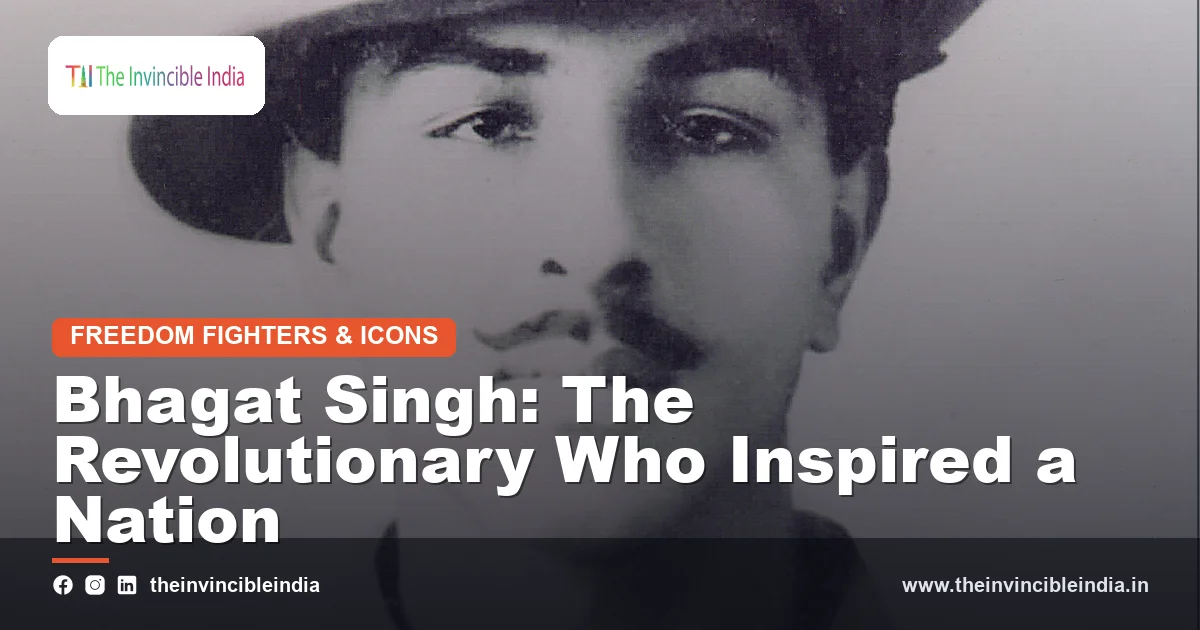
Bhagat Singh remains one of the most beloved and inspiring heroes of India’s freedom struggle, a young revolutionary whose courage, intellect and ultimate sacrifice continue to stir the hearts of millions. Executed by the British at the age of just twenty-three, he became a symbol of fearless resistance and youthful idealism, giving his life for the dream of a free and just India. His famous slogan, “Inquilab Zindabad” (Long Live the Revolution), still echoes across the country. This guide explores the life, ideals, actions and enduring legacy of the great martyr Bhagat Singh.
Quick Facts: Bhagat Singh
| Detail | Information |
|---|---|
| Born | 1907, in Punjab (present-day Pakistan) |
| Role | Revolutionary freedom fighter |
| Famous slogan | “Inquilab Zindabad” (Long Live the Revolution) |
| Key organisation | Hindustan Socialist Republican Association |
| Martyred | 23 March 1931, aged 23 |
| Remembered as | Shaheed (Martyr) Bhagat Singh |
Early Life and Influences
Bhagat Singh was born in 1907 into a patriotic Sikh family in Punjab that was deeply involved in the struggle against British rule, and this atmosphere shaped him from an early age. As a boy he was profoundly affected by the events of his time, especially the horrific Jallianwala Bagh massacre of 1919, in which hundreds of peaceful Indians were killed. A voracious reader with a sharp and questioning mind, he studied the histories of revolutions around the world and the ideas of freedom, justice and equality, developing a clear vision of the kind of independent and just society he wished to see in India.
The Path of Revolution
As a young man, Bhagat Singh became convinced that determined revolutionary action was needed to shake the foundations of British rule and awaken the masses. He joined and helped lead revolutionary organisations, most notably the Hindustan Socialist Republican Association, whose very name reflected his belief in not only political freedom but also social and economic justice. Unlike some, Bhagat Singh’s revolutionary ideas were deeply thoughtful and rooted in a vision of a free India based on equality and the welfare of ordinary people, and he combined action with a powerful intellectual commitment to his cause.
Avenging Lala Lajpat Rai
A turning point came with the death of the veteran nationalist leader Lala Lajpat Rai, who died after being injured in a brutal police charge, or lathi charge, during a peaceful protest against the Simon Commission. Outraged by this injustice, Bhagat Singh and his associates resolved to respond. In the events that followed, a British police officer was killed, an act the revolutionaries carried out in the belief that they were avenging the death of a beloved national leader and striking back against the violence of the colonial regime. This episode made Bhagat Singh a wanted man and deepened his commitment to the struggle.
The Assembly Bomb Incident
One of the most famous episodes of Bhagat Singh’s life was the Central Legislative Assembly incident in 1929. Along with his comrade Batukeshwar Dutt, he threw harmless bombs into the assembly hall, not to harm anyone, but to make a dramatic statement of protest against repressive laws. The bombs were deliberately designed to cause a loud noise rather than casualties, and the aim, in Bhagat Singh’s own words, was “to make the deaf hear”. Crucially, the two revolutionaries did not flee but allowed themselves to be arrested, courting imprisonment in order to use their trial as a platform to spread their message of freedom.
Trial, Imprisonment and Hunger Strike
During his imprisonment and trial, Bhagat Singh used every opportunity to advance the cause of freedom and to expose the injustices of the colonial system. He and his fellow prisoners undertook a lengthy hunger strike to demand better and more humane treatment for Indian political prisoners, drawing enormous public attention and sympathy. Throughout his trial, Bhagat Singh conducted himself with remarkable courage, dignity and conviction, articulating his ideals with clarity and turning the courtroom into a stage from which his message of revolution and justice reached people across the country.
Martyrdom and Its Impact
Bhagat Singh, along with his comrades Sukhdev and Rajguru, was sentenced to death and executed on 23 March 1931, when he was only twenty-three years old. He met his end with astonishing calm and bravery, embracing martyrdom for the cause he held dearer than life itself. His execution sent a wave of grief and anger across India and transformed him into a legendary figure and a martyr of the freedom struggle. The sacrifice of this fearless young man stirred the national conscience and inspired countless others to join the fight for independence.
The Ideals and Writings of Bhagat Singh
Bhagat Singh was not merely a man of action but also a serious thinker whose writings reveal a mind of remarkable depth and clarity. Even in prison, he read voraciously and wrote about his ideas, envisioning a free India that would also be a just and equal society, free of exploitation and oppression. His reflections on politics, society and belief, including his well-known essay explaining his rationalist views, show a young revolutionary deeply committed to reason, justice and the welfare of the common people. It is this combination of thought and action that gives his legacy such lasting power and depth.
The Enduring Legacy
Nearly a century after his death, Bhagat Singh remains one of the most revered and inspiring figures in Indian history, especially beloved by the young for his idealism, courage and sacrifice. Honoured as Shaheed, or Martyr, Bhagat Singh, he is commemorated in countless ways across the country, his image and slogans a constant presence in the national imagination. His life continues to inspire generations to stand up for justice, to think deeply about the kind of society they wish to build, and to be willing to sacrifice for their ideals, ensuring that his flame of revolution burns brightly still.
A Champion of the Youth
Bhagat Singh believed passionately in the power of the youth to transform society and win freedom, and he devoted much of his energy to organising and inspiring young people. He was associated with the Naujawan Bharat Sabha, an organisation aimed at rallying young Indians to the cause of independence and social change, spreading ideas of freedom, justice and equality among students and workers. His own example, of a brilliant, courageous young man willing to sacrifice everything for his ideals, made him a hero to the youth of his time and continues to inspire young people today, who see in him a symbol of idealism, courage and the will to change the world.
Comrades in the Struggle
Bhagat Singh did not fight alone, and his story is intertwined with those of his brave comrades who shared his ideals and his fate. Among them were Sukhdev and Rajguru, who were executed alongside him, and Batukeshwar Dutt, who joined him in the Assembly protest, as well as Chandrashekhar Azad and others in the revolutionary movement. Together, these young revolutionaries formed a band of dedicated patriots united by their vision of a free India. Remembering Bhagat Singh means also honouring these comrades, whose collective courage and sacrifice form one of the most stirring chapters of the freedom struggle.
Bhagat Singh in Popular Culture
Bhagat Singh’s life and sacrifice have inspired countless works of popular culture, keeping his memory vividly alive for successive generations. His story has been told and retold in films, books, songs, plays and works of art, portraying his courage, idealism and martyrdom to audiences across the country. These portrayals have cemented his status as a legendary national hero and have introduced his life and ideals to young people who might otherwise know little of the freedom struggle. The enduring popularity of Bhagat Singh in the arts reflects the deep and lasting hold he has on the imagination and affection of the nation.
Memorials and Remembrance
Bhagat Singh is honoured and remembered across India in numerous ways. The day of his martyrdom, 23 March, is observed as Martyrs’ Day (Shaheed Diwas) in his memory and that of his fellow revolutionaries, and memorials, museums and statues dedicated to him can be found in many places, including sites associated with his life and sacrifice. Institutions, roads and public spaces bear his name, and his image is a familiar and beloved presence throughout the country. This widespread remembrance ensures that the sacrifice of the young martyr is never forgotten and that his ideals continue to inspire new generations.
The Meaning of His Sacrifice
The sacrifice of Bhagat Singh carries a meaning that goes far beyond the events of his short life. In choosing to give his life so young, and with such calm courage, he demonstrated the depth of his commitment to the freedom and dignity of his people, and he awakened in countless Indians a spirit of fearless resistance and self-belief. His martyrdom was not an end but a beginning, inspiring waves of patriotic fervour and strengthening the resolve of the freedom movement. He showed that ideas and ideals could be more powerful than fear, and that the willingness to sacrifice for a just cause could stir the conscience of an entire nation.
An Eternal Inspiration
Nearly a century after his martyrdom, Bhagat Singh remains an eternal source of inspiration, his name synonymous with courage, patriotism and idealism. He continues to be especially beloved by the young, who find in his life a powerful example of standing up for one’s beliefs and working for a better and more just society. His thoughtful writings, his fearless actions and his ultimate sacrifice combine to make him not just a hero of a particular time, but a timeless symbol of the human spirit’s capacity for courage and conviction. In honouring Bhagat Singh, India honours the very ideals of freedom and justice on which the nation was built.
Remembering a Fearless Hero
Bhagat Singh remains, above all, a symbol of fearless courage and unshakeable conviction in the face of injustice. His willingness to lay down his life while still so young, combined with the depth of his ideals and the clarity of his vision for a free and just India, has secured his place among the most cherished heroes of the nation. To remember Bhagat Singh is to be reminded of the price paid for freedom and of the power of youthful idealism to change the course of history, an inspiration that continues to burn brightly in the hearts of Indians to this day.
Frequently Asked Questions
Who was Bhagat Singh?
Bhagat Singh was a young Indian revolutionary and freedom fighter who became a symbol of fearless resistance against British rule and was executed at the age of twenty-three, making him one of the most beloved martyrs of India’s independence struggle.
What is Bhagat Singh famous for?
He is famous for his revolutionary activities, the Assembly bomb protest of 1929, his hunger strike in prison, his powerful ideals, and his courageous martyrdom, along with his slogan “Inquilab Zindabad”.
When was Bhagat Singh executed?
Bhagat Singh was executed by the British on 23 March 1931, along with his comrades Sukhdev and Rajguru, when he was just twenty-three years old.
What did “Inquilab Zindabad” mean to Bhagat Singh?
“Inquilab Zindabad” means “Long Live the Revolution”, a slogan that expressed Bhagat Singh’s call for a complete transformation towards a free, just and equal society.


