

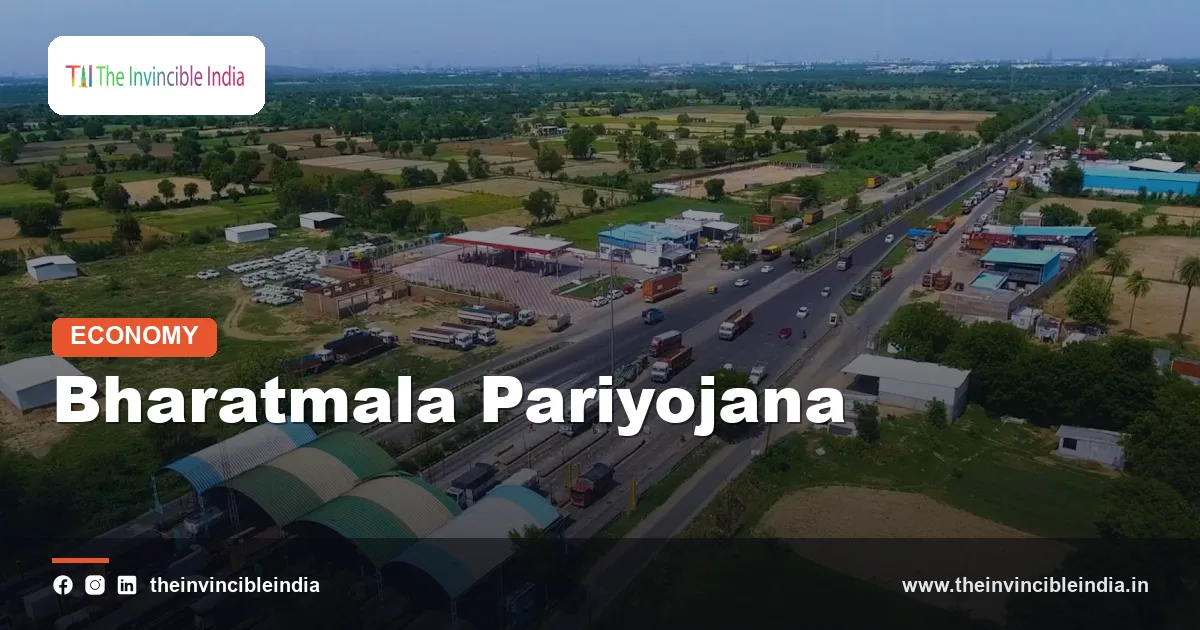
Bharatmala Pariyojana is the Government of India’s flagship umbrella highway programme, approved in 2017, that aims to improve freight and passenger movement by developing economic corridors, inter-corridor and feeder routes, border and coastal roads, and greenfield expressways across the country. The programme is run by the Ministry of Road Transport and Highways (MoRTH), and its first stage, Phase I, covers about 34,800 kilometres of roads.
The name Bharatmala means a garland of India, reflecting the idea of tying together the country’s regions, ports and borders with a strong network of national highways. Bharatmala Pariyojana shifted the planning of roads from building individual stretches to a corridor-based approach that targets gaps in the network and logistics efficiency.
| Attribute | Details |
|---|---|
| Full name | Bharatmala Pariyojana |
| Announced and approved | Announced in the 2015-16 Union Budget; Phase I approved by the Union Cabinet in October 2017 |
| Ministry | Ministry of Road Transport and Highways (MoRTH) |
| Executing agencies | National Highways Authority of India (NHAI), National Highways and Infrastructure Development Corporation Limited (NHIDCL) and state public works departments |
| Phase I length | About 34,800 km, including around 10,000 km of residual National Highways Development Project works |
| Phase I outlay | About Rs 5.35 lakh crore as approved in 2017 |
| Core components | Economic Corridors, Inter Corridor and Feeder Routes, National Corridor Efficiency, Border and International Connectivity, Coastal and Port Connectivity, Greenfield Expressways |
| Delivery models | EPC, BOT (Toll) and Hybrid Annuity Model (HAM) |
| Related programmes | Sagarmala, PM Gati Shakti, National Logistics Policy |
Key Takeaways
- Bharatmala Pariyojana is a highway development programme of the Ministry of Road Transport and Highways whose Phase I was approved by the Union Cabinet in October 2017 for about 34,800 kilometres of roads.
- Bharatmala Phase I has seven components: Economic Corridors, Inter Corridor and Feeder Routes, National Corridor Efficiency Improvement, Border and International Connectivity Roads, Coastal and Port Connectivity Roads, Greenfield Expressways, and the balance work of the National Highways Development Project.
- The National Highways Authority of India (NHAI) and the National Highways and Infrastructure Development Corporation Limited (NHIDCL) are the main bodies that execute Bharatmala projects.
- Bharatmala Pariyojana uses a corridor-based approach, in which stretches are chosen to remove bottlenecks on the highest-traffic freight routes, in place of the older practice of building roads in isolation.
- The programme is financed through a mix of budgetary support, the Central Road Fund, borrowings by NHAI, private investment and revenue from tolls and asset monetisation.
- Bharatmala is intended to complement the port-led Sagarmala programme and, later, the PM Gati Shakti National Master Plan for multimodal connectivity.
What is Bharatmala Pariyojana?
Bharatmala Pariyojana is a centrally led road and highway programme that aims to plan and build a network of national highways in a way that raises the efficiency of freight and passenger movement across India. It was announced in the Union Budget of 2015-16 and received Cabinet approval for its first phase in 2017.
The programme is described as an umbrella scheme because it brings together several types of road works under one plan. These include new economic corridors, feeder routes to those corridors, upgrades of existing highways, border roads and coastal roads, and new access-controlled expressways.
The programme replaces the earlier approach in which each national highway project was taken up on a separate basis. The new approach uses studies of traffic flows and freight patterns to decide where investment would have the highest effect on logistics.
How did Bharatmala Pariyojana come about?
Bharatmala Pariyojana came about as the successor of the National Highways Development Project (NHDP), which had built major projects such as the Golden Quadrilateral and the North-South and East-West Corridors. Policymakers wanted a new programme that would fill the gaps left by NHDP and improve multimodal links.
The Union Cabinet approved Phase I in October 2017. The plan consolidated work that was still pending under NHDP, roughly 10,000 kilometres, with about 24,800 kilometres of new components, giving a total of about 34,800 kilometres.
From NHDP to Bharatmala
The NHDP, started in the late 1990s, concentrated on four-laning and six-laning of high-density corridors. Bharatmala extended this thinking with a scientific selection of corridors, a focus on feeder roads and an emphasis on the last mile to ports, borders and industrial regions.
What are the components of Bharatmala Phase I?
The components of Bharatmala Phase I are Economic Corridors, Inter Corridor and Feeder Routes, National Corridor Efficiency Improvements, Border and International Connectivity Roads, Coastal and Port Connectivity Roads, Greenfield Expressways and the balance NHDP works. Together they add up to about 34,800 kilometres.
| Component | Approximate length (km) | Purpose |
|---|---|---|
| Economic Corridors | 9,000 | Develop high-traffic, high-economic-value routes for freight |
| Inter Corridor and Feeder Routes | 6,000 | Connect economic corridors and bring traffic from districts |
| National Corridor Efficiency Improvement | 5,000 | Remove bottlenecks, add lanes and bypasses on existing corridors |
| Border and International Connectivity Roads | 2,000 | Improve links to borders and neighbouring countries |
| Coastal and Port Connectivity Roads | 2,000 | Link ports and coastal areas to the national network |
| Greenfield Expressways | 800 | Build new access-controlled expressways |
| Balance NHDP works | 10,000 | Complete pending projects of the earlier programme |
The lengths were targets set at approval, and the actual composition has been adjusted as projects were reviewed and reprioritised.
What are economic corridors under Bharatmala?
Economic corridors under Bharatmala are major highway routes selected because they carry heavy freight and link important production, consumption and trade centres. The programme identified a set of such corridors, around 44 across the country, through a study of traffic and logistics patterns.
These corridors are meant to become the main arteries of goods movement. They are planned to take a large share of freight traffic and to reduce the time and cost of long-distance transport. Inter-corridor roads connect different corridors, and feeder routes bring local traffic from districts to the main arteries.
Why a corridor approach?
A corridor approach views the road as a logistics path, not merely as a link between two towns. Planners look at how much freight flows along the path, where trucks slow down, and what other modes such as rail and ports are available. This allows funds to be directed at parts of the network where they yield the largest efficiency gains.
What are greenfield expressways?
Greenfield expressways are new access-controlled highways built on fresh alignments instead of widening existing roads. Under Bharatmala they are meant to provide faster, safer routes between major cities and regions.
- The Delhi-Mumbai Expressway is a major access-controlled corridor connecting the national capital with the financial capital, passing through several states.
- The Dwarka Expressway in the Delhi-Gurugram region is an urban expressway designed to relieve congestion.
- The Ahmedabad-Dholera Expressway links Ahmedabad with the planned Dholera special investment region in Gujarat.
- Other expressway projects include routes such as Bengaluru-Chennai and Delhi-Amritsar-Katra, which are linked to the wider programme or related plans.
Expressways reduce travel time because vehicles can maintain higher speeds without intersections or roadside access. They also improve safety through controlled entry and exit points.
Who implements Bharatmala Pariyojana?
Bharatmala Pariyojana is implemented by the Ministry of Road Transport and Highways through the National Highways Authority of India (NHAI), the National Highways and Infrastructure Development Corporation Limited (NHIDCL) and state public works departments. Each agency handles projects in its own region or category.
- NHAI: builds and maintains most national highways and large corridor projects.
- NHIDCL: focuses on roads in the northeast, hill states and border areas, where terrain and security conditions are difficult.
- State public works departments: carry out some national highway projects entrusted to the states.
Projects are awarded through competitive bidding under different contract models, which determine who bears construction, traffic and financing risk.
How is Bharatmala Pariyojana funded?
Bharatmala Pariyojana is funded through a combination of budgetary support from the central government, the Central Road Fund, borrowings by NHAI from the market, private sector investment and receipts from tolls and monetisation of operating roads. The total outlay for Phase I was approved at about Rs 5.35 lakh crore.
The Central Road Fund (CRF) draws on a cess levied on petrol and diesel and is earmarked for road development. NHAI also raises money through bonds and loans, which it services through toll revenue. Since not all costs can be recovered from tolls, a part of the capital is given by the government as budgetary support.
Contract models
| Model | How it works | Who bears the traffic risk |
|---|---|---|
| EPC (Engineering, Procurement and Construction) | The government pays the contractor to build; the road is publicly owned and tolled by the government | Government |
| BOT (Toll) | A concessionaire builds, operates and collects tolls for a fixed period | Concessionaire |
| HAM (Hybrid Annuity Model) | The government pays part of the cost during construction and the rest as annuities; the private partner builds and maintains | Government |
| TOT (Toll-Operate-Transfer) | Completed roads are leased to private operators for upfront payments | Operator |
What are the goals of Bharatmala Pariyojana?
The goals of Bharatmala Pariyojana are to lower logistics costs, shorten travel times, improve road safety and connect remote regions, ports and borders to the main economic centres. Better roads are expected to make Indian goods more competitive and encourage the growth of industry along the corridors.
- Reduce the time and cost of moving freight by removing bottlenecks and improving highway quality.
- Shift towards a corridor-based plan that targets the most important routes first.
- Strengthen links to ports, supporting trade and the coastal economy.
- Improve connectivity to border areas and neighbouring countries for strategic and trade reasons.
- Create employment in construction and related industries.
- Integrate roads with logistics parks, rail terminals and inland waterways to promote multimodal transport.
How does Bharatmala relate to Sagarmala and PM Gati Shakti?
Bharatmala relates to Sagarmala and PM Gati Shakti as a complementary programme: Bharatmala builds the road network, Sagarmala develops ports and coastal shipping, and PM Gati Shakti provides a digital master plan that coordinates infrastructure across ministries. Together they aim at an integrated transport system.
Sagarmala, launched in 2015, focuses on port modernisation, coastal economic zones and port-linked industry, and it depends on good roads to move cargo inland. Bharatmala’s coastal and port connectivity component provides these roads.
PM Gati Shakti, launched in 2021, is a geographic information platform on which agencies share project plans, so that road, rail, port and utility projects can be planned together. The National Logistics Policy of 2022 pursues the same aim of reducing logistics costs and improving coordination.
What progress and criticism has Bharatmala faced?
Bharatmala has built a large length of national highways and several landmark expressways, but it has also faced delays, changes in scope and questions about costs. The programme has been revisited as projects were reviewed, and some components were reprioritised.
Audit reports by the Comptroller and Auditor General of India have commented on issues such as variations in project scope, cost per kilometre and the process of approval. Land acquisition, clearances and contractor financing have also affected timelines in some stretches.
Supporters argue that the programme has raised the pace of highway construction and brought a more planned approach to the network. Critics argue that careful cost control, transparent appraisal and balanced attention to rail and other modes are needed. The government has since moved towards planning under the PM Gati Shakti framework.
Challenges
- Acquiring land and obtaining environmental and forest clearances take time.
- Financing needs are large, and the private sector’s appetite for risk varies.
- Maintenance and road safety require continued attention once new roads are built.
- Terrain and security conditions slow work in border and hill regions.
Bottom Line
Bharatmala Pariyojana changed national highway planning in India by focusing on corridors, feeder routes and gaps in the network, and by combining many road works under a single umbrella. Its results depend on timely land acquisition, prudent financing and integration with ports, railways and logistics hubs. It remains central to the country’s effort to reduce logistics costs and improve connectivity.
Frequently Asked Questions
What is Bharatmala Pariyojana?
Bharatmala Pariyojana is the Government of India’s umbrella highway programme to develop economic corridors, feeder routes, border and coastal roads and expressways. It was approved in 2017 and is run by the Ministry of Road Transport and Highways. Phase I covers about 34,800 kilometres of roads.
When was Bharatmala Pariyojana launched?
Bharatmala Pariyojana was announced in the Union Budget of 2015-16, and the Union Cabinet approved Phase I in October 2017. The approval set a total length of about 34,800 kilometres and an outlay of about Rs 5.35 lakh crore. The original timeline was extended as projects were reviewed.
What are the components of Bharatmala Phase I?
Bharatmala Phase I has seven components: Economic Corridors, Inter Corridor and Feeder Routes, National Corridor Efficiency Improvement, Border and International Connectivity Roads, Coastal and Port Connectivity Roads, Greenfield Expressways and the balance NHDP works. The first six cover about 24,800 kilometres and the balance NHDP works about 10,000 kilometres.
Which agencies build Bharatmala roads?
The National Highways Authority of India (NHAI) builds most Bharatmala roads, while the National Highways and Infrastructure Development Corporation Limited (NHIDCL) handles border, hill and northeastern areas. State public works departments take up some projects. All of them work under the Ministry of Road Transport and Highways.
How is Bharatmala financed?
Bharatmala is financed through budgetary support, the Central Road Fund, market borrowings by NHAI, private investment and revenue from tolls and monetisation of existing roads. Contract models such as EPC, BOT and the Hybrid Annuity Model decide how the cost and risk are shared with private partners. The Phase I outlay was approved at about Rs 5.35 lakh crore.
How is Bharatmala different from the National Highways Development Project?
Bharatmala differs from the National Highways Development Project (NHDP) because it takes a corridor-based, logistics-driven approach instead of building highways stretch by stretch. NHDP focused on large projects such as the Golden Quadrilateral, while Bharatmala adds feeder routes, port and border roads and expressways. It also absorbed the pending work of NHDP.
{“@context”:”https://schema.org”,”@graph”:[{“@type”:”FAQPage”,”mainEntity”:[{“@type”:”Question”,”name”:”What is Bharatmala Pariyojana?”,”acceptedAnswer”:{“@type”:”Answer”,”text”:”Bharatmala Pariyojana is the Government of India’s umbrella highway programme to develop economic corridors, feeder routes, border and coastal roads and expressways. It was approved in 2017 and is run by the Ministry of Road Transport and Highways. Phase I covers about 34,800 kilometres of roads.”}},{“@type”:”Question”,”name”:”When was Bharatmala Pariyojana launched?”,”acceptedAnswer”:{“@type”:”Answer”,”text”:”Bharatmala Pariyojana was announced in the Union Budget of 2015-16, and the Union Cabinet approved Phase I in October 2017. The approval set a total length of about 34,800 kilometres and an outlay of about Rs 5.35 lakh crore. The original timeline was extended as projects were reviewed.”}},{“@type”:”Question”,”name”:”What are the components of Bharatmala Phase I?”,”acceptedAnswer”:{“@type”:”Answer”,”text”:”Bharatmala Phase I has seven components: Economic Corridors, Inter Corridor and Feeder Routes, National Corridor Efficiency Improvement, Border and International Connectivity Roads, Coastal and Port Connectivity Roads, Greenfield Expressways and the balance NHDP works. The first six cover about 24,800 kilometres and the balance NHDP works about 10,000 kilometres.”}},{“@type”:”Question”,”name”:”Which agencies build Bharatmala roads?”,”acceptedAnswer”:{“@type”:”Answer”,”text”:”The National Highways Authority of India (NHAI) builds most Bharatmala roads, while the National Highways and Infrastructure Development Corporation Limited (NHIDCL) handles border, hill and northeastern areas. State public works departments take up some projects. All of them work under the Ministry of Road Transport and Highways.”}},{“@type”:”Question”,”name”:”How is Bharatmala financed?”,”acceptedAnswer”:{“@type”:”Answer”,”text”:”Bharatmala is financed through budgetary support, the Central Road Fund, market borrowings by NHAI, private investment and revenue from tolls and monetisation of existing roads. Contract models such as EPC, BOT and the Hybrid Annuity Model decide how the cost and risk are shared with private partners. The Phase I outlay was approved at about Rs 5.35 lakh crore.”}},{“@type”:”Question”,”name”:”How is Bharatmala different from the National Highways Development Project?”,”acceptedAnswer”:{“@type”:”Answer”,”text”:”Bharatmala differs from the National Highways Development Project (NHDP) because it takes a corridor-based, logistics-driven approach instead of building highways stretch by stretch. NHDP focused on large projects such as the Golden Quadrilateral, while Bharatmala adds feeder routes, port and border roads and expressways. It also absorbed the pending work of NHDP.”}}]}]}


