

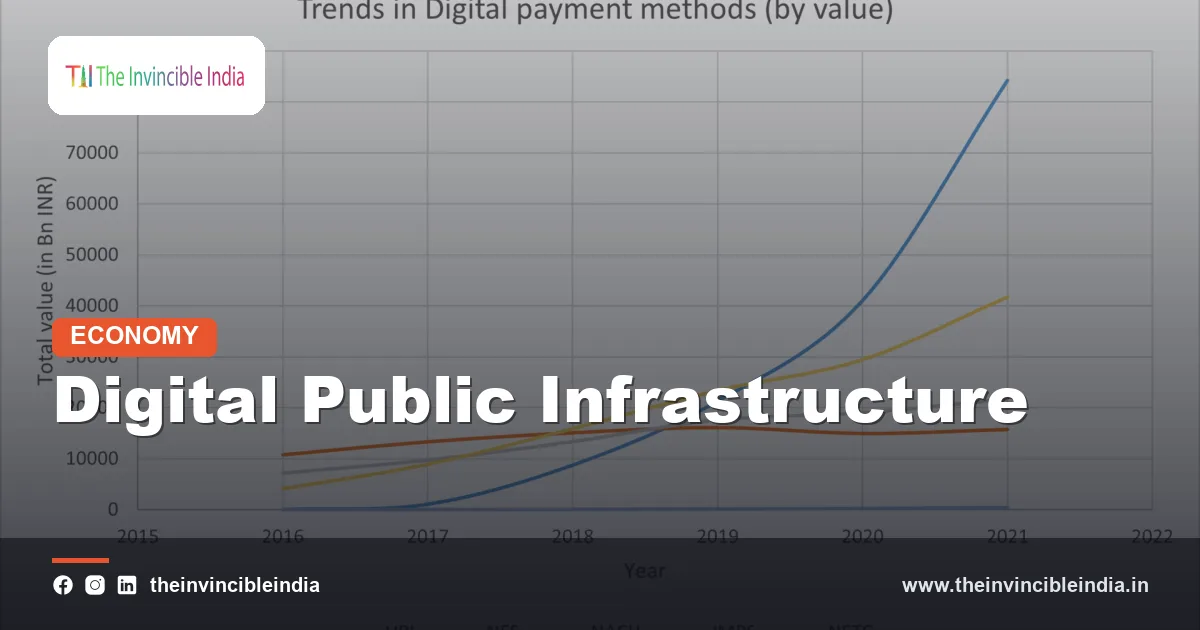
Digital Public Infrastructure (DPI) in India is a set of open, interoperable and publicly governed digital systems, often called the India Stack, that provide identity, payments and data-sharing services on which governments, businesses and citizens can build their own applications. Its core layers are Aadhaar for digital identity, the Unified Payments Interface (UPI) for instant payments, and the Account Aggregator framework for consent-based sharing of financial data.
India’s Digital Public Infrastructure works much like physical public infrastructure such as roads or power grids: the base layer is common and open, and many different services run on top of it. This design has helped India extend banking, welfare delivery and digital commerce to a very large population in a short time, and the country now promotes the approach internationally.
| Attribute | Details |
|---|---|
| Common name | India Stack, or Digital Public Infrastructure (DPI) |
| Identity layer | Aadhaar, issued by the Unique Identification Authority of India (UIDAI), set up in 2009 |
| Payments layer | Unified Payments Interface (UPI), launched by the National Payments Corporation of India (NPCI) in 2016 |
| Data layer | Account Aggregator framework, regulated by the Reserve Bank of India, live from 2021 |
| Other building blocks | DigiLocker, e-KYC, e-Sign, CoWIN, ONDC, FASTag |
| Foundational idea | JAM trinity: Jan Dhan accounts, Aadhaar and Mobile |
| Key principles | Open standards, interoperability, consent, public governance, private innovation |
| Privacy basis | Puttaswamy judgment (2017) and the Digital Personal Data Protection Act, 2023 |
| Global effort | Promoted during India’s G20 presidency in 2023 |
Key Takeaways
- Digital Public Infrastructure in India is a collection of open and interoperable digital rails for identity, payments and data sharing that are governed in the public interest while private companies build services on top.
- Aadhaar, managed by the Unique Identification Authority of India (UIDAI), is a twelve-digit identity number issued to residents on the basis of demographic and biometric data and is the identity layer of the India Stack.
- The Unified Payments Interface (UPI), launched in 2016 by the National Payments Corporation of India, allows instant bank-to-bank payments between any two interoperable apps using a mobile phone.
- The Account Aggregator framework lets individuals share their financial data with lenders and other regulated entities only with their explicit, revocable consent.
- The JAM trinity refers to the combination of Jan Dhan bank accounts, Aadhaar identity and mobile phones that enables direct delivery of benefits to citizens.
- India promoted Digital Public Infrastructure as a global good during its 2023 G20 presidency and has shared its approach with many countries.
What is Digital Public Infrastructure?
Digital Public Infrastructure is a set of shared digital systems and standards, built or backed by the state, that allow people, businesses and governments to carry out essential transactions such as proving identity, paying money and exchanging data. The systems are designed to be open, so that anyone who meets the rules can use them without needing to build the underlying layer again.
Three ideas define the approach. First, the core rails are treated as a public good, not as a private product. Second, they use open application programming interfaces (APIs) and common standards so that different providers can work together. Third, the rails are kept thin and neutral so that competition and innovation take place in the services above them.
Indian policy discussions often describe DPI as having three foundational layers: identity, payments and data exchange. Additional systems such as digital document storage, health records, e-commerce networks and credit platforms are built on these foundations.
What is the India Stack?
The India Stack is the name given to the collection of open APIs and digital public goods that India built to enable presence-less, paperless, cashless and consent-based service delivery. The term was popularised by a group of technologists and volunteers associated with the Indian Software Product Industry Round Table (iSPIRT) and the UIDAI.
The stack is commonly explained through four layers.
- Presence-less layer: a biometric and online identity (Aadhaar) lets a person prove who they are from anywhere.
- Paperless layer: e-KYC, e-Sign and DigiLocker replace physical documents and signatures with verified digital ones.
- Cashless layer: UPI and related rails move money instantly between bank accounts.
- Consent layer: the Account Aggregator framework allows data to move between institutions only with the user’s permission.
How did India build its Digital Public Infrastructure?
India built its Digital Public Infrastructure step by step over roughly a decade and a half, beginning with the creation of a universal identity and then adding payments, documents and data layers. Each layer was designed to work with the one before it.
| Year | Milestone |
|---|---|
| 2009 | UIDAI is set up to issue unique identity numbers |
| 2010 | First Aadhaar numbers are issued from Maharashtra |
| 2014 | Pradhan Mantri Jan Dhan Yojana launches a drive for universal bank accounts |
| 2015 | DigiLocker is launched for digital document storage |
| 2016 | Aadhaar Act is passed; UPI goes live |
| 2017 | Supreme Court recognises privacy as a fundamental right in the Puttaswamy case |
| 2018 | Supreme Court upholds Aadhaar with limits on its mandatory use by private entities |
| 2020 | NITI Aayog releases the Data Empowerment and Protection Architecture (DEPA) draft |
| 2021 | Account Aggregator network goes live; CoWIN supports the Covid-19 vaccination drive |
| 2022 | ONDC begins pilots for open e-commerce |
| 2023 | DPI features in the G20 New Delhi Leaders’ Declaration; the Digital Personal Data Protection Act is enacted |
How does Aadhaar work as the identity layer?
Aadhaar works as the identity layer by giving each resident a unique twelve-digit number linked to demographic details and biometric data, which can be verified online in real time. The Unique Identification Authority of India (UIDAI), a statutory authority under the Aadhaar Act, 2016, issues and manages the numbers.
Aadhaar does not by itself prove citizenship, address history or entitlement; it proves that a person is the same individual who enrolled. Service providers can authenticate a person by fingerprint, iris scan, one-time password or face match, and can also request a limited electronic Know Your Customer (e-KYC) record with the person’s consent.
Enrolment extends to well over a hundred crore residents. Aadhaar-based e-KYC reduced the cost and time of opening bank accounts and mobile connections, and it supports direct benefit transfer for welfare programmes.
Legal and privacy safeguards
The Supreme Court’s 2017 Puttaswamy judgment recognised the right to privacy as part of the fundamental rights under the Constitution. In 2018 the Court upheld the Aadhaar scheme but restricted its mandatory use by private companies and ruled that it cannot be required for access to certain services such as school admission. The Digital Personal Data Protection Act, 2023 now sets general rules on consent and data fiduciaries.
How does UPI work?
UPI works as an interoperable real-time payment system that lets a user send money from one bank account to another using a virtual payment address, mobile number or QR code, with no need to enter account details. It was launched in 2016 by the National Payments Corporation of India (NPCI), the umbrella organisation for retail payments in the country, and runs on top of the Immediate Payment Service (IMPS).
A user links a bank account to a UPI-enabled app, sets a PIN, and approves each payment with that PIN. The money moves between banks within seconds through a central switch operated by NPCI, and the payment works at any time of day, including holidays. Because many apps and banks can participate, the user is not locked into a single provider.
UPI has transformed small payments. Street vendors, small shops and gig workers accept payments by scanning a QR code, which has helped formalise cash-based trade. The number of transactions made on UPI each month now runs into the billions, which makes it one of the largest real-time payment systems in the world.
Why UPI scaled quickly
- It is free or very low cost for users, particularly for person-to-person and most merchant payments.
- It is interoperable across banks and apps, so any user can pay any other user.
- It works on basic smartphones and, through USSD-based options, on feature phones as well.
- It uses simple identifiers such as mobile numbers or QR codes instead of long account numbers.
What are the Account Aggregator framework and DEPA?
The Account Aggregator framework is a regulated system that lets people share their financial information held by one institution with another institution, such as a lender, through a secure consent-based channel. It is supervised by the Reserve Bank of India, and the entities that run it are called Account Aggregators (AAs), which do not see or store the data themselves.
The conceptual foundation is the Data Empowerment and Protection Architecture (DEPA), proposed by NITI Aayog in 2020. DEPA treats data as belonging to the individual, who gives permission to share it for a specific purpose and period, and can withdraw that permission.
The practical benefit is easier credit for people with little formal paperwork. A small business can share verified bank statements, tax data and other records with a lender in minutes and may qualify for a loan without collateral. The industry body Sahamati works with participants to promote the standards.
What is the JAM trinity?
The JAM trinity is the combination of Jan Dhan bank accounts, Aadhaar identity numbers and mobile phones, which together allow the government to transfer benefits directly into the bank accounts of citizens. The term gained wide use after it appeared in the Economic Survey of 2014-15.
- Jan Dhan: the Pradhan Mantri Jan Dhan Yojana, launched in 2014, aimed to give every household access to a basic bank account.
- Aadhaar: the identity number links the account to the right person and helps remove duplicate or ghost beneficiaries.
- Mobile: the phone provides the channel for alerts, payments and banking services.
Direct Benefit Transfer (DBT) uses JAM to send subsidies, scholarships and pensions straight to beneficiaries. This reduces leakages and delays that arose when benefits passed through multiple intermediaries.
What are DigiLocker, CoWIN, ONDC and other DPI components?
DigiLocker, CoWIN and ONDC are applications and networks built on India’s core digital rails to solve specific problems in documents, health and commerce. Each follows the DPI principle of open standards that many providers can use.
| Component | Purpose | Notes |
|---|---|---|
| DigiLocker | Stores and shares verified digital documents | Run by the Ministry of Electronics and Information Technology; documents issued through it are treated as valid under the Information Technology Rules |
| CoWIN | Registration, scheduling and certificates for Covid-19 vaccination | Introduced in 2021; vaccine certificates could be downloaded digitally |
| ONDC | Open network for e-commerce that links buyers and sellers across platforms | Uses open protocols so a buyer on one app can order from a seller on another |
| e-Sign | Aadhaar-based digital signature for documents | Removes the need for physical signing |
| FASTag | Electronic toll collection | Linked to a prepaid account or bank account |
| Ayushman Bharat Digital Mission | Digital health IDs and records | Allows consent-based sharing of health data |
The Open Network for Digital Commerce (ONDC) was set up with the support of the Department for Promotion of Industry and Internal Trade (DPIIT) to reduce the dominance of closed marketplaces and to help small sellers reach buyers. It uses the Beckn protocol for open communication between apps.
How has DPI helped financial inclusion?
Digital Public Infrastructure has helped financial inclusion by lowering the cost of opening accounts, moving payments and verifying customers, which made it viable for banks to serve low-income users. Bank account ownership among adults rose sharply after Jan Dhan and Aadhaar-based onboarding began.
Digital payments let small merchants build a transaction history, and the Account Aggregator system allows that history to be used as evidence for loans. Migrant workers can send money home instantly, and welfare beneficiaries can receive payments without travelling to collect them.
Studies also point to the need for continued efforts. Digital literacy, access to smartphones and reliable connectivity remain uneven, and some people have faced authentication failures. Policymakers have therefore kept alternatives such as offline verification and assisted services.
Why is India promoting DPI globally?
India is promoting Digital Public Infrastructure globally because it considers the model a low-cost route for other countries to build inclusive digital services, and because it wants shared standards that work across borders. The idea took centre stage during India’s G20 presidency in 2023.
The G20 New Delhi Leaders’ Declaration endorsed a framework for the development, deployment and governance of DPI. India also launched the Global Digital Public Infrastructure Repository and proposed a Social Impact Fund to support DPI in the Global South.
Examples of international reach
- UPI has been linked with fast-payment systems in several countries for cross-border payments, and the NPCI International Payments Limited (NIPL) leads these partnerships.
- MOSIP (Modular Open Source Identity Platform), developed at the International Institute of Information Technology Bangalore, helps countries build their own national identity systems.
- Several countries have signed agreements to adapt Indian digital platforms for their own use.
What are the risks and criticisms of DPI?
The main risks and criticisms of Digital Public Infrastructure concern privacy, data security, exclusion of people who cannot use digital systems, and concentration of risk in a few central platforms. These issues have been debated in courts, in Parliament and among researchers.
- Privacy: large databases and widespread use of identity numbers can enable profiling unless consent and purpose limits are enforced.
- Exclusion: people without reliable biometrics, phones or connectivity may be left out of services.
- Security: breaches, fraud and scams require continual investment in safeguards and grievance systems.
- Concentration: heavy dependence on a few apps or on central switches raises questions about resilience and competition.
The legal framework, including the Aadhaar Act, the Information Technology Act and the Digital Personal Data Protection Act, 2023, is intended to address these risks. Regulators such as the Reserve Bank of India and NPCI also set operational rules.
Bottom Line
India’s Digital Public Infrastructure combines open identity, payment and data layers into a shared platform that many public and private actors can use. It has expanded financial inclusion and simplified welfare delivery, while the debates on privacy and exclusion continue to shape its rules. As other countries study the model, its success will depend on trust, security and wide access.
Frequently Asked Questions
What is Digital Public Infrastructure in India?
Digital Public Infrastructure in India is a set of open and interoperable digital systems for identity, payments and data sharing that is governed in the public interest. Its main pillars are Aadhaar, UPI and the Account Aggregator framework. Many private and public applications are built on top of these shared rails.
What is the India Stack?
The India Stack is the collection of open APIs and digital public goods that enable identity verification, paperless documents, instant payments and consent-based data sharing. It is commonly described through presence-less, paperless, cashless and consent layers. The term was popularised by technologists associated with iSPIRT and the UIDAI.
Who runs UPI?
The National Payments Corporation of India (NPCI) runs UPI. NPCI is an umbrella organisation for retail payments that was set up with the guidance of the Reserve Bank of India and the Indian Banks’ Association. UPI was launched in 2016 and is used through apps offered by banks and other providers.
What does JAM stand for?
JAM stands for Jan Dhan, Aadhaar and Mobile. The three together allow benefits to be transferred directly into the bank accounts of beneficiaries. The term became popular after the Economic Survey of 2014-15.
What is the Account Aggregator system?
The Account Aggregator system is an RBI-regulated framework that lets individuals share their financial data with other institutions through a consent-based and secure channel. Account Aggregators act only as conduits and do not read or store the data. The framework went live in 2021 and supports easier access to credit.
Is Aadhaar proof of citizenship?
No, Aadhaar is not proof of citizenship. It is a unique identity number issued to residents that proves a person is the same individual who enrolled. It is used to verify identity for services and benefits but does not by itself establish nationality, domicile or date of birth.
{“@context”:”https://schema.org”,”@graph”:[{“@type”:”FAQPage”,”mainEntity”:[{“@type”:”Question”,”name”:”What is Digital Public Infrastructure in India?”,”acceptedAnswer”:{“@type”:”Answer”,”text”:”Digital Public Infrastructure in India is a set of open and interoperable digital systems for identity, payments and data sharing that is governed in the public interest. Its main pillars are Aadhaar, UPI and the Account Aggregator framework. Many private and public applications are built on top of these shared rails.”}},{“@type”:”Question”,”name”:”What is the India Stack?”,”acceptedAnswer”:{“@type”:”Answer”,”text”:”The India Stack is the collection of open APIs and digital public goods that enable identity verification, paperless documents, instant payments and consent-based data sharing. It is commonly described through presence-less, paperless, cashless and consent layers. The term was popularised by technologists associated with iSPIRT and the UIDAI.”}},{“@type”:”Question”,”name”:”Who runs UPI?”,”acceptedAnswer”:{“@type”:”Answer”,”text”:”The National Payments Corporation of India (NPCI) runs UPI. NPCI is an umbrella organisation for retail payments that was set up with the guidance of the Reserve Bank of India and the Indian Banks’ Association. UPI was launched in 2016 and is used through apps offered by banks and other providers.”}},{“@type”:”Question”,”name”:”What does JAM stand for?”,”acceptedAnswer”:{“@type”:”Answer”,”text”:”JAM stands for Jan Dhan, Aadhaar and Mobile. The three together allow benefits to be transferred directly into the bank accounts of beneficiaries. The term became popular after the Economic Survey of 2014-15.”}},{“@type”:”Question”,”name”:”What is the Account Aggregator system?”,”acceptedAnswer”:{“@type”:”Answer”,”text”:”The Account Aggregator system is an RBI-regulated framework that lets individuals share their financial data with other institutions through a consent-based and secure channel. Account Aggregators act only as conduits and do not read or store the data. The framework went live in 2021 and supports easier access to credit.”}},{“@type”:”Question”,”name”:”Is Aadhaar proof of citizenship?”,”acceptedAnswer”:{“@type”:”Answer”,”text”:”No, Aadhaar is not proof of citizenship. It is a unique identity number issued to residents that proves a person is the same individual who enrolled. It is used to verify identity for services and benefits but does not by itself establish nationality, domicile or date of birth.”}}]}]}


