

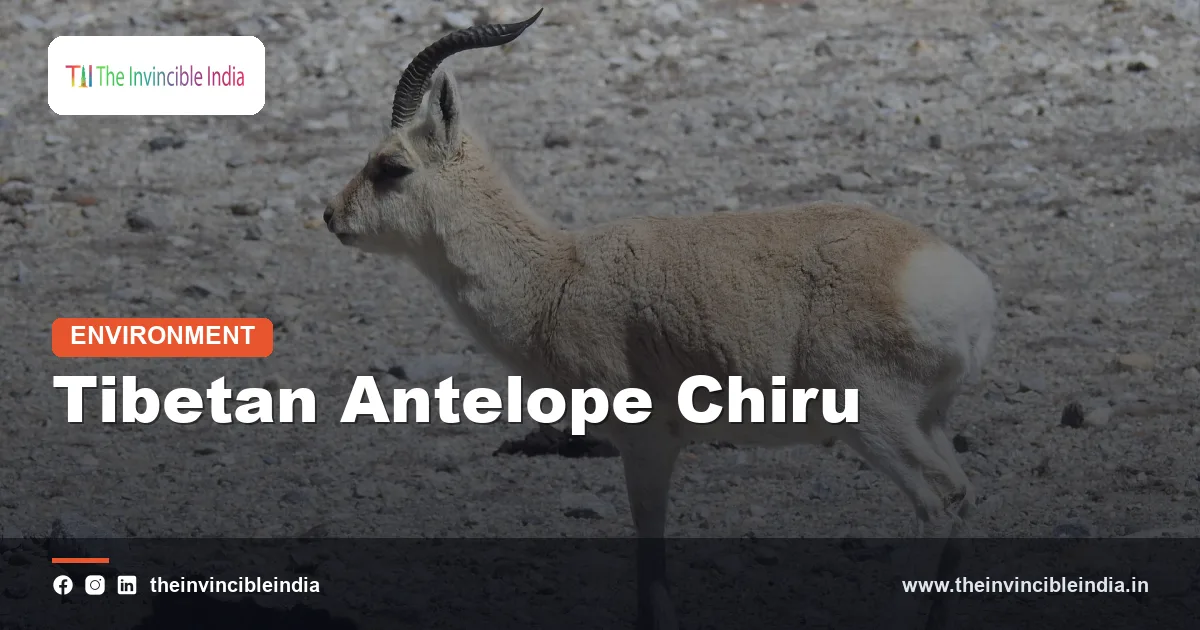
The Tibetan antelope (Pantholops hodgsonii), known in Ladakh and Tibet as the chiru, is a medium-sized, high-altitude antelope native to the cold, treeless Tibetan Plateau, with a small part of its range reaching the Chang Tang region of eastern Ladakh in India. The species was driven towards the brink by the illegal demand for shahtoosh, an ultra-fine wool taken from its underfur, and its recovery since the 1990s is regarded as one of the more hopeful conservation stories of Asian highlands.
This explainer covers where the chiru lives, how it survives at extreme altitude, why its long migration matters, how the shahtoosh trade nearly destroyed it, and what protection exists in India and internationally. Last updated: 17 October 2026.
| Attribute | Detail |
|---|---|
| Common names | Tibetan antelope, chiru (the name used in Ladakh and Tibet) |
| Scientific name | Pantholops hodgsonii (the only species in its genus) |
| Family | Bovidae (the family of cattle, antelopes, sheep and goats) |
| Main range | Tibetan Plateau in China (Tibet Autonomous Region, Qinghai, Xinjiang), with a small Indian range in the Chang Tang (Changthang) region of Ladakh |
| Typical altitude | Roughly 3,700 to 5,500 metres above sea level |
| Defining feature | Dense, extremely fine underfur known as shahtoosh; males carry long, slender, near-straight black horns |
| IUCN status | Near Threatened in recent assessments, after earlier listings as Endangered (check the current IUCN Red List) |
| Legal protection in India | Placed in the highest protection tier of the Wildlife (Protection) Act, 1972; trade in shahtoosh is prohibited |
| International trade control | Listed in Appendix I of CITES, which prohibits commercial international trade |
Key Takeaways
- The Tibetan antelope (Pantholops hodgsonii) is a high-altitude antelope of the Tibetan Plateau that lives mostly in China and in a small pocket of Ladakh in India.
- Shahtoosh, the wool taken from the underfur of the Tibetan antelope, is so fine that it can only be obtained by killing the animal, which is why its trade is illegal.
- Female Tibetan antelope make long seasonal migrations to traditional calving grounds, and any barrier across that route can threaten the population.
- Shahtoosh is a different material from pashmina, which is legally obtained from the combed fleece of the domestic Changthangi goat.
- The Tibetan antelope is protected under India’s Wildlife (Protection) Act, 1972 and under Appendix I of CITES, and its numbers are believed to have partly recovered since the 1990s.
- Population figures for the chiru are estimates that vary by survey and source, so they should be read as approximate ranges and not as exact counts.
What is the Tibetan antelope?
The Tibetan antelope is a hoofed mammal of the family Bovidae that is adapted to cold, thin-aired grasslands and desert steppe above 3,700 metres. Scientists place it in a genus of its own, Pantholops, and the species name hodgsonii honours the British naturalist Brian Houghton Hodgson, who documented a great deal of Himalayan wildlife in the nineteenth century.
An adult stands roughly 80 to 85 centimetres at the shoulder. The coat is a pale sandy fawn to reddish-brown on the back, fading to white on the belly and the inner legs. Adult males develop a dark face and dark markings on the legs, particularly in the breeding season, and they carry the long, ridged, gently curved horns that so often appear in photographs. Females are hornless and look plainer and smaller.
The face is one of the species’ most distinctive features. The nose of an adult chiru looks swollen and the nostrils are large, with air passages thought to help warm and humidify the extremely cold, dry air before it reaches the lungs. The species is gregarious in the right season, but its social groups change sharply between the sexes and across the year.
Where does the Tibetan antelope live in India?
The Tibetan antelope lives in India only in the Chang Tang (also written Changthang) region of eastern Ladakh, the Indian edge of the vast Tibetan Plateau. The animal is recorded in high, open, uninhabited tracts such as the Chang Chenmo valley, the Depsang plains and neighbouring high-altitude basins near the Line of Actual Control, where population estimates are small and surveys are difficult.
These landscapes are cold desert. Winters are long and fierce, rainfall is scarce, and vegetation consists of sparse tussock grasses, sedges and low cushion plants. Wildlife protected here includes the Changthang Cold Desert Wildlife Sanctuary, which also supports the kiang (Tibetan wild ass), the Tibetan gazelle, the bharal (blue sheep), the Tibetan wolf, the snow leopard and the black-necked crane in summer.
The Indian chiru population is a fringe of a much larger distribution that lies mostly across the border, and animals move across the plateau without regard to national boundaries. Because the terrain is remote and sensitive, exact counts in India are hard to establish and published figures should be treated with caution. Conservation of the species is therefore necessarily a transboundary concern.
How is the Tibetan antelope adapted to the high plateau?
The Tibetan antelope survives on the plateau through a combination of dense insulating fur, specialised breathing and circulation, and great mobility. At 4,500 metres the air carries only a little over half the oxygen found at sea level, and winter temperatures can fall far below freezing, so the animal needs more than a thick coat.
Insulating fur
The Tibetan antelope has a layered coat. A coarse guard-hair layer sheds wind and snow, while a very dense underfur traps warm air next to the skin. The underfur fibres are extremely thin, finer than those of most other wool-bearing animals, and this is exactly what made shahtoosh commercially attractive.
Breathing and endurance
The enlarged nasal chambers and the animal’s physiology are considered adaptations to thin, cold air. The chiru can run at high speed over open ground when pursued, and it can cover long distances during migration without access to permanent water.
Diet
The species grazes on grasses, sedges and low herbs, and in the harshest season it digs through thin snow to reach forage. It also uses shallow scrapes in the ground as resting beds that shelter it from the wind, which is a visible sign of its presence in surveys.
Why do female Tibetan antelope migrate to calving grounds?
Female Tibetan antelope migrate in early summer to traditional calving grounds, where they give birth in relative safety before returning to winter ranges. Males do not make this journey; they remain in separate groups on lower, more accessible pastures while the females and their young are away.
Researchers have documented movements of several hundred kilometres each way across the plateau, usually beginning in May or June and ending in July, with births occurring shortly after arrival. The calving grounds are generally in high basins in China, such as those in the Kekexili and Chang Tang nature reserve regions. After giving birth, females and calves head back, often joined by males in autumn for the rut.
The chief value of the migration is not fully settled, but proposed advantages include access to fresh summer forage and reduced predation pressure on newborn calves. Whatever the reason, the pattern shows that the Tibetan antelope needs large, connected landscapes. Fences, roads, railway embankments and other infrastructure can interrupt the route, which is why wildlife crossings have become part of high-altitude infrastructure planning on the plateau.
What is shahtoosh and why did it endanger the chiru?
Shahtoosh is a luxury wool woven from the fine underfur of the Tibetan antelope, and the demand for it caused heavy illegal killing of the species during the late twentieth century. The name comes from Persian and is commonly translated as “king of fine wool” or “king of wools”.
The fibre is only around 10 to 12 microns thick, which is much finer than ordinary cashmere. A single shawl is usually said to require the underfur of several animals, commonly cited as three to five, because the chiru, unlike the cashmere goat or the yak, cannot be combed or shorn safely in the wild. The wool had to be taken by killing the animal, and the hides then went through a chain of middlemen.
The result was a sustained illegal market. Poaching intensified in the 1980s and 1990s, and population figures for the plateau fell sharply from earlier decades, though the numbers quoted for the period differ among sources and should be read as approximations. Alarm over the decline prompted international attention, tougher law enforcement and public awareness campaigns, and the species was moved to the strictest trade-control category.
How did the shahtoosh trade reach India?
The shahtoosh trade reached India through smuggling routes that carried raw wool from the Tibetan Plateau to weaving workshops in Jammu and Kashmir, where the yarn was spun and woven into shawls for domestic and international buyers. The raw material often crossed through Nepal and the Himalayan trade corridors before reaching craftspeople in Srinagar.
Enforcement agencies in India have carried out raids over the years, and shawls have been seized in Indian cities and in overseas airports. Courts have heard cases involving possession and sale. The trade has also had a human side: many of the weavers and spinners involved were artisans who depended on the work, and conservation policy discussions have noted the need for alternative livelihoods based on legal materials such as pashmina.
Today, buying, selling or owning shahtoosh in India is prohibited under the Wildlife (Protection) Act, 1972 and its amendments, and shawls are subject to seizure. Readers who come across a very light, extremely warm “ring shawl” offered at an unusually low or unusually high price should assume it may be illegal and avoid it.
What is the difference between shahtoosh and pashmina?
Shahtoosh comes from the wild Tibetan antelope and cannot be obtained without killing the animal, whereas pashmina comes from the domestic Changthangi goat of Ladakh and is combed from the animal each spring without harming it. The two are often confused because both are associated with Kashmir weaving and both are fine and warm.
| Feature | Shahtoosh | Pashmina |
|---|---|---|
| Source animal | Wild Tibetan antelope (chiru) | Domestic Changthangi goat (Capra hircus) |
| How it is obtained | By killing the animal | By combing the soft undercoat in spring |
| Fibre fineness | Extremely fine, around 10 to 12 microns | Fine, commonly about 12 to 16 microns |
| Legal status in India | Prohibited | Legal and an established craft product |
| Herding community | None; the source animal is wild | Changpa pastoralists of Ladakh |
Because pashmina is a legal, renewable product raised by pastoral communities, it is often held up as the conservation-friendly alternative. Efforts to protect and label genuine pashmina have been part of the wider effort to separate legal textiles from the shahtoosh market.
What other threats does the Tibetan antelope face?
Beyond poaching, the Tibetan antelope faces threats from habitat fragmentation, competition with livestock, infrastructure expansion and climate change. These pressures are slower than the direct killing of the past but may become more important as the species recovers.
- Infrastructure: Roads, fences, mining and railways can block migration routes and disturb calving grounds.
- Livestock competition: Expanding herds of domestic sheep, goats and yaks compete for limited high-altitude pasture, particularly in areas where nomadic grazing has changed.
- Climate change: Warming on the plateau changes snow cover and vegetation, and may alter forage availability along migration routes.
- Predation and winter stress: Natural predators such as the Tibetan wolf take animals, and severe winters can cause heavy losses, so a small population is more vulnerable.
- Residual poaching: Illegal hunting has not disappeared, and demand for shahtoosh can return if enforcement weakens.
In the Indian portion of the range, remoteness, border sensitivity and limited monitoring present additional challenges. Wildlife managers in Ladakh work with local communities and the armed forces stationed in the region, and the protection of the species depends on cooperation among them.
Is the Tibetan antelope legally protected?
Yes, the Tibetan antelope is legally protected in India under the Wildlife (Protection) Act, 1972, and internationally under the Convention on International Trade in Endangered Species of Wild Fauna and Flora (CITES). The species sits in the highest protection category of the Indian law, which prohibits hunting and trade and prescribes severe penalties, though readers should check the current schedules after recent amendments.
CITES, which India joined in 1976, lists the Tibetan antelope in Appendix I, a category that generally bans commercial international trade in the species and its products. This is the main international barrier to the movement of shahtoosh shawls. Customs and wildlife authorities use it to seize shawls at borders and airports.
China, which holds most of the species’ range, protects the Tibetan antelope under its own wildlife laws and has established large reserves on the plateau, including in Qinghai, Tibet and Xinjiang. Anti-poaching patrols there, some of them led by local rangers at great personal risk, have been credited with helping the population to recover.
What conservation measures have helped the chiru recover?
Several complementary measures have helped the Tibetan antelope recover: strict legal protection, anti-poaching patrols, international trade controls, public awareness and protected areas. No single step was enough, but together they reduced the killing and allowed some populations to rebuild from their lowest point.
| Period | Development |
|---|---|
| 1970s | India passes the Wildlife (Protection) Act, 1972 and later joins CITES; the chiru is listed in the strictest categories |
| 1980s to 1990s | Intensive poaching for shahtoosh; population estimates for the plateau fall sharply |
| 1990s | Anti-poaching patrols begin on the plateau; international pressure on the shawl trade grows |
| Early 2000s | Large protected areas in China are consolidated; enforcement and shawl seizures increase |
| Mid-2000s onward | Wildlife underpasses are built along the Qinghai-Tibet railway; some surveys record population recovery |
| Later assessments | The IUCN downgrades the species’ conservation status to Near Threatened (check the current listing) |
The case is often cited as proof that targeted law enforcement and demand-side campaigns can work. It also shows the limits of success: the chiru is still a species that depends on continued vigilance, and its status is not guaranteed.
How can the public help protect the chiru?
The public can help protect the Tibetan antelope mainly by refusing to buy or trade shahtoosh, by choosing certified pashmina, and by reporting suspected illegal wildlife products to the authorities. Consumer demand drove the original decline, so consumer behaviour remains central to the species’ safety.
- Avoid very fine, light “ring shawls” offered without documentation, and be cautious about origin claims.
- Buy pashmina from sellers who can demonstrate that the wool comes from the domestic Changthangi goat.
- Report suspected wildlife trade to the state forest or wildlife department or to national wildlife crime enforcement bodies.
- Support responsible tourism in Ladakh and respect restrictions in sensitive wildlife areas.
- Share accurate information about the difference between shahtoosh and pashmina, since the confusion helps illegal sellers.
Bottom Line
The Tibetan antelope, or chiru, is a specialist of the high Tibetan Plateau whose small Indian presence in Ladakh’s Chang Tang forms part of a much larger, shared landscape. Shahtoosh demand once pushed the species towards extinction, and strict law, patrols and global trade controls helped it recover, but long migrations and a vulnerable habitat mean that careful, continuing protection is still needed.
Frequently Asked Questions
What is a Tibetan antelope?
A Tibetan antelope, or chiru, is a high-altitude antelope (Pantholops hodgsonii) that lives on the Tibetan Plateau and in the Chang Tang region of Ladakh. Males have long, slender black horns, while females are hornless. The animal is known for its extremely fine underfur, which was the source of the illegal shahtoosh trade.
Where can the chiru be found in India?
The chiru is found in India only in the high, cold desert of eastern Ladakh, in the Chang Tang region. It is associated with remote areas such as the Chang Chenmo valley and the Depsang plains. Because these places are remote and strategically sensitive, numbers are small and surveys are limited.
Why is shahtoosh illegal?
Shahtoosh is illegal because it can only be obtained by killing the Tibetan antelope, a protected species. Its trade is prohibited under India’s Wildlife (Protection) Act, 1972 and under CITES Appendix I. Possession, sale and export of shahtoosh shawls can lead to seizure and criminal penalties.
What is the difference between shahtoosh and pashmina?
Shahtoosh comes from the wild chiru and requires killing the animal, while pashmina comes from the domestic Changthangi goat and is combed off in spring. Pashmina is a legal and traditional product of Ladakh and Kashmir. Shahtoosh is banned, and the two should never be treated as interchangeable.
Is the Tibetan antelope endangered?
The Tibetan antelope was once classed as Endangered, but later IUCN assessments have placed it in the Near Threatened category after a partial recovery. The recovery has depended on anti-poaching efforts and trade controls. Readers should check the current IUCN Red List entry, as classifications can be revised.
Why do Tibetan antelope migrate?
Female Tibetan antelope migrate in early summer to calving grounds, where they give birth before returning to their winter ranges. Likely benefits include better summer forage and safer conditions for newborn calves. Because the journey can cover several hundred kilometres, the species depends on open, unobstructed landscapes.
{“@context”:”https://schema.org”,”@graph”:[{“@type”:”FAQPage”,”mainEntity”:[{“@type”:”Question”,”name”:”What is a Tibetan antelope?”,”acceptedAnswer”:{“@type”:”Answer”,”text”:”A Tibetan antelope, or chiru, is a high-altitude antelope (Pantholops hodgsonii) that lives on the Tibetan Plateau and in the Chang Tang region of Ladakh. Males have long, slender black horns, while females are hornless. The animal is known for its extremely fine underfur, which was the source of the illegal shahtoosh trade.”}},{“@type”:”Question”,”name”:”Where can the chiru be found in India?”,”acceptedAnswer”:{“@type”:”Answer”,”text”:”The chiru is found in India only in the high, cold desert of eastern Ladakh, in the Chang Tang region. It is associated with remote areas such as the Chang Chenmo valley and the Depsang plains. Because these places are remote and strategically sensitive, numbers are small and surveys are limited.”}},{“@type”:”Question”,”name”:”Why is shahtoosh illegal?”,”acceptedAnswer”:{“@type”:”Answer”,”text”:”Shahtoosh is illegal because it can only be obtained by killing the Tibetan antelope, a protected species. Its trade is prohibited under India’s Wildlife (Protection) Act, 1972 and under CITES Appendix I. Possession, sale and export of shahtoosh shawls can lead to seizure and criminal penalties.”}},{“@type”:”Question”,”name”:”What is the difference between shahtoosh and pashmina?”,”acceptedAnswer”:{“@type”:”Answer”,”text”:”Shahtoosh comes from the wild chiru and requires killing the animal, while pashmina comes from the domestic Changthangi goat and is combed off in spring. Pashmina is a legal and traditional product of Ladakh and Kashmir. Shahtoosh is banned, and the two should never be treated as interchangeable.”}},{“@type”:”Question”,”name”:”Is the Tibetan antelope endangered?”,”acceptedAnswer”:{“@type”:”Answer”,”text”:”The Tibetan antelope was once classed as Endangered, but later IUCN assessments have placed it in the Near Threatened category after a partial recovery. The recovery has depended on anti-poaching efforts and trade controls. Readers should check the current IUCN Red List entry, as classifications can be revised.”}},{“@type”:”Question”,”name”:”Why do Tibetan antelope migrate?”,”acceptedAnswer”:{“@type”:”Answer”,”text”:”Female Tibetan antelope migrate in early summer to calving grounds, where they give birth before returning to their winter ranges. Likely benefits include better summer forage and safer conditions for newborn calves. Because the journey can cover several hundred kilometres, the species depends on open, unobstructed landscapes.”}}]}]}


