

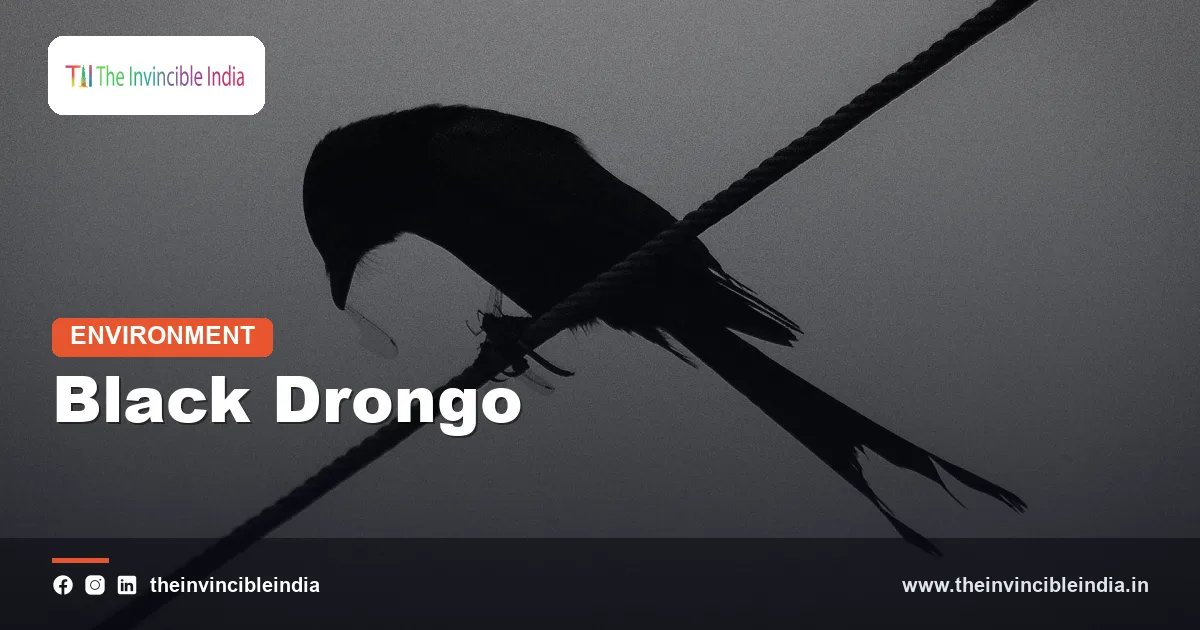
The black drongo (Dicrurus macrocercus) is a glossy, jet-black songbird of about 28 cm with a deeply forked tail, found across most of India, where it perches on wires, fence posts and the backs of cattle to hawk insects in mid-air. The black drongo is popularly called the “king crow” because of its fearless habit of attacking much larger birds, including crows, kites and eagles, that come near its nest.
Few Indian birds are as easy to find or as bold as the black drongo. It is a familiar sight along roads, over crop fields and at village edges, and it is valued by farmers as a natural controller of insects. This explainer covers its appearance, range, hunting style, voice, nesting behaviour and the protective role it plays for other birds.
Quick Facts: Black Drongo
| Common name | Black drongo (also king crow; kotwal in Hindi) |
|---|---|
| Scientific name | Dicrurus macrocercus |
| Family | Dicruridae (drongos) |
| Size | About 28 cm long |
| Plumage | Glossy black with a bluish or greenish sheen; deeply forked tail |
| Eyes | Dark red to reddish-brown |
| Typical habitat | Open farmland, grassland, village edges, light woodland, roadsides |
| Main diet | Flying and ground insects, plus occasional small vertebrates and nectar |
| Conservation status | Least Concern on the IUCN Red List |
Key Takeaways
- The black drongo (Dicrurus macrocercus) is a glossy black, fork-tailed songbird of about 28 cm that is common across most of India.
- The black drongo is nicknamed the “king crow” because it fearlessly mobs and drives away crows, kites and even eagles from its nesting area.
- The black drongo hunts insects by sallying out from a perch, such as a wire, branch or the back of a cow, and catching prey in mid-air.
- The black drongo builds a shallow, exposed cup nest of twigs and grass bound with cobweb, usually high in a tree fork, and small birds often nest nearby for protection.
- The black drongo is classed as Least Concern by the IUCN and is regarded as a farmer’s ally because it eats large numbers of crop-damaging insects.
- The black drongo is often among the first birds to sing at dawn, and its calls include harsh notes, whistles and imitations of other species.
What does the black drongo look like?
The black drongo is a slim, upright bird about 28 cm long with all-black plumage that shines with a bluish or greenish gloss in sunlight, a stout, hook-tipped bill, red-brown eyes and a long tail that is deeply forked, with the outer feathers curling slightly outward at the tips. The forked tail is the single most useful field mark and makes the bird easy to identify even in silhouette on a wire.
Adults of both sexes look the same. Many adults show a tiny white spot at the base of the bill, though it is not always visible. Young birds are duller and browner, often with pale fringes on the belly feathers and a less deeply forked tail, which deepens as the bird matures.
The black drongo usually sits very upright. Its legs are short and its feet are small, which suits perching rather than walking, and the bird seldom spends long periods on the ground. The sleek form and the long, agile tail help it twist and turn in flight while chasing flying insects.
Why is the black drongo called the king crow?
The black drongo is called the “king crow” because it is black like a crow but behaves like a fearless ruler, chasing away birds many times its size from its territory. The English name was widely used during the colonial era and is still common in Indian speech and in older bird books.
The bird is not related to crows, which are members of the corvid family. Drongos belong to their own family, Dicruridae, and are more closely linked to monarch flycatchers and fantails. The word “drongo” itself is thought to come from the Malagasy language of Madagascar, where it was a name for local drongo species.
In Hindi, the black drongo is often called kotwal, meaning village watchman or police officer. The name reflects the bird’s guarding behaviour, as it patrols open ground, shows no fear and drives off intruders. Both names show how closely rural communities have observed the bird’s character.
Where does the black drongo live in India?
The black drongo lives across most of India, from the plains and foothills of the north to the southern peninsula, and is especially common in open country with scattered trees. It is found throughout South Asia, including Sri Lanka, and extends east through South-East Asia into southern China.
The bird is common in a wide range of settings:
- Cultivated fields and orchards, where it uses poles, wires and bare branches as lookouts.
- Grasslands and scrub, particularly where cattle or buffalo graze.
- Roadsides, railway lines and village edges.
- Light, open woodland and the margins of forests.
Most black drongos in peninsular India are resident, staying in the same area through the year. Birds from the northern and Himalayan parts of the range move seasonally, with some shifting to lower elevations or warmer plains in winter. As a result, the density of black drongos in a given district can change across the year even though the species stays common.
How does the black drongo hunt?
The black drongo hunts by sitting on an exposed perch, watching for insects and flying out in a quick, agile loop to catch them in mid-air before returning to the same spot. This technique, known as sallying or hawking, is typical of drongos and flycatchers.
The bird will use almost any raised perch: a telegraph wire, a fence post, a dry twig or the back of a grazing animal. Cattle and buffalo are especially useful, because the animals disturb grasshoppers, beetles and other insects as they move through grass, and the drongo catches the insects as they take flight.
Other feeding habits
- It sometimes drops to the ground to seize insects, small lizards or other small prey.
- It gathers at grassland and stubble fires to catch insects fleeing the flames.
- It hunts around street lights at dusk, where moths and other insects are drawn to the glow.
- It drinks nectar from flowering trees such as silk-cotton and coral trees, and may carry pollen between flowers as a side effect.
Because its diet includes grasshoppers, caterpillars, beetles, flies and moths, the black drongo is widely regarded as a beneficial bird for agriculture.
Why is the black drongo so fearless?
The black drongo is so fearless because its nesting success depends on driving potential predators away early, and its agility lets it attack much larger birds without being caught. It dives at crows, kites, shikras and even eagles, striking them on the back or head and sometimes riding on them for a short distance while pecking.
The behaviour is called mobbing. It is loud and conspicuous, and it warns other birds of the danger. Larger raptors usually leave the area rather than risk injury. The black drongo also defends its territory against squirrels, snakes, monitor lizards and, on occasion, people who approach the nest too closely.
This aggression is not random. The bird is most defensive during the breeding season, when eggs and chicks are vulnerable. Outside that season, black drongos often tolerate neighbours and may roost together in groups at night.
How does the black drongo breed and nest?
The black drongo breeds by building a shallow cup nest of twigs, grass and fibre, bound together with cobwebs, placed in a fork of a tree, often at a fairly exposed height. The nest looks small and delicate, but it is firmly anchored and well defended.
In much of India the breeding season runs from roughly March to August, with timing varying by region. The female lays a small clutch of about three or four eggs, which are whitish or cream with reddish-brown markings. Both parents share incubation, which lasts about two weeks, and both feed the chicks on a diet of insects.
Young birds leave the nest after a few weeks but stay with the parents for some time while they learn to hunt. The parents continue to guard them fiercely during this period, mobbing any threat that comes near.
Does the black drongo protect other birds?
The black drongo does provide indirect protection to other birds, because smaller species often choose nest sites close to a drongo nest and benefit from its aggressive defence. This pattern, sometimes described as an “umbrella” or protective association, has been noted in several field observations and studies in Asia.
The reasoning is simple. Any crow, kite or other predator that enters the area is attacked by the drongo, and the neighbouring birds gain from the early warning and the removal of the threat. Birds such as doves, bulbuls, orioles, mynas and weavers have been reported nesting near drongo nests, although the strength of the effect can differ from place to place and species to species.
The drongo itself may not intend to protect neighbours, and the benefit is a by-product of its own territorial defence. Even so, the arrangement has made the black drongo an interesting subject of study in animal behaviour.
What is the call of the black drongo?
The black drongo has a varied voice that includes harsh, metallic notes, clear whistles and a rich, rambling song, and it is often one of the first birds to start calling before sunrise. The pre-dawn singing is a well-known feature of the species in Indian villages and is sometimes given as a reason for the bird’s popular name of watchman.
Drongos are also skilled mimics. Black drongos have been reported imitating the calls of other birds, including raptors and alarm calls, and some drongo species elsewhere in the world are known to use false alarm calls to make other animals drop their food. The extent and purpose of mimicry in the black drongo is still being studied, and it should not be overstated.
The bird’s alarm call is a loud, repeated scolding sound that warns neighbours of danger.
How do you tell the black drongo from other drongos?
The black drongo is told apart from other drongos by its uniform glossy black plumage, moderately deep fork in the tail, open-country habits and lack of crest or tail streamers. Several other drongos occur in India, and the table below compares the most commonly encountered ones.
| Drongo | Key identification features | Usual habitat |
|---|---|---|
| Black drongo | All black with a glossy sheen, deeply forked tail, red-brown eyes | Open farmland, roadsides, grassland |
| Ashy drongo | Slate-grey rather than black, red eyes, forked tail | Forests and wooded hills |
| White-bellied drongo | Dark bluish-grey with a white belly and vent | Forest and plantations in the peninsula |
| Bronzed drongo | Small, with metallic bronze-green sheen, shallow fork | Forest and secondary woodland |
| Greater racket-tailed drongo | Crest on the forehead and long wire-like tail streamers with racket tips | Moist forests, hills and plantations |
A bird sometimes confused with the black drongo is the fork-tailed drongo-cuckoo, a cuckoo whose plumage and tail resemble a drongo’s. Looking at the bill and the barring on the underside helps separate them.
Is the black drongo threatened, and why does it matter?
The black drongo is not threatened. The International Union for Conservation of Nature (IUCN) lists it as Least Concern, reflecting its wide range, large population and ability to live in farmland and human-modified landscapes. Native wild birds are also covered by wildlife protection law in India.
The bird matters for several reasons:
- It eats large numbers of insects, including pests of crops, and so supports pest control without chemicals.
- Its mobbing behaviour benefits neighbouring birds and keeps nest-raiders in check.
- It is a useful indicator of open, insect-rich farmland with scattered trees and perches.
The main local risks are heavy pesticide use, which reduces insect prey and can poison birds, and the removal of tall perches and nesting trees. Leaving a few standing trees, poles and hedgerows along field margins helps keep the black drongo active in an area.
Bottom Line
The black drongo is a bold, glossy, fork-tailed insect-hunter that has earned the title of king crow through its fearless defence of its territory. Common in Indian farmland and valued as an ally of farmers, the black drongo also offers shelter indirectly to smaller birds that nest nearby.
Frequently Asked Questions
What is a black drongo?
A black drongo is a glossy black, fork-tailed songbird about 28 cm long, scientifically named Dicrurus macrocercus. It is common across India and is usually seen on wires, posts and cattle in open country. It catches insects in mid-air and is widely valued by farmers.
Why is the black drongo called the king crow?
The black drongo is called the king crow because it is black like a crow and chases away much larger birds, including crows and eagles, from its territory. The bird is not related to crows. It belongs to the drongo family, Dicruridae.
What does the black drongo eat?
The black drongo eats mainly insects such as grasshoppers, beetles, moths, flies and caterpillars, which it catches in mid-air or on the ground. It occasionally takes small lizards and drinks nectar from flowers. Because of this diet, it helps control crop pests.
Why do other birds nest near the black drongo?
Other birds nest near the black drongo because it aggressively drives away predators such as crows and kites, which gives nearby nests protection. This effect is sometimes called the drongo umbrella. It is a by-product of the drongo’s own territorial defence, and its strength varies by place and species.
Is the black drongo found throughout India?
Yes, the black drongo is found across most of India, in open farmland, grassland, roadsides and light woodland. Birds in the peninsula are largely resident, while those from northern and Himalayan areas may move seasonally. It is common enough that it is one of the easiest birds for beginners to find.
Is the black drongo an endangered bird?
No, the black drongo is not endangered; the IUCN lists it as Least Concern. Its population is large and it adapts well to farmland and villages. The main local threats are heavy pesticide use and the loss of perches and nesting trees.
{“@context”:”https://schema.org”,”@graph”:[{“@type”:”FAQPage”,”mainEntity”:[{“@type”:”Question”,”name”:”What is a black drongo?”,”acceptedAnswer”:{“@type”:”Answer”,”text”:”A black drongo is a glossy black, fork-tailed songbird about 28 cm long, scientifically named Dicrurus macrocercus. It is common across India and is usually seen on wires, posts and cattle in open country. It catches insects in mid-air and is widely valued by farmers.”}},{“@type”:”Question”,”name”:”Why is the black drongo called the king crow?”,”acceptedAnswer”:{“@type”:”Answer”,”text”:”The black drongo is called the king crow because it is black like a crow and chases away much larger birds, including crows and eagles, from its territory. The bird is not related to crows. It belongs to the drongo family, Dicruridae.”}},{“@type”:”Question”,”name”:”What does the black drongo eat?”,”acceptedAnswer”:{“@type”:”Answer”,”text”:”The black drongo eats mainly insects such as grasshoppers, beetles, moths, flies and caterpillars, which it catches in mid-air or on the ground. It occasionally takes small lizards and drinks nectar from flowers. Because of this diet, it helps control crop pests.”}},{“@type”:”Question”,”name”:”Why do other birds nest near the black drongo?”,”acceptedAnswer”:{“@type”:”Answer”,”text”:”Other birds nest near the black drongo because it aggressively drives away predators such as crows and kites, which gives nearby nests protection. This effect is sometimes called the drongo umbrella. It is a by-product of the drongo’s own territorial defence, and its strength varies by place and species.”}},{“@type”:”Question”,”name”:”Is the black drongo found throughout India?”,”acceptedAnswer”:{“@type”:”Answer”,”text”:”Yes, the black drongo is found across most of India, in open farmland, grassland, roadsides and light woodland. Birds in the peninsula are largely resident, while those from northern and Himalayan areas may move seasonally. It is common enough that it is one of the easiest birds for beginners to find.”}},{“@type”:”Question”,”name”:”Is the black drongo an endangered bird?”,”acceptedAnswer”:{“@type”:”Answer”,”text”:”No, the black drongo is not endangered; the IUCN lists it as Least Concern. Its population is large and it adapts well to farmland and villages. The main local threats are heavy pesticide use and the loss of perches and nesting trees.”}}]}]}


