

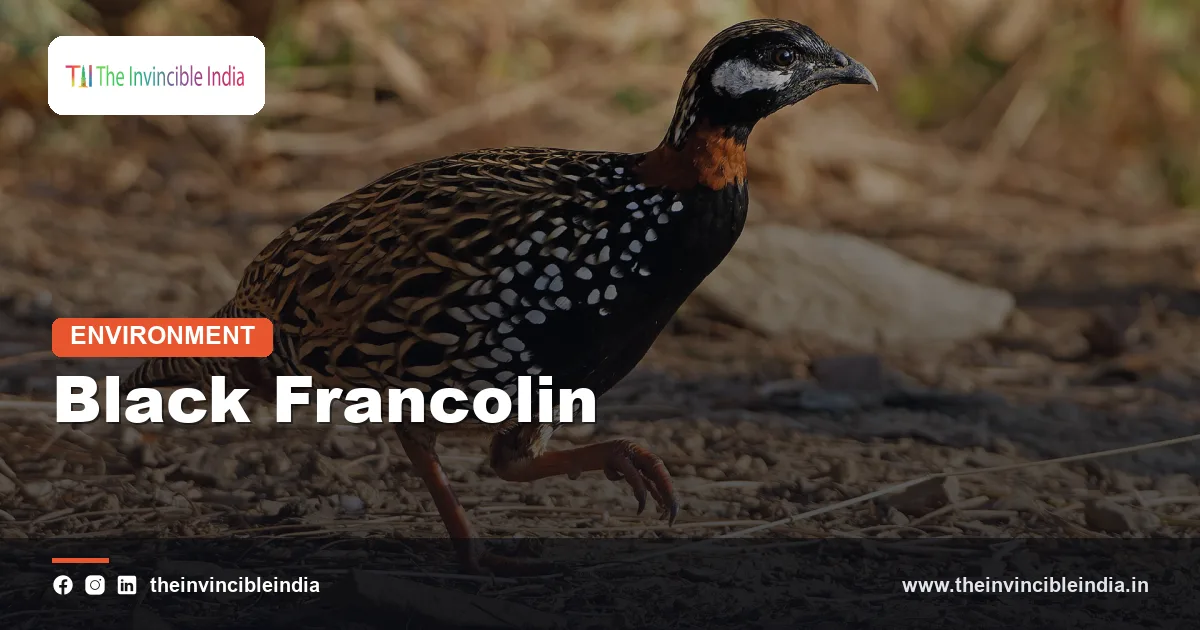
The black francolin (Francolinus francolinus) is a medium-sized gamebird of the pheasant family, found in tall grass, sugarcane and scrub across northern and north-eastern India, where the male is easily recognised by its glossy black plumage spotted with white. Known as kala titar in Hindi and Urdu, the bird spends most of its life on the ground, runs rather than flies when disturbed, and announces its territory with a loud, metallic call that carries across fields at dawn and dusk.
The black francolin is one of the few francolins that live in Asia, and it is the state bird of Haryana. This explainer covers how to identify the black francolin, where it lives in India, what it eats, how it breeds, how it differs from similar gamebirds, and why its numbers have fallen in many districts.
Quick Facts
| Common name | Black francolin (also called black partridge) |
|---|---|
| Scientific name | Francolinus francolinus |
| Family and order | Phasianidae, order Galliformes |
| Indian names | Kala titar (Hindi, Urdu); other regional names in Punjabi, Bengali and Assamese |
| Size | About 31 to 36 cm long; male larger and darker than the female |
| Range and habitat | Northern and north-eastern Indian plains, Himalayan foothills and Terai; tall grass, sugarcane, tamarisk and wet scrub near cultivation |
| Diet | Seeds, grain, shoots, tubers, termites and other insects |
| Breeding season | Roughly April to September, with a peak around the monsoon |
| Conservation status | Least Concern (IUCN), but declining locally; legally protected in India |
Key Takeaways
- The black francolin is a ground-dwelling gamebird of the pheasant family whose scientific name is Francolinus francolinus.
- The male black francolin has a black face and underparts finely spotted with white, white cheek patches and a bright chestnut collar.
- The black francolin lives in tall grass, sugarcane fields and moist scrub across northern and north-eastern India and the Himalayan foothills.
- The male black francolin gives a loud, rhythmic call from a mound or clod of earth, which listeners in north India have long rendered as a phrase meaning “glory to your creation”.
- The black francolin eats mostly seeds, grain and green shoots, supplemented with insects, which makes it both a farmland resident and a minor pest controller.
- The black francolin is the state bird of Haryana, and loss of grassland, wetland edge and hedgerow habitat is the main reason its numbers have fallen locally.
What is the black francolin?
The black francolin is a ground-nesting gamebird in the family Phasianidae, the same family that includes pheasants, partridges, quails and junglefowl. Its genus name Francolinus is shared with many African species, but the black francolin is the best-known francolin of South and West Asia. The species was formally described by Linnaeus in the 18th century and has remained a familiar bird of the Indo-Gangetic plain ever since.
The bird is built like a plump partridge, with a short rounded body, a short tail, strong legs and a stout bill adapted to pecking seeds. It is a bird of cover rather than open ground, and it relies on dense vegetation to hide from foxes, jackals, jungle cats and raptors. Several subspecies are recognised across its wide range, and the form found in most of north India differs slightly in tone and size from those in Iran and the Caucasus.
How do you identify a male and female black francolin?
The male black francolin is identified by its black face and underparts, white-spotted flanks, white cheek patch, chestnut collar and chestnut patch under the tail, while the female is a duller, barred brown bird. The sexes are strongly different, which is unusual among Indian gamebirds and makes the species one of the easiest to identify once seen.
The male
- Glossy black head and breast, with a bold white patch on each side of the face.
- Rich chestnut collar around the nape and neck.
- Black underparts and flanks marked with neat white spots.
- Brown back with buff-edged feathers, and a chestnut patch beneath the tail.
- Reddish-orange legs and a black bill; a short spur on each leg.
The female
The female black francolin is mottled brown and buff with fine barring on the underparts, a pale throat and a rufous patch on the back of the neck. The pattern blends well with dry grass and leaf litter, which suits a bird that must sit motionless on a ground nest for weeks. Young birds look like the female until their first moult, after which young males slowly acquire black plumage.
Where does the black francolin live in India?
The black francolin lives in the northern and north-eastern plains of India, along the foothills of the Himalaya and in the Terai belt, wherever tall grass, crops and damp scrub occur together. Its Indian range stretches broadly from Punjab, Haryana and the Ganga plains through Bihar and West Bengal to the Brahmaputra valley in Assam, and it also extends west through Pakistan and Iran to Turkey and Cyprus.
The habitat that suits the black francolin best is a mosaic rather than a single landscape type. A typical territory includes a patch of tall grass or sugarcane for cover, a canal bank or marsh edge for water, a field of wheat, mustard or pulses for food, and a few thorn bushes or tamarisk clumps for shade. Because it needs this combination, the black francolin is far commoner in the wetter north than in the arid west or the peninsula, where its relatives take over.
What does the black francolin eat?
The black francolin eats mainly seeds, grain, green shoots, roots and tubers, along with termites, ants, beetles, grasshoppers and other insects. The bird feeds on the ground, scratching at the soil with its feet and picking items with its bill, usually in the early morning and again in the late afternoon.
The diet shifts with the season. After harvest, the bird gleans spilt wheat, rice and millet from stubble fields. During the monsoon, it relies more on insects and fresh shoots, and chicks are fed almost entirely on small invertebrates, which supply the protein they need to grow quickly. The bird needs to drink regularly, which keeps it close to canals, ponds, ditches and marsh edges.
Why does the black francolin call so loudly?
The male black francolin calls loudly to advertise its territory and attract females, and the call is among the most recognisable sounds of north Indian farmland. The sound is a harsh, ringing, rhythmic series of notes that rises in pitch, and local listeners have rendered it as a Hindi-Urdu phrase meaning “glory to your creation” in praise of the Creator.
The male usually calls from a raised spot such as a termite mound, a clod of earth, a low branch or a bund. Calling peaks at dawn and dusk and is most frequent in the breeding season, when neighbouring males answer one another across fields. The call also betrays the bird to hunters, which is one reason the species has been targeted for so long. A bird that gives its position away so reliably is much easier to find than a silent one.
How does the black francolin breed and raise its young?
The black francolin breeds on the ground, with the female laying a clutch of roughly six to ten eggs in a shallow scrape lined with grass and hidden in thick cover. Breeding runs from about April to September in much of India, and many pairs time their nesting to the arrival of the monsoon, when cover grows tall and insects are abundant.
The female incubates the eggs alone for a little over three weeks, while the male stays nearby, calling and defending the territory. The chicks are precocial, which means they leave the nest within hours of hatching and feed themselves under the female’s watch. They can flutter short distances within about a fortnight, and they stay with the female until they are well grown. Nests in standing crops are often lost when fields are harvested, and ground nests are open to dogs, mongooses and snakes.
How does the black francolin differ from other Indian gamebirds?
The black francolin differs from other Indian gamebirds chiefly in its strongly patterned black male, its preference for tall damp grass, and its northern range. Several similar-sized ground birds share its landscape, and the comparison below shows how they are separated.
| Bird | Typical habitat | Key identification point | Main Indian range |
|---|---|---|---|
| Black francolin | Tall grass, sugarcane, moist scrub | Male black with white spots and chestnut collar | North and north-east plains, Terai |
| Grey francolin | Dry open scrub and farmland | Both sexes grey-brown, barred, with a pale throat edged in black | Most of the drier plains and peninsula |
| Painted francolin | Grassland and scrub near water | Heavily spotted underparts and rufous face | Central and peninsular India |
| Painted spurfowl | Rocky scrub hills | Spotted male with chestnut back, multiple leg spurs | Peninsular and central India |
The grey francolin is often heard in the same districts, and its loud, creaking call is easily confused with that of the black francolin by beginners. The two birds generally avoid each other ecologically, with the grey francolin favouring drier, more open ground and the black francolin keeping to wetter, denser cover.
What threats does the black francolin face?
The main threats to the black francolin are the loss of tall grass and wetland edge habitat, intensive farming, and hunting and trapping. The species is listed as Least Concern globally because its range is wide, but it has disappeared from many local areas, particularly where marshes have been drained and field boundaries cleared.
- Habitat loss: Conversion of grassland and marsh to monoculture crops, brick kilns and housing removes nesting cover.
- Pesticides and harvest timing: Chemicals reduce insect food for chicks, and mechanised harvesting destroys nests in standing crops.
- Hunting and trapping: The bird has long been hunted for the table and trapped for its call, despite legal protection under the Wildlife (Protection) Act, 1972.
- Predation: Free-ranging dogs and loss of hedgerows increase the risk to ground nests.
Because the bird tolerates farmland when cover remains, conservation advice usually stresses keeping field margins, canal-bank grass and small wetlands rather than creating new reserves.
Why does the black francolin matter to farmland and culture?
The black francolin matters because it is a visible indicator of healthy farmland-wetland mosaics and because it holds a place in the cultural life of north India. A district where the black francolin still calls usually retains grass, water and low-intensity cultivation, all of which support many other species such as hares, quails, snakes and small birds.
Culturally, the call of the black francolin features in folk songs, proverbs and storytelling across Punjab, Haryana and Uttar Pradesh, and the bird has long been a symbol of the countryside. Its adoption as the state bird of Haryana reflects that association. Birdwatchers value it as a charismatic species that is still approachable in places such as grassy reserves, riverbeds and canal banks in the northern plains.
Bottom Line
The black francolin is a handsome, vocal, ground-dwelling gamebird of north and north-eastern India, valued for its striking male plumage and its ringing call. It is not globally threatened, but it depends on grass, water and gentle farming, and it declines quickly when those disappear.
Frequently Asked Questions
What is a black francolin?
A black francolin is a medium-sized gamebird of the pheasant family, Phasianidae, found in the northern and north-eastern plains of India. The male is black with white spots and a chestnut collar, while the female is brown and barred. It lives mostly on the ground in tall grass, sugarcane and scrub.
What is the black francolin called in Hindi?
The black francolin is called kala titar in Hindi and Urdu, meaning black partridge. The word titar is used for partridges and francolins generally, and other regional names exist in Punjabi, Bengali and Assamese.
Which Indian state has the black francolin as its state bird?
Haryana has the black francolin as its state bird. The bird was chosen because it is a familiar, characteristic species of the farmland and grassland of the Haryana plains, and its call is strongly linked with the countryside.
What does the black francolin eat?
The black francolin eats seeds, grain, green shoots, roots and insects such as termites and beetles. Adults take more plant food, while chicks depend on small insects for the protein they need to grow.
Can the black francolin fly?
Yes, the black francolin can fly, but it prefers to run and hide. When flushed, it bursts into the air with a whirr of wings, flies low and fast for a short distance, then drops back into cover. It rarely makes long flights.
Is the black francolin endangered?
No, the black francolin is not globally endangered, as the IUCN lists it as Least Concern. However, populations have declined in many parts of India because of habitat loss, hunting and trapping, and the species is legally protected under the Wildlife (Protection) Act, 1972.
{“@context”:”https://schema.org”,”@graph”:[{“@type”:”FAQPage”,”mainEntity”:[{“@type”:”Question”,”name”:”What is a black francolin?”,”acceptedAnswer”:{“@type”:”Answer”,”text”:”A black francolin is a medium-sized gamebird of the pheasant family, Phasianidae, found in the northern and north-eastern plains of India. The male is black with white spots and a chestnut collar, while the female is brown and barred. It lives mostly on the ground in tall grass, sugarcane and scrub.”}},{“@type”:”Question”,”name”:”What is the black francolin called in Hindi?”,”acceptedAnswer”:{“@type”:”Answer”,”text”:”The black francolin is called kala titar in Hindi and Urdu, meaning black partridge. The word titar is used for partridges and francolins generally, and other regional names exist in Punjabi, Bengali and Assamese.”}},{“@type”:”Question”,”name”:”Which Indian state has the black francolin as its state bird?”,”acceptedAnswer”:{“@type”:”Answer”,”text”:”Haryana has the black francolin as its state bird. The bird was chosen because it is a familiar, characteristic species of the farmland and grassland of the Haryana plains, and its call is strongly linked with the countryside.”}},{“@type”:”Question”,”name”:”What does the black francolin eat?”,”acceptedAnswer”:{“@type”:”Answer”,”text”:”The black francolin eats seeds, grain, green shoots, roots and insects such as termites and beetles. Adults take more plant food, while chicks depend on small insects for the protein they need to grow.”}},{“@type”:”Question”,”name”:”Can the black francolin fly?”,”acceptedAnswer”:{“@type”:”Answer”,”text”:”Yes, the black francolin can fly, but it prefers to run and hide. When flushed, it bursts into the air with a whirr of wings, flies low and fast for a short distance, then drops back into cover. It rarely makes long flights.”}},{“@type”:”Question”,”name”:”Is the black francolin endangered?”,”acceptedAnswer”:{“@type”:”Answer”,”text”:”No, the black francolin is not globally endangered, as the IUCN lists it as Least Concern. However, populations have declined in many parts of India because of habitat loss, hunting and trapping, and the species is legally protected under the Wildlife (Protection) Act, 1972.”}}]}]}


