

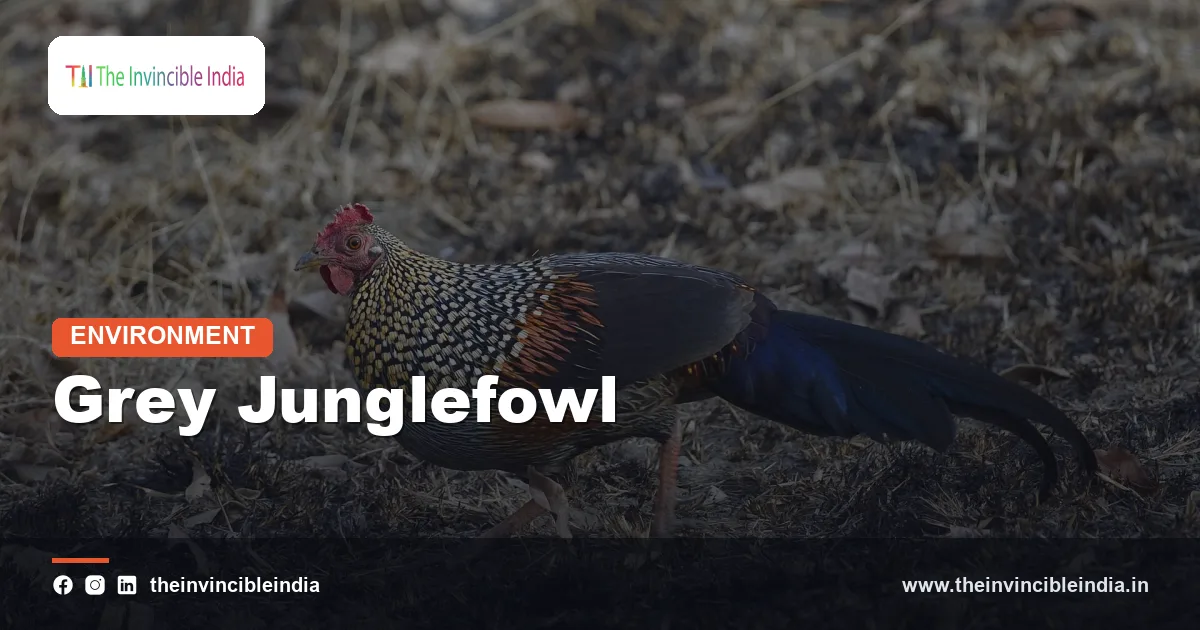
The grey junglefowl (Gallus sonneratii) is a wild jungle fowl endemic to peninsular India, a forest-floor bird that looks like a slender, grey-flecked version of a farmyard rooster and is one of the closest wild relatives of the domestic chicken. Also called Sonnerat’s junglefowl, the species lives in the Western Ghats, the Eastern Ghats and the dry and moist deciduous forests of the Deccan, where the male’s crowing carries through the woods at dawn.
The grey junglefowl is one of the four living junglefowl species of Asia and the only one found exclusively in India. This explainer describes how to identify the grey junglefowl, where it lives, what it eats, how it breeds, what role it played in the story of the domestic chicken, and what threatens it today.
Quick Facts
| Common name | Grey junglefowl (also Sonnerat’s junglefowl) |
|---|---|
| Scientific name | Gallus sonneratii |
| Family and order | Phasianidae, order Galliformes |
| Indian names | Jungli murgi (Hindi); kaadu kozhi in Kannada and kaattu kozhi in Tamil and Malayalam |
| Size | Male up to about 80 cm including tail; female about 40 cm |
| Range and habitat | Endemic to peninsular India; scrub, bamboo, deciduous and moist forests from the Aravalli region southwards |
| Diet | Seeds, grain, bamboo seeds, berries, termites and other insects |
| Breeding season | Mainly the dry months from about February to May, varying by region |
| Conservation status | Least Concern (IUCN); legally protected in India |
Key Takeaways
- The grey junglefowl is a wild member of the pheasant family, Phasianidae, found only in peninsular India.
- The male grey junglefowl has dark grey, white-streaked plumage, a red comb and wattles, and golden-yellow tipped neck feathers that look like drops of sealing wax.
- The grey junglefowl is named after the French naturalist Pierre Sonnerat, and it is also called Sonnerat’s junglefowl.
- The yellow skin of many domestic chickens is genetically derived from the grey junglefowl, although the red junglefowl is the main wild ancestor of the chicken.
- The grey junglefowl eats seeds, grain, fruit and insects, and in bamboo forests it feeds heavily on bamboo seeds when the bamboo flowers.
- The grey junglefowl is protected under the Wildlife (Protection) Act, 1972, and the trade in its neck feathers, once prized for fishing flies, is prohibited.
What is the grey junglefowl?
The grey junglefowl is a forest bird in the genus Gallus, the same genus that contains the red junglefowl and, by descent, the domestic chicken. It belongs to the order Galliformes, a group of heavy-bodied, ground-feeding birds with strong legs, short rounded wings and a talent for sudden, explosive flight.
The species is shy and wary, and it is far more often heard than seen. It is named after Pierre Sonnerat, the 18th-century French naturalist who travelled in India and sent specimens and descriptions back to Europe. The scientific name Gallus sonneratii commemorates him, and the bird was formally described in the early 19th century.
How do you identify a grey junglefowl?
The grey junglefowl is identified by the male’s dark grey body streaked with white, his red comb and wattles, his glossy arched tail and his golden-spotted neck feathers, while the female is a plain brown bird with pale streaks below. The two sexes are very different in size and colour, as in most junglefowl.
The male
- Grey-black body feathers with narrow white shaft streaks, giving a speckled look.
- Long, pointed neck feathers (hackles) tipped with stiff, glossy yellow-orange spots that shine like polished wax.
- A red comb and throat wattles, and a bare red face.
- A long, drooping tail of glossy greenish-black feathers, with the central feathers arched.
- Strong legs with sharp spurs used in fights with rival males.
The female
The female grey junglefowl is smaller and brownish, with whitish streaks on the underparts and none of the male’s ornamental hackles or long tail. She has no comb to speak of. Her plain colouring makes her almost invisible on the forest floor when she sits on her eggs.
After the breeding season, the male goes into a so-called eclipse plumage, losing the long hackles and tail feathers and looking dowdier for some months until the full plumage grows back before the next season.
Where does the grey junglefowl live?
The grey junglefowl lives across peninsular India, in the Western Ghats, the Eastern Ghats, the Deccan plateau and parts of central India, reaching north roughly to the Aravalli hills near Mount Abu. It is absent from the Gangetic plain, the Himalaya and the north-east, where the red junglefowl takes its place.
Within its range, the bird prefers forest with a thick understory. It is found in scrub jungle, bamboo thickets, teak and sal forest, moist deciduous forest, plantations such as coffee and cardamom estates, and the edges of cultivation. It occurs from the plains to roughly 1,500 metres or higher in the hills of the south. The bird needs dense cover for safety and small open clearings for feeding, so forest tracks, stream banks and plantation edges are favoured foraging spots.
What does the grey junglefowl eat?
The grey junglefowl eats a mixed diet of seeds, grain, fallen fruit, berries, shoots, termites, ants, beetles and other insects, which it finds by scratching through leaf litter. The bird forages in small groups, often early in the morning and late in the afternoon, and rests in shade during the heat of the day.
Bamboo seed is an especially important food. When bamboo flowers and sets seed, which happens only after many years in some species, the grey junglefowl and many other forest animals feed on the abundant seed fall. The bird also visits farm edges to eat spilled grain and, in coffee and cardamom areas, takes insects and fallen berries. A male can often be seen standing on a log or a rock, watching for danger while the group feeds.
How does the grey junglefowl breed?
The grey junglefowl breeds mostly in the dry season, with the female laying a small clutch of about three to seven eggs in a shallow scrape on the forest floor, often under a bush, among bamboo or beside a rock. The exact timing varies by region and often follows the availability of food, with many records from February to May.
The female alone incubates the eggs, usually for about three weeks. The chicks hatch covered in down, leave the nest within hours and feed themselves while the female guards them. The male is promiscuous in the sense that he defends a territory, calls to attract females, and takes no part in raising the young. Nests are vulnerable to snakes, mongooses, wild pigs and feral dogs, and a good deal of the year’s breeding can be lost in a dry or disturbed season.
Why does the grey junglefowl crow?
The male grey junglefowl crows to declare his territory and to attract females, and his call is a short, rhythmic, chuckling crow rather than the long drawn-out cry of a domestic rooster. It is often written out as a quick series such as “kuk-kaya-kaya-kuk”, and it carries a long way through the forest.
The crow is heard most often at dawn and dusk, and sometimes in response to loud noises. A male will also flap his wings with a whirring sound as part of the display. During the breeding season, rival males challenge one another by calling and, if necessary, by fighting with their spurs. The birds roost at night in trees and bamboo clumps to keep out of the reach of ground predators, flying up at dusk and dropping down again at first light.
How is the grey junglefowl related to the domestic chicken?
The grey junglefowl is a close relative of the domestic chicken, and although the red junglefowl is the main wild ancestor, genetic studies have shown that the grey junglefowl contributed some genes. The best-known example is the gene for yellow skin, which appears to have entered domestic chicken lines through crossing with the grey junglefowl.
The domestic chicken was derived from the red junglefowl (Gallus gallus), which lives across South and South-East Asia, and chickens were domesticated in Asia thousands of years ago. The four living junglefowl are compared below.
| Species | Scientific name | Main range |
|---|---|---|
| Red junglefowl | Gallus gallus | Northern and eastern India, South-East Asia; main wild ancestor of the chicken |
| Grey junglefowl | Gallus sonneratii | Peninsular India only |
| Sri Lankan junglefowl | Gallus lafayettii | Sri Lanka only |
| Green junglefowl | Gallus varius | Java and nearby Indonesian islands |
The grey and red junglefowl can hybridise in captivity, and hybrids with domestic fowl have been recorded, but wild populations are generally separated by range.
What threatens the grey junglefowl?
The grey junglefowl is threatened mainly by habitat loss, hunting and the feather trade, although the species as a whole is listed as Least Concern by the IUCN. Its large range and adaptability to plantations and secondary forest keep it from being endangered at present.
- Forest loss and fragmentation: Clearing of scrub and deciduous forest for farms, mines and infrastructure removes cover and nesting ground.
- Hunting and snaring: Local hunting for meat continues in some areas despite legal protection.
- The feather trade: The male’s neck hackles were sought for tying artificial fishing flies, and the trade drove illegal killing; trade in the feathers is banned.
- Dogs and disturbance: Feral dogs and human movement near nests reduce breeding success.
The grey junglefowl is protected under the Wildlife (Protection) Act, 1972, and it occurs in many national parks and sanctuaries of the Western Ghats and the Deccan, which give it secure habitat.
Why does the grey junglefowl matter?
The grey junglefowl matters because it is an endemic species, a seed disperser, prey for forest carnivores and a living link to the origins of the domestic chicken. The bird helps shape the forest floor by scratching leaf litter, eating insects and spreading some seeds, and it feeds leopards, jungle cats, dholes and large raptors.
For birdwatchers, the grey junglefowl is a prized sighting in forests such as those of Bandipur, Nagarhole, Mudumalai, Periyar, Sathyamangalam and the Biligiri Rangaswamy hills. It is also a reminder that the farmyard chicken has wild relatives still living in Indian forests, and that protecting these birds helps maintain the genetic diversity of a species on which millions of people depend for food.
Field naturalists also use the grey junglefowl as a rough measure of forest quality. A forest that still holds healthy numbers of the bird usually has intact undergrowth, limited snaring and few feral dogs, and these same conditions favour many other ground-dwelling birds and mammals. Surveys by call at dawn are the usual way of estimating how many males hold territories in a given tract of forest.
Bottom Line
The grey junglefowl is a striking, shy forest bird found only in peninsular India, and it is both an ecological asset and a cousin of the domestic chicken. It remains reasonably common in protected forests, but it needs intact scrub and woodland and strict enforcement against hunting and the feather trade.
Frequently Asked Questions
What is a grey junglefowl?
A grey junglefowl is a wild jungle fowl, Gallus sonneratii, found only in peninsular India. The male is dark grey with white streaks, a red comb and glossy golden-spotted neck feathers, while the female is a plain brown bird. It lives on the floor of scrub and forest.
Is the grey junglefowl the ancestor of the domestic chicken?
No, the red junglefowl is the main wild ancestor of the domestic chicken, but the grey junglefowl contributed some genes. Studies show that the yellow skin seen in many chickens came from the grey junglefowl through past crossing.
Where is the grey junglefowl found in India?
The grey junglefowl is found across peninsular India, including the Western Ghats, the Eastern Ghats and the Deccan, reaching north to about the Aravalli hills near Mount Abu. It does not occur in the Gangetic plain, the Himalaya or the north-east.
Why is it called Sonnerat’s junglefowl?
It is called Sonnerat’s junglefowl after Pierre Sonnerat, the French naturalist who travelled in India in the 18th century and documented the bird. The scientific name Gallus sonneratii honours him.
What does the grey junglefowl eat?
The grey junglefowl eats seeds, grain, fruit, shoots, termites and other insects. It gathers extra food from bamboo seed falls, and it scratches through leaf litter to find insects and fallen seeds.
Is the grey junglefowl protected by law?
Yes, the grey junglefowl is protected under the Wildlife (Protection) Act, 1972, so hunting it and trading its feathers are prohibited. The IUCN lists the species as Least Concern globally, but enforcement against poaching remains important in many forest areas.
{“@context”:”https://schema.org”,”@graph”:[{“@type”:”FAQPage”,”mainEntity”:[{“@type”:”Question”,”name”:”What is a grey junglefowl?”,”acceptedAnswer”:{“@type”:”Answer”,”text”:”A grey junglefowl is a wild jungle fowl, Gallus sonneratii, found only in peninsular India. The male is dark grey with white streaks, a red comb and glossy golden-spotted neck feathers, while the female is a plain brown bird. It lives on the floor of scrub and forest.”}},{“@type”:”Question”,”name”:”Is the grey junglefowl the ancestor of the domestic chicken?”,”acceptedAnswer”:{“@type”:”Answer”,”text”:”No, the red junglefowl is the main wild ancestor of the domestic chicken, but the grey junglefowl contributed some genes. Studies show that the yellow skin seen in many chickens came from the grey junglefowl through past crossing.”}},{“@type”:”Question”,”name”:”Where is the grey junglefowl found in India?”,”acceptedAnswer”:{“@type”:”Answer”,”text”:”The grey junglefowl is found across peninsular India, including the Western Ghats, the Eastern Ghats and the Deccan, reaching north to about the Aravalli hills near Mount Abu. It does not occur in the Gangetic plain, the Himalaya or the north-east.”}},{“@type”:”Question”,”name”:”Why is it called Sonnerat’s junglefowl?”,”acceptedAnswer”:{“@type”:”Answer”,”text”:”It is called Sonnerat’s junglefowl after Pierre Sonnerat, the French naturalist who travelled in India in the 18th century and documented the bird. The scientific name Gallus sonneratii honours him.”}},{“@type”:”Question”,”name”:”What does the grey junglefowl eat?”,”acceptedAnswer”:{“@type”:”Answer”,”text”:”The grey junglefowl eats seeds, grain, fruit, shoots, termites and other insects. It gathers extra food from bamboo seed falls, and it scratches through leaf litter to find insects and fallen seeds.”}},{“@type”:”Question”,”name”:”Is the grey junglefowl protected by law?”,”acceptedAnswer”:{“@type”:”Answer”,”text”:”Yes, the grey junglefowl is protected under the Wildlife (Protection) Act, 1972, so hunting it and trading its feathers are prohibited. The IUCN lists the species as Least Concern globally, but enforcement against poaching remains important in many forest areas.”}}]}]}


