

The black rajah (Charaxes solon) is a large, powerful, dark-winged nymphalid butterfly of South and Southeast Asia, found in the forests of peninsular India, the Himalayan foothills and the north-east, and recognised by its black-brown wings crossed by pale greenish or whitish bands and by the two tails on each hindwing. Like other members of the genus Charaxes, the black rajah is a strong and fast flier that spends much of its life high among the trees, and it is more often noticed as a sudden dark shape than as a leisurely visitor to flowers.
Many Indian readers have seen this butterfly without knowing its name, because it rarely sits still for long and tends to avoid open gardens. This article explains how to identify the black rajah, where it lives in India, what it eats at each stage of life, how its life cycle works and why its habits set it apart from the flower-feeding butterflies that most people know.
Quick Facts: Black Rajah
| Common name | Black rajah |
|---|---|
| Scientific name | Charaxes solon (Fabricius, 1793), first described as Papilio solon |
| Family and subfamily | Nymphalidae (brush-footed butterflies), subfamily Charaxinae |
| Wingspan | Roughly 70 to 80 mm in most published accounts |
| Caterpillar host plants | Mainly legumes (Fabaceae), for example tamarind (Tamarindus indica) |
| Range in India | South India, including the Western Ghats, and the Himalayan belt from Kumaon through Sikkim and Bhutan to Assam |
| Habitat | Forest and wooded country, mostly at low elevations and up to roughly 2,000 m |
| Flight season | Seen over much of the year in suitable forest, with several broods; numbers vary with the rains |
| Notable features | Black wings with a pale discal band, two hindwing tails, fast gliding flight, horned caterpillar |
Key Takeaways
- The black rajah, Charaxes solon, is a large brush-footed butterfly with dark brownish-black wings crossed by greenish or white bands.
- The black rajah has two tails on each hindwing, which are of similar length and are longer in females than in males.
- Black rajah caterpillars feed mainly on legume trees such as tamarind and carry four horn-like projections on a curved head.
- The black rajah occurs in South India and along the Himalayan foothills from Kumaon to Assam, and is generally not considered rare in South Asia.
- The black rajah is a fast, strong flier that often perches on trunks and branches instead of visiting flowers.
- The black rajah belongs to the same genus as the tawny rajah, and its English name follows the old colonial habit of giving butterflies titles such as rajah, nawab and baron.
What is the black rajah butterfly?
The black rajah is a species of butterfly in the genus Charaxes, a group of robust forest butterflies often called rajahs or emperors in English. The species was described by the Danish zoologist Johan Christian Fabricius in 1793 and has been reported from Sri Lanka and India eastwards through Myanmar and Indochina to the Malay Peninsula, Sumatra, Sulawesi and parts of the Philippines.
The black rajah is placed in the family Nymphalidae, the largest butterfly family, whose members are called brush-footed butterflies because the front pair of legs is reduced and held against the body. Within Nymphalidae, the black rajah belongs to the subfamily Charaxinae, whose members are heavy-bodied and strong-winged and are known for rapid, darting flight.
Its common name belongs to a set of English names coined in the nineteenth and early twentieth centuries for Indian butterflies. Other names from the same tradition include the common nawab, the common baron and the common emperor, all of which suggest status and power, and the black rajah fits the pattern well because of its dark, confident appearance.
How can you identify a black rajah?
A black rajah can be identified by its dark brownish-black upperside, which is crossed on both wings by a band of greenish or whitish colour, and by the two tails on each hindwing. The pale band on the forewing breaks into a curved series of spots towards the wing tip, while the band on the hindwing is more continuous.
Several features help to separate the black rajah from other large forest butterflies:
- Size: the wingspan of about 7 to 8 cm makes the black rajah a medium-large butterfly, smaller than a swallowtail but sturdier than most browns and whites.
- Tails: the two hindwing tails arise at similar points on the wing and are of comparable size, being longer in females and more pointed in males.
- Body: the thorax is thick and muscular, which supplies the power for rapid flight.
- Underside: the underside is paler and more patterned than the upperside, and it provides camouflage when the wings are closed against bark or leaf litter.
Because the black rajah usually perches with its wings closed, the cryptic underside is often the first and only view an observer gets. A good photograph therefore needs patience, since the upperside pattern is revealed mainly in flight or at the moment of take-off.
Where does the black rajah live in India?
The black rajah lives in the forests of South India and along the Himalayan belt, including Kumaon, Sikkim, Bhutan and Assam, and it is regarded as a generally low-elevation butterfly. Published accounts give an upper limit of roughly 2,000 metres, although most records come from much lower altitudes.
In peninsular India the species is associated with the Western Ghats and with moist and mixed deciduous forest. In the north and north-east it is found in foothill forests, river valleys and wooded country with a good canopy. The black rajah is less comfortable in treeless farmland, dry scrub and heavily built-up areas, although it may pass through wooded edges and well-planted gardens close to forest.
Within these regions the butterfly is not usually considered rare. It is, however, thinly spread and hard to see, so a reader should not conclude from a lack of sightings that it is absent. The same forest can hold a healthy population that is simply missed by casual observers.
What does the adult black rajah eat?
The adult black rajah feeds mainly on liquids other than flower nectar, and members of the genus Charaxes are well known for sipping tree sap, fermenting fruit and other moist, nutrient-rich sources. This is a feature of the whole subfamily, and it is one reason why Charaxinae are commonly attracted to fruit-baited traps set by butterfly researchers.
Observers have noted that feeding behaviour varies between places and between individuals, and not every record of the black rajah involves fermenting fruit or dung. In some regions adults are reported to ignore carrion and old fruit, so a careful writer should say that the butterfly may feed on sap and other fluids rather than that it always does.
The nutritional logic is simple. Sap and fermenting fruit contain sugars, amino acids and minerals, and males in particular benefit from the salts and nitrogen compounds that they cannot easily obtain from nectar. Feeding often takes place in the cooler parts of the day, when the butterfly settles low on a trunk or on the ground and opens its proboscis to probe the surface.
What do black rajah caterpillars feed on?
Black rajah caterpillars feed on the leaves of woody plants, and the host plants most often recorded belong to the legume family, Fabaceae, with tamarind (Tamarindus indica) being a widely cited example. As in many Charaxes, the female lays her eggs one at a time on young foliage so that the newly hatched caterpillar has tender leaves to eat.
Host-plant records for a butterfly with such a wide range can differ from one region to another, and a species may use different trees in the Western Ghats, in the Himalayan foothills and in Southeast Asia. For this reason it is safer to treat the host list as a pattern than as a fixed rule: legume trees are the core, and other woody plants may be used locally.
The dependence on trees has an important consequence for conservation. A black rajah population needs mature or semi-mature host trees and a surrounding forest structure that supports adult feeding, perching and mate-finding, which is why the species is more closely tied to wooded land than many garden butterflies.
How does the black rajah develop from egg to adult?
The black rajah develops through complete metamorphosis in four stages: egg, caterpillar, pupa and adult. Descriptions of the early stages are consistent with those of other Charaxes species, and each stage has its own distinct form.
| Stage | Appearance and notes |
|---|---|
| Egg | Spherical and transparent yellow, with fine longitudinal ridges and a darker reddish band around the upper half |
| Caterpillar | Dark green and cylindrical, with rows of yellow tubercles and a curved-out head carrying horns and spines; some individuals show a pale blotch on the seventh segment |
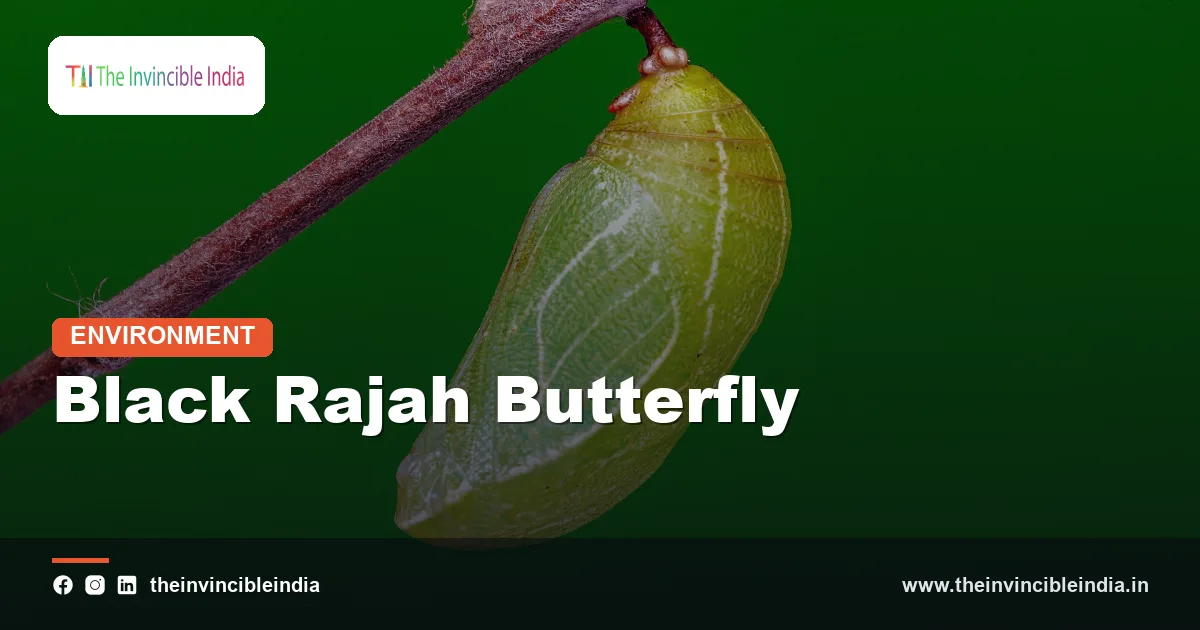
| Pupa | Short, stout and dark green, with a lateral line marbled with white, hanging from a silk pad |
| Adult | Black-brown butterfly with a pale discal band and two hindwing tails |
The horned head of the caterpillar is the most striking feature of the early stages. It gives the animal a dragon-like outline, breaks up its shape against leaves and may help to deter small predators. The green colour of both caterpillar and pupa serves the same camouflage purpose.
The duration of each stage depends on temperature and rainfall. In warm lowland forest the cycle can be completed within a few weeks, which allows several broods in a year, while in cooler foothills development is slower. The exact timing of broods therefore varies between regions and years and should not be read as a fixed calendar.
How does the black rajah behave?
The black rajah behaves like a typical Charaxes: it flies with speed and strength, perches on trunks and branches, and is more territorial than most butterflies. The flight is a mixture of rapid flapping and long glides, and the butterfly can change direction abruptly.
Perching and territory
Males commonly choose a prominent perch, such as a branch tip or a spot on a trunk, from which they watch for rivals and for females. When another insect enters the area, the male may dash out to chase it and then return to the same perch. This behaviour, known as perching or territorial defence, is widespread in the genus.
Resting posture
When at rest the black rajah usually holds its wings closed, which reveals the cryptic underside. Resting on bark, leaf litter or shaded foliage, the butterfly can be very hard to spot even when it is close.
Daily activity
Activity is typically highest in the warmer hours of the morning and again in the late afternoon, with a quieter period in the hottest part of the day. Sudden rain or heavy cloud usually sends the butterfly into the shelter of the canopy.
Which butterflies look similar to the black rajah?
Several other large, dark or strongly banded forest butterflies in India resemble the black rajah at first glance, and the main ones belong to the same subfamily, Charaxinae. Careful attention to tails, band colour and wing shape is usually enough to separate them.
- Tawny rajah (Charaxes bernardus): a close relative with warmer brown and orange tones above, giving it a very different overall colour from the black rajah.
- Common nawab (Polyura athamas): a related butterfly with a pale green band and two pairs of tails on the hindwing, unlike the single pair of the black rajah.
- Other dark forest nymphalids: several dark-winged species share the same habitat but differ in tail structure, band colour and wing shape.
Counting the tails on the hindwing is a quick field check. Two tails of similar size point towards the black rajah, whereas four tails indicate a nawab. Band colour and the position of spots near the forewing tip are additional clues.
What role does the black rajah play in the ecosystem?
The black rajah plays several roles in a forest ecosystem: it is a herbivore as a caterpillar, a consumer of sap and fermenting fruit as an adult, and a prey animal for birds, lizards, spiders and other predators. Its presence indicates that a forest still has a functioning structure of trees, sap flows and shaded refuges.
Because Charaxes butterflies feed on tree sap and rotting fruit, they interact with other animals that use the same resources, including beetles, moths and fruit-eating mammals. They do not pollinate flowers on any large scale, so their ecological value lies more in nutrient cycling and in food-web links than in pollination.
The butterfly is also valued by naturalists as an indicator species. Changes in the abundance of forest-dependent butterflies such as the black rajah can reflect habitat quality, canopy cover and the effects of logging, fragmentation and fires.
How can you watch and photograph a black rajah responsibly?
The best way to watch a black rajah is to visit a well-wooded forest edge or trail on a calm, warm morning and to wait quietly near a likely feeding or perching spot, such as a sap-oozing trunk or a fallen fruit. Charaxes butterflies tend to return to favoured perches, so patience is usually rewarded.
Some practical points make observation easier and kinder to the animal:
- Move slowly and avoid casting a shadow over the butterfly, since sudden shadows trigger flight.
- Use a telephoto or macro lens from a distance instead of trying to approach closely.
- Do not handle, chase or collect butterflies in protected forests, since wildlife rules in India restrict collection in many areas.
- Record the date, place and habitat, and share the sighting on a citizen-science platform if possible, as such data help to map ranges.
Is the black rajah threatened?
The black rajah is not generally regarded as a threatened butterfly in South Asia, because it is described in standard accounts as not rare and it occupies a wide range. Its long-term future nevertheless depends on the health of the forests where it breeds and feeds.
The main pressures on forest butterflies in India are habitat loss, forest fragmentation, the clearing of host trees and the use of pesticides near forest edges. Climate change may also shift the timing of broods and the altitude at which butterflies can survive. Conservation of intact forest corridors and the retention of native legume trees are the most effective measures for species of this type.
Bottom Line
The black rajah is a large, dark and fast forest butterfly of India, easily identified by its pale discal band and paired hindwing tails, and it depends on trees at every stage of life. Learning to recognise it adds one more species to the list of everyday wildlife that rewards slow, attentive observation of India’s forests.
Frequently Asked Questions
What is a black rajah butterfly?
The black rajah is a large, dark-winged butterfly named Charaxes solon, belonging to the family Nymphalidae. It has blackish-brown wings crossed by greenish or white bands and two tails on each hindwing. It lives in forests of South India, the Himalayan foothills and the north-east.
Where is the black rajah found in India?
The black rajah is found in South India, including the Western Ghats, and along the Himalayan belt from Kumaon through Sikkim and Bhutan to Assam. It is mainly a low-elevation forest butterfly, with records reaching roughly 2,000 metres. It prefers wooded country over open, treeless land.
What do black rajah caterpillars eat?
Black rajah caterpillars eat the leaves of woody plants, especially legumes of the family Fabaceae, such as tamarind. The female lays eggs singly on young foliage. Host plants can differ somewhat from region to region.
How can I tell a black rajah from a common nawab?
The easiest way is to count the hindwing tails: the black rajah has two tails of similar size, while the common nawab has four. The black rajah also has black-brown wings with a greenish or white band, whereas the nawab shows a broader pale green band. Wing shape and band position give further clues.
Is the black rajah a rare butterfly?
The black rajah is generally described as not rare in South Asia. It is, however, fast, shy and often high in the trees, so it is seen less often than garden butterflies. Its survival depends on forest cover and host trees.
Why does the black rajah not visit flowers like other butterflies?
The black rajah, like other Charaxes butterflies, feeds mainly on tree sap, fermenting fruit and other moist sources instead of flower nectar. These foods provide sugars and minerals that suit its strong, active lifestyle. Feeding habits can vary between places, so it may sometimes use other fluids.
{“@context”:”https://schema.org”,”@graph”:[{“@type”:”FAQPage”,”mainEntity”:[{“@type”:”Question”,”name”:”What is a black rajah butterfly?”,”acceptedAnswer”:{“@type”:”Answer”,”text”:”The black rajah is a large, dark-winged butterfly named Charaxes solon, belonging to the family Nymphalidae. It has blackish-brown wings crossed by greenish or white bands and two tails on each hindwing. It lives in forests of South India, the Himalayan foothills and the north-east.”}},{“@type”:”Question”,”name”:”Where is the black rajah found in India?”,”acceptedAnswer”:{“@type”:”Answer”,”text”:”The black rajah is found in South India, including the Western Ghats, and along the Himalayan belt from Kumaon through Sikkim and Bhutan to Assam. It is mainly a low-elevation forest butterfly, with records reaching roughly 2,000 metres. It prefers wooded country over open, treeless land.”}},{“@type”:”Question”,”name”:”What do black rajah caterpillars eat?”,”acceptedAnswer”:{“@type”:”Answer”,”text”:”Black rajah caterpillars eat the leaves of woody plants, especially legumes of the family Fabaceae, such as tamarind. The female lays eggs singly on young foliage. Host plants can differ somewhat from region to region.”}},{“@type”:”Question”,”name”:”How can I tell a black rajah from a common nawab?”,”acceptedAnswer”:{“@type”:”Answer”,”text”:”The easiest way is to count the hindwing tails: the black rajah has two tails of similar size, while the common nawab has four. The black rajah also has black-brown wings with a greenish or white band, whereas the nawab shows a broader pale green band. Wing shape and band position give further clues.”}},{“@type”:”Question”,”name”:”Is the black rajah a rare butterfly?”,”acceptedAnswer”:{“@type”:”Answer”,”text”:”The black rajah is generally described as not rare in South Asia. It is, however, fast, shy and often high in the trees, so it is seen less often than garden butterflies. Its survival depends on forest cover and host trees.”}},{“@type”:”Question”,”name”:”Why does the black rajah not visit flowers like other butterflies?”,”acceptedAnswer”:{“@type”:”Answer”,”text”:”The black rajah, like other Charaxes butterflies, feeds mainly on tree sap, fermenting fruit and other moist sources instead of flower nectar. These foods provide sugars and minerals that suit its strong, active lifestyle. Feeding habits can vary between places, so it may sometimes use other fluids.”}}]}]}


