

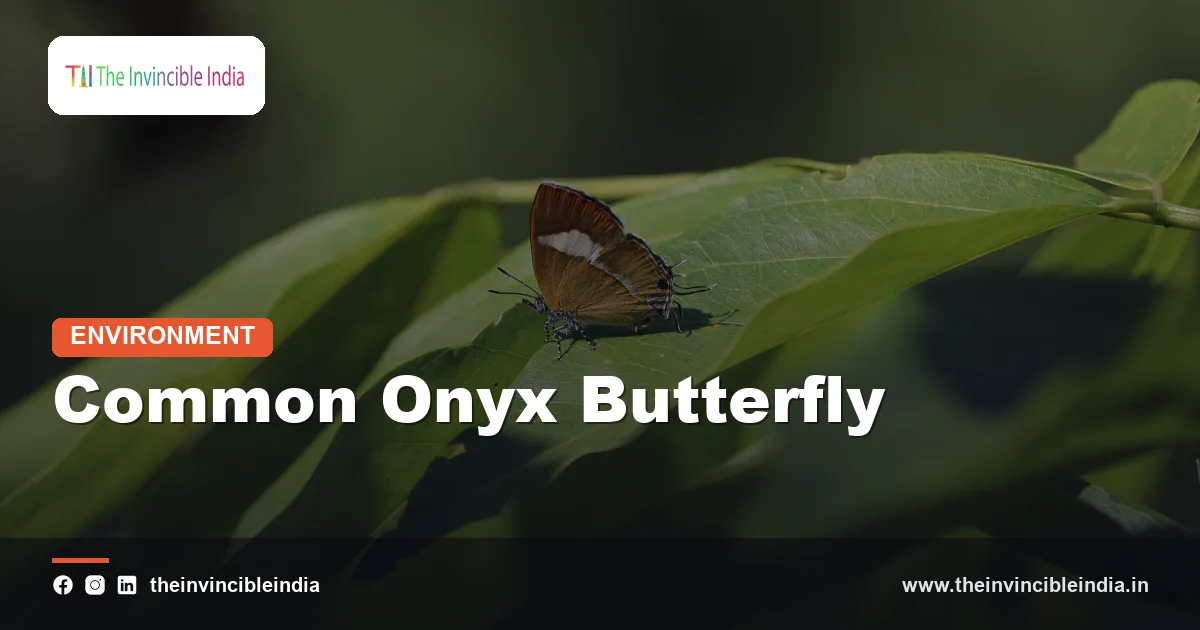
The common onyx (Horaga onyx) is a small lycaenid butterfly of the Indian subcontinent and Southeast Asia, with a blue upperside broadly edged in black and a dark yellowish-brown underside crossed by an irregular white band, and it lives in hilly, forested country, never on open plains. A visitor to a shady forest trail may see only the underside, because the common onyx usually rests with its wings closed on a leaf, and the white band is what gives the species its distinctive look.
Few people can name this butterfly, yet it belongs to a fascinating family whose caterpillars often live in close association with ants. This article explains how to identify the common onyx, where it occurs in India, which plants its caterpillars are recorded on, how its life history works and what its quiet habits tell us about the health of the forests it inhabits.
Quick Facts: Common Onyx
| Common name | Common onyx |
|---|---|
| Scientific name | Horaga onyx (Moore, 1857; some sources give 1858) |
| Family and subfamily | Lycaenidae (blues, hairstreaks and allies), subfamily Theclinae |
| Wingspan | About 27 to 33 mm |
| Caterpillar host plants | Recorded on several unrelated trees and shrubs, including Coriaria nepalensis, mango (Mangifera indica) and Litchi chinensis; some records still need confirmation |
| Range in India | Western Ghats from Maharashtra southwards, and the Himalayan belt from Himachal Pradesh to Arunachal Pradesh |
| Habitat | Thick, hilly forest; reaches about 2,000 m in the north; not found on the plains |
| Flight season | In the northern hills, mainly March to May and September to October; more variable in the south |
| Notable features | Blue upperside with a broad black border; brown underside with an irregular white band; weak flight; basks on leaves |
Key Takeaways
- The common onyx, Horaga onyx, is a small lycaenid butterfly with a wingspan of roughly 27 to 33 millimetres.
- The common onyx has a blue upperside with broad black borders and a brown underside crossed by an irregular white band.
- The common onyx lives in thick hill forest in the Western Ghats and in the Himalayan belt from Himachal Pradesh to Arunachal Pradesh, and it is never found on open plains.
- Common onyx caterpillars have been recorded on several different host plants, and some of these records still await confirmation by rearing.
- The common onyx flies weakly, avoids open ground and often basks on leaves in filtered sunlight.
- The common onyx belongs to a butterfly family in which many caterpillars are tended by ants, although the details for this species are poorly documented.
What is the common onyx butterfly?
The common onyx is a species of butterfly in the family Lycaenidae that was described by the British entomologist Frederic Moore in the nineteenth century. The genus Horaga contains a small group of Asian forest butterflies known as onyxes, and Horaga onyx is the one most often encountered in India.
Lycaenidae is the second-largest butterfly family and includes the blues, coppers, hairstreaks and their relatives. Members are usually small, many have short tails on the hindwing, and a large number have caterpillars with specialised glands that attract ants. The common onyx sits in the subfamily Theclinae, the group that contains the hairstreaks.
Several regional subspecies of Horaga onyx are recognised across its wide range, which extends beyond India into Nepal, Bhutan, Bangladesh, Myanmar, Sri Lanka and parts of Southeast Asia such as the Malay Peninsula, Borneo, Java, Sumatra and the Philippines. The name onyx probably refers to the banded appearance of the underside, which recalls the layered stone of the same name.
How can you identify a common onyx?
A common onyx can be identified by its small size, its blue upperside edged in black and its brown underside with a broad, irregular white band running across both wings. The underside is the surface that most observers see, because the butterfly rests with its wings folded.
- Upperside: blue in both sexes, with a broad black apex, outer margin and front edge on the forewing.
- Underside: dark yellowish or greenish brown with a white band whose width and outline vary from one individual to another.
- Size: a wingspan of about 3 cm, comparable to many common blues.
- Tail: a short tail on the hindwing, typical of hairstreak-type lycaenids.
- Males and females: males show a well-defined mark along the basal half of one forewing vein, a detail that is useful for specialists but hard to see in the field.
The white band is the most useful field character. Its irregular outline can make it look like a broken stripe of paint across the brown background, and it clearly separates the common onyx from the plain-brown hairstreaks and from the many blues that have pale or spotted undersides.
Where does the common onyx live in India?
The common onyx lives in two main regions of India: the Western Ghats, from Maharashtra southwards, and the Himalayan belt that extends from Himachal Pradesh eastwards to Arunachal Pradesh. In both regions the butterfly is tied to thick, hilly forest.
Observers describe the species as a butterfly of shaded forest interiors and edges, where it keeps to cool, damp and densely wooded terrain. In the Himalaya it reaches elevations of about 2,000 metres, while in the peninsula it occurs in the moist evergreen and semi-evergreen forests of the hill ranges.
The statement that the species is never found on the plains is important for identification. A small blue-and-brown butterfly seen in a plains garden or farmland is very unlikely to be a common onyx, and a more likely candidate would be one of the widespread blues or hairstreaks that tolerate open, disturbed land.
What does the common onyx eat?
The adult common onyx feeds on nectar from small flowers and on other moisture available in the forest, while its caterpillars feed on the leaves or young shoots of host plants. Like most lycaenids, the adult has a short, delicate proboscis that is best suited to shallow flowers and to damp spots on leaves and soil.
Host plants are recorded from several different families. Published records from the Indian region include Coriaria nepalensis (a shrub of the Himalayan foothills), mango (Mangifera indica), lychee (Litchi chinensis) and, from some southern sites, Macaranga indica, with oak (Quercus leucotrichophora) also mentioned for the western Himalaya. Some of these entries have not yet been confirmed by rearing the caterpillars through to adults, so researchers describe the host list as incomplete.
This mix of recorded plants suggests that the common onyx is flexible in its choice of trees and shrubs, or that local populations differ in their preferences. Either way, the butterfly needs a forest with a diverse structure of native trees and shrubs, not a single plant species.
How does the common onyx grow from egg to adult?
The common onyx grows through the four standard stages of butterfly life: egg, caterpillar, pupa and adult, and the early stages of this species are poorly described in published literature. This is a reminder that even in a well-studied country such as India, the complete life histories of many small forest butterflies remain unwritten.
For lycaenids in general, the pattern is well known and can be summarised as follows:
| Stage | Typical lycaenid pattern |
|---|---|
| Egg | Small, usually flattened or dome-shaped, laid singly on young leaves, buds or shoots |
| Caterpillar | Short, broad and slug-like, often with glands that produce sugary or chemical secretions |
| Pupa | Compact and rounded, often attached to a leaf, bark or litter by a silk pad and girdle |
| Adult | Small butterfly with a short life, spent feeding, basking and breeding |
These generalisations come from the family as a whole and should not be treated as exact descriptions of the common onyx. For this species, the safest statement is that the caterpillar is likely to follow the family model of a slug-like body and a compact pupa, while the colours and exact timing remain to be fully documented.
Do common onyx caterpillars live with ants?
Many lycaenid caterpillars live in association with ants, but the specific relationship between the common onyx and ants is not well documented. This is a case where the family pattern is clear, while the species detail is not.
In ant-associated lycaenids, the caterpillar usually has a gland that releases a sugary droplet, together with other organs that produce chemical signals. Ants collect the droplets as food and in return guard the caterpillar from parasitic wasps and other enemies. Some species depend on ants for survival, while others are only loosely connected to them.
A cautious reader should therefore avoid assuming that the common onyx has any particular ant partner. What can be said is that the family contains many ant-tended species, that the relationship is one of the most celebrated stories in butterfly biology and that field observers who find a common onyx caterpillar would add useful information by recording the host plant and any attending ants.
When is the common onyx on the wing?
The common onyx is on the wing at different times in different regions, and in the northern hills it flies mainly from March to May and again from September to October. These periods match the warm spring and the post-monsoon season, when new growth on host plants is abundant.
In the south, where temperatures are less seasonal, the butterfly may be seen over a longer period, although it is seldom common. Adults are most often noticed on warm, sunny mornings when they open their wings on a leaf to absorb heat. This basking posture shows the blue upperside briefly and is the best moment for an observer to confirm the identification.
Because the flight is weak and short, the common onyx does not travel far. A trained eye can often find the same individual on the same leaf or on a nearby shrub several times in a morning, and this site fidelity is typical of small forest lycaenids.
How does the common onyx behave?
The common onyx behaves as a quiet, weakly flying forest butterfly that avoids open areas, rests on leaves and basks in patches of sunlight. It is far less conspicuous than a swallowtail or a pierid, and it rarely forms large groups.
Basking and resting
The butterfly often rests on the upper surface of a leaf with its wings closed, and it may open them partly in sunlight. Basking helps small insects reach flight temperature quickly, which is particularly important in cool, shaded hill forest.
Defensive tricks
Many hairstreak-type lycaenids carry markings and tails at the rear of the hindwing that resemble a false head. A predator that strikes at the false head may catch only a piece of wing, giving the butterfly a chance to escape. The short tail of the common onyx fits this general pattern, although the exact effect has not been studied in detail for this species.
Flight
Flight is short and weak, usually between nearby perches. When disturbed, the butterfly flutters a short distance and settles again, which makes it easy to lose among foliage.
Which butterflies are similar to the common onyx?
Several other small Indian lycaenids can be mistaken for the common onyx, particularly those with tails and brown undersides. The white band on the underside is the main feature that separates the common onyx from its look-alikes.
- Other onyx species in the genus Horaga: related species such as the brown onyx have different underside patterns, such as a white patch instead of a long band.
- Plain-brown hairstreaks: these lack the broad white band and often show thin lines on the underside.
- Common blues and cerulean-type blues: these usually have spotted or finely lined undersides and are more at home in open habitats.
Photographing both the upperside and the underside makes identification far more reliable. Many iNaturalist and butterfly-club records of small lycaenids are confirmed only when both surfaces are visible.
Why does the common onyx matter for forest conservation?
The common onyx matters for forest conservation because its restriction to thick, hilly forest makes it a useful indicator of intact, shaded habitat. A butterfly that avoids the plains and open land responds quickly to forest loss, fragmentation and drying of the understorey.
Threats to such species in India include clearance of forest for agriculture and plantations, road building through hill forest, grazing and the invasion of native understorey by weeds. Protection of hill forests, maintenance of canopy cover and retention of native trees and shrubs along trails all help to keep populations viable.
The species is not described as globally threatened, and its wide Asian range gives some security. Its apparent rarity in many places is partly a result of its inconspicuous habits and partly a result of the limited number of observers working in remote hill forests.
How can you record a common onyx sighting?
The best way to record a common onyx sighting is to photograph the butterfly from both sides if possible, note the date, place, altitude and host plant, and upload the record to a citizen-science platform. Reliable records of small forest butterflies contribute directly to distribution maps and to the understanding of seasonal patterns.
- Walk slowly along shaded forest trails in the morning and look at leaf surfaces at eye level and above.
- Take several photographs, including one with the wings closed to show the white band.
- Record the plant on which the butterfly rests, since this may point to a larval host.
- Avoid collecting, trampling vegetation or disturbing eggs and caterpillars on leaves.
Bottom Line
The common onyx is a small, quiet butterfly of India’s hill forests, recognised by its black-bordered blue upperside and the irregular white band on its brown underside. Much about its caterpillar stages and ant relationships remains to be documented, which makes careful field records from ordinary observers especially valuable.
Frequently Asked Questions
What is the common onyx butterfly?
The common onyx is a small lycaenid butterfly with the scientific name Horaga onyx. It has a blue upperside with broad black borders and a brown underside crossed by an irregular white band. It lives in thick, hilly forest.
Where is the common onyx found in India?
The common onyx is found in the Western Ghats, from Maharashtra southwards, and in the Himalayan belt from Himachal Pradesh to Arunachal Pradesh. It prefers thick hill forest and is never found on the plains. In the north it reaches about 2,000 metres.
How big is a common onyx?
A common onyx has a wingspan of roughly 27 to 33 millimetres, which is about 3 centimetres. That makes it a small butterfly, similar in size to many blues. It is easiest to notice when it rests on a leaf.
What do common onyx caterpillars eat?
Common onyx caterpillars have been recorded on several host plants, including Coriaria nepalensis, mango and lychee. Some records, such as Macaranga indica in Sri Lanka, still need confirmation by rearing. The full host list is therefore considered incomplete.
Do common onyx caterpillars live with ants?
Many lycaenid caterpillars are tended by ants, but the exact relationship for the common onyx is not well documented. The family as a whole is known for sugary secretions that attract ants, which in return protect the caterpillars. Observers who find caterpillars can add useful data by noting any ants present.
When can I see a common onyx?
In the northern hills the common onyx flies mainly from March to May and from September to October. In the south it may appear over a longer period. Look for it on warm, sunny mornings, basking on leaves in shaded forest.
{“@context”:”https://schema.org”,”@graph”:[{“@type”:”FAQPage”,”mainEntity”:[{“@type”:”Question”,”name”:”What is the common onyx butterfly?”,”acceptedAnswer”:{“@type”:”Answer”,”text”:”The common onyx is a small lycaenid butterfly with the scientific name Horaga onyx. It has a blue upperside with broad black borders and a brown underside crossed by an irregular white band. It lives in thick, hilly forest.”}},{“@type”:”Question”,”name”:”Where is the common onyx found in India?”,”acceptedAnswer”:{“@type”:”Answer”,”text”:”The common onyx is found in the Western Ghats, from Maharashtra southwards, and in the Himalayan belt from Himachal Pradesh to Arunachal Pradesh. It prefers thick hill forest and is never found on the plains. In the north it reaches about 2,000 metres.”}},{“@type”:”Question”,”name”:”How big is a common onyx?”,”acceptedAnswer”:{“@type”:”Answer”,”text”:”A common onyx has a wingspan of roughly 27 to 33 millimetres, which is about 3 centimetres. That makes it a small butterfly, similar in size to many blues. It is easiest to notice when it rests on a leaf.”}},{“@type”:”Question”,”name”:”What do common onyx caterpillars eat?”,”acceptedAnswer”:{“@type”:”Answer”,”text”:”Common onyx caterpillars have been recorded on several host plants, including Coriaria nepalensis, mango and lychee. Some records, such as Macaranga indica in Sri Lanka, still need confirmation by rearing. The full host list is therefore considered incomplete.”}},{“@type”:”Question”,”name”:”Do common onyx caterpillars live with ants?”,”acceptedAnswer”:{“@type”:”Answer”,”text”:”Many lycaenid caterpillars are tended by ants, but the exact relationship for the common onyx is not well documented. The family as a whole is known for sugary secretions that attract ants, which in return protect the caterpillars. Observers who find caterpillars can add useful data by noting any ants present.”}},{“@type”:”Question”,”name”:”When can I see a common onyx?”,”acceptedAnswer”:{“@type”:”Answer”,”text”:”In the northern hills the common onyx flies mainly from March to May and from September to October. In the south it may appear over a longer period. Look for it on warm, sunny mornings, basking on leaves in shaded forest.”}}]}]}


